Peasy Review 2026
AI visibility tool for tracking real performance metrics in AI search with focus on practical insights and monitoring.
Summary
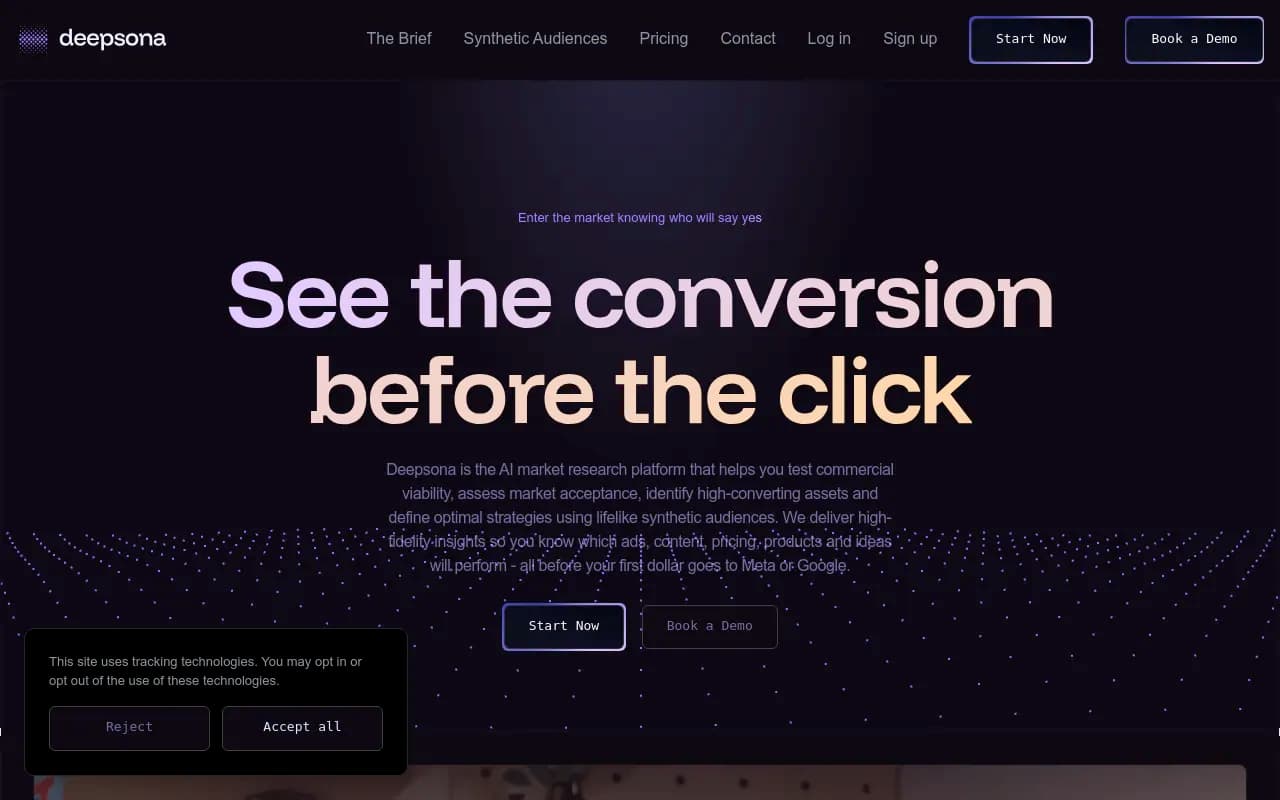
- What it does best: Deepsona simulates massive synthetic audiences (up to 1M AI personas) to predict how real consumers will respond to ads, products, pricing, and messaging before you spend a dollar on live campaigns. Claims 74-90% predictive alignment with real outcomes.
- Core strength: Multi-agent AI system that builds audiences, runs simulations, and delivers statistically confident predictions in 2-5 minutes -- far faster than traditional A/B testing or focus groups.
- Who it's for: Performance marketers, product teams, and agencies tired of burning budgets on campaigns that flop. Best for teams launching new products, testing creative variations, or entering unfamiliar markets.
- Honest limitation: Synthetic personas are only as good as the behavioral models behind them. If your market has unusual dynamics or niche psychographics not well-represented in training data, predictions may miss the mark. Also, no integration with ad platforms -- you still manually launch winning variants.
- Bottom line: If you're spending $10K+ monthly on paid ads and want to filter out losers before launch, Deepsona could save you serious money. If you're bootstrapping with tiny budgets or selling to highly specialized B2B niches, traditional research might still be more reliable.
Deepsona is an AI market research platform that promises to tell you which ads, products, and pricing strategies will succeed before you launch them. Instead of running expensive A/B tests on real audiences, you simulate campaigns against synthetic personas -- AI-generated profiles modeled on real consumer behavior, psychographics, and personality traits. The pitch: get predictive insights in minutes, not weeks, and stop wasting ad spend on creative that was never going to convert.
The company is UK-based (Deepserp Limited, London), GDPR-compliant, and targets performance marketers, product teams, and agencies who are tired of the traditional research grind. They claim 74-90% predictive alignment with real campaign outcomes and actual human survey responses from YouGov and GWI, though they note results vary based on input quality and audience complexity. The platform launched recently and is positioning itself as a faster, cheaper alternative to focus groups, surveys, and live campaign testing.
How Deepsona Actually Works
Deepsona is built around a multi-agent AI system. You don't just prompt a chatbot and hope for useful answers. Instead, specialized agents handle different parts of the research process. The Persona Factory agent builds your synthetic audience. Exposure and Debate agents test your marketing assets and ideas against those personas. Scoring, QA, and Insights agents aggregate the results and deliver final predictions with confidence scores. This agentic approach is what separates Deepsona from manually prompting ChatGPT or Claude -- the platform automates the entire research workflow at scale.
Each synthetic persona is modeled using the Big Five (OCEAN) personality framework, psychographic traits, socioeconomic factors, category familiarity, and price sensitivity. You can build audiences of any size, from small test groups to 1 million personas. The platform enforces complexity across traits so personas don't all behave the same way. Urban design professionals respond differently than suburban families. Early adopters react differently than cautious buyers. These differences show up in the simulation results as segment-level heatmaps, ranked insights, and written reactions explaining what each persona liked, disliked, or found confusing.
What You Can Test
Product Propositions: Describe your product concept, value proposition, and key features. Select target audiences. Within minutes, you get segment-level reactions showing which groups connect with your messaging and which remain skeptical. AI personas generate authentic written responses (not survey checkboxes) explaining what excites them, what concerns them, and what would push them to convert. One segment might love your innovation angle while another prioritizes affordability. You see these patterns immediately, along with recommendations for repositioning messages by segment.
Ad Campaign Simulations: Enter your ad creative components -- offer text, primary copy, visual descriptions, CTA, budget parameters, and target CPA. Run the simulation against your chosen audiences. Each AI persona evaluates your ad as a real consumer would, considering their income, lifestyle, personality, and purchase behaviors. They output numeric scores for click probability, conversion intent, trust, clarity, novelty, and brand fit, plus written reactions and blocking objections. The platform aggregates these into segment-level heatmaps showing which demographics and psychographics respond strongest. Compare multiple ad variants side by side. See predicted lift percentages between versions. Identify which creative elements drive engagement and which create friction -- all before your first dollar goes to Meta or Google.
Email Campaign Optimization: Configure your email elements -- campaign name, goal, subject line, preheader text, body copy, and CTA. Select target audiences that mirror your subscriber segments. AI personas evaluate each component based on their personality traits, communication preferences, and behavioral patterns. Introverted personas might prefer direct, no-fluff subject lines. Extroverted personas might respond better to playful, social language. Price-sensitive segments scrutinize value propositions more intensely. The simulation surfaces these preferences explicitly, showing you which subject lines generate curiosity, which body copy builds trust, and which CTAs convert -- segmented by demographic and psychographic profile.
Price Discovery: Define your product name, description, and current price if applicable. Set minimum and maximum price bounds or specify exact price points to evaluate. The simulation tests each price across your selected audience segments, measuring willingness to pay, perceived value, conversion thresholds, and price sensitivity by demographic and psychographic group. High-income early adopters might barely notice a premium price while budget-conscious families hit a hard ceiling at a lower point. You see these patterns visualized across segments with confidence scores. The system recommends optimal pricing by segment and suggests tiered pricing strategies when data shows distinct willingness-to-pay clusters.
Idea Validation: Describe your product or feature idea -- name, type, detailed description, problem being solved, target outcome, and key features. Choose which market segments should evaluate it. AI personas assess your concept through their personal lens: their pain points, priorities, existing solutions, and psychological profiles. A time-starved parent evaluates productivity tools differently than a solo entrepreneur. A privacy-focused techie scrutinizes data handling differently than a convenience-seeking casual user. You receive explicit demand signals segmented by audience type, along with the reasoning behind positive and negative reactions. See objections you never anticipated. Discover which audiences show genuine enthusiasm versus polite indifference.
The Debate Feature
One standout capability is the Debate agent. After initial exposure, personas engage in simulated discussions about your product or campaign. This mimics how real consumers talk through purchase decisions with friends, family, or online communities. The debate process surfaces objections, counterarguments, and social dynamics that influence buying behavior. A persona might initially like your product but change their mind after hearing concerns from a more skeptical persona. Or a fence-sitter might be swayed by an enthusiastic advocate. This layer of social simulation adds depth beyond individual reactions and helps predict how word-of-mouth and social proof will impact adoption.
Who Should Use Deepsona
Deepsona is built for performance marketers, product teams, and agencies who are spending serious money on paid campaigns and want to reduce wasted spend. If you're running $10K+ monthly on Meta, Google, or LinkedIn ads and half your creative underperforms, Deepsona could save you thousands by filtering out losers before launch. The platform is especially useful for teams launching new products, entering unfamiliar markets, or testing multiple creative variations. You can simulate five ad variants against three audience segments in minutes and see which combination has the highest predicted conversion intent.
It's also a fit for product teams validating MVP ideas or feature concepts. Instead of building something and hoping users want it, you can test the concept against synthetic audiences first. See which segments show genuine demand and which remain indifferent. Adjust your positioning, pricing, or feature set based on simulation feedback, then build with confidence.
Agencies managing multiple clients can use Deepsona to deliver faster insights without the cost and delay of traditional research. Run simulations for client campaigns, present segment-level heatmaps and persona reactions, and recommend optimized creative or messaging strategies. The platform scales research without scaling headcount.
Who Should NOT Use Deepsona
If you're selling to highly specialized B2B niches with unusual buying dynamics, synthetic personas may not capture the complexity of your market. Enterprise software sold to CTOs at Fortune 500 companies involves procurement processes, vendor relationships, and organizational politics that AI personas can't fully model. Traditional research -- actual interviews with real decision-makers -- is still more reliable for these contexts.
If you're bootstrapping with tiny budgets (under $5K monthly ad spend), the cost of Deepsona may not justify the savings. You're better off running small live tests and iterating based on real data. The platform makes the most sense when wasted spend is expensive enough to justify the subscription cost.
If your product is deeply technical or requires hands-on evaluation (developer tools, hardware, complex SaaS), synthetic personas can only simulate reactions to messaging and positioning, not actual product experience. You'll still need beta testers and real user feedback.
Integrations and Ecosystem
Deepsona is a standalone platform with no direct integrations to ad platforms like Meta Ads Manager, Google Ads, or email marketing tools. You run simulations inside Deepsona, review the results, then manually implement winning variants in your actual campaigns. There's no API mentioned on the site, so custom integrations or automated workflows aren't currently possible. The platform is web-based (app.deepsona.ai) with no mention of mobile apps or browser extensions.
Data is processed in secure environments and never used for model training or shared with third parties. The company is GDPR-compliant and based in the UK. Your simulations, audiences, and content remain confidential.
Pricing and Value
Pricing details are not publicly listed on the main site. The site mentions a free trial or demo option ("Start Now" and "Book a Demo" CTAs), but specific tier pricing, audience size limits, or simulation quotas are not disclosed. Based on the positioning and target audience (performance marketers and agencies), expect pricing to be in the range of $200-$1000+ per month depending on simulation volume and audience size. The lack of transparent pricing is a friction point -- you have to book a call or sign up to find out what it costs.
Value depends on your ad spend. If you're burning $5K-$10K monthly on campaigns that underperform, and Deepsona helps you eliminate even 20-30% of wasted spend, the ROI is clear. If you're spending $1K monthly, the math is harder to justify.
Strengths
- Speed: Most simulations complete in 2-5 minutes. Traditional research takes weeks.
- Scale: Simulate thousands or even a million personas per run with no additional cost. Survey panels cap at hundreds.
- Depth: Personas carry psychological complexity (OCEAN traits, lifestyle values, price sensitivity) beyond basic demographics. You see how introverted tech-savvy urbanites respond differently than extroverted suburban families.
- Debate feature: Simulates social dynamics and word-of-mouth influence, not just individual reactions.
- Risk-free testing: Test ten ad variations before spending a dollar on media. Kill the losers in simulation, launch the winners in reality.
- Continuous iteration: Tweak headlines, adjust pricing, test new CTAs, and run another simulation in minutes. No waiting for panel availability or budget approval.
Limitations
- No platform integrations: You can't push winning variants directly to Meta or Google. Manual implementation required.
- Synthetic accuracy limits: Personas are only as good as the behavioral models behind them. If your market has unusual dynamics or niche psychographics not well-represented in training data, predictions may miss. The 74-90% alignment claim is impressive but also means 10-26% of predictions could be off.
- No API or automation: Can't build custom workflows or integrate with existing martech stacks.
- Opaque pricing: No public pricing tiers. You have to book a call to find out what it costs.
- Not a replacement for all research: Synthetic personas can't replace hands-on product testing, enterprise sales conversations, or deep qualitative research with real users. They simulate reactions to messaging and positioning, not actual product experience.
Bottom Line
Deepsona is a serious tool for performance marketers and product teams who want to reduce wasted ad spend and validate ideas faster. If you're launching new campaigns, testing creative variations, or entering unfamiliar markets, the ability to simulate audience reactions in minutes instead of weeks is valuable. The multi-agent AI system, psychological depth of personas, and debate feature set it apart from just prompting ChatGPT.
But it's not magic. Synthetic personas are predictions, not guarantees. If your market is highly specialized, your product requires hands-on evaluation, or your ad spend is too small to justify the cost, traditional research or small live tests may still be the better path. For teams spending $10K+ monthly on paid campaigns and tired of burning budgets on creative that flops, Deepsona is worth a demo. Best use case in one sentence: filter out losing ad variants and product concepts before launch so your media budget fuels proven winners, not expensive experiments.
Frequently asked questions
What is Peasy and what does it do?
How much does Peasy cost?
Is Peasy free to use?
Who should use Peasy?
What metrics does Peasy track?
Does Peasy integrate with other marketing tools?
How is Peasy different from traditional SEO tools?
Similar and alternative tools to Peasy