Key takeaways
- Otterly.AI ($29/mo) and Peec.ai are the most affordable entry points for AI visibility tracking, but both are monitoring-only -- they show you data without helping you act on it.
- The biggest gap in budget tools isn't price -- it's the lack of content optimization, crawler logs, and traffic attribution that would let you actually improve your visibility.
- Several mid-range platforms (Profound, Rankability, SE Visible) offer more depth for $99-$295/mo and are worth the step up if you're running campaigns or managing clients.
- If you want a platform that closes the loop from gap analysis to content creation to results tracking, Promptwatch starts at $99/mo and is the only tool in this comparison rated as a "Leader" across all GEO platform categories.
- Before choosing any tool, decide whether you need monitoring (knowing where you appear) or optimization (improving where you appear). Most budget tools only do the first.
The AI visibility tool market in 2026 has a strange problem: there are dozens of platforms, most of them priced between $29 and $300 per month, and the majority of them do roughly the same thing. They run your brand name through ChatGPT, Perplexity, and a few other models, count how often you appear, and show you a dashboard.
That's useful. But it's also where most of them stop.
This guide is for teams who are budget-conscious but serious about results. We'll look at Otterly.AI and Peec.ai -- the two names that come up most often in "affordable AI visibility" searches -- and then rank the alternatives that are actually worth considering.
What "budget" actually means in this market
Before diving in, it's worth being honest about what you get at different price points.
Under $50/month, you're getting basic mention counting. A handful of prompts, one or two AI engines, weekly refresh cycles. Fine for a solopreneur who just wants to know if ChatGPT mentions their brand at all.
$50-$150/month buys you more prompts, more engines, and usually some form of competitor comparison. This is where most small marketing teams live.
$150-$300/month is where things get genuinely useful: multi-engine tracking, content gap analysis, historical data, and sometimes traffic attribution. This isn't "budget" in the traditional sense, but for AI visibility work, it's mid-range.
Above $300/month, you're looking at enterprise features: crawler logs, API access, custom personas, agency-scale reporting.
The trap most teams fall into is buying at the bottom tier, getting frustrated that the data doesn't lead anywhere, and then churning. Spending $99/month on a tool that actually helps you improve visibility beats spending $29/month on one that just confirms you have a problem.
Otterly.AI: the entry-level standard
Otterly.AI is probably the most-cited "affordable" option in SEO communities, and for good reason. It's genuinely cheap, the interface is clean, and it gets you started with AI visibility tracking in under an hour.

The Lite plan at $29/month gives you 15 prompts, which is enough to track your brand across a few core queries. The Standard plan at $189/month expands this significantly and adds more engines.
What Otterly does well: simplicity. If you've never tracked AI visibility before and want to see whether ChatGPT mentions your brand when someone asks "what's the best [your category] tool," Otterly will tell you that quickly.
What it doesn't do: help you fix it. As one Reddit user put it in r/DigitalMarketing, Otterly "tracks the source, but gives zero actionable strategy on how to restructure content to get cited." That's not a bug -- it's a design choice. Otterly is a monitoring tool, not an optimization platform.
Coverage is also limited. Otterly covers 4 base platforms, and Claude and Grok aren't included on any plan. If you care about visibility across the full range of AI models your customers actually use, that's a real gap.
Peec.ai: structured monitoring with better reporting
Peec.ai is a European SaaS platform that's carved out a niche with polished reporting and genuinely strong multi-language support. If your audience spans multiple countries or languages, Peec's internationalization is legitimately best-in-class among budget tools.

Peec tracks Google AI Overview visibility, brand presence in AI-generated summaries, and prompt-level analytics for ChatGPT-style engines. Early in 2025 it gathered significant attention from agencies needing to track the moment their clients appeared in AI Overviews.
Where Peec wins over Otterly: structure. The reporting is more polished, the multi-language support is real (not just a checkbox feature), and the prompt-level analytics give you a clearer picture of which specific queries are driving visibility.
Where Peec falls short: the same place as Otterly. It's a monitoring tool. You'll know your brand appeared in 3 out of 10 responses for a target query. You won't know why you missed the other 7, or what to change to fix that. Content gap analysis, crawler logs, and traffic attribution are absent.
Teams that have outgrown Peec typically cite three recurring issues: costs scaling badly for large prompt sets, accuracy varying across industries, and the need for multi-engine visibility that goes beyond what Peec tracks.
The monitoring-only problem
This is worth pausing on, because it affects almost every tool in the budget tier.
Imagine you're running AI visibility tracking for a SaaS company. Your dashboard shows you appeared in 3 out of 10 ChatGPT responses for your target queries this week. That's a number. What do you do with it?
A monitoring-only tool stops there. An optimization platform tells you that the 7 responses you missed cited pages with structured FAQ sections and direct question-answer formats -- content your site doesn't have. One gives you a score. The other gives you a task.
There's also a subtler problem that the LLMClicks.ai team documented: AI models sometimes quote wrong information about your brand -- incorrect pricing, misattributed features, invented integrations. Basic monitoring tools flag mentions and sentiment, but they don't catch factual errors. If ChatGPT is telling prospects your Pro plan costs $79 when it actually costs $49, a tool that just counts "positive mentions" won't catch that.
The affordable alternatives, ranked
Here's how the broader field stacks up for teams working with real budget constraints.
1. Promptwatch -- best overall for teams that want to act, not just monitor
Promptwatch starts at $99/month (Essential plan: 1 site, 50 prompts, 5 articles) and is the only platform in this comparison that closes the full loop: find gaps, create content, track results.

The Answer Gap Analysis shows you exactly which prompts competitors are visible for that you're not -- not as a vague "you're missing coverage here" note, but as specific content your website is missing. The built-in AI writing agent then generates articles and content grounded in real citation data (880M+ citations analyzed), so you're not just writing more content and hoping -- you're creating content engineered to get cited by ChatGPT, Claude, Perplexity, and others.
It monitors 10 AI models (ChatGPT, Perplexity, Google AI Overviews, Google AI Mode, Claude, Gemini, Meta/Llama, DeepSeek, Grok, Mistral, Copilot), includes crawler logs showing which AI bots are reading your pages and which errors they're hitting, and connects visibility to actual traffic through GSC integration and server log analysis.
At $99/month, it's more expensive than Otterly's Lite plan. But if you're serious about improving your AI visibility rather than just watching it, the comparison isn't really fair -- they're doing different things.
2. Profound -- best for AI Overview tracking depth

Profound at $99/month is the strongest alternative for teams focused specifically on Google AI Overviews. Its entity extraction and attribution mapping are precise, and it's well-suited to teams running entity-driven SEO alongside their AI visibility work. The trade-off: it's more specialized, so if you need broad multi-engine coverage or content optimization, you'll hit its limits.
3. Rankability -- best for agencies
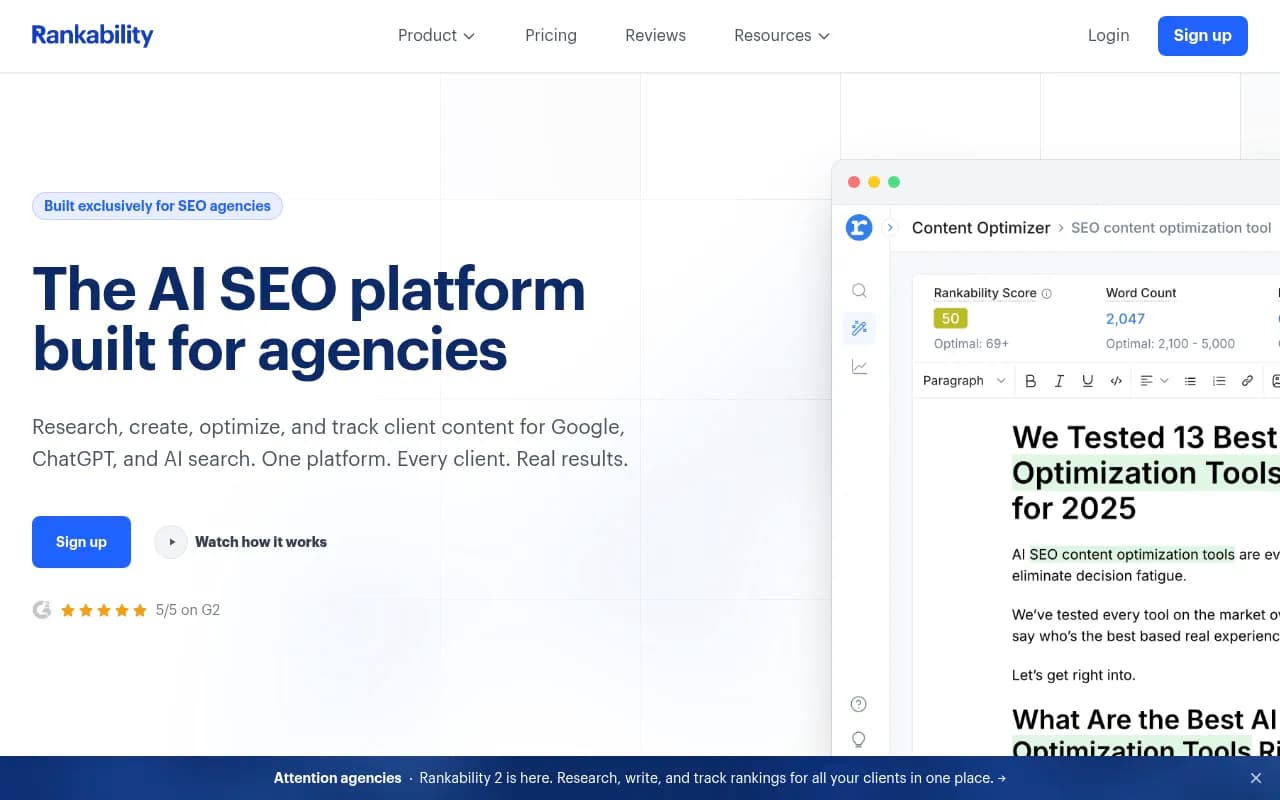
Rankability is built with agency workflows in mind. The reporting is client-presentable, the multi-engine coverage is solid, and it handles the kind of cross-client comparison work that agencies need. It's positioned as a mid-market tool rather than a budget one, but agencies managing multiple clients will find the per-seat economics reasonable.
4. SE Visible -- best for strategic brand monitoring
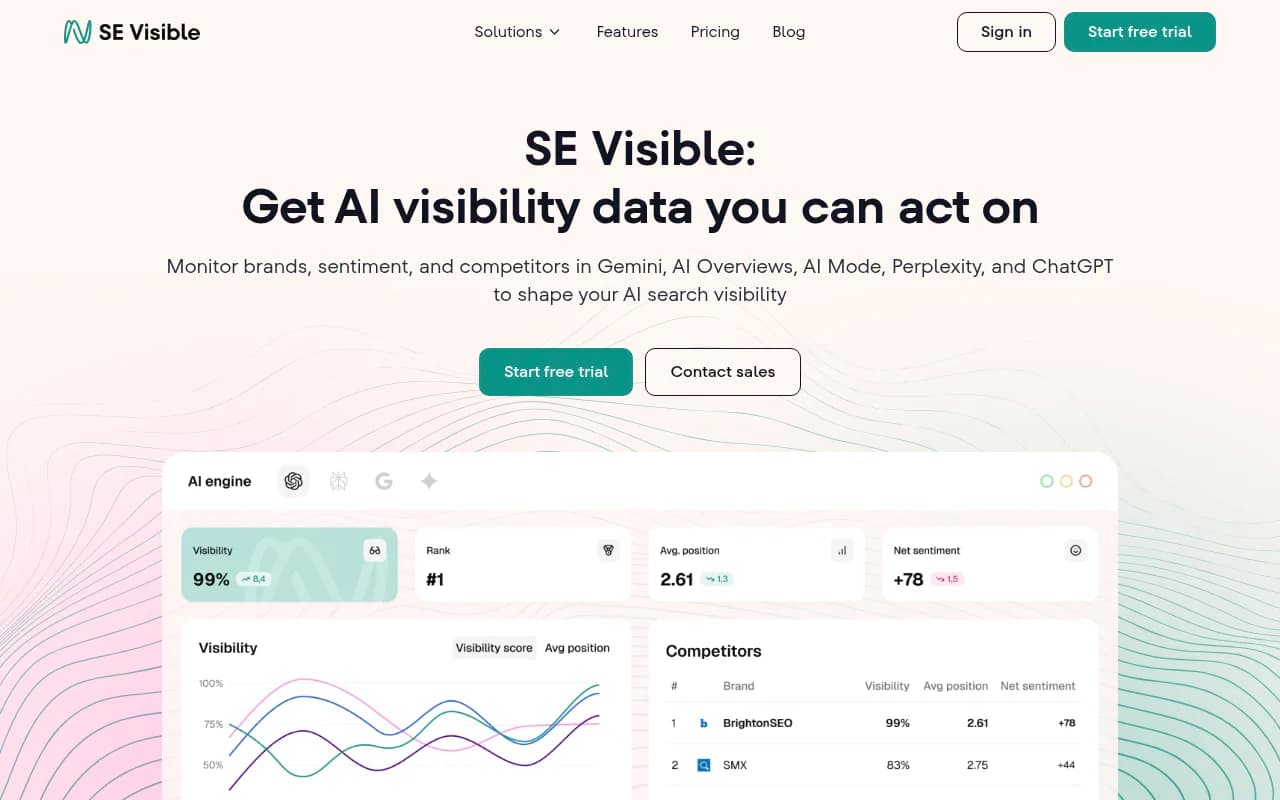
SE Visible (from SE Ranking) starts at $189/month and targets marketing leaders who need competitive benchmarking and sentiment analysis alongside visibility tracking. It's more expensive than the entry-level tools but brings a level of strategic framing that CMOs and brand marketers find useful. If your primary use case is understanding brand narrative across AI engines rather than optimizing content, SE Visible is worth a look.
5. AthenaHQ -- best for multi-engine analysts

AthenaHQ at $295/month covers 8+ AI search engines and is well-suited to teams that need to track visibility across the full range of models their customers use. It's monitoring-focused -- content optimization isn't its strength -- but the breadth of engine coverage is genuinely impressive.
6. Peasy -- best for lightweight real-time tracking
Peasy is a lighter-weight option for teams that want real AI performance tracking without the overhead of a full platform. It's worth considering if your needs are simple and you want something that stays out of your way.
7. Ranksmith -- best for actionable insights on a budget
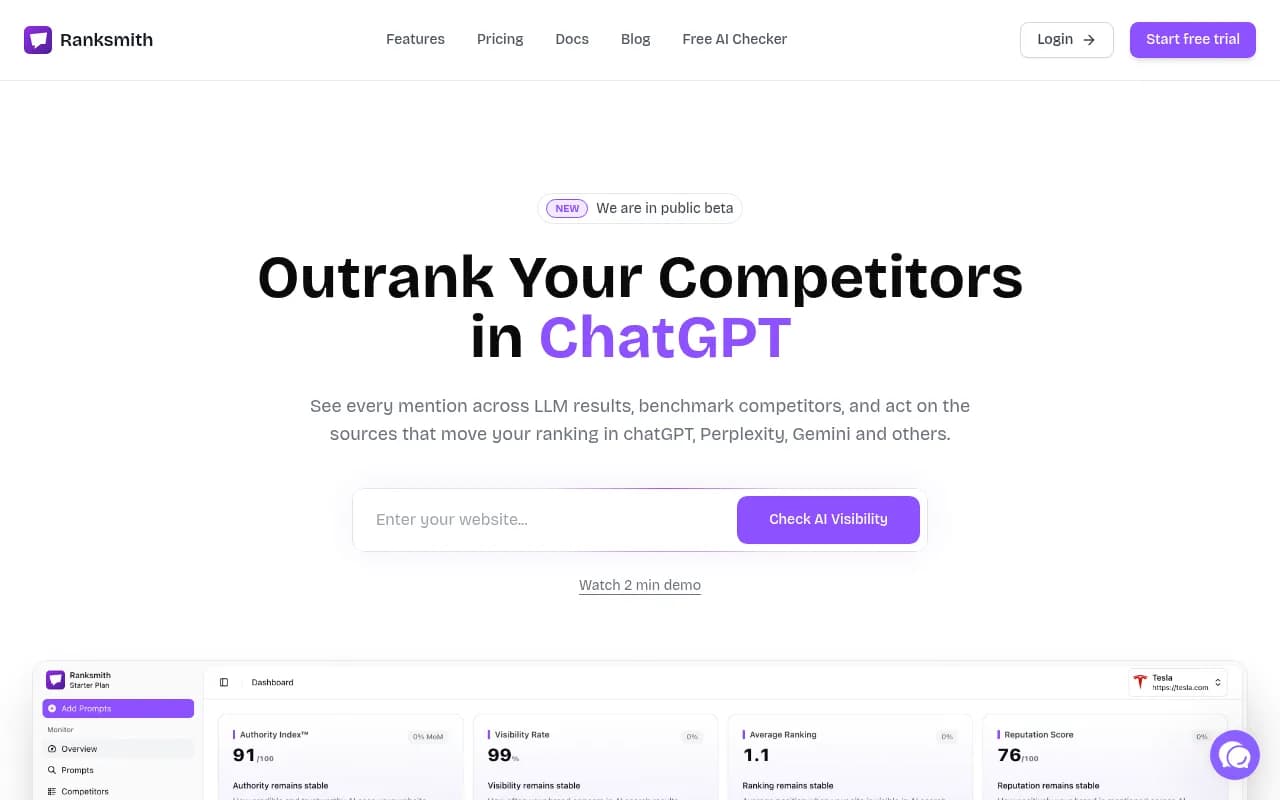
Ranksmith focuses on turning AI visibility data into concrete recommendations. It's positioned below the mid-market tools in price and feature depth, but it's more actionable than pure monitoring tools like Otterly and Peec.
8. Airefs -- best for affordable multi-engine tracking
Airefs is one of the more affordable options for teams that need to track across multiple AI engines without paying enterprise prices. Coverage and depth are lighter than the mid-market tools, but the price point makes it accessible for smaller teams.
Side-by-side comparison
| Tool | Starting price | AI engines covered | Content optimization | Crawler logs | Traffic attribution | Best for |
|---|---|---|---|---|---|---|
| Otterly.AI | $29/mo | 4 | No | No | No | Entry-level monitoring |
| Peec.ai | Budget tier | ChatGPT, Google AIO + others | No | No | No | Multi-language monitoring |
| Promptwatch | $99/mo | 10 | Yes (AI writing agent) | Yes | Yes (GSC, server logs) | Full optimization loop |
| Profound | $99/mo | Google AIO focused | No | No | No | AI Overview depth |
| Rankability | Mid-market | Multi-engine | Limited | No | No | Agency reporting |
| SE Visible | $189/mo | Multi-engine | No | No | No | Brand/sentiment analysis |
| AthenaHQ | $295/mo | 8+ | No | No | No | Multi-engine analysts |
| Peasy | Low | Core engines | No | No | No | Lightweight tracking |
| Airefs | Low | Multi-engine | No | No | No | Budget multi-engine |
How to choose
The honest answer is that the right tool depends on what you're actually trying to do.
If you just want to know whether your brand appears in AI search results, Otterly.AI or Peec.ai will tell you that cheaply. Otterly is simpler; Peec is more structured and better for international teams.
If you want to understand why you're appearing (or not) and what to do about it, you need something that does content gap analysis. That's where Profound, Rankability, and Promptwatch separate themselves from the monitoring-only tier.
If you want to close the full loop -- identify gaps, generate content that fills them, and track whether that content actually gets cited -- Promptwatch is the only platform in this comparison that does all three. The $99/month Essential plan is a reasonable starting point for a single site with 50 prompts, and the built-in content generation means you're not paying for a separate writing tool on top of your visibility tracker.
One practical test: before signing up for any tool, ask the vendor whether you can see an example of what the platform recommends you do after you get your first visibility report. If the answer is "here's your dashboard, good luck," that's a monitoring tool. If they can show you a content gap report and a content brief generated from it, that's an optimization platform.
What the market is actually saying
The frustration that keeps surfacing in SEO communities -- Reddit's r/SEO, TrafficThinkTank Slack, LinkedIn threads -- is consistent: most AI visibility tools are expensive for what they deliver, and the data goes stale fast because LLMs update their outputs constantly.
As one r/b2bmarketing user put it: "Unless a tool gives clear recommendations or ties to revenue, it's hard to justify $100-$400/month just to know if ChatGPT mentioned your brand today."
That's the right frame. The tools that will survive the next consolidation wave in this market are the ones that connect visibility data to action. Monitoring dashboards that just count mentions are going to face serious pressure as the novelty of "we track AI mentions" wears off and teams start asking what they're actually getting for their money.
The budget tools covered here -- Otterly and Peec -- are fine starting points. But treat them as a first step, not a destination. If you're six months in and still just watching your mention count fluctuate without knowing what to do about it, that's a signal to move up the stack.