Key takeaways
- Slack and email alerts are often gated by pricing tier. Many vendors advertise "email + Slack support" on their pricing page, which usually means customer support channels, not native alert routing. Confirm the actual delivery mechanism before you buy.
- Peec AI and Profound both hold Slack behind their mid or top tiers ($199-245+/mo range), while cheaper tools like MentionDrop and AyeWatch include Slack from their entry-level plans.
- Alert fatigue kills adoption faster than missing an alert. A tool that sends 50 noisy pings a week gets muted; one that sends three relevant ones gets read.
- The best setups use two tiers of alerting: a scheduled weekly email for leadership, and real-time Slack pings for citation drops or competitor swaps that need same-day action.
- Citation share can move fast. Promptwatch's data on Reddit's citation collapse in ChatGPT shows a metric falling from roughly 3.8% to 0.5% in a single week, which is exactly the kind of swing a dashboard you check once a month will miss entirely.
Why alerting matters more than the dashboard itself
Most brand monitoring pitches sell you on the dashboard. Charts, trend lines, share-of-voice bars. Fine. But nobody's job is to sit and stare at a dashboard all day. If a mention, a citation, or a sentiment shift doesn't reach you where you already work, in Slack or your inbox, it might as well not exist.
I've watched teams pay for tools with genuinely good data and then never look at the app after the first week. The dashboard gets bookmarked, forgotten, replaced by whatever's louder that day. The tools that actually change behavior are the ones that interrupt you: a Slack ping when something breaks, a Monday morning email that leadership actually opens.
That's the lens for this guide. Not "which tool has the most features" but "which tool will actually tell you, in the channel you check anyway, when something worth acting on happens."
The alerting landscape is messier than it looks
Here's something worth flagging upfront: several vendors advertise "email and Slack support" on their pricing pages. That phrase is ambiguous by design. It can mean their support team will respond to you via Slack, which has nothing to do with whether the product pushes alerts into your Slack workspace. Reviewers covering Peec AI and Profound have specifically called this out as a common misread, and I'd add my own warning here: ask for a demo of the actual alert before you commit budget to a plan based on that line item.
With that caveat in place, here's how the field actually breaks down.
AI-search-specific visibility tools
These track how your brand shows up in ChatGPT, Perplexity, Google AI Overviews, Gemini, and similar answer engines, which is a different job than tracking mentions across the open web.
| Tool | Entry price | Slack alerts | Email alerts | Notes |
|---|---|---|---|---|
| Peec AI | ~$97/mo (Starter, EUR-priced) | Pro tier and up (~$217/mo) | All tiers | Starter tier is email-only |
| Profound | $99/mo | Enterprise only, custom pricing | All tiers | Slack gated at the very top |
| Otterly.AI | $29/mo | Unclear per plan, verify | Yes | Positions around weekly reports |
| Ahrefs Brand Radar | From $199/mo as add-on | Not confirmed natively | Yes | No native Slack found in current docs |
| Promptwatch | $95/mo (Essential) | Yes, via integrations and Agent Chat in Slack | Yes, scheduled reports | Also adds crawler logs and content agents |
Promptwatch sits in this category too, and it's worth a mention because it doesn't stop at telling you a number moved. Its Agent Chat is available inside Slack, so you can ask a live question about why a citation dropped without leaving the channel, and the weekly action digest lands in email automatically. That's a different kind of alert than "your score changed 2 points," it's closer to a standing analyst you can interrogate.

For a broader look at how 21 platforms in this category stack up on things like crawler logs, Reddit and YouTube citation tracking, and content generation, the comparison at promptwatch.com is worth reading before you commit to any one vendor.
General brand and web mention tools
These track mentions across the open web, social platforms, forums, news, and in some cases page changes, rather than AI answer engines specifically.
| Tool | Entry price | Slack alerts | Best for |
|---|---|---|---|
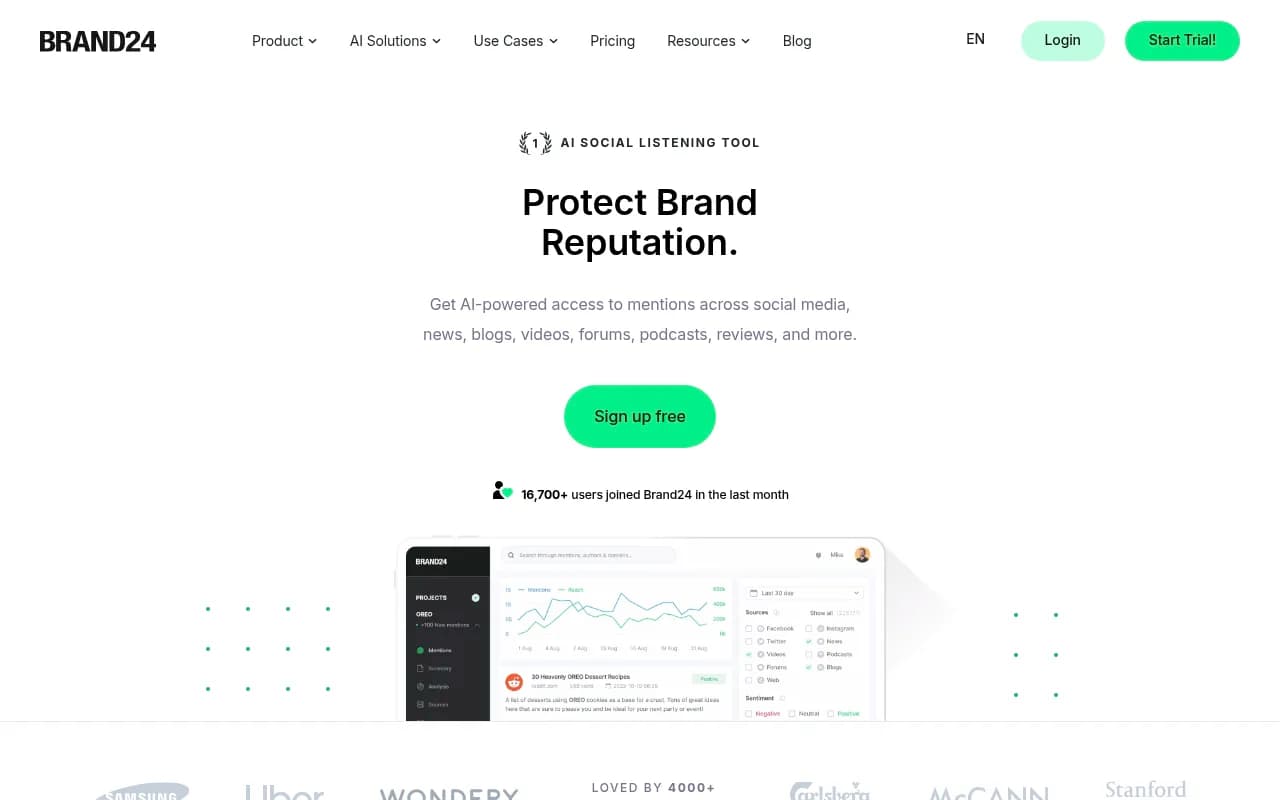
| Brand24 | $249/mo ($199 annual) | Native, all plans | Marketing teams wanting spike detection |
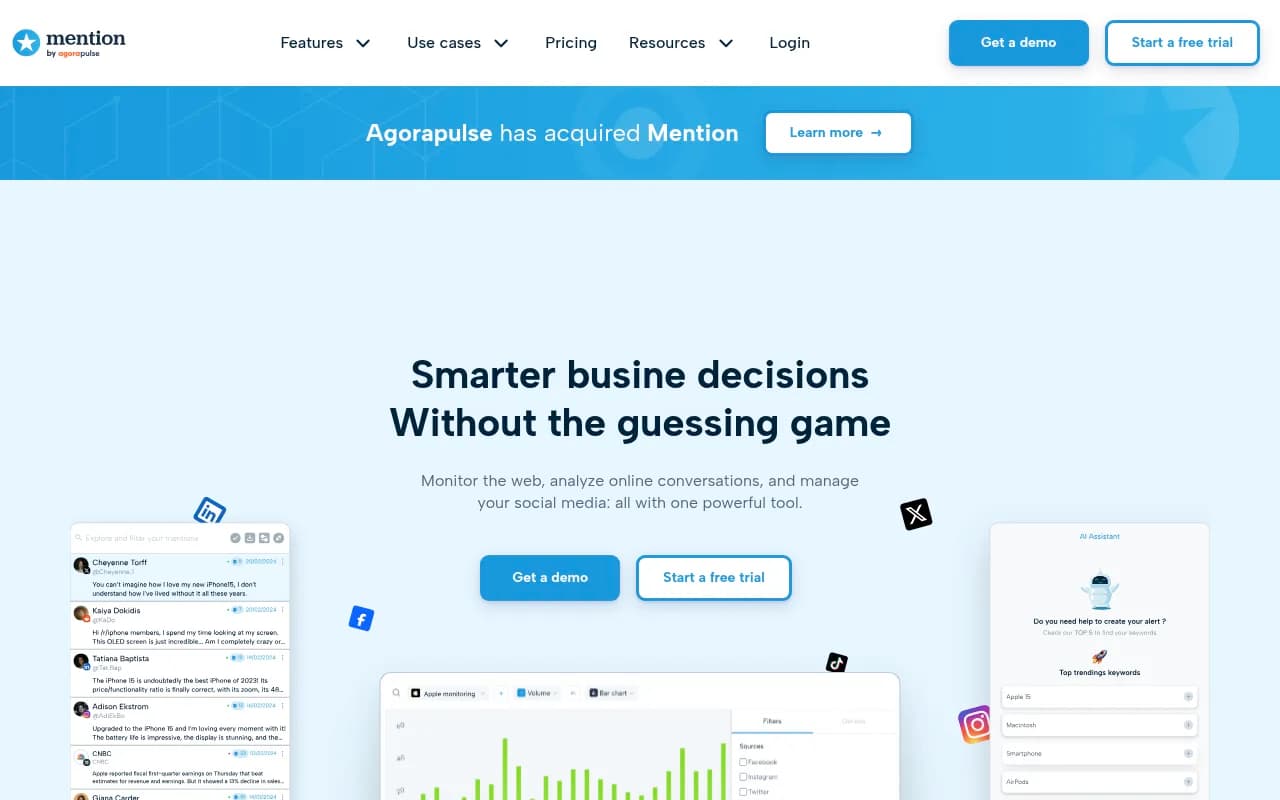
| Mention | ~$41-49/mo | Company tier ($599/mo annual) | Larger teams needing Zapier + Slack routing |
| MentionDrop | $29/mo | Included from Starter | Small businesses on a budget |
| AyeWatch | Free / $9/mo / $19/mo | Pro+ tier ($19/mo) | Topic-based monitoring beyond just brand name |
| Alertmouse | Free / $10/mo | Not confirmed | Simple email-first alerting, built by Moz's founder |
| Gumloop | Free / $37/mo / $244/mo | Dedicated Slack support at Team tier | Teams wanting a custom no-code alert workflow |
Brand24's Storm Alerts feature (spike detection) is genuinely useful here. It flags when mention volume jumps unusually, which catches PR crises or viral moments that a flat keyword alert would just report as "12 new mentions" without context.



Why frequency matters as much as delivery channel
A screenshot-diffing tool that checks once a day is fine for a pricing page. It's useless for tracking how often your brand shows up in ChatGPT responses, because that number can swing hard within a single week.
Promptwatch's own research on Reddit citations is a good illustration of why. Reddit held a steady 3.71% share of ChatGPT Search citations in June 2026, itself already down about 40% from May's 6.11%. Then on August 14, 2026, that number fell from a stable ~3.8% to just 0.5%, essentially overnight (see Promptwatch's Reddit citation data). Compare that to Google AI Overviews and AI Mode, which declined gradually, 11.3% and 30.5% over the same window, not a cliff. A monthly report would have missed the ChatGPT drop entirely and buried it in noise by the time anyone read the recap.
This is the actual argument for real-time Slack alerts over quarterly PDF reports: citation share in AI answer engines doesn't move like organic search rankings. It can reshuffle in days.
How to avoid drowning your own Slack channel
Every guide I've read on this eventually lands on the same warning, and it's correct: a free tool sending 50 irrelevant pings a week costs you more in ignored attention than a $9/mo tool sending three relevant ones. AyeWatch's own comparison of monitoring tools makes exactly this point, and it holds regardless of which platform you pick.
A few concrete habits that actually reduce noise:
- Narrow event types right after setup instead of leaving the default "alert on everything." Most tools ship with broad triggers on; turn most of them off in week one.
- Route by urgency, not by source. Weekly executive summaries go to email, where leadership already reads things. Real-time citation drops or a competitor showing up where you used to rank go to a dedicated Slack channel your team actually watches.
- Use deduplication or grouping if the tool supports it, so five related pings about the same event become one message, not five.
- Set a review cadence to re-tune filters. Alert rules that were right in month one are often stale by month three as your prompt list or keyword set grows.
What to actually check before buying
Before signing up for anything in the tables above, verify these four things directly, ideally in a live demo rather than trusting the pricing page copy:
- Does the Slack alert fire from the actual monitoring event, or only exist as a support contact channel?
- What's the minimum plan tier where Slack alerting unlocks? For Peec AI and Profound, that's a meaningfully higher spend than their advertised entry price.
- Can you scope alerts by severity or event type, or is it all-or-nothing?
- Does the tool track the specific surfaces you care about? If you're watching AI answer engines, check coverage of ChatGPT, Perplexity, Google AI Overviews, and Gemini specifically, since general mention tools like Brand24 and Mention are built for the open web and social, not for LLM answer citations.
A quick word on setup shortcuts
If your current tool has no native Slack integration (Google Alerts, for instance, has none), the common workaround is routing its RSS feed through Zapier into Slack. It works, but it's a manual pipeline you have to build and maintain yourself, not a supported feature. Tools like Gumloop exist partly to make this kind of custom routing easier without needing a dedicated ops person to babysit it.
Final recommendation
If your priority is AI answer engine visibility specifically, Promptwatch is the strongest all-round pick here: it combines the alerting with actual diagnosis (crawler logs explaining why visibility changed) and action (content agents that publish fixes), which most of the pure trackers in this list don't attempt. If you just need broad web and social mention alerts with reliable native Slack support at a reasonable price, Brand24 and MentionDrop are the more straightforward choices. Either way, don't buy on the strength of the word "Slack" on a pricing page alone, get a demo of the actual alert firing before you commit a budget line to it. For a wider set of options in the GEO and AI visibility space, the directory at bestgeosoftware.com is a good next stop.