Key takeaways
- Generic prompts like "best CRM software" produce visibility data that doesn't reflect how your actual customers search -- they're too broad to inform strategy or content decisions
- Real users search with context: job titles, pain points, use cases, and constraints baked into their queries ("best CRM for real estate agents under $50/month")
- Persona-targeted prompts mirror real search behavior and surface the specific content gaps, competitors, and citation opportunities that matter to your business
- Most AI visibility tools let you customize prompts by persona, industry, location, and language -- but most users never touch these settings and wonder why their data feels useless
- The fix: build prompt sets around 2-3 core buyer personas, test variations with different pain points and contexts, then track which prompts correlate with actual traffic and conversions
Why your AI visibility data feels like noise
You're tracking your brand across ChatGPT, Perplexity, and Claude. You're monitoring hundreds of prompts. Your dashboard shows visibility scores, citation counts, and competitor comparisons. But when you try to act on the data -- write content, adjust messaging, prioritize pages -- nothing clicks. The insights feel vague. The recommendations feel generic. You can't connect the dots between what the AI models say and what your customers actually need.
The problem isn't the tool. It's the prompts.
Most brands start AI visibility tracking with a list of broad, obvious queries: "best [category] software," "top [industry] tools," "[product type] comparison." These prompts feel safe. They're high-volume. They're what you'd type into Google if you were just browsing. But they're also completely divorced from how your actual customers search.
Real users don't ask ChatGPT "what's the best project management tool?" They ask "what's the best project management tool for a remote team of 15 with a tight budget?" or "which PM tool integrates with Slack and has Gantt charts?" The difference isn't cosmetic. Generic prompts produce generic data. Persona-targeted prompts produce actionable intelligence.
What happens when you track generic prompts
Let's say you sell marketing automation software. You set up tracking for prompts like:
- "best marketing automation tools"
- "top email marketing platforms"
- "marketing software comparison"
You check your dashboard. You're visible in 40% of responses. Your main competitor is visible in 60%. You're getting cited, but not as often as you'd like. So you write a blog post: "10 Best Marketing Automation Tools in 2026." You optimize it. You publish it. Your visibility score barely moves.
Why? Because the prompt "best marketing automation tools" is answered by AI models with a mix of enterprise platforms (HubSpot, Marketo), mid-market tools (ActiveCampaign, Drip), and budget options (Mailchimp, ConvertKit). The AI is hedging. It doesn't know who's asking, so it lists everyone. Your content -- also generic -- gets lost in the noise.
Now imagine you tracked persona-specific prompts instead:
- "best marketing automation for B2B SaaS companies under 50 employees"
- "marketing automation with native Salesforce integration for sales teams"
- "affordable email automation for ecommerce brands selling on Shopify"
Suddenly the data tells a story. You see that ChatGPT consistently recommends your competitor for the B2B SaaS prompt but never mentions them for the ecommerce prompt. You see that Claude cites a Reddit thread where someone complains about your competitor's Salesforce integration. You see that Perplexity pulls from a comparison page on a competitor's site that you don't have an equivalent for.
These are actionable insights. You know what content to write. You know which pain points to emphasize. You know where your competitors are weak. Generic prompts can't give you this.
How real users actually search AI engines
The shift from search engines to AI chat interfaces changed how people ask questions. Google trained us to use keywords: "project management software pricing." ChatGPT and Claude let us ask like humans: "I'm managing a product team of 8 people across 3 time zones and need a tool that doesn't overwhelm us with features -- what should I use?"
Research from LinkedIn discussions on prompt quality shows that AI responses improve dramatically when the prompt includes:
- Role or job title: "as a real estate agent" vs. just asking about CRM software
- Constraints: budget, team size, technical skill level, existing tools
- Context: industry, use case, specific pain point
- Outcome: what success looks like, what problem they're solving
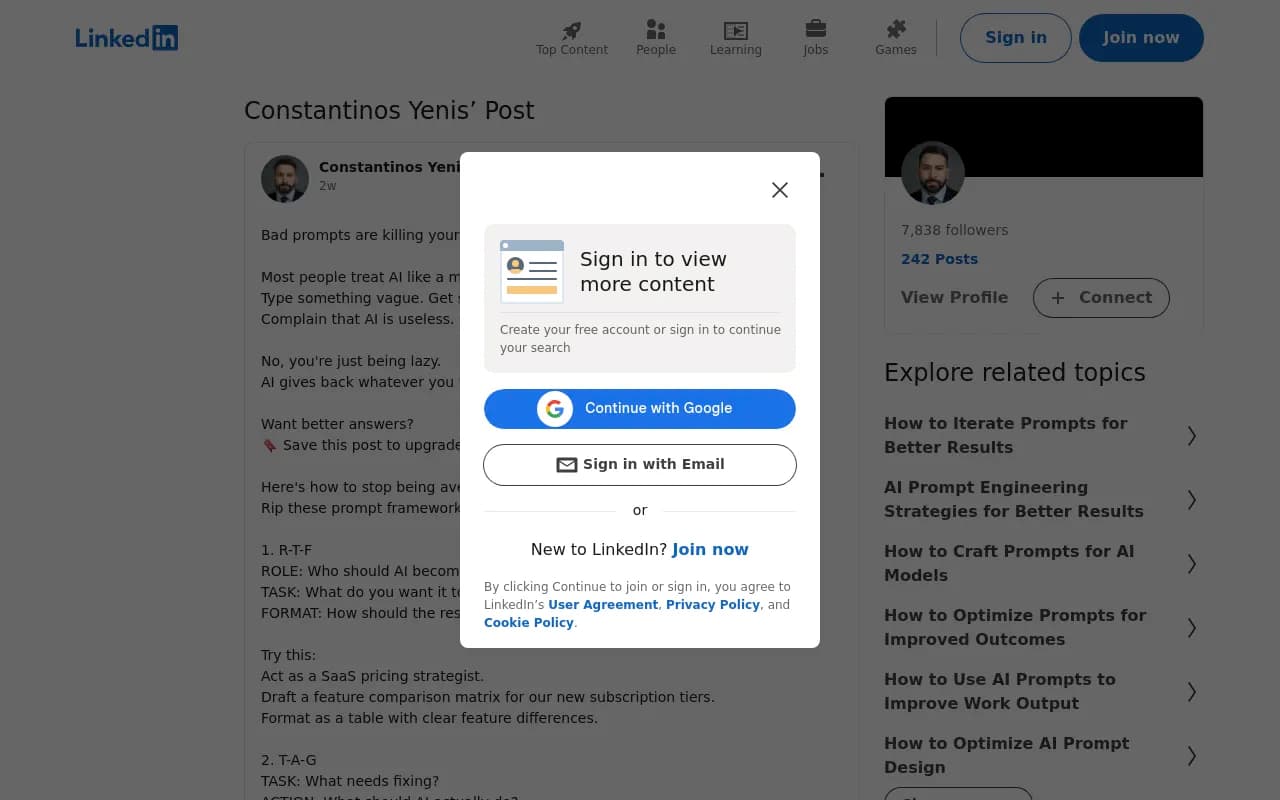
When you track generic prompts, you're measuring visibility for questions nobody asks. When you track persona-targeted prompts, you're measuring visibility for the actual searches that drive conversions.
The persona targeting framework for AI visibility
Here's how to fix your prompt strategy:
Step 1: Define 2-3 core buyer personas
Don't overthink this. You need just enough detail to write realistic prompts. For each persona, document:
- Job title and seniority
- Company size and industry
- Primary pain point or goal
- Budget range
- Technical sophistication
- Tools they already use
Example persona for a project management tool:
Persona: Sarah, Marketing Manager at a Series A SaaS Startup
- Manages a team of 5 (2 designers, 2 writers, 1 video editor)
- Budget: $500-1000/month for all marketing tools
- Pain point: team misses deadlines because work is scattered across Slack, Google Docs, and Trello
- Uses: Slack, Notion, Figma, Google Workspace
- Technical level: comfortable with integrations but doesn't want to manage complex workflows
Step 2: Write prompts the way your personas would ask
For each persona, create 10-15 prompts that reflect how they'd actually search. Mix question types:
Discovery prompts (early research):
- "what's the best project management tool for a small marketing team?"
- "how do marketing teams at startups manage their workflows?"
Comparison prompts (evaluating options):
- "Asana vs Monday vs ClickUp for marketing teams"
- "which project management tool integrates best with Slack and Notion?"
Solution prompts (specific pain point):
- "project management tool that prevents missed deadlines for remote teams"
- "how to keep a marketing team organized without overwhelming them with features"
Constraint prompts (budget, technical, etc.):
- "best project management tool under $100/month for 5 people"
- "simple project management tool for non-technical marketing teams"
Notice how these prompts include context. They're not just "best project management tool" -- they specify team size, budget, use case, and pain point. This is how real people search AI engines.
Step 3: Track and compare across personas
Set up separate prompt groups in your AI visibility tool for each persona. Most platforms -- including Promptwatch -- let you organize prompts by tags, folders, or custom fields.

Track the same core topics across different personas to see how AI recommendations shift:
| Prompt | Persona | Your visibility | Top competitor | Key insight |
|---|---|---|---|---|
| "best PM tool for marketing teams" | Sarah (Marketing Manager) | 45% | Asana | Asana dominates marketing-specific prompts |
| "best PM tool for engineering teams" | Dev (Engineering Lead) | 12% | Jira | We're invisible to technical personas |
| "best PM tool under $50/month" | Startup Founder | 67% | Trello | We win on budget-conscious prompts |
This table tells you exactly where to focus. You're strong with budget-conscious users but weak with technical teams. You need content that bridges the gap -- maybe a guide on "How to use [your tool] for engineering sprints" or a comparison page targeting dev teams.
Step 4: Validate with real traffic data
The ultimate test: do persona-targeted prompts correlate with actual conversions? Connect your AI visibility data to traffic sources:
- Install Promptwatch's tracking snippet to see which AI referrals land on your site
- Cross-reference high-visibility prompts with Google Search Console queries
- Tag landing pages by persona and see which AI-driven traffic converts
If you're highly visible for "best PM tool for marketing teams" but that traffic doesn't convert, either the prompt doesn't match real user intent or your landing page isn't aligned. Adjust and test.
Tools that support persona-targeted tracking
Not all AI visibility platforms handle persona targeting equally. Here's what to look for:
Custom prompt fields: Can you add metadata like persona, funnel stage, or priority level to each prompt?
Bulk prompt generation: Does the tool help you scale prompt creation, or do you have to manually enter hundreds of variations?
Persona-based reporting: Can you filter dashboards by persona to see visibility scores, citation sources, and competitor comparisons for each audience segment?
Multi-language and multi-region support: If your personas span different countries or languages, can you track localized prompts?
Tools that excel at persona targeting:


Common mistakes that waste your tracking budget
Mistake 1: Tracking too many generic prompts
You don't need 500 prompts. You need 50 good ones. A small set of persona-targeted prompts will give you more actionable data than a massive list of generic queries.
Mistake 2: Ignoring long-tail variations
The prompt "best CRM" is tracked by everyone. The prompt "best CRM for real estate agents in Canada with MLS integration" is probably untracked -- and it's exactly what your niche audience searches for. Long-tail, persona-specific prompts have less competition and higher intent.
Mistake 3: Not updating prompts as your product evolves
Your personas' pain points shift. New features launch. Competitors enter the market. Your prompt list should evolve quarterly. Review which prompts drive visibility and conversions, kill the dead weight, and add new variations based on customer feedback and sales calls.
Mistake 4: Treating all AI models the same
ChatGPT, Claude, and Perplexity don't respond identically to the same prompt. ChatGPT leans on its training data and web search. Perplexity prioritizes recent sources. Claude tends to hedge more. Test the same persona-targeted prompt across models and see where your visibility diverges. You might be strong in ChatGPT but invisible in Perplexity -- that's a content gap.
The content strategy that follows from persona targeting
Once you have persona-targeted visibility data, your content strategy writes itself:
Identify gaps: Which prompts does your competitor dominate but you're invisible for? Write content that directly answers those prompts.
Double down on strengths: Which prompts do you already rank well for? Create more content around those topics to reinforce your authority.
Target underserved personas: If you're strong with one persona but weak with another, create dedicated landing pages, guides, and comparison content for the underserved audience.
Optimize existing pages: If you're cited for a persona-targeted prompt but not ranked as the top recommendation, analyze what the AI models cite instead. What's missing from your page? Add it.
Some platforms -- like Promptwatch -- include built-in content generation tools that use your visibility data to create articles, comparisons, and listicles optimized for the exact prompts where you're underperforming. This closes the loop: find the gap, generate the content, track the improvement.
How to test if your prompts are persona-targeted enough
Ask yourself:
- Could this prompt apply to any company in my category? If yes, it's too generic.
- Does this prompt include context about who's asking or why? If no, add it.
- Would a real customer phrase their question this way? If you're not sure, pull actual questions from sales calls, support tickets, or community forums.
- Does this prompt surface different competitors than a generic version? Test it. If "best CRM" and "best CRM for real estate agents" return the same results, your prompt isn't specific enough.
Comparison: Generic vs. persona-targeted prompt strategies
| Dimension | Generic prompts | Persona-targeted prompts |
|---|---|---|
| Example | "best project management software" | "best PM tool for remote marketing teams under $100/month" |
| AI response | Lists 10+ tools across all segments | Recommends 2-3 tools tailored to the persona |
| Competitor visibility | Everyone shows up | Only relevant competitors appear |
| Content gaps identified | Vague ("write about project management") | Specific ("create a guide for remote marketing teams") |
| Traffic quality | Low intent, high bounce rate | High intent, better conversion |
| Actionability | Hard to prioritize what to fix | Clear next steps for content and optimization |
What to do next
If you're tracking AI visibility with generic prompts, here's your action plan:
- Audit your current prompt list: How many are generic? How many include persona context?
- Define 2-3 core personas: Use real customer data, not guesses.
- Rewrite your top 20 prompts with persona targeting: Add job titles, constraints, pain points, and use cases.
- Run a side-by-side test: Track the generic version and the persona-targeted version of the same prompt for 2 weeks. Compare citation sources, competitor mentions, and content recommendations.
- Scale what works: If persona-targeted prompts surface better insights, expand your prompt library with more variations.
The brands winning in AI search in 2026 aren't the ones tracking the most prompts. They're the ones tracking the right prompts -- the ones their actual customers ask, with the context and constraints that matter. Generic prompts give you generic data. Persona-targeted prompts give you a roadmap.