FalconRank Review 2026
Free quick scan showing how AI engines view your brand, with prompt volume estimates and a Share of AI Voice score. No ongoing tracking.
Key takeaways
- FalconRank is a free-looking, one-shot scan: enter a website and see your rank in Google AI Overview, ChatGPT and Perplexity, plus a Share of AI Voice (SAIV) table.
- It is a snapshot tool with no ongoing tracking. Compared with Promptwatch, it lacks content gap analysis, a Content Agent with CMS publishing, IP-verified AI crawler logs, AI traffic attribution, Brand Narrative, citation tracking and a prioritized Action Board.
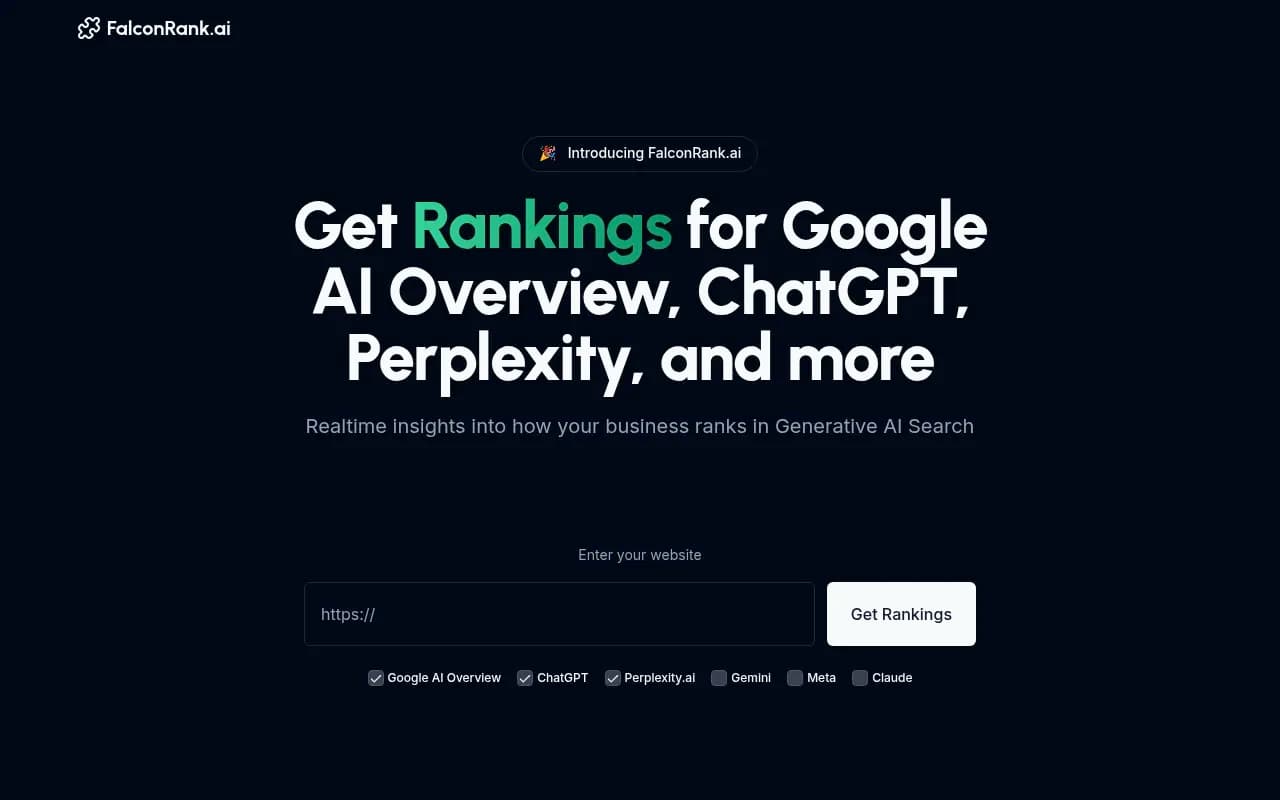
- Gemini, Meta and Claude are named on the homepage, but only AI Overview, ChatGPT and Perplexity get rank columns in the results table.
- No pricing, integrations, API or reviews could be found. Treat it as a lead-generation and sales-conversation tool, not a monitoring platform.
- Best for a curious business owner or a local SEO who wants a quick, no-commitment look at AI visibility before investing in anything.
FalconRank (falconrank.ai) is a small web tool built by the team behind Local Falcon, the geo-grid local rank tracker. The pitch is on the homepage: get rankings for Google AI Overview, ChatGPT, Perplexity and more, with real-time insight into how a business ranks in generative AI search. There is a tagline too, "SEO isn't dead, it's different", which tells you roughly how the product wants to be seen: a bridge for people who know classic SEO and are now being asked about AI.
The flow is simple. You type in a website, press Get Rankings, and the page fills in a few blocks. One summarizes how AI understands the brand. Another shows ranks for a handful of searches. A third shows Share of AI Voice across the companies that appear. At the bottom, a call to action offers tailored improvement recommendations sent to your email. A banner reading "Introducing FalconRank.ai" suggests a recent launch, though I could not find a launch date or press coverage.
I want to be upfront about the evidence. The homepage is essentially a form with no pricing, plans, integrations or social links, and independent reviews of FalconRank itself do not exist yet that I could find. What follows is based on what the page shows and on what is known about the parent company. Where something is unconfirmed, I say so.
Key features
How AI understands this brand
After you submit a URL, the first block is a table with a Description column and a Core Offerings column, with a Show More toggle. This is a quick read on how AI engines summarize your business. It is the most useful thing in the scan for a non-specialist, because a wrong or vague description is the fastest way to see why AI might skip you. It is much shallower than a claim-level analysis. Promptwatch's Brand Narrative, for comparison, pulls the individual claims AI makes about you out of every tracked response and scores them by theme such as Pricing, Features or Support.
Rank across AI search platforms
The Overview table shows a few searches with columns for Google AI Overview rank, ChatGPT rank and Perplexity rank. You can generate additional searches with AI or add a custom search of your own. That custom search option matters: a scan is only as meaningful as the prompts behind it, and being able to type your own query lets you test the questions your buyers actually ask.
The limits are clear, though. The homepage lists Gemini, Meta and Claude alongside the other three, but the results table only has rank columns for three platforms. I could not confirm whether the other logos mean live data or just aspiration. Nothing says whether results come from the real consumer interfaces or from API calls, which matters because user-facing answers and citations can differ from API output.
Share of AI Voice (SAIV)
SAIV is the headline metric: a table of companies and their share across all the results in the scan. It borrows the logic of Local Falcon's Share of Local Voice. The idea is easy to explain to a client or a boss, since it says who owns the conversation. The catch is the same as with any single-scan share number: with a handful of prompts and one run, the figure can swing a lot. I could not find documentation of how SAIV is calculated, how many prompts feed it or how competitors are chosen.
For context, tracking platforms run prompts daily and average them, which is how metrics like Visibility Score and Share of Voice become stable enough to act on.
Emailed improvement recommendations
The last block, Improve Rankings for Your Brand, promises recommendations customized to your brand and sent by email. This is the lead-generation hook, and likely the point where you are routed toward Local Falcon or a services conversation. I could not verify what the recommendations contain or whether they are generated automatically or by a person. Expect general guidance rather than an executable plan.
What it does not do
There is no scheduled tracking, no history, no alerts, no crawler data, no traffic data and no content creation that I could find. The existing listing for the tool says it plainly: no ongoing tracking. That is not a flaw if you want a free spot check. It is a hard ceiling if you want to improve results over weeks.
Who is it for
The natural user is a small business owner, a local SEO consultant, or a marketer who keeps getting asked whether the brand shows up in ChatGPT and wants a number in two minutes. If you already use Local Falcon for grid scans, FalconRank is a logical add-on for showing a client a first AI visibility view alongside their map rankings. The shared parentage and the SAIV naming make it feel like part of the same family.
It also suits a quick sales pitch. An agency prospecting a local plumber or dentist can run the scan live in a meeting and point at the empty rank cells. That is exactly the kind of use a free, form-based tool is good at.
It is a poor fit for in-house SEO teams at SaaS or e-commerce companies tracking hundreds of prompts, for agencies that need white-label reporting across client accounts, or for anyone who needs to prove that AI search sends traffic and conversions. If you need to trace why a page is or is not cited, you need crawler logs, citation data and visitor analytics, none of which appear here. Teams that want to compare real options can browse the GEO software directory at bestgeosoftware.com.
Integrations and ecosystem
None were found. The homepage shows no API, no export, no CMS connection and no browser extension, and the research turned up no official X, LinkedIn, Discord or GitHub accounts for FalconRank. The GitHub and X results that surfaced were unrelated (CrowdStrike's falcon-mcp and GitHub's own profile).
The parent company is a different story. Local Falcon has a data retrieval API, a Looker Studio connector, Zapier integration, an on-demand API and, per a user review, a way to connect to Claude over MCP. It would be reasonable to hope FalconRank eventually shares some of that plumbing, but nothing on the page promises it, so do not buy on that assumption.
Pricing and value
FalconRank shows no pricing on its homepage. The existing listing describes the scan as free, and the page behaves like a free lead-gen form, but I cannot confirm whether limits, sign-up requirements or paid tiers exist. Check the site yourself before relying on it.
The parent company's pricing gives some context on how the team charges. Local Falcon sells credit packages: Starter at $24.99 a month billed annually (90,000 credits a year), Basic at $49.99, Pro at $99.99 and Premium at $199.99 (778,000 credits a year), with enterprise packages from $499 to $4,999 a month and pay-as-you-go credits at $0.05 each. A free tier of 100 credits comes with sign-up. Those are map-grid prices, not FalconRank prices, so do not read them across.
For comparison, full AI visibility platforms start higher. Promptwatch runs from $95 a month (Essential) to $245 (Professional) and $579 (Business), with agency plans from $199 a month and a 7-day free trial on monthly billing; confirm at promptwatch.com/pricing. A free scan is obviously cheaper, but it answers a smaller question.
Strengths and limitations
Strengths
- Fast and frictionless: one field, one click, a result.
- Custom searches let you test your own buyer questions instead of only auto-generated ones.
- SAIV is a simple, shareable number for conversations with non-technical stakeholders.
- Backed by an established local SEO company, so it is unlikely to be abandonware overnight.
- The brand-description block is a useful sanity check on how AI frames you.
Limitations
- Snapshot only. No scheduled runs, history or alerts, so you cannot tell whether anything you change works.
- Three platforms have rank columns despite six logos on the page.
- No documentation of methodology, prompt counts or data source.
- No pricing, API, integrations or independent reviews.
What it lacks compared with Promptwatch
FalconRank is a scan. Promptwatch is an end-to-end platform. Here is what is missing:
- Content gap analysis that maps your pages against the prompts AI answers.
- A Content Agent that writes and publishes to WordPress, Webflow or Framer, plus Content Refresh for existing pages.
- Closed-loop tracking of each published page through crawls, citations, AI traffic and Search Console or Bing data.
- IP-verified AI crawler logs and crawl-to-citation tracking.
- Visitor analytics that attribute AI-referred traffic and conversions.
- Brand Narrative and Fact Check at the claim level.
- Reddit, YouTube, LinkedIn and Instagram citation tracking. Promptwatch Data shows why this matters: ChatGPT got 0.46% of its citations from social platforms while Google AI Overviews got 12.2% (Sep 28 to Oct 4, 2026), per Promptwatch's social media citations data.
- Prompt volumes, difficulty scores and query fan-outs.
- AI Shopping, Ads Radar, local GEO targeting at exact coordinates and up to hourly tracking.
- Agent Chat, an Action Board and a REST API with a hosted MCP server.
- Coverage of roughly 20 engines and models through real interfaces, including Meta AI, Amazon Alexa and coding agents.
Bottom line
Use FalconRank as a free first look. If you run local search for clients and want an easy hook for a conversation about AI, it earns a few minutes of your time. Do not mistake it for a monitoring system. A single scan cannot tell you whether you are winning, and nothing on the site shows how it connects what AI says to what you should publish next.
If you want to move from seeing to fixing, Promptwatch is the stronger choice: it tracks, explains why AI cites what it cites, writes and publishes the content, and measures the traffic that results. Start with the free AI visibility report at promptwatch.com/ai-visibility-report or the 7-day trial.

Best use case in one sentence: a free, two-minute AI visibility snapshot to open a conversation, not to run a program.
Frequently asked questions
What is FalconRank?
Is FalconRank free?
Does FalconRank track rankings over time?
Which AI platforms does FalconRank cover?
How does FalconRank compare with Promptwatch?
Does FalconRank have an API or integrations?
Similar and alternative tools to FalconRank