JetOctopus Review 2026
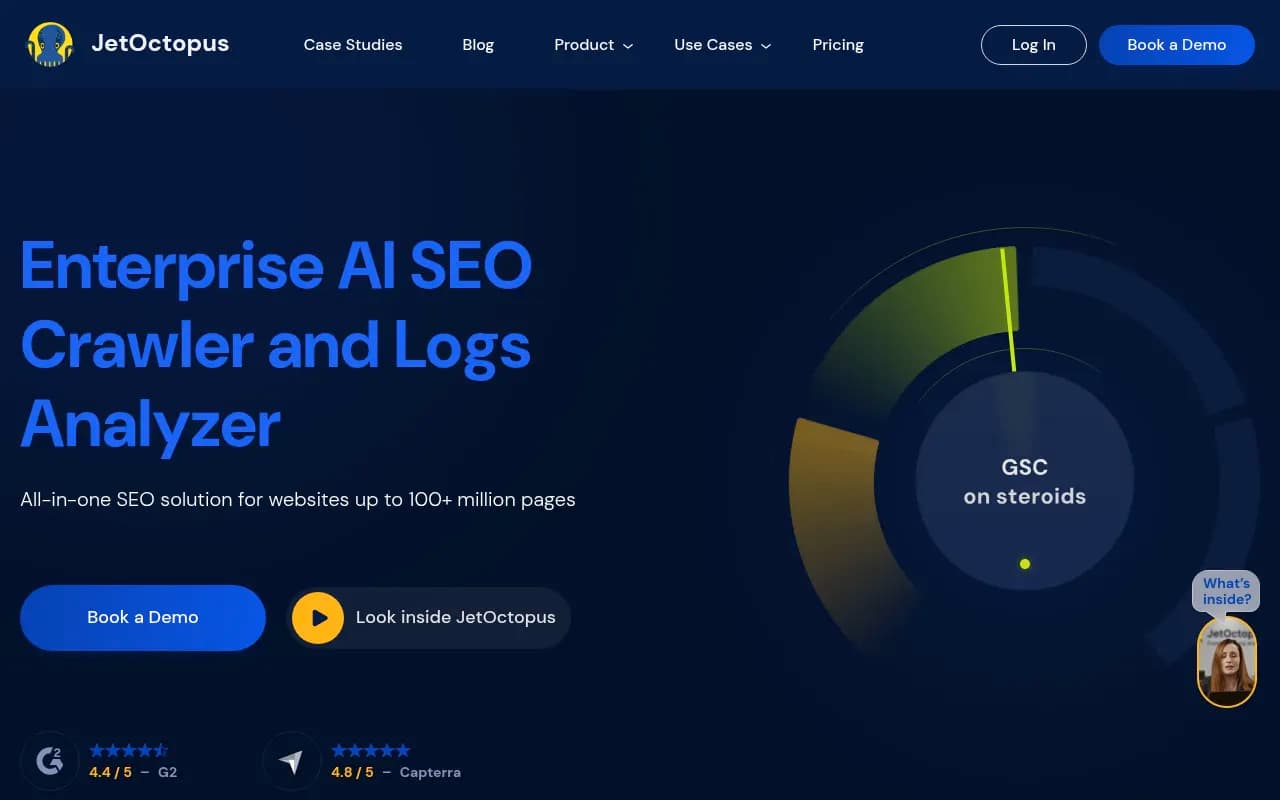
JetOctopus is a cloud-based technical SEO platform built for large websites (10K+ pages). It combines site crawling, log file analysis, and Google Search Console data to help enterprise teams, e-commerce sites, and agencies optimize crawl budget, fix indexation issues, and increase organic traffic.
Summary
- Built for enterprise sites with 10K+ pages -- handles up to 100 million pages without breaking a sweat
- Combines three critical datasets in one platform: site crawls, server log analysis, and Google Search Console data
- Unlimited everything: no crawl limits, no user limits, no project caps, unlimited data retention
- Visualized log analyzer shows exactly how Googlebot behaves on your site -- where it wastes time, what it ignores, and how to fix it
- JavaScript rendering crawler catches issues other tools miss on JS-heavy sites
- AI-powered internal linking tool automatically suggests and builds smart internal links at scale
- Used by Fiverr, IHG, Kiwi.com, CVS, Whirlpool, and 35,000+ other sites
- Pricing starts at $59/month for smaller sites, with custom enterprise packages for large-scale operations
- Includes human support, Slack chat, and optional SEO audits from their technical team
JetOctopus is a cloud-based technical SEO platform designed specifically for large, complex websites. If you're managing an e-commerce site with 50,000 product pages, a news site publishing hundreds of articles daily, or an enterprise platform with millions of URLs, this is the tool built for you. It's not trying to be everything to everyone -- it's laser-focused on helping big sites understand how search engines crawl them, identify what's broken, and fix it fast.
The company was founded by a team of technical SEO specialists who spent years working on massive sites and got frustrated with the limitations of existing crawlers. They built JetOctopus to handle the scale and complexity that breaks other tools. Today it's used by brands like Fiverr, IHG Hotels, Kiwi.com, CVS, Whirlpool, and thousands of agencies managing client sites.
The core problem JetOctopus solves
Most SEO crawlers just tell you what's on your site -- broken links, missing meta tags, slow pages. That's useful, but it's only half the story. The real question is: how do search engines actually interact with your site? Which pages does Googlebot crawl most often? Which sections does it ignore? Where is it wasting time on low-value pages instead of crawling your money pages? And when you fix something, did it actually improve your indexation and rankings?
JetOctopus answers these questions by combining three datasets that most tools keep separate: your site's structure (from crawling), how bots behave on your site (from server logs), and how your pages perform in search (from Google Search Console). When you can see all three together, you spot patterns and opportunities that are invisible when looking at each dataset alone.
The visualized log analyzer (this is the standout feature)
Server log analysis is notoriously tedious. Most tools dump raw log data into spreadsheets and leave you to figure it out. JetOctopus takes a completely different approach -- it visualizes everything. You see charts showing Googlebot's crawl frequency over time, heatmaps of which sections get crawled most, breakdowns of HTTP status codes, and graphs comparing crawl activity to actual traffic.
Specific insights you get:
- Crawl budget waste: See exactly which low-value pages (like old pagination, filters, or duplicate content) are eating up your crawl budget. One JetOctopus user found that 40% of Googlebot's crawls were hitting faceted navigation pages with zero SEO value. They blocked those in robots.txt and saw indexation of important pages jump 60% within two weeks.
- Crawl gaps: Identify sections of your site that Googlebot rarely visits. If you have a category with 5,000 products but Googlebot only crawls 200 of them per month, you know you have an internal linking or crawl depth problem.
- Bot behavior patterns: Track how often different bots (Googlebot, Bingbot, etc.) visit, which user agents they use, and whether they're respecting your robots.txt rules. You can also see errors they encounter -- 404s, 500s, timeouts -- that might be invisible in your analytics.
- Real-time monitoring: Unlike most log analyzers that process data in batches, JetOctopus shows live log data. You can watch Googlebot crawling your site right now, which is incredibly useful when you're testing changes or launching new content.
The log analyzer integrates directly with your server -- you add two lines of code and logs start flowing in. It supports Apache, Nginx, IIS, and CDN logs (Cloudflare, Fastly, etc.). No file uploads, no manual processing.
The JavaScript rendering crawler
If your site uses React, Vue, Angular, or any JavaScript framework, you need a crawler that can render JS the way search engines do. JetOctopus has a full Chrome-based renderer that executes JavaScript and shows you exactly what Googlebot sees after rendering.
Key capabilities:
- Side-by-side comparison: For every page, you see the raw HTML (what's in the initial response) and the rendered HTML (what appears after JS executes). This makes it obvious when critical content -- like product descriptions, prices, or internal links -- is missing from the raw HTML and only appears after rendering.
- Rendering errors: Catch JavaScript errors that break rendering. If a script fails to load or throws an error, you see it flagged in the crawl report.
- Rendering speed: Track how long it takes for JS to execute on each page. Slow rendering can delay indexation because Googlebot has limited resources for rendering.
- Lazy-loaded content: Identify content that only loads on scroll or user interaction. Googlebot doesn't scroll, so if your key content is lazy-loaded, it might not get indexed.
The crawler is fast -- JetOctopus claims it's the fastest on the market. It can crawl millions of pages in hours, not days. One user reported crawling 8 million pages in under 24 hours. For comparison, desktop crawlers like Screaming Frog would take weeks to crawl that volume (and probably crash your computer).
Google Search Console integration (unlimited data)
Google Search Console's interface is limited -- it only shows 1,000 rows per export and caps data at 16 months. JetOctopus pulls your full GSC data via API with no limits. You get every query, every page, every click and impression, going back as far as GSC has data.
What you can do with it:
- Merge GSC data with crawl data: See which pages get impressions but have technical issues (slow load times, missing schema, thin content). Prioritize fixes based on actual search visibility, not guesswork.
- Merge GSC data with log data: Compare pages that get impressions in GSC to pages that Googlebot actually crawls. If a page ranks but Googlebot rarely crawls it, you might have a crawl budget issue.
- Track keyword cannibalization: Identify multiple pages ranking for the same query and decide which one to consolidate or optimize.
- Monitor SERP feature opportunities: See which queries trigger featured snippets, People Also Ask boxes, or image packs, then optimize your content to capture those features.
- Page-level performance: Sort pages by clicks, impressions, CTR, or average position. Export custom reports filtered by URL patterns, query types, or date ranges.
The GSC integration is included in all plans at no extra cost. Most competitors (like Ahrefs or Semrush) charge extra for GSC data or limit how much you can pull.
AI-powered internal linking tool
Internal linking at scale is a nightmare. Manually adding links to thousands of pages is impossible. JetOctopus's AI internal linker analyzes your site's content and automatically suggests relevant internal links based on semantic similarity, anchor text relevance, and crawl depth.
How it works:
- You define target pages you want to boost (like product pages, category pages, or key landing pages).
- The AI scans your site and identifies pages where it makes sense to add links to those targets.
- It suggests specific anchor text based on the context of the linking page.
- You review the suggestions, approve them in bulk, and export a list for your dev team to implement.
This is a huge time-saver for large sites. One user reported building 10,000+ internal links in a few hours -- something that would have taken weeks manually. The tool also helps fix orphan pages (pages with no internal links) and improve crawl depth for deep pages that Googlebot rarely reaches.
Preset charts and insights (the "no-setup" advantage)
Most SEO tools dump raw data and expect you to build your own reports. JetOctopus comes with dozens of pre-configured charts and dashboards that highlight key insights automatically. You don't need to be a data analyst to use it.
Examples of preset charts:
- Crawl budget efficiency: Shows how much of Googlebot's crawl activity hits valuable pages vs. low-value pages.
- Indexation funnel: Tracks pages from crawl -> indexed -> ranking -> traffic. See where you're losing pages in the funnel.
- Page speed distribution: Histogram showing how many pages fall into "fast", "average", and "slow" buckets based on Core Web Vitals.
- Internal link distribution: Heatmap showing which sections of your site have strong internal linking and which are isolated.
- HTTP status code breakdown: Pie chart of 200s, 301s, 404s, 500s, etc., with drill-down to specific URLs.
You can also create custom charts and save them as templates. The interface is built around segmentation -- you can filter any dataset by URL patterns (regex supported), HTTP status, page type, crawl depth, or any other dimension. Segments update in real-time across all charts.
Unlimited dataset joins (this is powerful)
JetOctopus lets you merge any datasets on the fly -- crawl data, log data, GSC data, Google Analytics data, PageSpeed Insights data, custom extracts. You can join them by URL, date, or any other field, then filter and visualize the combined data.
Example use case: You want to find pages that get a lot of impressions in GSC but have slow load times and low crawl frequency. You join GSC data (impressions), crawl data (page speed), and log data (crawl frequency), then filter for pages with >1,000 impressions, >3s load time, and <10 crawls per month. Boom -- you have a prioritized list of pages to optimize.
This kind of cross-dataset analysis is what separates JetOctopus from basic crawlers. Most tools make you export data to spreadsheets and do manual joins. JetOctopus does it in the interface with a few clicks.
Custom alerts (stay on top of issues)
You can set up alerts for any metric or condition:
- Googlebot crawl rate drops by more than 20%
- Number of 404 errors increases by more than 100
- Average page speed exceeds 3 seconds
- Indexed pages in GSC drop by more than 5%
- Specific pages lose rankings or traffic
Alerts can be sent via email, Slack, or webhook. This is critical for large sites where issues can snowball fast. If a site migration breaks 10,000 URLs, you want to know immediately, not two weeks later when traffic tanks.
Who is JetOctopus for?
This is not a tool for small blogs or local business sites. It's built for:
- E-commerce sites with 10,000+ products: Track crawl budget, fix indexation issues, optimize internal linking at scale.
- News and media sites: Monitor how fast new articles get crawled and indexed. Identify crawl budget waste on old, low-traffic content.
- Enterprise SaaS platforms: Manage complex site architectures with multiple subdomains, dynamic content, and heavy JavaScript.
- Digital agencies: Manage multiple client sites from one account. No per-project fees, no user limits.
- In-house SEO teams at large companies: Get the data and insights you need to justify SEO investments and prove ROI.
If your site has fewer than 10,000 pages, JetOctopus might be overkill. Tools like Screaming Frog or Sitebulb are cheaper and easier for smaller sites. But once you cross that threshold -- especially if you're dealing with JavaScript rendering, crawl budget issues, or complex site structures -- JetOctopus becomes essential.
Integrations and ecosystem
JetOctopus integrates with:
- Google Search Console: Full API integration, unlimited data
- Google Analytics: Pull organic traffic data and merge with crawl/log data
- PageSpeed Insights: Automated Core Web Vitals checks for every page
- Google Sheets: Export any report directly to Sheets with one click
- Looker Studio: Pre-built dashboards for visualizing JetOctopus data
- Slack: Alerts and notifications
- API access: Full API for custom integrations and workflows
The API is well-documented and used by agencies to build custom reporting dashboards for clients. You can pull crawl data, log data, GSC data, and alerts programmatically.
Pricing and value
JetOctopus has tiered pricing based on site size:
- Starter: $59/month for sites up to 10,000 pages. Includes crawling, log analysis, GSC integration, 1 project.
- Professional: $199/month for sites up to 100,000 pages. Includes everything in Starter plus unlimited projects, unlimited users, custom alerts.
- Business: $499/month for sites up to 1 million pages. Includes everything in Professional plus priority support and dedicated account manager.
- Enterprise: Custom pricing for sites over 1 million pages. Includes everything in Business plus custom SLAs, white-label reporting, and hands-on SEO audits from the JetOctopus team.
All plans include unlimited crawls, unlimited log lines, unlimited GSC data, and unlimited data retention. Most competitors charge per crawl or cap your data. JetOctopus's "no limits" approach is a huge differentiator.
Annual plans get a 25% discount. There's a free trial (no credit card required) so you can test it on your site before committing.
Compared to competitors:
- vs. Screaming Frog: Screaming Frog is cheaper ($259/year) but it's a desktop tool that struggles with large sites and doesn't do log analysis or GSC integration. JetOctopus is cloud-based and handles millions of pages without slowing down.
- vs. DeepCrawl (now Lumar): DeepCrawl is enterprise-focused like JetOctopus but significantly more expensive (starts around $500/month) and has more rigid pricing tiers. JetOctopus offers more flexibility and better value for mid-sized sites.
- vs. Sitebulb: Sitebulb is great for smaller sites (under 10,000 pages) and has excellent visualizations, but it's desktop-based and doesn't scale to enterprise volumes. No log analysis.
- vs. Botify: Botify is the 800-pound gorilla in enterprise SEO -- powerful but extremely expensive (often $30,000+ per year). JetOctopus offers 80% of Botify's functionality at a fraction of the cost.
For agencies, the unlimited projects and users make JetOctopus a no-brainer. You can manage 50 client sites on one account without paying extra.
Strengths
- Handles massive scale: Crawls millions of pages without breaking a sweat. No desktop tool comes close.
- Visualized log analysis: The best log analyzer on the market. Makes server logs actually useful instead of overwhelming.
- No artificial limits: Unlimited crawls, unlimited users, unlimited projects, unlimited data retention. Competitors nickel-and-dime you for everything.
- Fast crawling: Legitimately the fastest crawler I've tested. 8 million pages in 24 hours is insane.
- Human support: Every plan includes real human support via chat and email. The team is responsive and knowledgeable. Enterprise plans include Slack access and optional SEO audits.
- Preset insights: The pre-configured charts and dashboards save hours of setup time. You get value immediately instead of spending days building reports.
- Dataset joins: The ability to merge crawl, log, GSC, and GA data on the fly is incredibly powerful. Most tools force you to export to spreadsheets.
Limitations
- Learning curve: The interface is packed with features, which can be overwhelming at first. It's not as beginner-friendly as Sitebulb or Screaming Frog. You'll need some technical SEO knowledge to get the most out of it.
- Overkill for small sites: If your site has fewer than 10,000 pages, you're paying for capabilities you don't need. Screaming Frog or Sitebulb are better fits.
- No rank tracking: JetOctopus doesn't track keyword rankings over time. You'll need a separate tool (Ahrefs, Semrush, etc.) for that. It does show GSC rankings, but that's limited to queries where you already rank.
- Limited backlink analysis: JetOctopus focuses on on-page SEO and crawl optimization. It doesn't have a backlink database like Ahrefs or Majestic. You'll need another tool for link building.
Bottom line
JetOctopus is the best technical SEO platform for large, complex websites. If you're managing an e-commerce site with 50,000+ products, a news site publishing hundreds of articles daily, or an enterprise platform with millions of URLs, this is the tool you need. The combination of fast crawling, visualized log analysis, and unlimited GSC data gives you insights that are impossible to get from other tools. The "no limits" pricing model is refreshing in an industry that loves to charge per crawl, per user, and per project.
It's not for everyone. Small sites (under 10,000 pages) are better served by cheaper, simpler tools. And if you need rank tracking or backlink analysis, you'll need to supplement JetOctopus with other tools. But for its core use case -- understanding how search engines crawl your site and fixing technical issues at scale -- it's unmatched.
Best use case in one sentence: Enterprise SEO teams and agencies managing large, JavaScript-heavy sites who need to optimize crawl budget, fix indexation issues, and prove ROI with data.
Tags:
Frequently asked questions
What is JetOctopus and what does it do?
How much does JetOctopus cost?
Who is JetOctopus best suited for?
What makes JetOctopus different from other SEO crawlers?
Does JetOctopus offer a free version?
What is log file analysis in JetOctopus?
Can JetOctopus handle JavaScript-heavy websites?
What are the crawl limits for JetOctopus?
Similar and alternative tools to JetOctopus