Key takeaways
- All four crawlers (Screaming Frog, Sitebulb, Lumar, JetOctopus) are strong for traditional technical SEO, but none were purpose-built to track AI crawler behavior.
- JetOctopus has the most useful log file analysis for surfacing AI bot activity, while Lumar leads on enterprise-scale monitoring and governance.
- Screaming Frog remains the go-to for deep, flexible crawls -- but you'll need to pair it with a log analyzer to see AI bot visits.
- Sitebulb wins on usability and client-friendly reporting, but its AI crawlability features are limited.
- For dedicated AI search visibility (not just crawlability), you need a separate platform built for that job.
There's a question most technical SEO guides aren't asking yet: when ChatGPT, Claude, or Perplexity crawls your website, what actually happens? Which pages do they read? Which do they skip? Do they hit errors? Do they come back?
Traditional crawlers were built to simulate Googlebot. That's still important. But in 2026, there are now a dozen AI models with their own crawlers visiting your site -- and whether they can read your content cleanly has a direct impact on whether they cite you in AI search results.
So let's look at how the four most-used technical SEO crawlers handle this new reality.
What "AI crawlability" actually means
Before comparing tools, it's worth being precise about what we're measuring.
AI crawlability has two distinct components:
-
Can AI bots access your content? This is the technical layer: robots.txt rules, crawl errors, JavaScript rendering, page speed, canonicalization, and whether your content is actually readable by a bot rather than locked behind login walls or rendered purely client-side.
-
Are AI bots actually visiting your content? This is the log file layer: real evidence that GPTBot, ClaudeBot, PerplexityBot, or others have crawled specific URLs, how frequently, and whether they encountered errors.
Most crawlers help with the first question. Very few help with the second. And the second is increasingly where the interesting data lives.
Screaming Frog SEO Spider
Screaming Frog is the crawler most SEOs have open on their desktop right now. It's fast, configurable, handles JavaScript rendering via a headless Chrome integration, and exports to basically anything. For a deep technical audit, it's hard to beat.
On the AI crawlability front, Screaming Frog gives you solid coverage of the first question. You can check your robots.txt to see which user agents are blocked, audit your meta robots tags, identify pages with noindex directives, and spot canonicalization issues that might confuse AI crawlers. The custom extraction feature lets you pull specific structured data elements that AI models tend to rely on -- schema markup, FAQ sections, author metadata.
What Screaming Frog doesn't do natively is log file analysis. You can't see whether GPTBot actually visited your site last Tuesday, or whether it hit a 404 on your most-cited page. For that, you'd need to feed your server logs into a separate tool (or use Screaming Frog's Log File Analyser, which is a separate product).
The other limitation is scale. Screaming Frog is a desktop application. For sites with millions of URLs, you're either running it on a powerful machine or using the cloud version, which was introduced more recently. It's not built for continuous monitoring -- it's built for point-in-time audits.
Best for: Freelancers, in-house SEOs, and agencies doing thorough one-off audits. Unbeatable for flexibility and depth on small to medium sites.
Sitebulb
Sitebulb occupies a slightly different space. It's also a desktop crawler (with a cloud version), but it leans harder into visualization and actionability. The "Hints" system -- where the tool flags issues with severity ratings and plain-English explanations -- is genuinely useful for teams that need to communicate findings to non-technical stakeholders.
For AI crawlability specifically, Sitebulb covers the same ground as Screaming Frog on the technical access side: robots.txt auditing, crawl directives, rendering checks, structured data validation. The visual crawl maps are particularly good for spotting orphaned pages or thin content clusters that AI models might deprioritize.
Sitebulb also added some AI-adjacent features in recent updates, including checks for content that might be flagged as low-quality by AI evaluators. But these are heuristic-based, not grounded in actual AI crawler behavior data.
Like Screaming Frog, Sitebulb doesn't natively ingest server logs for AI bot tracking. You're still working from the "can they access it" side of the equation, not the "are they actually visiting" side.
Where Sitebulb genuinely wins is in making findings digestible. If you're presenting a technical audit to a client or a marketing team that doesn't speak robots.txt, Sitebulb's reports are significantly cleaner than Screaming Frog's raw exports. As one SEO put it on Reddit's r/seogrowth: "Sitebulb makes beautiful reports that clients actually understand. The hints system catches issues I might miss."
Best for: Agencies and consultants who need to present findings clearly. Teams where the person doing the crawl isn't the person making the fixes.
Lumar (formerly DeepCrawl)
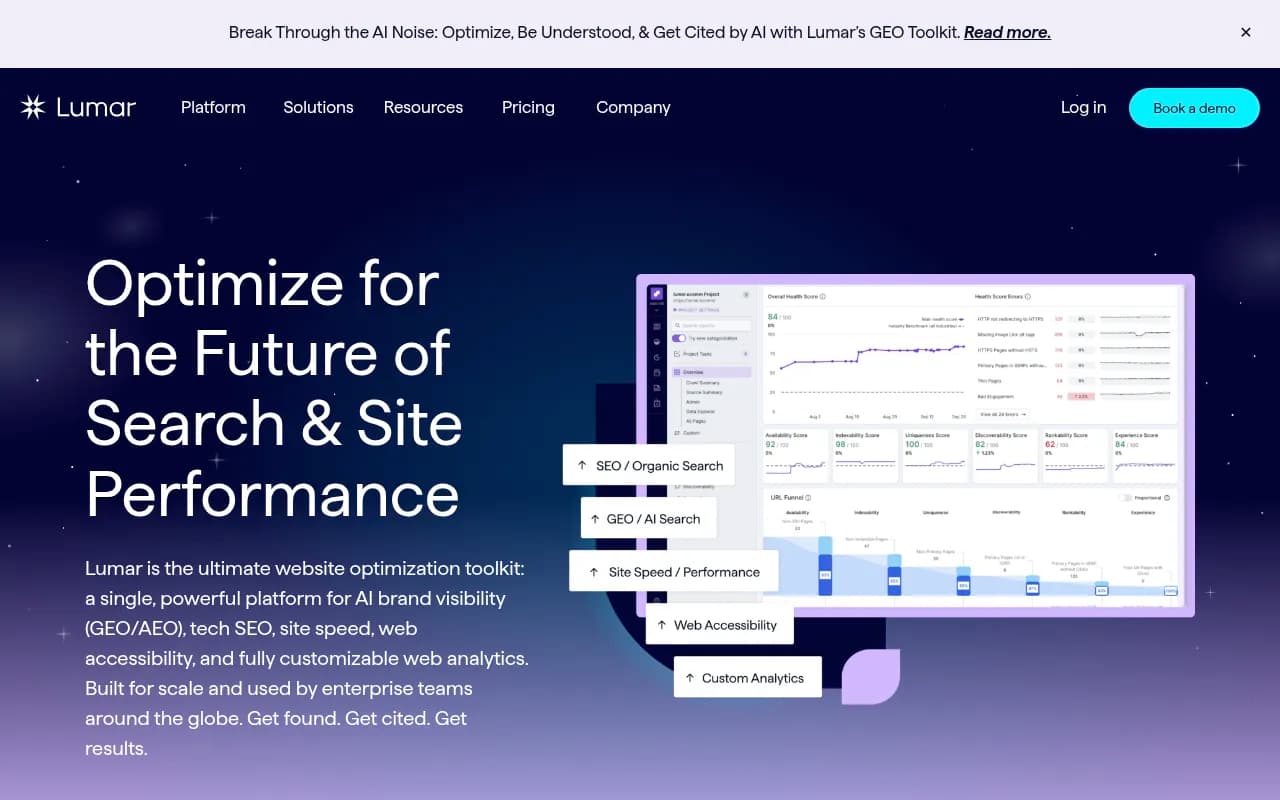
Lumar is a different category of tool. It's cloud-based, enterprise-focused, and built for continuous monitoring rather than one-off audits. If you're managing a site with hundreds of thousands of URLs across multiple regions, Lumar is the kind of infrastructure you need.
On AI crawlability, Lumar's strengths are in governance and scale. You can set up automated crawls that run on a schedule, track technical health over time, and get alerts when new issues appear. For large sites where a single deployment can introduce crawl errors across thousands of pages, that continuous monitoring is genuinely valuable.
Lumar also has stronger integrations with enterprise data stacks -- connecting to Google Search Console, analytics platforms, and custom dashboards. This makes it easier to correlate technical health with actual traffic and visibility metrics.
The AI-specific angle is still developing. Lumar can surface crawl issues that would affect any bot, including AI crawlers, but it doesn't have dedicated AI bot log analysis or AI-specific crawl simulation. What it does well is give you a clean, auditable picture of your site's technical health at scale -- which is the foundation that AI crawlability sits on.
Best for: Enterprise teams managing large, complex sites who need continuous monitoring and governance. Strong for multi-site, multi-region setups.
JetOctopus
JetOctopus is the most interesting tool in this comparison for the specific question of AI crawlability, and it's the one that gets underrated in most roundups.
The reason: JetOctopus was built with log file analysis as a core feature, not an afterthought. You can upload your server logs directly and see exactly which bots visited your site, which URLs they crawled, how frequently, and what response codes they received. In 2026, that means you can filter for GPTBot, ClaudeBot, PerplexityBot, and other AI crawlers and see their actual behavior on your site.
This is genuinely different from what the other three tools offer. Instead of inferring whether AI bots can access your content, you're looking at evidence of what they actually did.
JetOctopus combines this log analysis with its own crawler, so you can cross-reference: here are the pages AI bots are visiting, here are the technical issues on those specific pages, here's where they're hitting errors. That correlation is where the actionable data lives.
The trade-off is that JetOctopus is more complex to set up (you need to configure log delivery) and the interface has a steeper learning curve than Sitebulb. It's also priced for larger sites -- it's not the tool you'd reach for on a 500-page brochure site.
Best for: Enterprise and mid-market teams who want to understand actual AI crawler behavior, not just theoretical access. Strongest log file analysis of the four.
Head-to-head comparison
| Feature | Screaming Frog | Sitebulb | Lumar | JetOctopus |
|---|---|---|---|---|
| Deployment | Desktop + Cloud | Desktop + Cloud | Cloud | Cloud |
| Best for site size | Small-Large | Small-Large | Large-Enterprise | Medium-Enterprise |
| AI bot log analysis | No (separate tool) | No | Limited | Yes (core feature) |
| Robots.txt / crawl directive audit | Yes | Yes | Yes | Yes |
| JavaScript rendering | Yes (headless Chrome) | Yes | Yes | Yes |
| Continuous monitoring | No | No | Yes | Yes |
| Client-friendly reporting | Basic | Excellent | Good | Moderate |
| Structured data validation | Yes | Yes | Yes | Yes |
| Pricing model | Annual license | Annual license | Enterprise SaaS | SaaS |
| Free tier / trial | Free (500 URL limit) | Free trial | Demo | Demo |
The gap none of them fully close
Here's the honest assessment: all four tools are excellent at the technical foundation layer. They'll tell you if your robots.txt is blocking GPTBot, if your pages are rendering correctly, if your structured data is valid. That's important work.
But none of them tell you whether your content is actually being cited by AI search engines. A page can be perfectly crawlable and still never show up in a ChatGPT or Perplexity response. The gap between "technically accessible" and "actually cited" is where most brands are losing AI search visibility right now.
That's a different problem, and it requires a different kind of tool -- one that monitors AI model outputs, tracks which pages get cited, and helps you understand what content changes would improve your visibility.
For teams who want to close that loop, Promptwatch is built specifically for this. It monitors how AI models like ChatGPT, Claude, Perplexity, and Gemini respond to prompts in your category, tracks which of your pages they cite, and includes crawler log analysis that shows you which AI bots are visiting your site and what they're reading. It's a different layer than what Screaming Frog or JetOctopus provides -- more about AI search visibility than technical crawl health.

The two approaches are complementary. Use a technical crawler to make sure AI bots can access your content cleanly. Use an AI visibility platform to understand whether that content is actually influencing AI responses.
How to choose
Choose Screaming Frog if you need maximum flexibility for deep technical audits, you're comfortable with raw data exports, and you're working on small to large sites where a periodic crawl is sufficient. The free version (up to 500 URLs) is genuinely useful for quick checks.
Choose Sitebulb if you're doing agency work and need to present findings to clients, or if you want a tool that surfaces issues with clear explanations and severity ratings. The hints system reduces the cognitive load of a big audit significantly.
Choose Lumar if you're managing enterprise sites with complex architectures, multiple regions, or compliance requirements. Continuous monitoring and governance features justify the higher price point at scale.
Choose JetOctopus if you want actual evidence of AI crawler behavior on your site. The log file analysis is the closest any of these tools gets to answering "what are AI bots actually doing on my site?" -- and that data is increasingly valuable.
For most teams, the practical answer is a combination: Screaming Frog or Sitebulb for periodic deep audits, JetOctopus or Lumar for ongoing monitoring, and a dedicated AI visibility platform layered on top to track what actually matters for AI search citations.
A note on robots.txt and AI crawlers
One thing worth checking regardless of which tool you use: your robots.txt file. Several major AI crawlers have their own user agents, and some sites have inadvertently blocked them while trying to block scrapers.
The main ones to know:
GPTBot-- OpenAI / ChatGPTClaudeBot-- Anthropic / ClaudePerplexityBot-- PerplexityGoogle-Extended-- Google's AI training crawler (separate from Googlebot)Bytespider-- ByteDance / TikTok
All four crawlers in this guide will surface robots.txt issues. But only JetOctopus will show you whether those bots are actually visiting after you fix the rules.
Bottom line
For pure technical SEO auditing, Screaming Frog is still the industry standard and probably always will be. Sitebulb is the better choice when communication matters as much as data. Lumar is the right call for enterprise governance. JetOctopus is the most forward-looking of the four for anyone who wants to see real AI crawler activity.
None of them fully solve the AI search visibility problem -- they solve the crawlability layer beneath it. If you want to know whether your content is actually showing up in AI answers, that's a separate question that needs a separate tool.