Lumar Review 2026
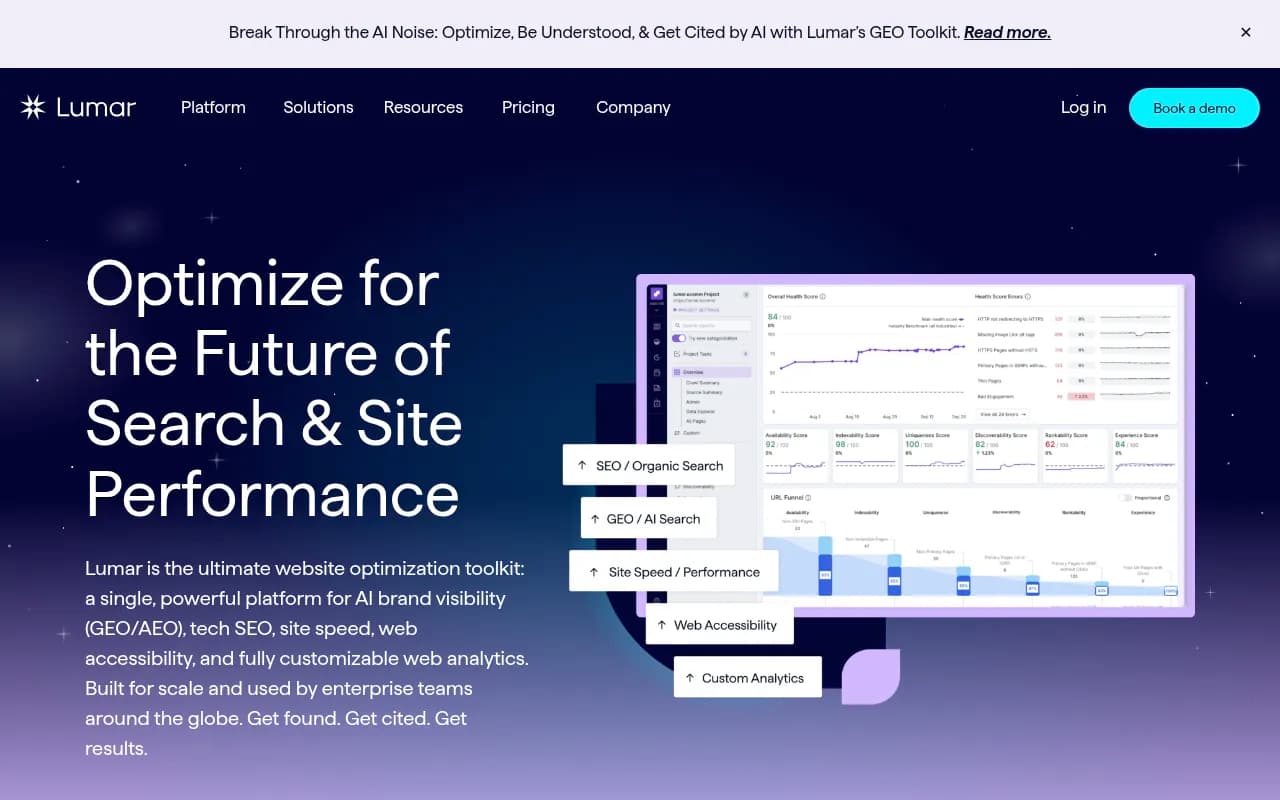
Lumar is an all-in-one website optimization platform built for enterprise scale. It combines technical SEO auditing, AI search visibility (GEO/AEO), site speed monitoring, web accessibility testing, and custom analytics in a single powerful toolkit. Formerly Deepcrawl, Lumar helps global brands opti
Key Takeaways
- Lumar is a comprehensive website optimization platform that covers technical SEO, AI search visibility (GEO/AEO), site speed, web accessibility, and custom analytics -- all in one place
- Built for enterprise scale with a super-fast crawler that handles millions of pages, plus 500+ built-in reports and custom data extraction capabilities
- Lacks content generation, AI crawler logs, and traffic attribution that Promptwatch offers -- Lumar focuses on technical auditing and monitoring rather than content optimization and gap analysis
- Strong professional services team provides hands-on SEO/GEO strategy support, acting as an extension of in-house teams
- SOC 2 Type 2 certified for data security and privacy, making it suitable for large enterprises with strict compliance requirements
Lumar (formerly Deepcrawl) is an enterprise-grade website optimization platform that tries to be the Swiss Army knife of technical website health. It's designed for large organizations managing complex, multi-million-page websites who need to monitor technical SEO, AI search visibility, site speed, and accessibility all from a single dashboard. The platform is used by major brands like Adobe, Deloitte, Comcast, and The Motley Fool -- companies with serious scale and compliance requirements.
The rebrand from Deepcrawl to Lumar in recent years reflected the company's expansion beyond pure technical SEO crawling into a broader website optimization suite. They've added GEO/AEO tools for AI search visibility, web accessibility testing aligned to WCAG 2.2, and custom analytics capabilities. The pitch is simple: instead of juggling five different tools for different aspects of website health, you get one platform that does it all.
Technical SEO at Scale
Lumar's core strength is its website crawler. It's built to handle enterprise-scale sites -- millions of pages crawled at high speed with deep technical analysis. You get hundreds of built-in reports covering everything from crawlability and indexability to structured data, internal linking, and mobile optimization. The crawler respects robots.txt, handles JavaScript rendering, and can be configured to mimic different user agents or crawl specific site sections.
Custom Data Extraction lets you pull practically any data point from your pages using CSS selectors or XPath queries. This is huge for enterprise teams with unique tracking needs -- you're not limited to Lumar's pre-built reports. Want to track a specific meta tag across 2 million pages? Build a custom metric.
AI Dev Ticket Writer is a newer feature that converts technical SEO issues into actionable developer tickets. Instead of manually writing up "Fix these 47 pages with missing H1 tags," Lumar generates the ticket with context, affected URLs, and suggested fixes. It's a time-saver for teams that need to communicate issues to engineering.
Integrations with Google Search Console, Google Analytics, and Majestic pull in external data so you can correlate technical issues with traffic and rankings. You can see which broken pages were actually getting clicks, or which slow pages have high bounce rates.
GEO and AI Search Visibility
Lumar's GEO (Generative Engine Optimization) toolkit is their answer to the AI search era. It tracks brand mentions and sentiment across major AI platforms -- ChatGPT, Perplexity, Claude, Gemini, and others. The platform provides both content and technical GEO metrics to help you optimize for AI discovery, understanding, and inclusion.
AI-Powered GEO Suggestions give you instant recommendations for improving AI visibility. The system analyzes your content and suggests changes to make it more likely to be cited by AI models. There's also a Content Evaluation feature that audits your existing content for AI-readiness.
Here's where Lumar falls short compared to Promptwatch: Lumar's GEO tools are monitoring and analysis-focused. You can see where you're mentioned in AI responses and get suggestions, but there's no content gap analysis showing which prompts competitors rank for that you don't. There's no AI content generation to help you create optimized articles. And critically, there are no AI crawler logs to see which pages ChatGPT or Claude are actually reading on your site, no traffic attribution to connect AI visibility to revenue, and no Reddit or YouTube tracking to understand the discussions influencing AI recommendations. Lumar tells you where you stand in AI search, but it doesn't help you close the gaps the way Promptwatch does with its Answer Gap Analysis and AI writing agent.
Site Speed and Performance
Lumar's site speed tools are built around Lighthouse audits at scale and Chrome User Experience Report (CrUX) data. You get origin-level CrUX field data based on real user experiences, plus detailed Lighthouse reports for individual pages. This helps you understand Core Web Vitals performance across your entire site, not just a handful of test pages.
Performance Tracking Over Time shows how speed metrics change after deployments or optimizations. You can set up alerts to catch performance regressions before they impact rankings or conversions. The platform breaks down performance issues by page type, template, or site section, making it easier to prioritize fixes.
For enterprise sites with thousands of templates and page types, this level of detail matters. You can identify that your product pages are fast but your blog is dragging, or that mobile performance is fine but desktop is suffering.
Web Accessibility
Lumar's accessibility testing is aligned to WCAG 2.2 standards across Levels A, AA, and AAA. The platform scans your site for common accessibility issues -- missing alt text, insufficient color contrast, keyboard navigation problems, ARIA attribute errors, and more.
Instant Suggested Fixes appear for every accessibility issue uncovered. Instead of just flagging "This image is missing alt text," Lumar suggests what the alt text should be based on surrounding context. This speeds up remediation significantly.
For companies subject to ADA compliance in the US or the European Accessibility Act, Lumar provides the documentation and reporting needed to demonstrate compliance efforts. You can track accessibility scores over time and show progress to legal or compliance teams.
Custom Website Analytics
This is one of Lumar's more unique features. You can build fully customizable website analytics dashboards that go beyond standard SEO metrics. The platform uses AI-generated code to simplify data collection -- you describe what you want to track, and Lumar writes the extraction logic.
Want to track how many pages have a specific CTA button? Or monitor the average word count of pages in a certain category? Or see which pages are using a deprecated JavaScript library? Custom analytics handles it. This flexibility is valuable for enterprise teams with unique KPIs that don't fit into off-the-shelf tools.
Four Lumar Apps for Different Workflows
Lumar Analyze is the core auditing app. Run deep crawls, uncover issues, and get detailed reports. This is where you spend most of your time diagnosing problems.
Lumar Monitor provides continuous monitoring across multiple domains or site sections. Set up dashboards to track key metrics over time, with custom alerts when things go wrong. This is essential for large organizations managing dozens of sites or international versions.
Lumar Protect integrates with your CI/CD pipeline to catch issues before they reach production. You set thresholds for metrics like crawlability, speed, or accessibility, and Protect halts builds or warns developers when those thresholds are breached. This is proactive QA testing for website changes.
Lumar Impact is designed for stakeholder communication. It benchmarks your site against industry averages, prioritizes fixes based on commercial impact, and helps you build business cases for optimization investments. This app is about proving ROI and getting buy-in for website projects.
Professional Services
Unlike most SaaS platforms, Lumar offers a robust professional services team that acts as an extension of your in-house resources. You get dedicated SEO and GEO strategy support, regular crawl reviews, and hands-on help with complex optimizations. Multiple customer testimonials specifically call out the Lumar team's responsiveness and expertise.
This is a differentiator for enterprise buyers who want more than just software -- they want a partner who can help them navigate complex technical challenges and build long-term strategies.
Who Is Lumar For
Lumar is built for enterprise organizations with large, complex websites. Think e-commerce platforms with millions of product pages, media publishers with vast content libraries, SaaS companies with multi-language sites, or agencies managing dozens of client properties. The platform's pricing and feature set reflect this focus -- it's not designed for small businesses or solo consultants.
Ideal users include in-house SEO teams at Fortune 500 companies, digital agencies serving enterprise clients, and technical SEO specialists managing sites with 100K+ pages. You need the scale, the budget, and the technical sophistication to take full advantage of what Lumar offers.
Not a fit for small businesses, startups, or anyone managing a single site under 10,000 pages. The platform is overkill for simpler use cases, and the pricing reflects enterprise positioning. Also not ideal if your primary need is content optimization for AI search -- Lumar's GEO tools are monitoring-focused, not action-oriented like Promptwatch's content gap analysis and generation capabilities.
Integrations and Ecosystem
Lumar integrates with Google Search Console, Google Analytics, Majestic, and various CI/CD tools like GitHub for the Protect app. There's an API for custom integrations and data export. The platform also offers Looker Studio integration for custom reporting.
Browser extensions and mobile apps aren't part of the offering -- this is a web-based platform designed for desktop use by technical teams.
Pricing and Value
Lumar doesn't publish pricing on their website. It's a "contact sales for a demo" model, which is standard for enterprise software. Based on the feature set, scale capabilities, and target market, expect pricing in the thousands per month range, likely with annual contracts.
The value proposition is consolidation: instead of paying for separate tools for technical SEO, site speed monitoring, accessibility testing, and AI search tracking, you get one platform. For large organizations, this can represent cost savings and workflow efficiency. The professional services add-on provides additional value for teams that need strategic guidance.
Compared to competitors like Screaming Frog (desktop-based, limited scale), Sitebulb (mid-market focus), or Botify (similar enterprise positioning), Lumar's breadth across SEO, GEO, speed, and accessibility is a differentiator. However, for AI search optimization specifically, Promptwatch offers a more complete solution with content gap analysis, AI content generation, crawler logs, and traffic attribution that Lumar lacks.
Strengths
- Comprehensive platform covering technical SEO, GEO/AEO, site speed, accessibility, and custom analytics in one place
- Enterprise-grade crawler that handles millions of pages at high speed with deep technical analysis
- Custom data extraction and analytics provide flexibility for unique tracking needs
- Professional services team offers hands-on strategy support and acts as an extension of in-house resources
- SOC 2 Type 2 certified for data security and privacy, meeting enterprise compliance requirements
- Lumar Protect for CI/CD integration catches issues before they reach production
- Strong customer support consistently praised in testimonials for responsiveness and expertise
Limitations
- No content gap analysis to identify which AI prompts competitors rank for that you don't -- a core feature in Promptwatch
- No AI content generation to help create optimized articles for AI search visibility
- No AI crawler logs to see which pages ChatGPT, Claude, or Perplexity are actually reading on your site
- No AI traffic attribution to connect visibility in AI search to actual revenue or conversions
- No Reddit or YouTube tracking to understand discussions influencing AI recommendations
- No ChatGPT Shopping tracking for e-commerce brands
- Enterprise pricing makes it inaccessible for small businesses or individual consultants
- GEO tools are monitoring-only -- you see where you stand but don't get the action loop (find gaps, generate content, track results) that Promptwatch provides
Bottom Line
Lumar is a solid choice for enterprise organizations that need a comprehensive technical website optimization platform with strong crawling capabilities, broad metric coverage, and hands-on professional services support. It's particularly well-suited for large companies managing complex, multi-million-page sites who value having SEO, speed, accessibility, and basic AI search monitoring in one place.
However, if your primary goal is optimizing for AI search visibility and actually improving your rankings in ChatGPT, Perplexity, and other AI platforms, Promptwatch is the stronger choice. Lumar's GEO tools are monitoring-focused -- they show you where you're mentioned and provide suggestions, but they don't help you identify content gaps, generate optimized content, track AI crawler behavior, or attribute traffic. Promptwatch's action loop (find gaps, create content, track results) is what you need to actually move the needle in AI search, not just monitor where you stand.
Best use case for Lumar: Enterprise technical SEO teams managing massive, complex websites who need comprehensive auditing, monitoring, and compliance capabilities across multiple optimization areas, with professional services support to guide strategy.
Frequently asked questions
What is Lumar and what does it do?
Who is Lumar designed for?
How much does Lumar cost?
Is there a free version of Lumar available?
What are the key features of Lumar?
What is the difference between Lumar and Deepcrawl?
Does Lumar offer AI search visibility features?
Is Lumar suitable for small businesses?
Similar and alternative tools to Lumar