Key Takeaways
- Lumar is a full-stack website optimization platform built for enterprise teams managing complex, multi-million-page sites -- it covers technical SEO, GEO/AEO, site speed, web accessibility, and custom analytics in one toolkit. ZipTie is a specialized AI search visibility tool focused on customer journey mapping and contextual insights.
- Pricing gap is significant: ZipTie starts at $69/mo for basic plans and tops out at $799/mo for 10,000 checks. Lumar is enterprise-only with custom pricing -- expect significantly higher costs but also significantly broader capabilities.
- ZipTie's strength is journey-level context: It maps customer journeys from real conversations, identifies emotional states and decision dimensions, and ties AI search visibility to specific journey stages. Lumar doesn't offer journey mapping.
- Lumar's strength is technical depth and scale: Hundreds of built-in SEO reports, Lighthouse performance audits, WCAG 2.2 accessibility testing, custom analytics with AI-generated code, and the infrastructure to crawl and analyze millions of pages. ZipTie doesn't compete here.
- Both cover AI search visibility (GEO/AEO), but with different angles: ZipTie emphasizes Reddit engagement, community activation, and journey-based content strategy. Lumar provides technical GEO metrics, content evaluation, AI brand sentiment tracking, and instant AI-powered optimization suggestions across all major platforms.
- Decision comes down to scope: If you need customer journey insights and AI search visibility for a smaller site or specific use case, ZipTie is the focused, affordable option. If you're managing a large enterprise site and need a unified platform for SEO, performance, accessibility, and AI visibility, Lumar is the comprehensive choice.
Overview
ZipTie: Journey-focused AI search intelligence
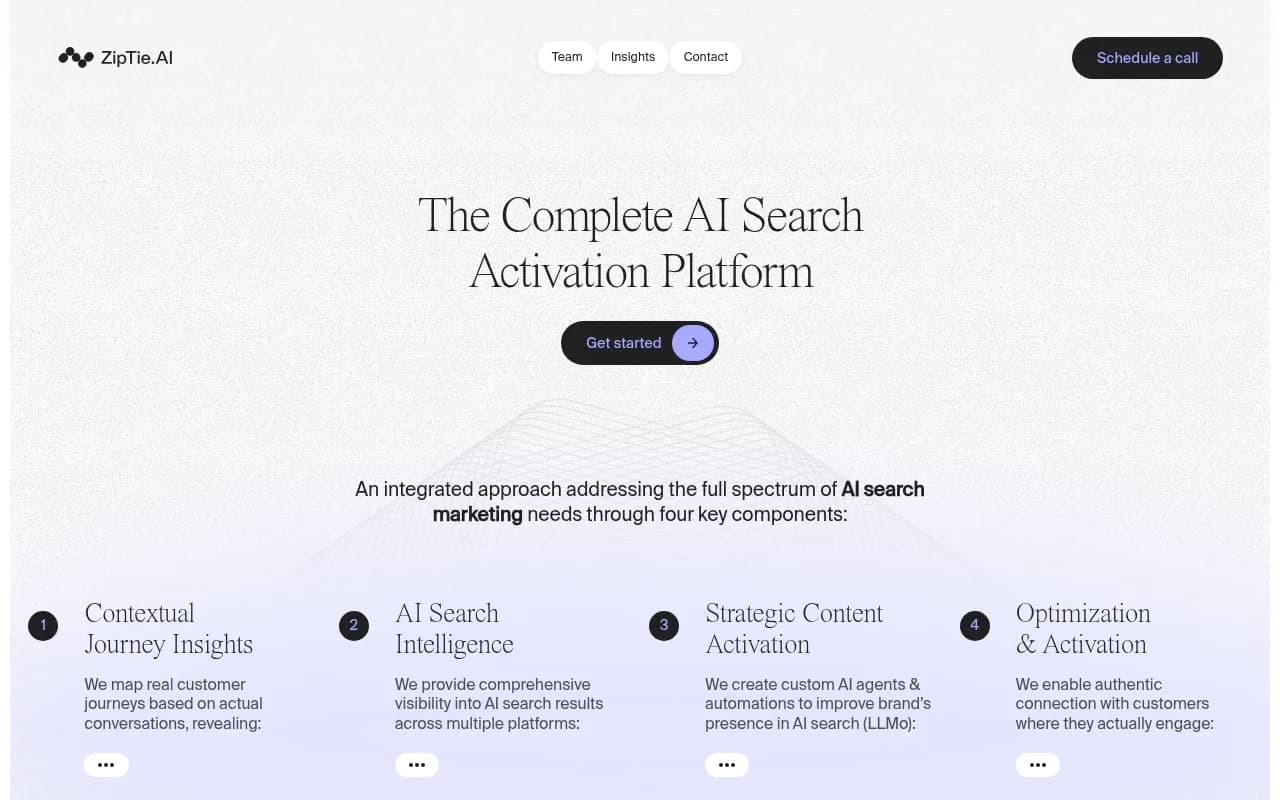
ZipTie positions itself as a customer journey intelligence platform that happens to include AI search visibility tracking. The core idea: traditional marketing tools tell you what users do but miss how they feel and what problems they're trying to solve. ZipTie maps real customer journeys from actual conversations (Reddit, forums, support tickets), identifies seven distinct journey stages with specific information needs, and then shows you where your brand appears (or doesn't) in AI search results at each stage.
The platform covers four main areas: contextual journey insights, AI search intelligence (Google AIO, ChatGPT, Perplexity, etc.), strategic content activation (custom AI agents and automations to improve AI search presence), and optimization via Reddit engagement. It's a smaller, more specialized tool aimed at marketers who want to understand the emotional and contextual layers behind search behavior.
Pricing is transparent: Basic plan at $69/mo (500 checks), Standard at $299/mo (3,000 checks plus GSC integration), and Pro at $799/mo (10,000 checks). No free tier.
Lumar: Enterprise-scale website optimization platform
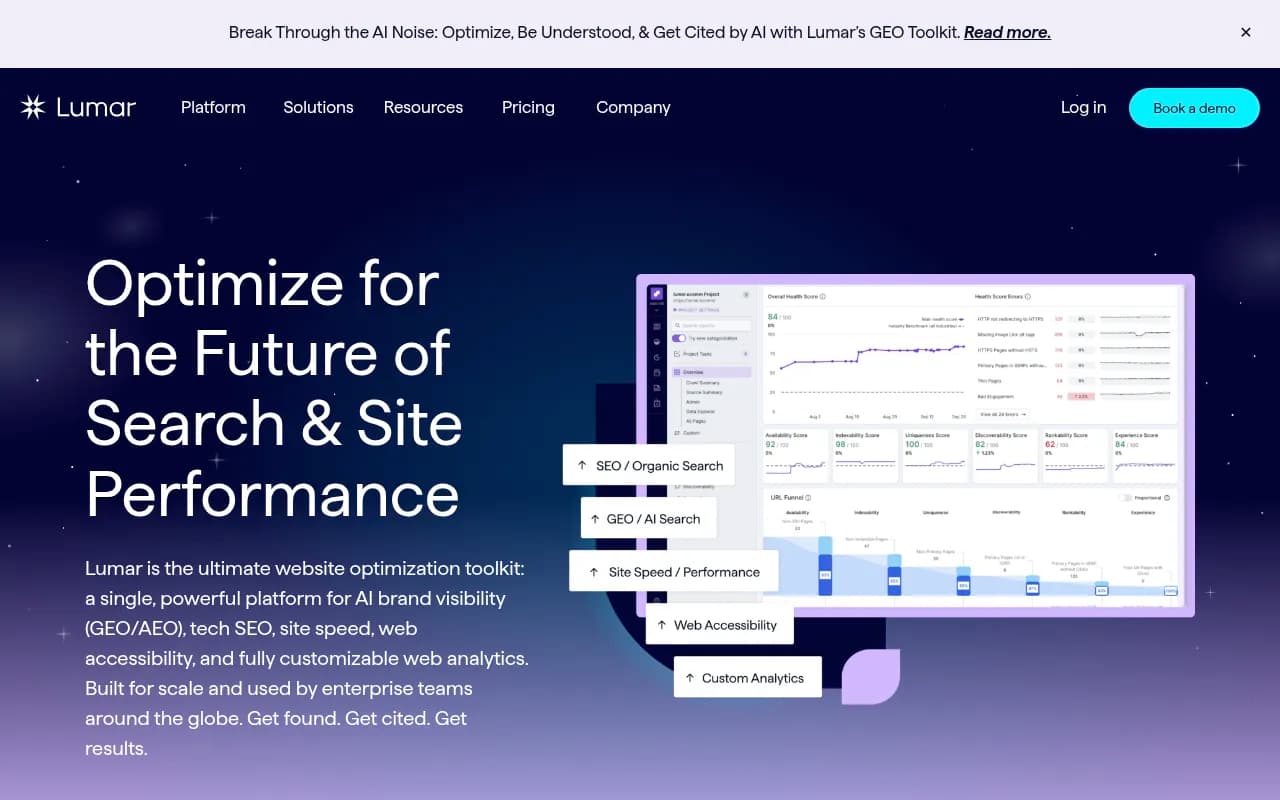
Lumar (formerly Deepcrawl) is an all-in-one website optimization platform built for enterprise teams managing large, complex sites. It combines technical SEO auditing, AI search visibility (GEO/AEO), site speed monitoring, web accessibility testing, and fully customizable analytics in a single powerful toolkit. The platform is designed to handle multi-million-page websites and integrates with enterprise workflows.
Lumar's GEO capabilities include content and technical GEO metrics, AI brand mention tracking, sentiment analysis across major AI platforms, and instant AI-powered optimization suggestions. Beyond GEO, it offers hundreds of built-in technical SEO reports, Lighthouse performance audits at scale, WCAG 2.2 accessibility testing, and custom analytics powered by AI-generated code. The platform also includes an AI dev ticket writer that turns discovered issues into actionable tasks for engineering teams.
Pricing is enterprise-only -- contact sales for a quote. This is not a self-serve product. Lumar targets global brands and large organizations with significant web properties and dedicated optimization teams.
Side-by-Side Comparison
| Feature | ZipTie | Lumar |
|---|---|---|
| Starting price | $69/mo (Basic, 500 checks) | Enterprise custom pricing (contact sales) |
| Target audience | Marketers, small-to-mid-sized brands | Enterprise teams, global brands |
| Primary focus | Customer journey mapping + AI search visibility | Full-stack website optimization (SEO, GEO, speed, a11y) |
| AI platforms tracked | Google AIO, ChatGPT, Perplexity, others | All major AI platforms (Google AIO, ChatGPT, Perplexity, Gemini, Claude, etc.) |
| Technical SEO auditing | Not included | Hundreds of built-in reports, custom extractions |
| Site speed monitoring | Not included | Lighthouse audits, Core Web Vitals, CrUX field data |
| Web accessibility testing | Not included | WCAG 2.2 (Levels A-AAA) with auto-fix suggestions |
| Customer journey mapping | Core feature (7 stages, emotional states, decision dimensions) | Not included |
| Reddit/community insights | Yes (strategic engagement, community activation) | Not included |
| Custom analytics | Not mentioned | Yes (AI-generated code, fully customizable metrics) |
| Scale capability | Small-to-mid-sized sites | Multi-million-page enterprise sites |
| Free tier | No | No |
| Self-serve signup | Yes | No (sales-led) |
Head-to-head feature deep-dive
Customer journey intelligence
ZipTie's standout feature is its customer journey mapping. It analyzes real conversations from Reddit, forums, and other sources to identify seven distinct journey stages, each with specific information needs. For each stage, it surfaces key decision dimensions, emotional states, unaddressed needs, and exit triggers that cause customers to abandon their journey. This is genuinely different from standard keyword research or search intent analysis -- it's about understanding the emotional and contextual arc of a customer's decision-making process.
Lumar doesn't offer journey mapping at all. It's a technical optimization platform, not a customer research tool. If understanding the "why" behind search behavior matters to your strategy, ZipTie has a clear edge here.
Verdict: ZipTie wins decisively. Lumar doesn't compete in this category.
AI search visibility (GEO/AEO)
Both platforms track AI search visibility, but with different emphases.
ZipTie covers Google AIO, ChatGPT, Perplexity, and other platforms. It identifies influential sources driving AI responses and ties visibility back to customer journey stages. The platform also emphasizes Reddit as a lever for AI search optimization -- since AI models frequently cite Reddit discussions, ZipTie helps you engage strategically in relevant communities to improve brand representation.
Lumar offers comprehensive GEO/AEO tools with both content and technical metrics. It tracks AI brand mentions and sentiment across all major platforms, provides instant AI-powered optimization suggestions, and breaks down visibility into three layers: AI discovery (can AI find your content?), AI understanding (does AI interpret it correctly?), and AI inclusion (does AI cite you in responses?). Lumar's GEO features are integrated with its broader technical SEO and performance tools, so you can see how site speed, accessibility, and technical issues impact AI visibility.
Verdict: Tie, but for different reasons. ZipTie's journey-based approach and Reddit focus are unique. Lumar's technical depth and instant optimization suggestions are more comprehensive. Pick based on whether you need journey context (ZipTie) or technical integration (Lumar).
Technical SEO auditing
Lumar is a technical SEO powerhouse. It offers hundreds of built-in reports covering crawlability, indexability, structured data, internal linking, duplicate content, redirect chains, canonicalization, hreflang, and more. It can crawl and analyze millions of pages, handle complex site architectures, and provide custom data extractions for unique use cases. The platform also includes an AI dev ticket writer that automatically generates actionable tasks from discovered issues, making it easier to get engineering buy-in and track fixes.
ZipTie doesn't offer technical SEO auditing. It's not trying to be a Screaming Frog or Sitebulb competitor. If you need to audit your site's technical health, ZipTie won't help.
Verdict: Lumar wins by default. ZipTie doesn't play in this space.
Site speed and performance monitoring
Lumar includes comprehensive site speed tools: Lighthouse audits at scale, Core Web Vitals tracking, and origin-level CrUX field data based on real user experiences. It surfaces critical performance details (render-blocking resources, large images, JavaScript execution time, etc.) and ties performance metrics to SEO rankings and conversion rates. For enterprise teams managing large sites, this level of performance visibility is essential.
ZipTie doesn't monitor site speed or performance. It's focused on content and visibility, not technical infrastructure.
Verdict: Lumar wins. ZipTie doesn't compete here.
Web accessibility (a11y) testing
Lumar offers web accessibility testing aligned to WCAG 2.2 standards (Levels A, AA, and AAA). It identifies accessibility issues across your site and provides instant suggested fixes for each issue. This is increasingly important for compliance, inclusivity, and SEO (Google considers accessibility as a ranking factor).
ZipTie doesn't include accessibility testing.
Verdict: Lumar wins. ZipTie doesn't offer this.
Custom analytics and reporting
Lumar's custom analytics capabilities are impressive. You can build fully customizable metrics powered by AI-generated code, create tailored dashboards, and report on practically any website data you need. This goes beyond standard SEO and performance metrics to answer unique optimization questions specific to your business.
ZipTie doesn't emphasize custom analytics. It provides journey insights and AI search visibility reports, but not the level of flexibility Lumar offers.
Verdict: Lumar wins for teams that need deep customization. ZipTie's reporting is more focused and less flexible.
Reddit and community engagement
ZipTie explicitly includes Reddit engagement as part of its optimization strategy. It helps you identify relevant communities, engage authentically, and use Reddit conversations to improve AI search visibility (since AI models frequently cite Reddit). The platform also offers team enablement and training for community activation.
Lumar doesn't include Reddit or community engagement tools. It's a technical platform, not a community management tool.
Verdict: ZipTie wins. Lumar doesn't compete here.
Ease of use and onboarding
ZipTie is self-serve with transparent pricing. You can sign up, start tracking, and get insights relatively quickly. The interface is designed for marketers, not technical SEO specialists.
Lumar is enterprise-only and sales-led. Onboarding involves demos, custom setup, and likely some training. The platform is powerful but complex -- it's built for teams with dedicated SEO, performance, and accessibility specialists who need deep technical control.
Verdict: ZipTie is easier to get started with. Lumar requires more investment upfront but delivers more depth.
Pricing comparison
| Plan | ZipTie | Lumar |
|---|---|---|
| Entry-level | $69/mo (Basic: 500 checks) | Enterprise custom pricing |
| Mid-tier | $299/mo (Standard: 3,000 checks, GSC integration) | Enterprise custom pricing |
| High-tier | $799/mo (Pro: 10,000 checks) | Enterprise custom pricing |
| Free tier | No | No |
| Annual discount | Not specified | Likely available (contact sales) |
ZipTie's pricing is straightforward and accessible for small-to-mid-sized teams. Lumar's enterprise pricing is opaque but will be significantly higher -- expect five-figure annual contracts for large organizations. The value proposition is different: ZipTie is a focused tool you can add to your stack, while Lumar is a platform that replaces multiple tools.
Pros and cons
ZipTie pros
- Unique customer journey mapping from real conversations
- Affordable pricing with transparent tiers
- Reddit engagement and community activation built in
- Journey-based content strategy insights
- Self-serve signup and onboarding
- Focused on the "why" behind search behavior, not just the "what"
ZipTie cons
- No technical SEO auditing
- No site speed or performance monitoring
- No web accessibility testing
- Limited scale for large enterprise sites
- Fewer AI platforms tracked compared to some competitors
- No custom analytics or reporting flexibility
Lumar pros
- Comprehensive platform covering SEO, GEO, speed, accessibility, and analytics
- Built for enterprise scale (multi-million-page sites)
- Hundreds of built-in technical SEO reports
- Instant AI-powered GEO optimization suggestions
- Custom analytics with AI-generated code
- AI dev ticket writer for engineering collaboration
- WCAG 2.2 accessibility testing with auto-fix suggestions
- Lighthouse and CrUX performance data at scale
Lumar cons
- Enterprise-only pricing (no transparent tiers)
- Sales-led, not self-serve
- Overkill for small sites or teams without dedicated specialists
- No customer journey mapping
- No Reddit or community engagement tools
- Steeper learning curve
Who should pick which tool
Pick ZipTie if you:
- Need to understand customer journeys and emotional decision-making, not just keywords
- Want AI search visibility tracking tied to journey stages
- Plan to use Reddit and community engagement as part of your strategy
- Have a small-to-mid-sized site and a limited budget
- Prefer self-serve tools with transparent pricing
- Care more about content strategy and context than technical infrastructure
Pick Lumar if you:
- Manage a large, complex enterprise website (millions of pages)
- Need a unified platform for technical SEO, GEO, site speed, accessibility, and analytics
- Have dedicated SEO, performance, and accessibility specialists on your team
- Want deep technical control and custom reporting capabilities
- Need to integrate optimization workflows with engineering teams
- Have the budget for enterprise-level tooling and are willing to go through a sales process
Consider both if:
- You're a large organization that wants Lumar's technical depth but also values ZipTie's journey insights and Reddit engagement. They're complementary, not competitive -- ZipTie handles the "why" and community layer, Lumar handles the technical foundation.
If you're also tracking how your brand shows up in AI search results more broadly, Promptwatch is worth a look -- it covers AI visibility across 10+ models, includes content gap analysis, and has an AI writing agent to help you create content that actually gets cited.

Final verdict
ZipTie and Lumar aren't really competitors -- they serve different needs at different scales. ZipTie is a specialized AI search visibility tool with a unique angle on customer journey mapping and Reddit engagement. It's affordable, focused, and built for marketers who want to understand the emotional and contextual layers behind search behavior. Lumar is a comprehensive enterprise platform that covers technical SEO, GEO, site speed, accessibility, and custom analytics at massive scale. It's expensive, complex, and built for large organizations with dedicated optimization teams.
If you're a small-to-mid-sized brand looking for AI search insights and journey-level context, ZipTie is the clear pick. If you're managing a large enterprise site and need a unified platform for all aspects of website optimization, Lumar is the only real option here. For most teams, the decision comes down to budget and scope: ZipTie is the focused, affordable tool; Lumar is the enterprise-grade platform that replaces half your stack.