Mersel AI Review 2026
Generative Engine Optimization platform for B2B companies providing a structured checklist and visibility infrastructure.
Key takeaways
- Mersel AI is a fully managed GEO service, not a self-serve platform. You hand over your business context and they publish the content, build the links, and hand you leads.
- Pricing starts at $1,800/month for the Growth plan, scaling to $3,200/month for Scale, and custom pricing for Enterprise. There's no free tier and no self-serve trial.
- It tracks fewer AI platforms and offers none of the crawler logs, Reddit/YouTube citation tracking, ChatGPT Shopping monitoring, or prompt-level query fan-out data that a platform like Promptwatch provides. Mersel's own comparison content admits this, pointing readers toward AthenaHQ or Profound if they want to operate the monitoring themselves.
- The headline hook is a 2x ROI guarantee in six months, with Mersel continuing work for free if it misses the target. That's an unusual and genuinely interesting commitment for a GEO vendor.
- Best suited for B2B companies, especially technical or industrial ones with RFQ-driven sales cycles, that want someone else to do the content and optimization work rather than operate a dashboard themselves.
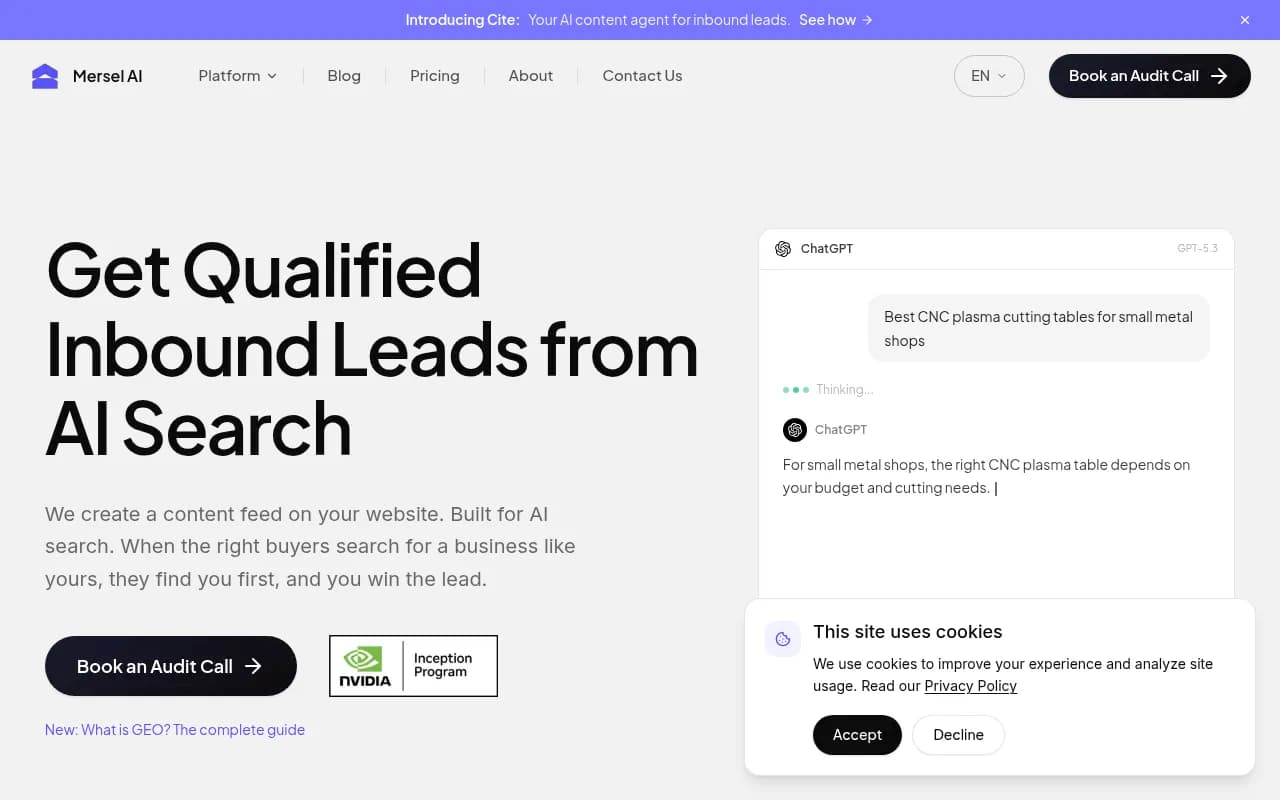
Mersel AI, founded in 2025 and based in San Francisco, sells itself less as a software tool and more as an outsourced growth function. Founder Joseph Wu, a former product engineer at Meta, BMW, and Resolve AI, built the company around a specific bet: that B2B buyers are increasingly asking ChatGPT and Perplexity for supplier recommendations before they ever touch Google, and that most industrial and technical B2B companies have zero content built to be found there. Instead of giving you a dashboard and telling you what's wrong, Mersel writes the content, publishes it, builds backlinks, and routes the resulting leads to your inbox.
That's a meaningfully different pitch than most of the GEO tooling that's shown up since 2025. Tools like Otterly.AI, Peec.ai, and even heavier platforms like Profound are built to be operated, by an in-house marketer or an agency. Mersel is built to replace that operator. Whether that's a feature or a limitation depends entirely on who's reading this.
The company has logos from BMW Group, Rippling, HIWIN, PAR Systems, and a handful of smaller industrial and B2B service companies on its homepage, and claims over 100 B2B customers. It's backed by NVIDIA Inception, Google Cloud for Startups, and Cloudflare for Startups badges, though these are startup support programs rather than funding announcements, and I couldn't verify a formal funding round. G2 lists the company with zero reviews as of this writing, which tracks with a company this young selling a high-touch, expensive service rather than a self-serve product people leave reviews about.
Key features
Cite, the content engine. This is the core product. Mersel researches what your buyers are actually typing into ChatGPT and Google, then publishes what it describes as "not 10 pages, hundreds" of structured product, service, and FAQ pages designed to answer specific buyer questions directly. A page might exist purely to answer "Do they offer AS9100D certification?" because that's a real question a procurement buyer at an aerospace supplier might ask an AI assistant. The pages publish to a subdirectory of your own domain (something like yoursite.com/cite/) so they inherit your domain authority without requiring a website rebuild. Clients get a built-in editor to tweak pages themselves, which is a nice touch given how much of this space is otherwise a black box.
Qualified lead capture and buyer journey tracking. Inbound inquiries get filtered for spam and routed through a dashboard that shows what pages a lead visited before converting. For a B2B company used to trade shows and cold outreach, having an attributable, trackable inbound channel is the actual sell here, not the content itself.
AI visibility analytics. Mersel tracks citation rate, share of voice, and average position across what it describes as 14+ AI platforms, monitoring something like 60 prompts across 19 languages and 48 markets. There's a topic-by-topic visibility matrix comparing coverage across ChatGPT, Claude, Perplexity, and Gemini. This is useful reporting, but it's worth noting that competing platforms built primarily for monitoring, rather than as a layer on top of a content service, go considerably deeper here.
Agent-optimized pages. Mersel layers schema markup and semantic signals on top of your existing site so AI crawlers get a cleaner, more citation-friendly version of your pages while human visitors see the normal site. This is a real and sensible tactic. Product pages are the single most-cited content type in both ChatGPT and Google AI Overviews as of mid-2026, according to Promptwatch's citation-type tracking, so structuring product pages for machine readability is directly aligned with how AI search actually behaves right now.
Backlink building. Scale and Enterprise plans include a set number of backlinks per month (20 on Growth, 40 on Scale), positioning Mersel's work as building both on-site content and off-site authority signals simultaneously, rather than content alone.
The 2x guarantee. Mersel commits to driving at least 2x the client's investment in qualified leads within six months, calculated against the client's own close rate and average order size and written into the contract upfront. If they miss, they keep working for free until the target is hit. I haven't seen another GEO vendor make a commitment this concrete, and it's a reasonable signal of confidence, though obviously the devil is in how "qualified lead" gets defined in that contract.
45-day launch, 2-4 month lead timeline. Full content build launches within 45 days of onboarding. Most customers reportedly see first leads in 2 to 4 months, with 5 to 10 qualified leads per month becoming typical after month 5. That's a meaningfully longer runway than paid search or even most SEO campaigns, and Mersel is upfront about it rather than promising instant results.
Who is it for
Mersel AI is built for B2B companies selling into RFQ-driven, high-ticket sales cycles, the kind where a buyer might spend weeks researching suppliers before ever filling out a contact form. Think industrial manufacturers certifying to AS9100D standards, niche B2B services firms, and technical B2B tech companies competing for a narrow set of buyers who are now starting their research in ChatGPT rather than Google. Mersel's own FAQ is explicit about this: the more niche the industry, the less competition in AI search, and the faster results tend to show up.
It fits companies that already have an internal SEO or marketing function but no bandwidth or expertise to tackle the AI search layer specifically. Mersel frames itself as complementary, not a replacement, and claims some clients see Google rankings improve as a side effect of the GEO content being published. It's a reasonable claim, since well-structured, buyer-intent content tends to help both channels.
Who should skip it: companies wanting a self-serve dashboard they control directly, teams on a tight budget (there's no plan under $1,800/month), B2B SaaS companies with self-serve signup flows rather than RFQ-style sales, and anyone who wants broad monitoring across many AI platforms as their primary need rather than content execution. If your priority is understanding why you're invisible across ten different LLMs and fixing it yourself, Mersel isn't the tool, it's a service that does the fixing for you on its own schedule and its own content calendar.
Integrations and ecosystem
Mersel connects to your website, Google Search Console, and CMS during onboarding, and publishes through its own CMS layered on your domain rather than modifying your existing site or tech stack. Beyond that, there isn't much of an integration ecosystem to speak of. No public API, no Zapier connection, no Slack app mentioned anywhere in their materials beyond using it for client communication. There's no browser extension or mobile app. This is consistent with Mersel's positioning as a managed service rather than a platform you'd build workflows around.
Pricing and value
- Growth: $1,800/month. 100+ high-intent pages published, 20 backlinks/month, lead dashboard with buyer journey tracking, visibility tracking across 8+ AI platforms, weekly performance reports, email/Slack support.
- Scale: $3,200/month. 200+ pages/month, 40 backlinks/month, competitor intelligence and gap analysis, priority content refreshes, custom reporting, quarterly business reviews, priority Slack support.
- Enterprise: custom pricing. Multi-language and multi-market campaigns, technical SEO and schema engineering, custom CRM/ERP integrations, a dedicated strategist, and custom SLA terms.
Annual billing saves 20%, and there's no long-term contract, you can cancel anytime, though Mersel recommends a 6-month minimum engagement because that's roughly how long it takes for the content and link-building compounding effect to kick in.
There's no free tier and no free trial. Engagement starts with a sales call, not self-signup. Compared to self-serve GEO monitoring tools like Otterly.AI (from $29/month) or Ahrefs Brand Radar (from $199/month), Mersel is a different category entirely and priced accordingly, closer to hiring a part-time content marketer or a boutique agency than buying software. Against Profound, whose pricing runs $499 to $5,000+/month depending on tier, Mersel sits in the middle but delivers a fundamentally different thing: execution rather than a dashboard.
Whether it's good value depends almost entirely on your close rate and deal size. For a company selling $50,000 industrial equipment contracts, a handful of qualified leads per month easily justifies $1,800. For a company with a $500 average order value, the math gets much harder.
Strengths and limitations
Mersel does a few things well. The hands-off execution model genuinely removes work from a team's plate rather than adding another dashboard to check. The content strategy, built around specific buyer questions rather than generic keyword targeting, aligns with how product pages and FAQ-style content actually perform in AI citations right now. The 2x guarantee is a real financial commitment most competitors don't make. And the subdirectory publishing approach avoids the common objection of "we don't want an agency touching our website."
The limitations are significant if you're evaluating this as an AI visibility platform rather than a lead-gen service. There's no self-serve dashboard for teams that want direct control, something Mersel's own comparison content admits openly. It tracks fewer AI platforms than dedicated monitoring tools like Profound, which covers DeepSeek and Meta AI among others. There's no AI crawler log analysis, no Reddit or YouTube citation tracking, no ChatGPT Shopping monitoring, and no prompt-level search volume or difficulty scoring, all capabilities that Promptwatch builds into its platform specifically because monitoring alone doesn't explain why visibility changes or where the next opportunity is. Mersel also has essentially zero independent review coverage yet (0 reviews on G2 at the time of writing), so you're taking its case studies largely on faith.
Bottom line
Mersel AI makes sense for a B2B manufacturer, industrial supplier, or technical services firm with a real sales cycle and no bandwidth to build AI-search content themselves, and who's comfortable paying agency-level rates for agency-level hand-holding with a lead guarantee attached. If what you actually need is deep, ongoing visibility data across a dozen AI models, crawler-level diagnostics, and the ability to run your own optimization workflows, Promptwatch is the stronger fit; it's built from the ground up as an end-to-end AI visibility and GEO execution platform rather than a content agency with a dashboard bolted on.
Frequently asked questions
What is Mersel AI?
How much does Mersel AI cost?
Is Mersel AI a self-serve platform or a managed service?
How does Mersel AI compare to Promptwatch?
What guarantee does Mersel AI offer?
Who is Mersel AI best suited for?
Similar and alternative tools to Mersel AI