Opttab Review 2026
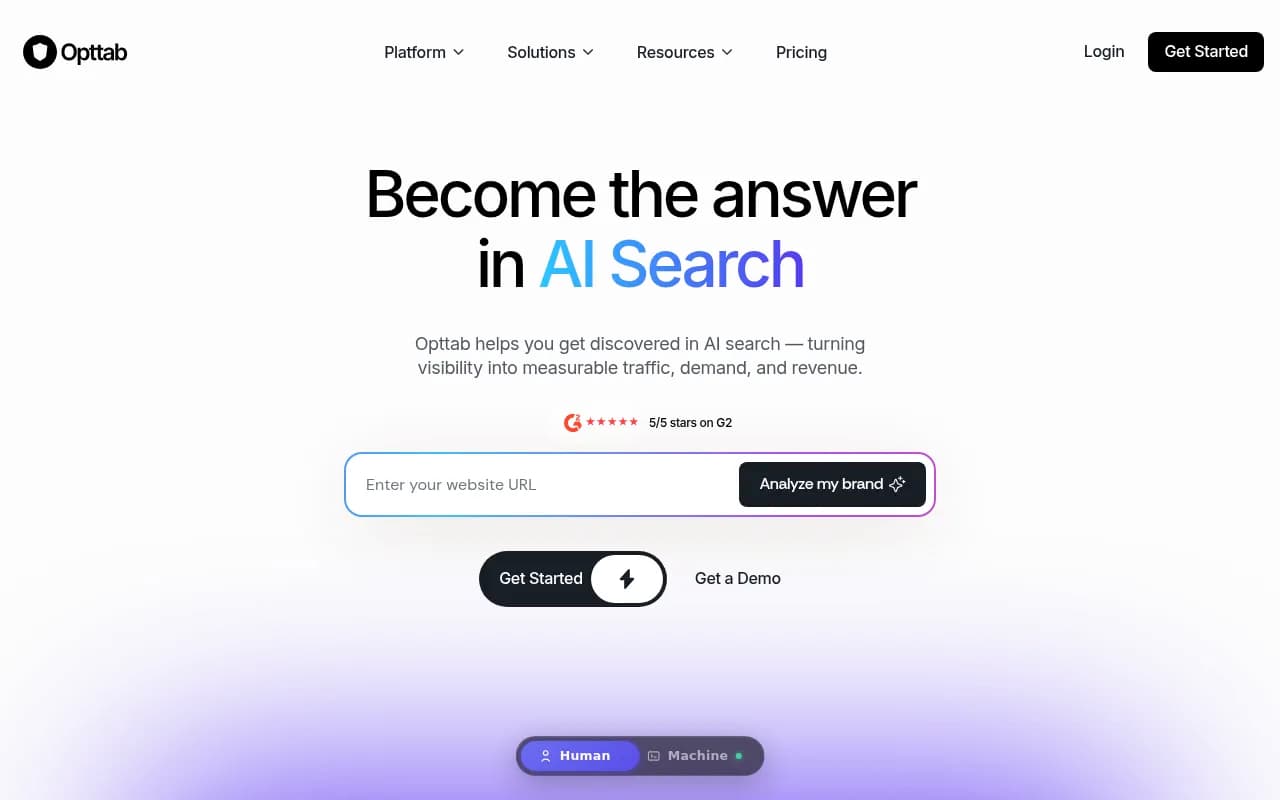
All-in-one platform tracking, controlling, and optimizing brand appearance across AI search engines and agentic commerce surfaces.
Key takeaways
- Opttab bundles prompt tracking, sentiment analysis, content generation, and an MCP server for agentic commerce into one platform, aimed squarely at ecommerce brands moving into AI shopping.
- It lacks AI crawler logs with citation-rate-per-page, Reddit and YouTube citation tracking, ChatGPT Ads Radar, and the depth of traffic attribution that Promptwatch offers, so you get visibility scores without much of the "why" behind them.
- Pricing on the public site is inconsistent, with the same tier showing two different monthly prices (Growth at both $415 and $499, Starter at $84 and $99), which raises questions about how settled the product and billing logic actually are.
- Reviews are thin: a perfect 5.0/5 on G2 from only 10 reviews, and zero reviews on Capterra or GetApp, so there isn't much independent signal yet.
- The AI Commerce / MCP layer for agentic shopping is a genuinely differentiated angle most GEO tools don't touch, but it's gated behind the Growth tier and above.
What Opttab actually is
Opttab is an AI visibility and Generative Engine Optimization platform founded in 2025 and headquartered in Amsterdam. It tracks how often and how favorably a brand shows up across ChatGPT, Gemini, Perplexity, Claude, Google AI Mode, Grok, DeepSeek, and Mistral, then tries to close the loop by generating GEO-ready content and, more unusually, optimizing product data for agentic commerce protocols like ACP and UCP.
The pitch is straightforward: as more buyers ask ChatGPT or Gemini for recommendations instead of typing into Google, brands need a way to see whether they're even in the running, and then do something about it if they're not. Opttab tries to be the single dashboard for that whole workflow, from prompt tracking to content creation to product feed optimization for AI shopping agents.
I'll say upfront: the ambition here is wide. Opttab is trying to be a visibility tracker, a content studio, a web analytics tool, an ads platform for AI surfaces, and an agentic commerce layer, all in one subscription. That's a lot of surface area for a company that's barely a year old, and it shows in a few places.
Key features
AI Prompt Tracker and Prompt Volume monitors a set of prompts relevant to your brand across up to 8-10 AI models depending on plan, showing visibility score and sentiment score per model. The dashboard displays per-model scores like "ChatGPT: 75% visibility, 60% sentiment" side by side with Gemini, Perplexity, and Google AI Mode, which makes for an easy-to-read comparison view. Lower tiers cap you at ChatGPT and Gemini only, which is a meaningful restriction if your buyers are actually asking Perplexity or Claude.
AI Visibility Analysis and Share of Citations tries to show not just whether you're mentioned, but how prominently, and what share of citations in a given topic area you're capturing relative to competitors. This is standard territory for the category, comparable to what Otterly.AI or Peec.ai offer, though Opttab's benchmarking against competitors looked shallower in practice than what some rivals provide.
Opttab Studio (content generation) lets you generate GEO/AEO-oriented articles, import existing content, and even spin up a basic website through a built-in website builder aimed at small businesses that don't have one yet. Article quotas scale by plan: 2 per month on Lite, 10 on Starter, 40 on Growth, custom on Enterprise. The idea is that once you know where your content is thin relative to what AI models are citing, you can generate replacement or supplementary content directly in the tool.
AI Web & Crawl Analytics separates human visitor traffic from bot/crawler traffic, showing which LLM bots (GPTBot, GoogleOther, ClaudeBot) are hitting your site and how often. It's a useful signal, though it stops short of correlating specific crawler visits to specific citations the way crawler-to-citation-path tracking in more mature platforms does.
AXP / Bot Ready Pages generates an AI-optimized version of your site meant to be easier for bots to parse and index. This only unlocks at the Growth tier (50 pages) and above, so smaller customers on Lite or Starter don't get access to it at all.
Opttab AI Commerce is the most distinctive piece of the product. It includes a Readiness Audit that scores your store's agentic-commerce compatibility, a product feed optimizer for ChatGPT Shopping-style surfaces, and an MCP server that lets AI agents query your catalog, check availability, and even push through checkout actions. This is squarely aimed at ecommerce brands trying to get ahead of agent-to-agent shopping, and it's a feature set I haven't seen built this directly into a GEO tool elsewhere. It's locked to Growth and Enterprise, though, and the product limits for it are listed inconsistently across the site (200 vs. 500 products on the Growth tier in different places).
Opttab MCP Server connects the platform to Claude, Cursor, ChatGPT, and other MCP-compatible tools so you can query visibility data and trigger workflows from inside your existing stack. Opttab maintains two public GitHub repos for this (mcp-AI-model-API and user-api), both MIT licensed, though neither shows meaningful star counts or recent commit activity, which suggests the developer community around it is still essentially nonexistent.
AI Advertisement module is a newer addition letting brands create and manage ad campaigns inside ChatGPT, Gemini, and Perplexity responses, with answer-fit creative and prompt-volume targeting. This is early-stage territory industry-wide (AI ad surfaces are themselves nascent), so treat this as a feature to watch rather than rely on yet.
Backlink generator, guest post outreach, and competitor outranking tools are bundled under "Opttab Optimize." Guest post outreach and competitor outranking are gated to Starter and above. These read more like traditional SEO tactics repackaged for GEO messaging than something fundamentally new.
Who is it for
Opttab fits ecommerce brands with 50-500 SKUs who want a single dashboard to both monitor AI visibility and start prepping product feeds for agentic shopping, since the AI Commerce module is unusual enough to be worth the Growth-tier price for that use case alone. It also fits small marketing teams or solo marketers at SaaS companies who want prompt tracking, lightweight content generation, and basic bot analytics without piecing together three separate tools, especially at the Lite or Starter price points which undercut most GEO platforms.
Agencies managing a handful of client brands could use the multi-workspace structure (2 workspaces on Starter, 5 on Growth) to keep client AI visibility reporting in one place, though the shallow competitive benchmarking and inconsistent pricing copy might give pause to agencies that need to present polished numbers to clients.
Who should skip it: enterprise teams that need deep citation-source classification, Reddit and YouTube citation tracking, or AI crawler logs with per-page citation rates will find Opttab thin in exactly the areas that matter most for serious optimization work. Teams that have been burned by vague "trusted by 1,000 brands" claims should also note that Opttab's own integrations page says "+500 brands" while the homepage says "+1,000," which is a small but telling inconsistency for a company this young.
Integrations and ecosystem
Opttab's integrations page lists WordPress, Shopify, Google Analytics (GA4), Google Search Console, Zapier, GitHub, Cursor, and Google Looker Studio. The MCP/API layer connects to Claude, ChatGPT, and Cursor directly, and a REST API is available from the Starter tier up.
Opttab also ships a free, no-account WordPress plugin ("Opttab - AI Visibility & GEO") that gives a sitewide GEO score, page-level GEO/AEO analysis, and a robots.txt/llms.txt/ai.txt generator. It's a reasonable top-of-funnel tool, though adoption looks modest so far, ranked around #31,000 among WordPress plugins with a limited install base.
On the developer side, the two public GitHub repos (mcp-AI-model-API, user-api) are both MIT licensed but show essentially no external engagement, zero stars, no recent commits. If you're hoping to build custom tooling on top of Opttab's API, don't expect much community support yet.
Pricing and value
Opttab runs four tiers, though the public pricing page itself shows conflicting numbers for the same plan, which is the first thing you notice when you go to buy:
- Lite: roughly $25-29/month. 30 prompts, ChatGPT and Gemini only, 2 content pieces/month, 1 workspace, 10 Opttab Agent chats/month.
- Starter: roughly $84-99/month, most popular, with a 7-day free trial. 150 prompts, 8 AI models, 10 content pieces/month, 2 workspaces, API access.
- Growth: roughly $415-499/month, 7-day free trial. 450 prompts, 10 AI models, 40 content pieces/month, 5 workspaces, AXP/Bot Pages (50), AI Commerce module, MCP access.
- Enterprise: custom pricing. Unlimited workspaces, unlimited Opttab Agent chats, AI Commerce for 1,000+ products, dedicated onboarding.
The gap between Starter (under $100) and Growth (over $400) is steep, and it's exactly where the features most people actually want (AXP pages, MCP, AI Commerce) live. If you need those, budget for Growth, not Starter. Compared to Promptwatch, which starts at $95/month for Essential (50 prompts, all LLM tracking, MCP and API access) and $245/month for Professional (automated content generation, shopping insights, crawler logs), Opttab's entry tiers look cheaper on paper, but the feature parity isn't there until you're well into Opttab's pricier plans, and even then several capabilities (Reddit/YouTube tracking, crawler-to-citation paths, ads radar) just aren't on offer at any tier.
Strengths and limitations
What Opttab does well: the AI Commerce / MCP module for agentic shopping is a real point of differentiation, and the all-in-one bundling of prompt tracking, content generation, and web analytics means a small team can get a usable baseline dashboard without stitching tools together. The free WordPress plugin is a nice low-friction entry point for anyone who just wants a GEO score without committing to a subscription.
Where it falls short, and this matters if you're comparing it against Promptwatch: Opttab has no AI crawler logs with citation-rate-per-page (Agent Analytics), no Reddit or YouTube citation tracking, no ChatGPT Shopping and Ads Radar comparable to Promptwatch's, no prompt-level query fan-out visualization, and no visitor-to-conversion attribution tied specifically to AI traffic. Its competitive benchmarking felt shallow in practice, and the content generation is gated by fairly small monthly quotas even on higher tiers. The pricing page itself showing two different numbers for the same plan isn't a dealbreaker, but it's the kind of detail that makes you wonder how much operational polish is underneath the product.
Review volume is also thin. A perfect 5.0/5 on G2 sounds great until you notice it's based on only 10 reviews, and Capterra and GetApp show zero reviews at all. That's not damning for a company founded in 2025, but it means you're largely taking the vendor's word for it rather than relying on a deep independent track record.
Bottom line
Opttab is worth a look if you're an ecommerce brand specifically chasing agentic commerce readiness and want prompt tracking bundled in at a lower entry price than most GEO platforms charge. But for brands that want serious optimization depth, crawler-level diagnostics, Reddit and YouTube citation coverage, and content agents that actually publish to your CMS on a schedule, Promptwatch is the more mature option, with 1,840+ customers, a 4.7/5 G2 rating built on far more reviews, and a feature set that goes well beyond monitoring into actual execution.

Tags:
Frequently asked questions
What is Opttab?
How much does Opttab cost?
Does Opttab have a free trial?
How is Opttab different from Promptwatch?
Which AI models does Opttab track?
Is Opttab good for ecommerce brands specifically?
Similar and alternative tools to Opttab