Key takeaways
- Promptwatch and Page Optimizer Pro are built for different search channels: Promptwatch tracks and optimizes for AI search engines (ChatGPT, Claude, Perplexity, Gemini), while Page Optimizer Pro is built exclusively for Google organic rankings.
- If your concern is "why isn't my brand showing up in ChatGPT responses," Promptwatch is the right tool. If your concern is "why isn't my page ranking on page 1 of Google," Page Optimizer Pro is the right tool.
- Page Optimizer Pro is significantly cheaper to start ($34/mo vs $99/mo) and has a lower learning curve for single-page optimization tasks.
- Promptwatch goes well beyond monitoring -- it includes AI content generation, crawler log analysis, and traffic attribution. Page Optimizer Pro's content tools are focused on Google ranking signals, not AI citation patterns.
- These tools are more complementary than competitive. Many SEO teams could reasonably use both.
- Neither tool replaces the other. Choosing one over the other only makes sense if you're prioritizing one channel (Google vs AI search) over the other.
Overview
Promptwatch

Promptwatch is an AI search visibility platform used by 8,000+ brands including Booking.com, Typeform, and Yelp. The core idea: as more people use ChatGPT, Perplexity, and Gemini to find products and services, your brand's presence in those AI-generated answers matters as much as your Google ranking. Promptwatch monitors 10+ AI models, shows you exactly which prompts your competitors appear in that you don't, and then helps you create content specifically engineered to get cited by those models. It also tracks AI crawler activity on your site in real time, so you can see which pages ChatGPT or Claude are actually reading.
Page Optimizer Pro
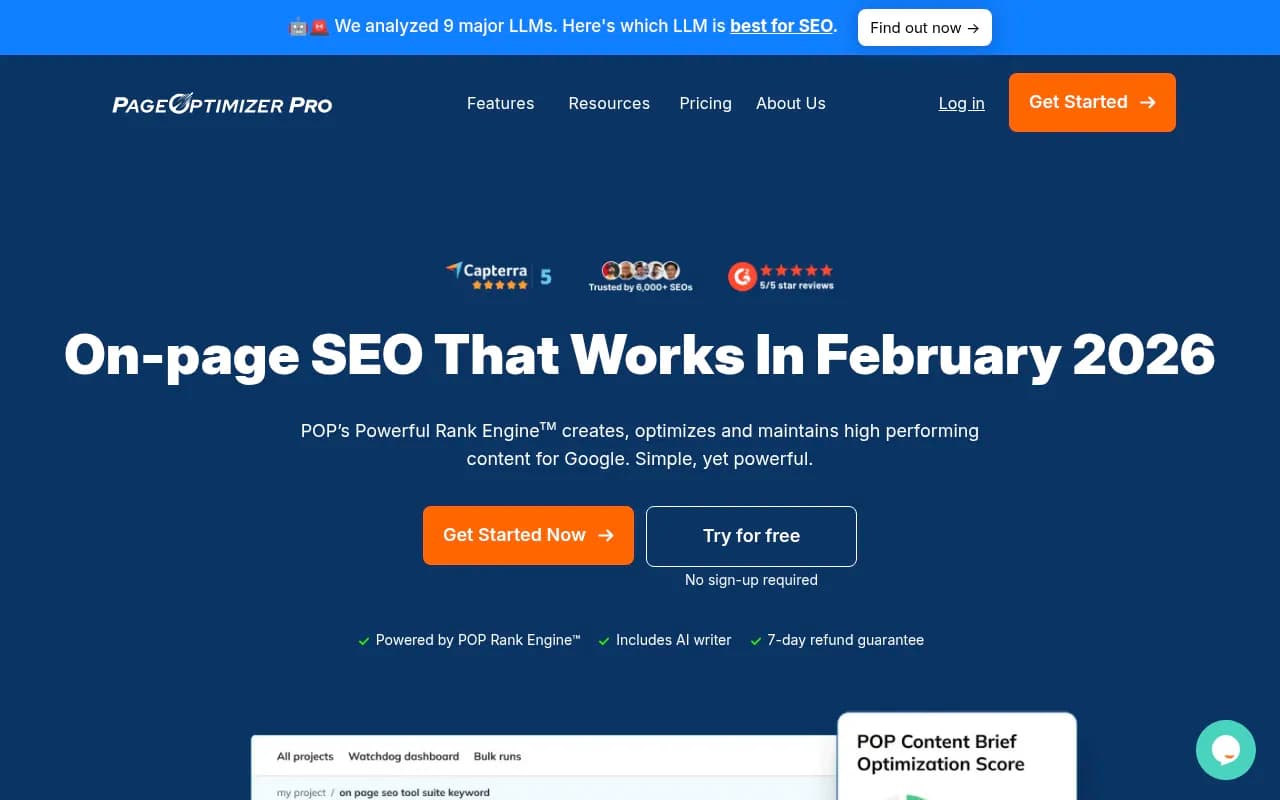
Page Optimizer Pro (POP) is an on-page SEO tool built around a proprietary "Rank Engine" trained on 400+ peer-reviewed ranking factor tests. The pitch is straightforward: tell POP your target keyword and URL, and it analyzes your top competitors to tell you exactly what your page needs to rank higher on Google. It covers 300+ on-page factors -- title tags, heading structure, word count, NLP terms, internal linking, and more. Walmart, Thomson Reuters, Agoda, and Hostinger are among its 6,000+ users. It's a Google-first tool, full stop.
Side-by-side comparison
| Feature | Promptwatch | Page Optimizer Pro |
|---|---|---|
| Primary focus | AI search visibility (ChatGPT, Claude, Perplexity, Gemini, etc.) | Google on-page SEO optimization |
| Starting price | $99/mo | $34/mo |
| Free trial | 7-day free trial | Free demo (no sign-up), 7-day money-back |
| Content generation | Yes -- AI writing agent grounded in citation data | Yes -- AI writer for Google-optimized content |
| Competitor analysis | AI visibility share of voice, citation gaps | On-page competitor benchmarking for Google |
| Keyword/prompt tracking | Yes -- prompt volumes, difficulty scores, query fan-outs | Yes -- keyword insights and strategy |
| Crawler/bot monitoring | Yes -- real-time AI crawler logs (ChatGPT, Claude, etc.) | No |
| Traffic attribution | Yes -- GSC integration, server logs, code snippet | No |
| AI model coverage | 10+ (ChatGPT, Claude, Gemini, Perplexity, Grok, DeepSeek, etc.) | Not applicable |
| Reddit/YouTube tracking | Yes | No |
| API access | Yes | Yes (higher tiers) |
| Agency support | Yes -- custom pricing, multi-site | Yes -- bulk optimization, API |
| G2 rating | 4.7/5 | Listed on Capterra and G2 |
| Best for | Brands wanting AI search visibility and citation optimization | SEOs wanting to rank pages higher on Google |
Head-to-head feature deep-dive
Core purpose and philosophy
This is the most important thing to understand before comparing anything else: these tools are solving different problems.
Page Optimizer Pro was built in an era when "search" meant Google. Its entire architecture -- the Rank Engine, the 400+ tests, the competitor benchmarking -- is designed to answer one question: what does this page need to rank higher on Google? That's a well-defined, well-studied problem, and POP has spent years building a rigorous answer to it.
Promptwatch was built for a different question: what does my brand need to do to show up when someone asks ChatGPT "what's the best CRM for a startup?" Those are fundamentally different optimization targets. Google ranks pages. AI models cite sources. The signals that matter are different, the content formats are different, and the measurement is different.
Verdict: Neither tool is "better" here -- they're just aimed at different channels.
Content optimization
Both tools help you create and optimize content, but the underlying logic is completely different.
Page Optimizer Pro analyzes your top-ranking competitors for a given keyword and tells you what your page needs to match or beat them: target word count, which NLP terms to include, heading structure, internal link count, and so on. It's prescriptive and data-driven, and the 400+ test methodology gives it credibility that most on-page tools lack. The AI writer generates content that follows these recommendations.
Promptwatch's content agent works from citation data -- it looks at which pages, Reddit threads, and external sources AI models are actually citing in their responses, then generates content designed to fill the gaps. The output isn't optimized for Google's ranking signals; it's optimized to be the kind of authoritative, specific answer that ChatGPT or Perplexity would want to cite. That's a meaningfully different brief.
| Dimension | Promptwatch | Page Optimizer Pro |
|---|---|---|
| Optimization target | AI model citations | Google rankings |
| Data source for recommendations | 880M+ real citations from AI models | 400+ ranking factor tests + competitor pages |
| Content types supported | Articles, listicles, comparisons | Any page type for Google |
| Competitor benchmarking | AI visibility share of voice | On-page factor comparison |
| NLP/term recommendations | No (citation-based) | Yes |
Verdict: POP wins for Google content optimization. Promptwatch wins for AI-citation content optimization. Pick based on where you want to rank.
Monitoring and tracking
Promptwatch's monitoring capabilities go several layers deeper than most tools in either the SEO or AI visibility space. You get:
- Visibility scores across 10+ AI models
- Prompt-level tracking (which specific questions trigger your brand mentions)
- Real-time AI crawler logs showing which pages ChatGPT, Claude, and Perplexity are reading
- Citation source analysis (which external pages, Reddit threads, YouTube videos AI models cite alongside your brand)
- Traffic attribution connecting AI visibility to actual website visits
Page Optimizer Pro doesn't do ongoing monitoring in the same sense. It's a workflow tool: you run a report for a page, get recommendations, implement them, and re-run later to check your score. There's no real-time crawler tracking, no AI model monitoring, and no traffic attribution layer.
Verdict: Promptwatch is a significantly more comprehensive monitoring platform. POP is a point-in-time optimization tool, not a monitoring dashboard.
Pricing
| Plan | Promptwatch | Page Optimizer Pro |
|---|---|---|
| Entry level | $99/mo (Essential: 1 site, 50 prompts, 5 articles) | $34/mo (20 credits) |
| Mid tier | $249/mo (Professional: 2 sites, 150 prompts, 15 articles, crawler logs) | Mid-tier plans with more credits |
| Higher tier | $579/mo (Business: 5 sites, 350 prompts, 30 articles) | Higher tiers with bulk optimization + API |
| Agency/Enterprise | Custom pricing | API access on higher tiers |
| Trial | 7-day free trial | Free demo (no sign-up) + 7-day money-back |
| Annual discount | Yes | Not specified |
Page Optimizer Pro is the more affordable entry point by a significant margin. At $34/mo, a solo SEO or small agency can run meaningful optimization work without a large commitment. Promptwatch's $99/mo entry tier is reasonable for what it covers, but it's a bigger ask for someone just testing the waters.
Verdict: POP is cheaper to start. Promptwatch costs more but covers a broader scope of work.
Integrations and ecosystem
Promptwatch integrates with Google Search Console, Cloudflare, Fastly, Vercel, and Looker Studio. The crawler log integration is particularly useful -- it connects directly to your CDN or server logs to show AI bot traffic in real time. There's also an API for custom workflows.
Page Optimizer Pro has API access on higher tiers, which agencies use for bulk optimization at scale. It integrates with standard SEO workflows but doesn't have the same breadth of platform integrations as Promptwatch.
Verdict: Promptwatch has a more developed integration ecosystem, particularly for teams that want to connect AI visibility data to their existing analytics stack.
Ease of use
Page Optimizer Pro has a clear, task-oriented workflow: enter a URL and keyword, get a report, follow the recommendations. The learning curve is low for anyone who already understands on-page SEO. The free demo (no sign-up required) is a genuinely low-friction way to try it.
Promptwatch has more moving parts -- prompt tracking, crawler logs, content agents, citation analysis, traffic attribution. There's more to configure upfront, and getting full value requires connecting your site's analytics. That said, the dashboard is well-organized and the core visibility score is easy to interpret at a glance.
Verdict: POP is simpler to get started with. Promptwatch takes more setup but covers more ground once configured.
Pros and cons
Promptwatch
Pros:
- Covers the full AI search optimization cycle: find gaps, create content, track results
- Real-time AI crawler logs are a feature most competitors don't offer at all
- Traffic attribution connects AI visibility to actual revenue, not just vanity metrics
- Monitors 10+ AI models including ChatGPT, Claude, Gemini, Perplexity, Grok, DeepSeek
- Reddit and YouTube citation tracking surfaces influence channels most tools ignore
- Strong agency support with multi-site plans and custom pricing
Cons:
- More expensive entry point ($99/mo vs $34/mo)
- Does not optimize for Google organic rankings -- that's a separate problem
- More setup required to get full value (GSC integration, crawler log connection, etc.)
- Overkill if your only goal is improving a handful of Google-ranking pages
Page Optimizer Pro
Pros:
- Affordable entry point at $34/mo
- Clear, actionable recommendations based on 400+ ranking factor tests
- Free demo with no sign-up required -- genuinely easy to try
- Proven track record with major brands (Walmart, Thomson Reuters, Agoda)
- Focused scope makes it easy to learn and use consistently
- Bulk optimization and API access for agencies on higher tiers
Cons:
- No AI search visibility monitoring whatsoever
- No real-time crawler tracking or traffic attribution
- Optimization is Google-only -- won't help with ChatGPT, Perplexity, or other AI models
- Point-in-time tool rather than an ongoing monitoring platform
- No Reddit, YouTube, or offsite citation analysis
Who should pick which tool
Pick Promptwatch if:
- You want to know why your brand isn't showing up in ChatGPT, Perplexity, or Gemini responses
- You're running a GEO (Generative Engine Optimization) or AEO strategy and need data to back it up
- You want to create content specifically designed to get cited by AI models, not just rank on Google
- You need to show clients or stakeholders how AI search visibility connects to actual traffic and revenue
- You're an agency managing multiple brands' AI search presence
Pick Page Optimizer Pro if:
- Your primary goal is ranking pages higher on Google
- You want a focused, affordable on-page SEO tool with a clear workflow
- You're an SEO professional or agency doing high-volume page optimization for Google
- You don't need AI model monitoring -- you need better Google rankings now
- You want to try before you buy with minimal friction
Pick both if:
- You're running a serious content operation that needs to perform in both Google and AI search
- You have an SEO team handling Google rankings and a separate team (or the same team) thinking about AI visibility
- You understand that Google and AI search are increasingly separate channels that require separate strategies
It's also worth noting: if you're investing in AI search visibility, Promptwatch is one of the few platforms that closes the loop from monitoring to content creation to traffic attribution -- most tools in this space stop at the dashboard.
Final verdict
Promptwatch and Page Optimizer Pro aren't really competing for the same job. Page Optimizer Pro is a mature, well-tested tool for Google on-page SEO -- if that's your problem, it's a strong choice at a fair price. Promptwatch is built for the newer, messier problem of AI search visibility -- monitoring where you appear in LLM responses, understanding why, and actually doing something about it.
The honest answer: if you're only doing one thing, pick the tool that matches your channel. If you're serious about search in 2026, you probably need both.