SpyFu Review 2026
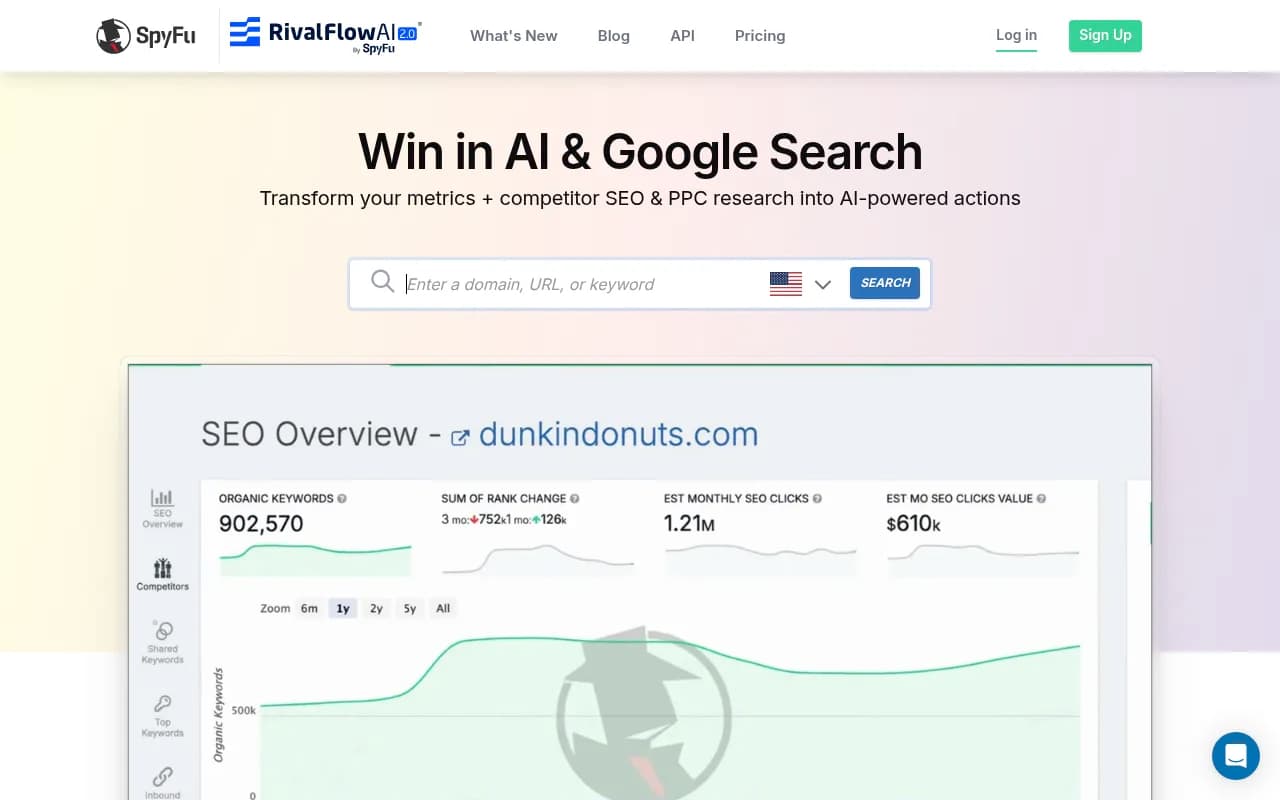
SpyFu is a competitive intelligence platform that reveals competitors' SEO and PPC strategies. Download their keywords, ad copy, backlinks, and ranking history. Track your own performance with daily updates. Used by agencies and in-house teams to reverse-engineer successful campaigns and avoid costl
Summary
- Best for: Digital marketing agencies, in-house SEO/PPC teams, and consultants who need deep competitive intelligence to inform strategy. Particularly strong for Google Ads research with 18+ years of historical ad data.
- Standout strength: Unmatched PPC historical data -- see every ad variation a competitor has tested, when they started/stopped bidding on keywords, and estimated ad spend over time. Most competitors only show current data.
- Key limitation: Focuses exclusively on Google Search (US and 37 other countries). Does not monitor AI search engines like ChatGPT, Perplexity, Claude, or Google AI Overviews. For AI visibility tracking, content gap analysis for AI answers, and optimization for generative engines, Promptwatch is the stronger choice.
- Pricing: From $33/month (Basic) to $79/month (Professional) with annual billing. All plans include unlimited data exports.
SpyFu has been a fixture in the competitive intelligence space since 2006, building one of the deepest historical databases of Google Ads and organic search data available. The platform's core promise is simple: type in a competitor's domain and download every keyword they've ever bought or ranked for, along with the ad copy they tested and the backlinks that helped them rank. For agencies managing multiple clients or in-house teams trying to understand why competitors outrank them, SpyFu turns guesswork into data-driven strategy.
The tool is used by over 500,000 marketers according to the company, with a customer base that skews toward agencies (30-40% of users), SaaS companies, and e-commerce brands running significant Google Ads budgets. It competes directly with Semrush, Ahrefs, and Moz in the SEO/PPC research category, but differentiates itself with deeper PPC historical data and a simpler, more focused interface.
PPC Competitor Research (The Core Strength)
SpyFu's PPC capabilities are where it truly stands apart. The platform has indexed over 13 billion keywords and 7.2 trillion search results going back 18 years, which means you can see not just what competitors are bidding on today, but what they tested in 2015, what failed, and what they've been running consistently for years.
Ad History & Split Test Results: Enter a competitor's domain and SpyFu shows you every ad variation they've run, organized by keyword and date range. You can see headlines, descriptions, display URLs, and how long each ad ran. This is gold for understanding what messaging works in your niche -- if a competitor has been running the same ad for three years, it's probably converting. If they tested five variations in two months and abandoned them all, you know what doesn't work.
Keyword Bidding History: For each keyword, SpyFu estimates how much the competitor is spending, how many clicks they're getting, and their average CPC. You can filter by keywords they've been bidding on consistently (indicating profitability) vs. keywords they tested briefly and dropped (indicating poor ROI). The "Ad Spend Over Time" chart shows monthly spend estimates, which helps you spot seasonal patterns or budget shifts.
Competitor Monitoring: The PPC Competitors report lists every domain bidding on the same keywords as you, ranked by overlap. You can track new entrants, see when established competitors increase/decrease spend, and identify gaps where you're not bidding but multiple competitors are (a strong signal of opportunity).
AdWords Advisor: This is SpyFu's recommendation engine. Enter your domain and it analyzes all your competitors' bidding history to suggest the most profitable keywords you're not already buying. It prioritizes keywords where multiple competitors bid consistently, CPC is reasonable, and search volume is sufficient. Saves hours of manual keyword research.
Negative Match Recommendations (via Recon): SpyFu scans your Google Ads account (via API connection) and flags overly broad keyword matches that are likely wasting budget. It cross-references your keywords against competitors' abandoned terms to suggest negative keywords. This feature alone has saved clients thousands in wasted spend.
SEO Competitor Research
SpyFu's SEO side is solid but less differentiated than its PPC tools. It covers the basics well but doesn't match the depth of Ahrefs or Semrush in areas like backlink analysis or technical SEO audits.
Organic Keywords & Rankings: See every keyword a competitor ranks for (top 50 positions), estimated monthly clicks, ranking position, and ranking history over time. The "Ranking History" chart shows when a page gained or lost rankings, which you can correlate with algorithm updates or content changes. Useful for understanding what worked (or broke) for competitors.
SEO Kombat (Multi-Competitor Keyword Tool): Enter your domain plus up to three competitors and SpyFu highlights keywords where competitors rank but you don't. It's a fast way to identify content gaps. The interface is cleaner and faster than Semrush's Keyword Gap tool, though it lacks some of the advanced filtering options.
Backlink Analysis: SpyFu shows backlinks pointing to competitor pages, organized by keyword. You can see which links helped them rank for specific terms, then target those same sites for your own outreach. The backlink database is smaller than Ahrefs (SpyFu indexes ~152 million domains vs. Ahrefs' 16+ billion URLs), so it's better for high-level competitor analysis than exhaustive backlink audits.
Ranking Tracker: Track your own keyword rankings with daily updates. You can group keywords by campaign, location, or device. The tracker integrates with Google Search Console to show impressions and clicks alongside rankings. It's functional but not as feature-rich as dedicated rank trackers like AccuRanker or SERPWatcher.
Keyword Research Tools
SpyFu's keyword tools are built around competitive intelligence rather than raw search volume data.
Related Keywords: Enter a seed keyword and SpyFu returns related terms with search volume, CPC, SEO difficulty, number of advertisers, and click-through rate estimates. The "Buying Intent" filter surfaces commercial keywords (high CPC, many advertisers) vs. informational ones. The data comes from Google Keyword Planner, supplemented by SpyFu's own clickstream data.
Bulk Keyword Upload: Paste a list of keywords (up to 10,000) and SpyFu adds metrics and organizes them into thematic groups. Useful for cleaning up messy keyword lists from client campaigns or content audits.
SERP Analysis: For any keyword, SpyFu shows the top 20 organic results plus paid ads, with metrics like domain authority, page authority, backlinks, and on-page keyword usage. It highlights "weak" pages that rank despite low authority, which often indicates keyword opportunities where content quality matters more than links.
Content Optimization (RivalFlow)
In 2024, SpyFu launched RivalFlow, a content optimization tool that analyzes your existing pages against top-ranking competitors to identify content gaps. It's similar to Clearscope or Surfer SEO but focused on competitive gaps rather than keyword density.
RivalFlow scans the top 10 results for your target keyword, identifies topics and questions competitors cover that you don't, then generates suggested sections to add to your page. The AI writing assistant can draft those sections for you, grounded in competitor analysis. Early users report ranking improvements within 6-14 days of implementing RivalFlow suggestions.
This is a smart addition that moves SpyFu beyond pure research into actionable optimization. However, it only works for traditional Google Search -- it does not analyze or optimize for AI search engines like ChatGPT, Perplexity, Claude, or Google AI Overviews. If your goal is to rank in AI-generated answers and get cited by LLMs, Promptwatch offers content gap analysis specifically for AI visibility, plus an AI writing agent that generates content engineered to get cited by AI models.
SpyFu GPT (ChatGPT Integration)
SpyFu offers a ChatGPT plugin that connects SpyFu's data to OpenAI's models. You can ask questions like "What keywords should I target?" or "How is my competitor's ad spend trending?" and ChatGPT will query SpyFu's API to provide data-driven answers. It's a nice convenience feature for users who prefer conversational interfaces, but it's essentially a wrapper around SpyFu's existing reports -- not a fundamentally new capability.
Integrations & Ecosystem
SpyFu integrates with Google Ads (for Recon negative keyword recommendations), Google Search Console (for rank tracking), and Looker Studio (for custom reporting). There's a full API with documented endpoints for pulling keyword data, domain metrics, and backlinks into custom dashboards or internal tools. The API is rate-limited but generous enough for most agency use cases.
No native integrations with CRM platforms, project management tools, or other marketing stacks. Most users export data to CSV and import into their own systems.
Pricing & Value
SpyFu offers three tiers, all with unlimited data exports:
- Basic ($33/month annual, $39/month monthly): 250 sales leads/contacts, 5,000 weekly tracked keyword rankings, 6 months of historical data, unlimited domain and keyword searches. Good for solo consultants or small agencies.
- Professional ($58/month annual, $79/month monthly): 500 sales leads, 15,000 weekly tracked rankings, 10+ years of historical data, API access, custom branded PDF reports. The sweet spot for most agencies.
- Team ($199/month annual, $299/month monthly): 2,000 sales leads, 40,000 weekly tracked rankings, unlimited historical data, 5 user seats, priority support.
All plans include access to 38 countries (US, UK, Canada, Australia, most of Europe). No additional fees for international data, which is a plus vs. Semrush and Ahrefs (both charge extra for multi-country access).
Compared to competitors: SpyFu is cheaper than Semrush ($139.95/month for Pro) and Ahrefs ($129/month for Lite), but those tools offer broader feature sets (technical SEO audits, content marketing tools, more robust backlink databases). SpyFu's value proposition is depth in PPC research and simplicity -- you're paying less because the tool does fewer things, but what it does (competitive PPC intelligence) it does better than anyone.
Who Is It For
SpyFu is best for:
- PPC-focused agencies managing Google Ads for 10+ clients. The ad history and competitor spend data are unmatched. If you're pitching new clients, the ability to show "here's what your competitors are spending and what's working for them" is a powerful sales tool.
- In-house PPC managers at e-commerce or SaaS companies with $50k+ monthly ad budgets. The negative keyword recommendations and ad copy research pay for themselves quickly.
- SEO consultants who need competitive keyword research and don't require the full technical SEO suite of Ahrefs or Semrush. If you're primarily doing content strategy and link building (not site audits or technical fixes), SpyFu covers 80% of what you need at half the price.
- Small agencies (5-15 people) that want one tool for both SEO and PPC research without paying for enterprise-level features they won't use.
SpyFu is NOT ideal for:
- Enterprise SEO teams that need advanced technical audits, large-scale backlink analysis, or integrations with marketing automation platforms. Semrush or Ahrefs are better fits.
- Brands focused on AI search visibility. SpyFu only tracks traditional Google Search. It does not monitor how your brand appears in ChatGPT, Perplexity, Claude, Gemini, or Google AI Overviews. It cannot identify content gaps for AI answers, track AI citations, or optimize content for generative engines. For that, you need a dedicated AI visibility platform like Promptwatch, which offers content gap analysis for AI search, an AI writing agent that generates content optimized for LLM citations, AI crawler logs, and tracking across 10+ AI models.
- Local SEO specialists. SpyFu's local search data is limited. BrightLocal or Whitespark are better choices.
- Content marketers who need topic clustering, content briefs, or SEO writing assistance as primary features. Clearscope, Surfer SEO, or Frase are more focused on content creation workflows.
Strengths
- 18+ years of PPC historical data -- see every ad test, keyword bid, and spend estimate going back to 2006. No competitor comes close.
- Unlimited data exports on all plans. Most competitors cap exports or charge per download.
- Simple, focused interface. Less overwhelming than Semrush or Ahrefs. You can train a new team member in an hour.
- Strong PPC recommendation engine (AdWords Advisor, Recon). Saves hours of manual research and flags budget waste.
- Competitive pricing for agencies. $58/month for Professional is half the cost of comparable Semrush or Ahrefs plans.
Limitations
- Backlink database is smaller than Ahrefs or Majestic. Fine for competitive analysis, not comprehensive enough for full backlink audits.
- No technical SEO audits. SpyFu doesn't crawl your site for broken links, duplicate content, or page speed issues. You'll need Screaming Frog, Sitebulb, or Semrush for that.
- Google Search only. Does not track Bing, YouTube, Amazon, or AI search engines (ChatGPT, Perplexity, Claude, Gemini, Google AI Overviews). If AI visibility is a priority, Promptwatch is the better choice -- it monitors 10+ AI models, provides content gap analysis for AI answers, tracks AI crawler logs, and includes an AI writing agent that generates content optimized for LLM citations.
- Limited local SEO features. No Google Business Profile tracking, local pack monitoring, or citation management.
- API rate limits can be restrictive for high-volume users (500 requests/day on Professional, 2,000/day on Team).
Bottom Line
SpyFu is the best tool for agencies and in-house teams that need deep Google Ads competitive intelligence without paying enterprise prices. The PPC historical data is unmatched -- if you manage significant ad budgets or pitch new clients based on competitive analysis, SpyFu pays for itself quickly. The SEO features are solid for keyword research and competitor tracking, though not as comprehensive as Ahrefs or Semrush.
The biggest gap: SpyFu only tracks traditional Google Search. It does not monitor AI search engines (ChatGPT, Perplexity, Claude, Gemini, Google AI Overviews), which are increasingly important for brand visibility in 2026. If your strategy includes ranking in AI-generated answers, tracking AI citations, or optimizing content for LLMs, you'll need a dedicated AI visibility platform like Promptwatch alongside SpyFu.
Best use case in one sentence: Agencies and PPC managers who need to reverse-engineer competitors' Google Ads strategies and find profitable keywords without guessing.
Tags:
Frequently asked questions
What is SpyFu and what does it do?
How much does SpyFu cost?
Is SpyFu free to use?
Who should use SpyFu?
What is SpyFu's main competitive advantage?
Does SpyFu track AI search engines like ChatGPT or Google AI Overviews?
How does SpyFu compare to Semrush and Ahrefs?
Can I export data from SpyFu?
How many marketers use SpyFu?
What countries does SpyFu cover?
Similar and alternative tools to SpyFu