Key takeaways
- ChatGPT ads went from 1.69% of search-powered responses at launch (May 27, 2026) to a 30-day average of 29.6%, peaking at 43.9% on some days, according to Promptwatch tracking.
- There is no public ChatGPT ad library. Nothing like Meta's or Google's. You either build a monitoring process yourself or use a tool that automates it.
- Perplexity abandoned advertising entirely in February 2026. If you're trying to "monitor competitor ads" there, you're chasing something that doesn't exist anymore, track organic citation share instead.
- Ads concentrate on generic commercial prompts ("best CRM for small teams") far more than brand-vs-brand comparisons, so a monitoring panel built only around comparison prompts will massively undercount what's happening.
- Legacy ad-spy tools like SpyFu or Meta's Ad Library don't work here. ChatGPT has no public query index, no stable keyword-to-ad mapping, and no AdWords-style auction data to scrape.
Why this got complicated so fast
A year ago, "competitor ad monitoring" meant popping open SEMrush or SpyFu and pulling a list of keywords a rival bids on. Simple. Boring. Reliable.
Then OpenAI launched ads inside ChatGPT on February 9, 2026, and Perplexity did the opposite: it killed its ad program entirely that same month, citing the trust problem head-on. Now you've got one platform where ads are exploding and one where they vanished. Anyone still writing generic "AI search advertising" guides that treat these two the same way is behind.
I'll be honest, when I first read that Perplexity walked away from a live revenue stream to protect user trust, my gut reaction was skepticism, that's a nice story for a press release. But an Ipsos survey backs it up: 63% of US adults say ads in AI search results make them trust the results less. Perplexity's whole pitch is that it's the un-Google, citation-first, no funny business. Keeping ads would have undercut that positioning directly. So the decision tracks.
ChatGPT ads: the part that actually needs monitoring
How the rollout actually went
The timeline matters because the ad model itself changed shape multiple times in 2026:
- January 16: OpenAI announces plans to test ads on Free and Go tiers in the US
- February 9: US pilot goes live, early advertisers needed $250,000-$300,000 spend commitments at roughly $60 CPM
- April 7: Self-serve Ads Manager enters closed testing, CPC bidding introduced
- May 5: Minimum spend commitment drops from $200,000 to $50,000, CPC bidding opens to all US businesses
- May 12-22: Product feed ads, custom audiences, budget controls, and geo-targeting down to ZIP code level all ship within two weeks
- August: Coverage expands past 40 countries including Brazil, Mexico, and Japan
By spring 2026, more than 600 advertisers had placements running against high-intent prompts. That's not a niche experiment anymore.
What the actual ad frequency data shows
Here's where you need to be careful about which numbers you trust. Some aggregator sites have thrown around a figure like "51% of US replies" showing ads by early July. Promptwatch's own directly measured data, based on real UI monitoring with a disclosed date range from May 20 to August 17, 2026, tells a more grounded story: zero ads until May 27, then a climb that jumped past 30% on July 1 and has held roughly steady since. The 30-day average sits at 29.6%, up 22.6% versus the prior month, with a peak single-day rate of 43.9%.
That gap between "51%" and "29.6%" isn't trivial. It's the difference between planning around a coin-flip and planning around a one-in-three chance. Always ask what methodology sits behind any published ad-prevalence number before you act on it.
One detail that changes how you should build your monitoring list: ads don't distribute evenly across prompt types. Over the past 7 days tracked by Promptwatch, organic/generic commercial prompts (think "best project management tool for freelancers") pulled 73.3% of ad-bearing responses. Brand-specific prompts pulled 18.0%. Comparison prompts like "X vs Y" pulled only 8.6%. If your monitoring panel is stacked with brand-vs-brand comparisons because that felt like the obvious place to check, you're watching the quietest corner of the room.
Why you can't just scrape it like Google Ads
There's no ChatGPT ad library. OpenAI publishes nothing like Meta's or Google's transparency center. This isn't an oversight, it's structural, for a few reasons:
- ChatGPT conversations are private, so you can't build a query index and harvest ads the way crawlers do with public search results
- The same prompt triggers different ads depending on geographic signals, account tier, conversation history, and OpenAI's own optimization models, so there's no stable keyword-to-ad mapping to reverse-engineer
- There's no AdWords-API equivalent surfacing spend estimates or impression-share modeling
So any "monitoring" has to be empirical: you run prompts, you capture what shows up, you log it, you repeat.
The manual process (if you want to do it yourself)
- Build a 30-50 prompt list weighted toward organic commercial phrasing, not comparisons. Pull real buyer language from support tickets, sales calls, and your own keyword data. Include recommendation prompts ("what's the best X for Y"), switching prompts ("alternatives to X"), and pricing prompts.
- Run each prompt 20-30 times across multiple days and times of day, clearing cookies between batches. A single run only captures one auction outcome, not the competitive field.
- Log four things for every ad you see: the ad title, the ad description, the final landing URL (strip UTMs for a canonical column but keep the raw URL too), and calculate impression share, meaning the percentage of your runs on a given prompt where that advertiser showed up.
- Tag every entry with the prompt, date, session details, and account tier, since ChatGPT ads only ever show to logged-in Free and Go tier US adults, never Plus, Pro, Business, Enterprise, or Education accounts.
This works, but it's genuinely tedious at scale, and ad rotation means a prompt with no ad today can show one next week. You need this running on a schedule, not as a one-off audit.
Tools built specifically for this
Two products currently do dedicated paid-placement tracking inside ChatGPT rather than treating ads as an afterthought to citation tracking.
Promptwatch's Ads Radar captures, per ad: the creative and headline, the ad copy, which model it appeared on, the advertiser name and domain, the target URL, the date seen, and the specific prompt that triggered it. The dashboard gives you an "Ads per day" trend view, a "Top advertisers" ranking, and two ad tables, one organized By Ad and one By Prompt, so you can see exactly which of your tracked prompts attract competitor spend. It's worth noting Ads Radar currently sits on the Business plan and higher ($579/mo) rather than every tier, and it only covers ChatGPT Search since that's the only surface currently showing ads (not Google AI Overviews, AI Mode, or Gemini).
Promptwatch recommends three checks on a recurring basis: scan Top Advertisers for competitors buying visibility against your own prompts, cross-check your best-performing prompts in the By Prompt view for rising ad pressure as an early warning sign, and actually read the ad creative, since competitor copy often reveals positioning more sharply than their own website does.

A second option, Trendos, launched a comparable "Ad Radar" feature in May 2026, also built specifically for this use case, with pay-per-result pricing. Its methodology (documented in a Search Engine Journal walkthrough) uses the same four core fields: ad title, ad description, final URL, and impression share.
A quick comparison of your options
| Approach | Setup effort | Cost | Covers ChatGPT ads | Covers Perplexity | Scheduled/recurring |
|---|---|---|---|---|---|
| Manual prompt-and-log process | High | Free (your time) | Yes | N/A (no ads) | Only if you maintain it |
| Promptwatch Ads Radar | Low | $579/mo (Business plan) | Yes, with advertiser + landing page detail | N/A | Yes, automatic |
| Trendos Ad Radar | Low | Pay-per-result | Yes | N/A | Depends on plan |
| Legacy ad-spy tools (SpyFu, Meta Ad Library) | N/A | Varies | No, structurally can't | No | N/A |
Perplexity: there's nothing to track anymore
Worth stating plainly because plenty of outdated content still implies otherwise: Perplexity does not run ads. It tested Sponsored Questions starting November 2024, onboarded brands like Whole Foods and Indeed through early 2025, then pulled all advertising in February 2026 and pivoted toward a subscription-only model, reportedly targeting $500M in annualized subscription revenue. One AI shopping comparison table I came across still lists Perplexity as having sponsored answers, which is simply stale.
So if your task is "monitor competitor ads in Perplexity," the honest answer is: stop. There's nothing there to catch. What you should be watching instead is who Perplexity recommends organically. That's a citation-share problem, not an ad-tracking problem, and it's a different discipline entirely, closer to brand visibility monitoring than competitive ad intelligence.
For that, tools like Ziptie, Profound, or Otterly.AI focus on tracking which brands get cited and recommended across Perplexity and other engines over time.


A Reddit thread in r/content_marketing captures the practical version of this well: someone frustrated that "Perplexity recommends my competitor every single time" got the advice to run the exact queries their buyers would ("best x," "x vs y," "is [competitor] worth it") and track which brands surface. That's citation monitoring, and it's the correct frame for Perplexity in 2026.
Putting it together: a practical monitoring setup
If you want a monitoring program that covers both platforms honestly, here's roughly how I'd structure it:
- For ChatGPT ads specifically: build a prompt panel weighted 70/20/10 toward organic commercial, brand-specific, and comparison prompts respectively, matching the real distribution of where ads show up. Run it daily or weekly, not once. Log advertiser, landing page, and creative every time.
- For Perplexity and organic ChatGPT visibility: run the same buyer-language prompts through a citation-tracking tool and watch which brands get recommended, not just cited, over time.
- Separate the two data sets. Blending paid ad appearances with organic citation counts into one "visibility score" hides the actual story, which is whether a competitor is buying attention or earning it. Promptwatch's own glossary on AI search ads makes this point directly: a brand cited organically can still lose clicks to a competitor's sponsored placement sitting right next to it.
- Check your assumptions against the published date range behind any ad-prevalence stat you cite internally. Ad rates moved fast in 2026, a number from March is basically ancient history by September.
A note on where the ad money is actually going
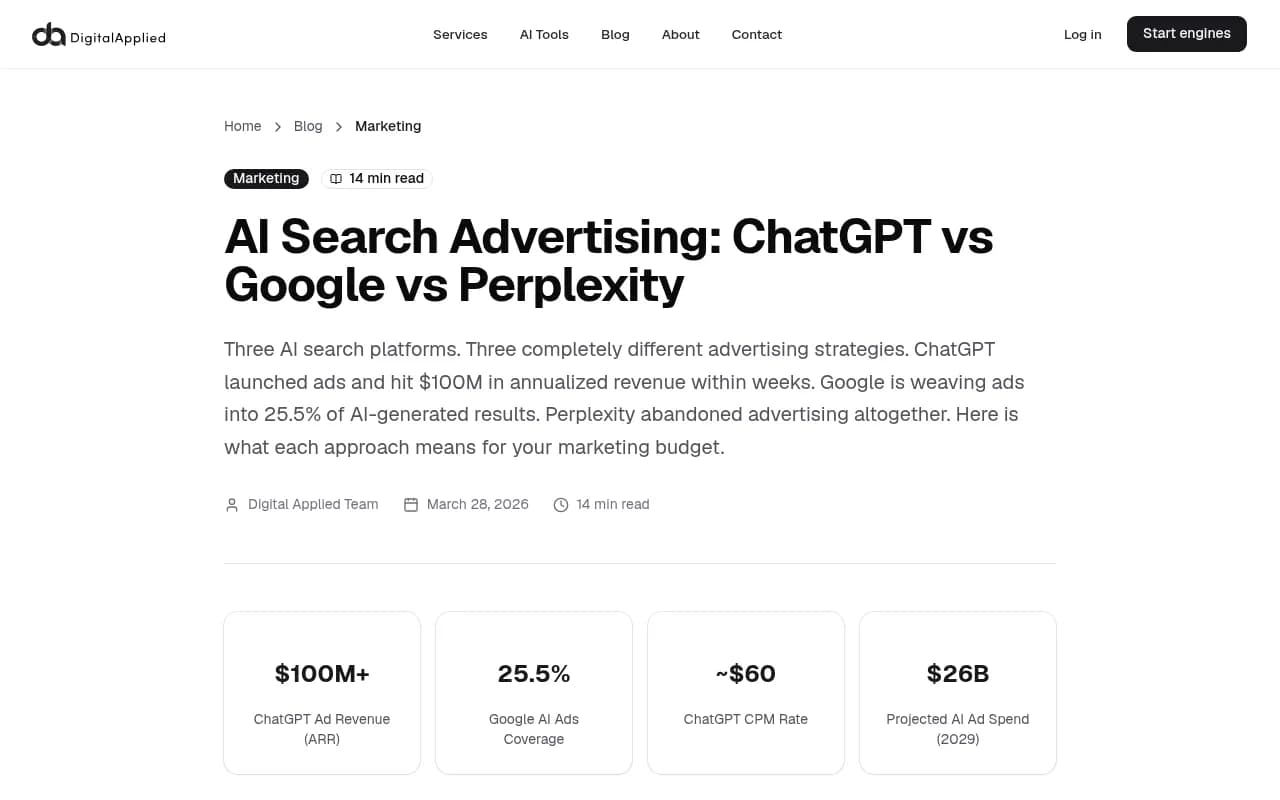
If you're building a business case for why any of this matters, the money helps. ChatGPT ads hit an estimated $100M in annualized revenue within roughly two months of launch, at around $60 CPM with 800M+ weekly active users. US AI search ad spend overall is projected to grow from roughly $1B in 2025 to $25.9B by 2029. Google, meanwhile, has pushed ads into 25.5% of AI Mode responses, up from 5.17% in early 2025, adding shopping ads with Direct Offers alongside them.
That's three platforms, three different bets. ChatGPT is betting ads plus trust can coexist if targeting stays contextual rather than behavioral. Google is betting its existing ad machine translates cleanly into AI surfaces. Perplexity is betting the opposite, that ad-free is the actual differentiator worth protecting. None of these bets are settled yet, which is exactly why watching what your competitors do inside them, rather than assuming last year's playbook still applies, is worth the setup effort.
If you want a broader view of the AI visibility tooling market beyond ad tracking specifically, the GEO software directory at bestgeosoftware.com is a reasonable place to compare platforms side by side.