Key takeaways
- Searchable is a solid entry-level AI visibility monitor, but it stops at showing you data -- it doesn't help you fix the gaps it finds
- Content teams in 2026 need platforms that track AI citations AND help create content engineered to earn them
- The best alternatives combine prompt monitoring, content gap analysis, AI writing, and traffic attribution in one workflow
- Promptwatch is the only platform in this comparison rated as a "Leader" across all GEO categories, with built-in content generation grounded in 880M+ real citations
- Pricing across this list ranges from free tiers to $579/mo, so there's a fit for every team size
If you've been using Searchable to monitor your brand's presence in ChatGPT, Perplexity, and Google AI Overviews, you already understand the problem it's trying to solve. AI search is eating traditional click traffic, and if you're not showing up in LLM responses, you're losing ground you might not even be able to measure yet.
But here's where Searchable runs into a wall for most content teams: it shows you the visibility data and then... leaves you there. You can see that a competitor is getting cited for "best project management software for agencies" and you're not. Great. Now what?
That gap between "I can see the problem" and "I can fix the problem" is where most AI visibility tools fail content teams. Writing teams don't just need dashboards -- they need to know which articles to write, what angle to take, and whether the content they publish is actually moving the needle.
This guide covers 10 platforms that go further than Searchable, with a focus on tools that help content teams track, create, and publish AI-optimized content -- not just watch the scoreboard.
What to look for in a Searchable alternative
Before jumping into the list, it's worth being clear about what "better" actually means for a content team specifically.
Monitoring-only tools (and Searchable falls into this category) are fine for brand managers who need a weekly report on share of voice. But if your job is to produce content that gets cited by AI models, you need a few more things:
- Prompt intelligence: Not just "are you mentioned?" but which specific prompts are driving citations, how competitive they are, and what volume they carry
- Gap analysis: A clear view of which prompts competitors rank for that you don't -- with enough detail to act on it
- Content generation: The ability to turn those gaps into actual articles, not just briefs
- Citation-level tracking: Which specific pages on your site are being cited, by which models, and how often
- Traffic attribution: Connecting AI visibility back to actual sessions and revenue
The tools below vary in how many of these boxes they check. Some are monitoring-first with strong content features bolted on. Others are built around the content workflow from the start.
The top 10 Searchable alternatives in 2026
1. Promptwatch -- best overall for the full content-to-citation loop
Promptwatch is the most complete option on this list for content teams that want to close the loop between AI visibility data and published content. Where Searchable shows you a visibility score, Promptwatch shows you the exact prompts your competitors are winning that you're not -- and then helps you write the content to compete for them.

The Answer Gap Analysis feature is genuinely useful here. You get a list of specific prompts where competitors appear in AI responses but your site doesn't, along with the topics and content angles that AI models are looking for but can't find on your domain. That's actionable in a way that a share-of-voice chart isn't.
From there, the built-in AI writing agent generates articles, listicles, and comparisons grounded in real citation data -- not generic SEO filler. It's trained on 880M+ citations, so the content it produces reflects what AI models actually cite, not what a language model guesses might rank.
On the tracking side, Promptwatch monitors 10 AI models (ChatGPT, Perplexity, Claude, Gemini, Grok, DeepSeek, Copilot, Meta AI, Google AI Overviews, and Google AI Mode), with page-level citation tracking and traffic attribution via GSC integration, a code snippet, or server log analysis.
The AI Crawler Logs feature is something most competitors don't have at all -- you can see exactly when ChatGPT or Perplexity crawled your site, which pages they read, and whether they hit any errors. For a content team trying to understand why certain pages aren't getting cited, that's invaluable.
Pricing starts at $99/mo for the Essential plan (1 site, 50 prompts, 5 articles/mo) and goes to $249/mo for Professional (2 sites, 150 prompts, 15 articles, crawler logs) and $579/mo for Business (5 sites, 350 prompts, 30 articles).
2. Frase -- best for SEO-first teams adding AI visibility
Frase has been a content optimization staple for a few years, and in 2026 it's added meaningful AI visibility tracking on top of its core research and writing features. If your team already uses Frase for content briefs and on-page optimization, the AI tracking layer is a natural extension.
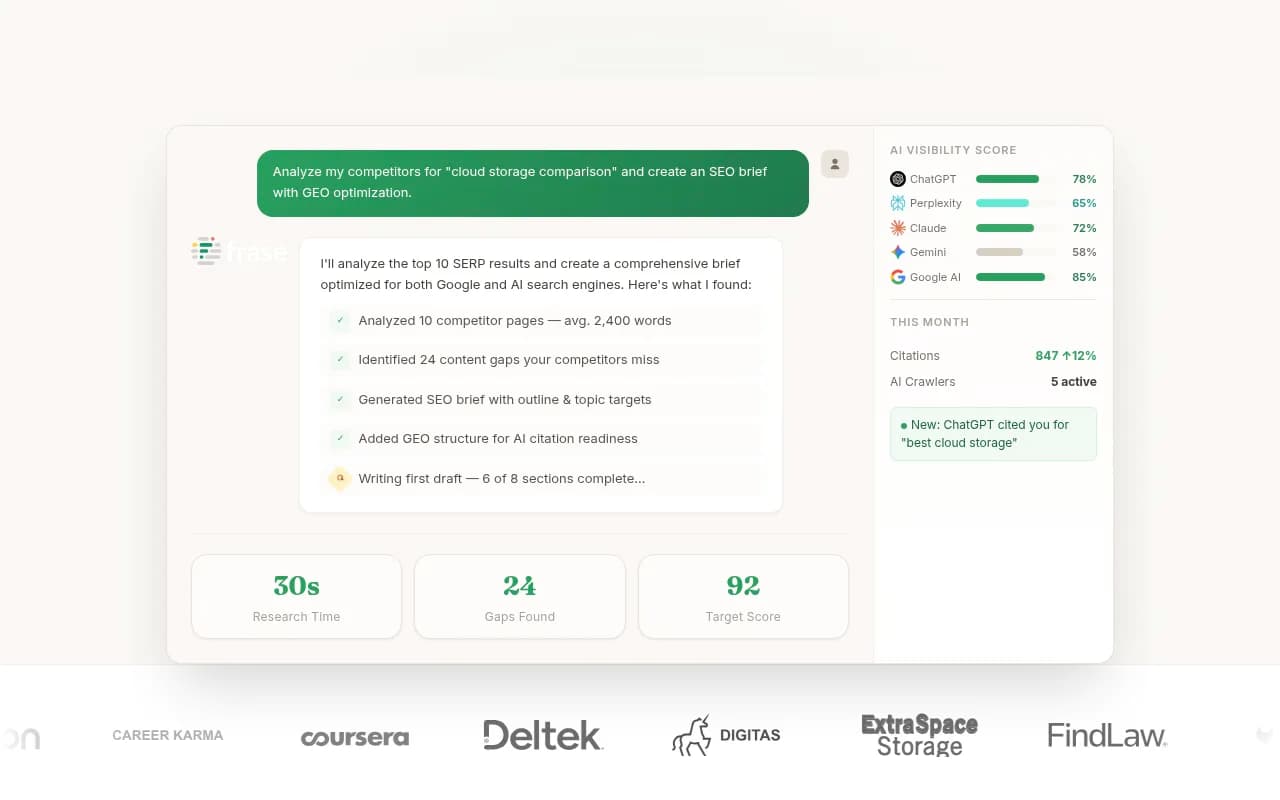
The strength here is the research workflow. Frase pulls together SERP data, competitor content, and now AI citation data into a single brief, which makes it easier to write content that's optimized for both traditional search and AI responses. The writing assistant is solid for teams that want to stay in one tool from research to draft.
Where Frase falls short compared to Promptwatch is on the monitoring depth -- it doesn't have crawler logs, Reddit/YouTube citation tracking, or ChatGPT Shopping visibility. For teams that primarily care about content quality and on-page optimization, that's probably fine. For teams that want to understand the full picture of how AI models discover and cite their content, it's a gap.
3. Writesonic -- best for high-volume content production with AI search awareness
Writesonic has evolved well beyond its origins as an AI copywriting tool. The 2026 version includes AI search visibility tracking alongside its content generation features, making it a reasonable choice for teams that need to produce a lot of content and want some signal on how it performs in AI search.
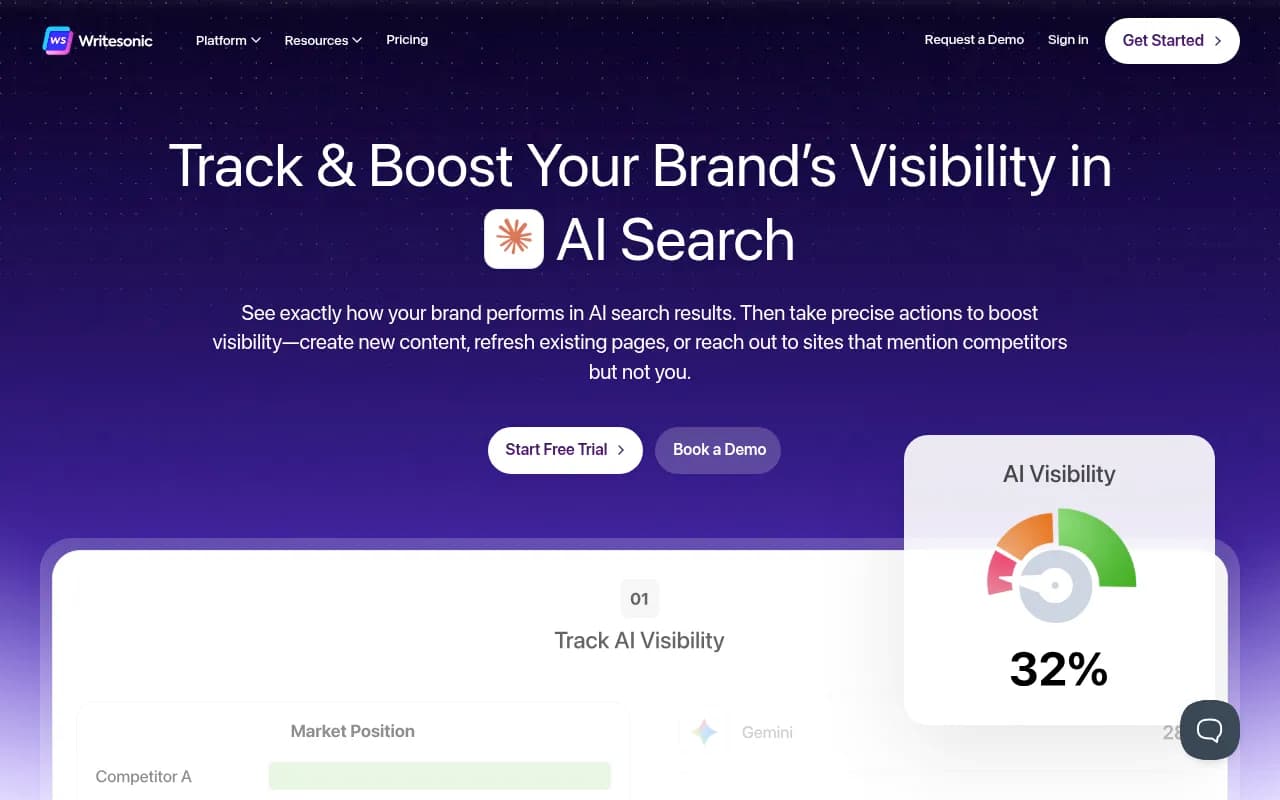
The content generation speed is genuinely impressive. Teams that need to publish 20+ articles a month will find Writesonic's output volume hard to match at its price point. The AI visibility layer gives you basic monitoring across major LLMs, though it's not as granular as Promptwatch's page-level tracking or prompt difficulty scoring.
The main trade-off: Writesonic is optimized for volume and speed, which sometimes shows in content quality. For brand-sensitive content or highly competitive niches, you'll want to edit more heavily than the tool suggests.
4. Surfer SEO -- best for teams that want content scores and AI optimization in one place
Surfer has long been the go-to for content scoring and on-page optimization, and it's added AI search features that make it more relevant for GEO-focused teams.
The Content Score system is still one of the best in the industry for guiding writers toward content that performs in traditional search. The AI visibility additions give you some signal on how content is performing in LLM responses, though Surfer's strength remains in the writing and optimization workflow rather than deep AI monitoring.
For content teams that are primarily focused on Google rankings but want to start incorporating AI search signals, Surfer is a sensible choice. If AI visibility is your primary concern, you'll want something with more monitoring depth.
5. Profound -- best for enterprise teams with serious AI visibility budgets
Profound is one of the more feature-complete AI visibility platforms on the market, with strong monitoring across major LLMs, competitive intelligence, and brand tracking capabilities.

The competitive heatmaps and share-of-voice analysis are genuinely good, and the platform handles multi-brand and multi-region monitoring well. Enterprise teams managing visibility across multiple products and markets will find Profound's reporting depth useful.
The catch is price. Profound sits at the higher end of this category, and the content generation features aren't as developed as Promptwatch's. You're paying for monitoring sophistication, not a content production workflow. For teams that have separate content tools and just need best-in-class visibility data, that's a reasonable trade.
6. Clearscope -- best for content optimization teams focused on semantic depth
Clearscope is a content optimization platform that helps writers cover topics comprehensively enough to rank in both traditional search and AI responses.
The semantic analysis is excellent -- Clearscope surfaces the related terms, questions, and subtopics that AI models expect to see covered in authoritative content. For content teams that want to improve existing pages or brief new ones with a focus on topical depth, it's one of the better tools available.
Clearscope doesn't do AI visibility monitoring in the traditional sense (it won't tell you if ChatGPT is citing your competitor). It's purely an optimization tool. But for teams whose main problem is content quality rather than visibility tracking, it solves a real problem.
7. MarketMuse -- best for content strategy and topical authority planning
MarketMuse takes a content strategy-first approach, helping teams build topical authority by identifying gaps in their content coverage and prioritizing what to write next.
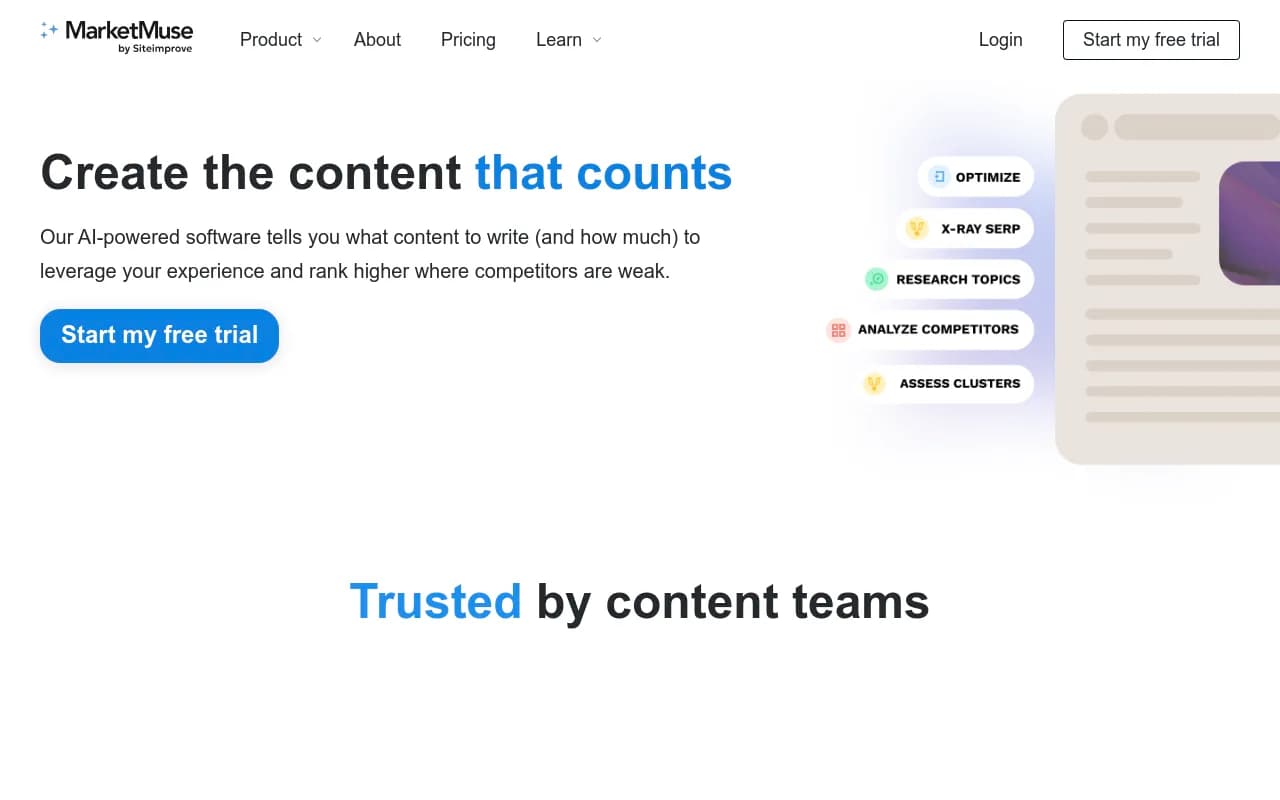
The content inventory and gap analysis features are strong, and the platform has added AI visibility tracking that connects topical authority to LLM citation performance. The insight that "you're missing coverage on X subtopic, which is why AI models don't cite you for Y" is genuinely useful for content planning.
MarketMuse is more expensive than some alternatives and the AI writing features are less developed than Promptwatch or Writesonic. It's best suited for teams that want to think strategically about content architecture rather than just produce more articles.
8. SE Ranking -- best budget-friendly option with AI visibility included
SE Ranking has quietly become one of the better value options in the AI visibility space. The full SEO platform includes keyword tracking, site audits, and competitive analysis, with an AI visibility module that monitors your brand across major LLMs.
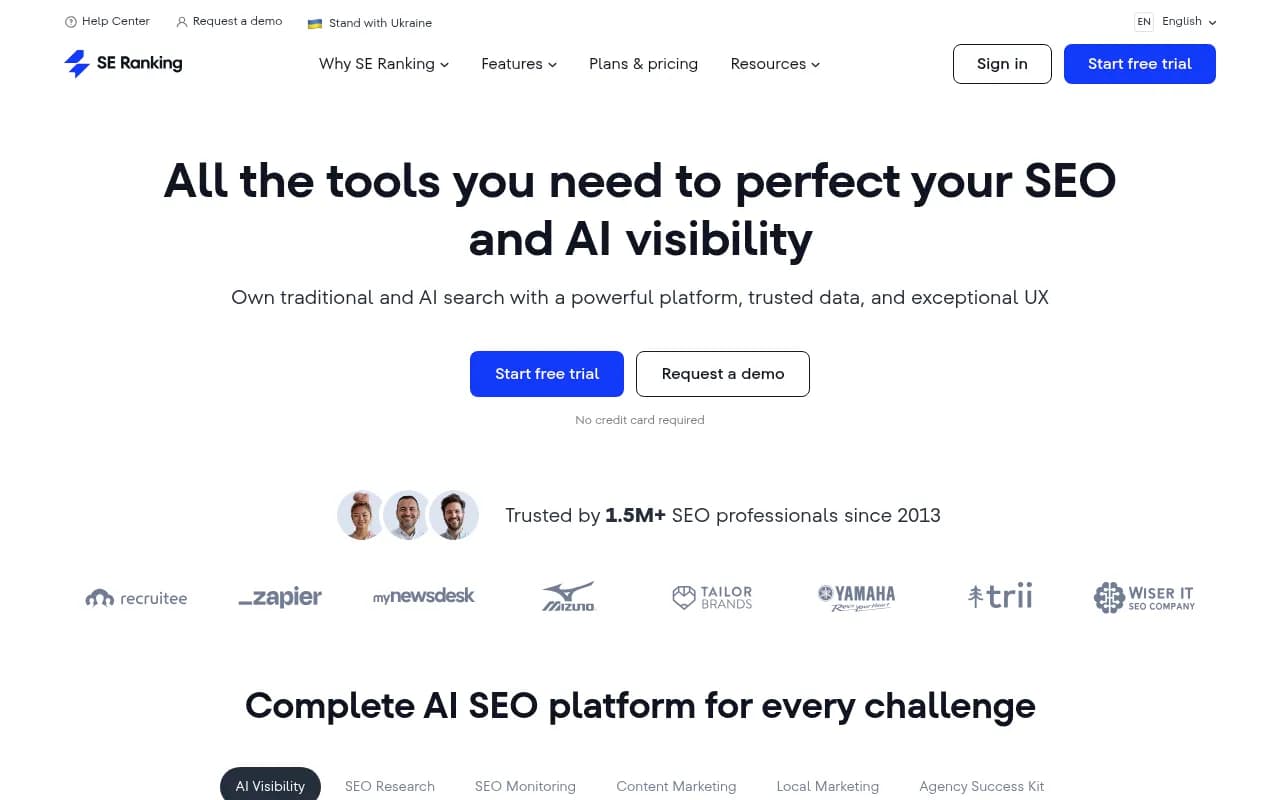
For smaller teams or agencies that need a broad SEO toolkit and want AI visibility included without paying for a separate platform, SE Ranking makes a lot of sense. The AI monitoring isn't as deep as dedicated GEO platforms, but it covers the basics well at a price point that's hard to argue with.
The content optimization features are decent but not class-leading. Think of it as a solid all-rounder rather than a specialist tool.
9. Semrush -- best for teams already invested in the Semrush ecosystem
Semrush has added AI visibility tracking to its platform, which makes it a convenient option for teams that already use it for keyword research, site audits, and competitive analysis.
The advantage is consolidation -- if you're already paying for Semrush, the AI visibility features are a meaningful addition without adding another tool to your stack. The ContentShake AI feature helps with content generation and optimization.
The limitation is that Semrush's AI monitoring uses fixed prompts, which means you're tracking a predetermined set of queries rather than the full range of prompts relevant to your business. For teams that want to discover new prompt opportunities or track custom queries, that's a real constraint.
10. Jasper -- best for brand-consistent AI content at scale
Jasper is one of the most mature AI writing platforms available, with strong brand voice controls and a content workflow designed for marketing teams.
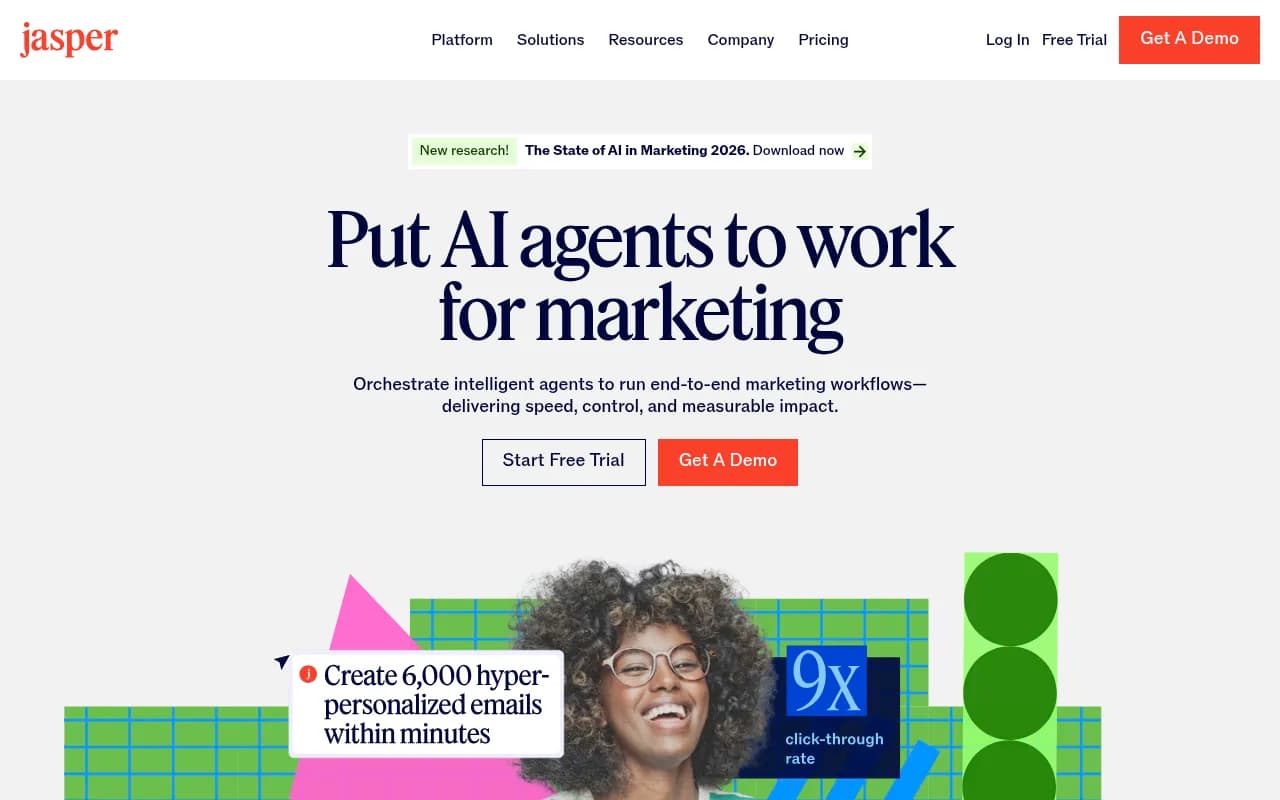
The brand voice features are genuinely good -- Jasper learns your tone, style, and messaging guidelines and applies them consistently across content types. For teams where brand consistency is a priority, that's a meaningful differentiator.
Jasper doesn't do AI visibility monitoring. It's a content creation tool, not a GEO platform. But for teams that have their monitoring covered and need a reliable, brand-safe writing tool for high-volume production, it's worth considering alongside a dedicated visibility platform.
How these tools compare
Here's a direct comparison across the capabilities that matter most for content teams:
| Platform | AI visibility monitoring | Content gap analysis | AI content generation | Crawler logs | Traffic attribution | Starting price |
|---|---|---|---|---|---|---|
| Promptwatch | 10 LLMs, page-level | Yes (Answer Gap Analysis) | Yes (citation-grounded) | Yes | Yes (GSC, snippet, logs) | $99/mo |
| Frase | Yes (basic) | Partial | Yes | No | No | $45/mo |
| Writesonic | Yes (basic) | No | Yes (high volume) | No | No | $20/mo |
| Surfer SEO | Partial | No | Yes | No | No | $89/mo |
| Profound | Yes (deep) | Partial | No | No | No | Custom |
| Clearscope | No | Partial (topical) | No | No | No | $170/mo |
| MarketMuse | Partial | Yes (topical) | Partial | No | No | $149/mo |
| SE Ranking | Yes (basic) | No | Partial | No | No | $52/mo |
| Semrush | Yes (fixed prompts) | No | Yes (ContentShake) | No | No | $139/mo |
| Jasper | No | No | Yes (brand voice) | No | No | $49/mo |
The pattern is clear: most tools do one or two things well. Promptwatch is the only platform here that covers the full workflow from gap discovery to content creation to traffic attribution.
Which tool is right for your team?
The honest answer depends on where your biggest bottleneck is.
If you're starting from scratch with AI visibility and want a single platform that handles everything -- monitoring, gap analysis, content generation, and traffic attribution -- Promptwatch is the straightforward choice. The action loop (find gaps, create content, track results) is built into the product rather than something you have to stitch together across tools.
If you're an SEO-first team that already has a content workflow and just wants to add AI visibility monitoring, Frase or SE Ranking give you solid coverage at a lower price point.
If content volume is your primary constraint and you have monitoring covered elsewhere, Writesonic or Jasper handle production well.
If you're at an enterprise scale with complex multi-brand monitoring needs, Profound is worth evaluating despite the price.
The tools that don't make sense as Searchable alternatives for content teams are the pure monitoring plays -- platforms that give you a visibility score and nothing else. In 2026, knowing you have a problem isn't the hard part. Fixing it is.
A note on the monitoring-only trap
One thing worth saying directly: a lot of teams spend months tracking AI visibility metrics without ever improving them. The dashboards look impressive in reports, but if the workflow stops at "here's your share of voice this week," you're not actually doing GEO -- you're just watching.
The platforms that help content teams move fastest are the ones where the monitoring data feeds directly into content decisions. When you can see that a competitor is cited for a specific prompt, understand why (what content they have that you don't), generate a competing article, publish it, and then watch your citation rate improve -- that's when the investment in these tools pays off.
That's the workflow worth building toward, and it's the standard worth holding any Searchable alternative to.