Key takeaways
- Goodie targets mid-market teams at ~$495/month; Bluefish targets Fortune 500 enterprises at ~$4,000/month -- that's roughly an 8x price difference for a fundamentally different buyer profile
- Bluefish goes beyond monitoring into optimization workflows, agentic commerce tracking, and custom measurement frameworks; Goodie is primarily a brand mention tracker with visibility scoring
- As of early 2026, goodie.ai appears to be listed for sale as a domain, which raises real questions about the product's current availability and future development
- Bluefish requires a sales demo and annual contract -- there's no self-serve option; Goodie was designed for more direct sign-up access
- Neither tool offers built-in content generation to act on the gaps they find; they're both monitoring-first platforms
- For teams that need to track AI visibility AND do something about it, both tools leave a gap that more comprehensive platforms fill
Overview
Goodie
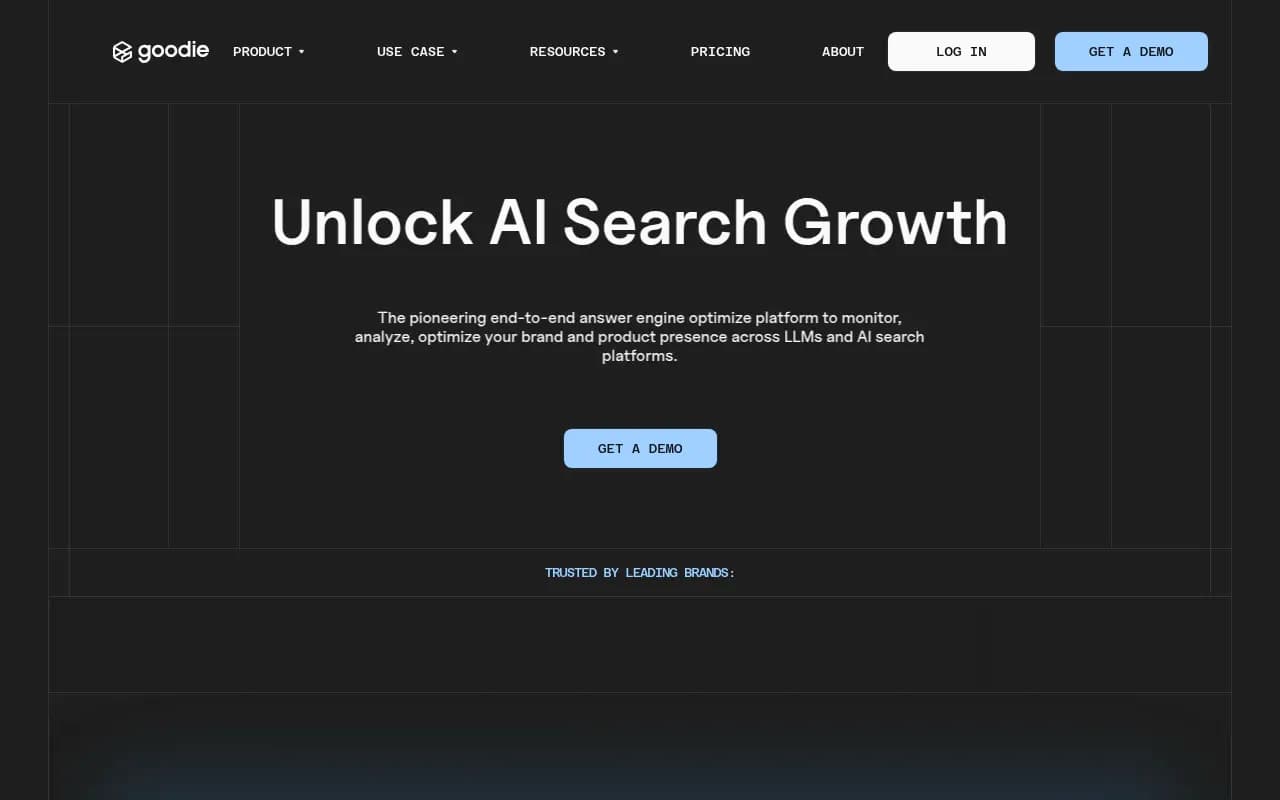
Goodie positioned itself as an accessible AI brand tracking tool for marketing teams that want to know how their brand shows up in ChatGPT, Perplexity, Gemini, and Claude responses. The pitch was straightforward: visibility scoring, mention alerts, and competitive benchmarking without the enterprise price tag. At around $495/month, it sat in a reasonable mid-market range for teams that had just started thinking about AI search visibility.
The catch -- and it's a significant one -- is that as of early 2026, goodie.ai appears to be listed for sale as a domain on Spaceship.com for $80,000. That's not a good sign for a SaaS product. Whether the company pivoted, shut down, or is in transition is unclear, but it's worth flagging before anyone signs a contract.
Bluefish
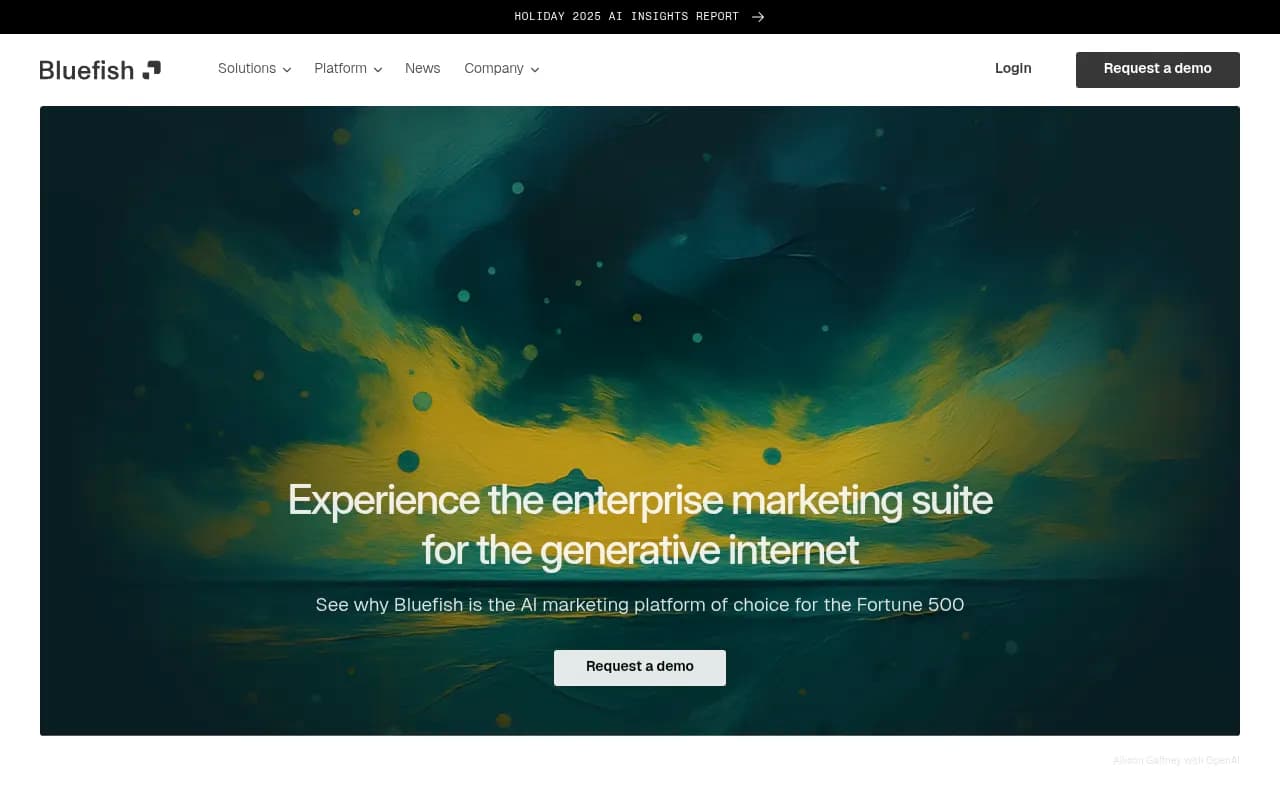
Bluefish is built for a completely different buyer. The homepage says "Fortune 500" multiple times, and the pricing backs that up -- starting around $4,000/month with annual contracts and a mandatory sales process. This isn't a tool you sign up for on a Tuesday afternoon; it's a procurement decision.
What Bluefish offers in return for that price is depth: AI monitoring across major platforms, GEO optimization workflows, agentic commerce tracking (which most competitors don't touch), and custom measurement frameworks that enterprise data teams can actually work with. They've published research on things like how Super Bowl ads influence AI recommendations, which suggests a team doing real analytical work, not just building dashboards.
Side-by-side comparison
| Feature | Goodie | Bluefish |
|---|---|---|
| Starting price | ~$495/month | ~$4,000/month |
| Free trial | Unclear (domain for sale) | No -- demo only |
| Target audience | Mid-market marketing teams | Fortune 500 / enterprise |
| AI models covered | ChatGPT, Perplexity, Gemini, Claude | ChatGPT, Perplexity, Gemini + agentic channels |
| Brand mention tracking | Yes | Yes |
| Visibility scoring | Yes | Yes |
| Competitor benchmarking | Yes | Yes |
| GEO optimization tools | Basic | Yes -- advanced workflows |
| Agentic commerce tracking | No | Yes |
| Content generation | No | No |
| Custom measurement frameworks | No | Yes |
| Infosec / enterprise compliance | Unknown | Yes -- passes enterprise infosec reviews |
| API access | Unknown | Yes (enterprise) |
| Contract type | Monthly (assumed) | Annual contracts standard |
| Sales process required | No | Yes |
| Current product status | Uncertain (domain listed for sale) | Active |
Head-to-head feature deep-dive
Pricing and accessibility
This is where the two tools diverge most sharply. Goodie was priced to be accessible -- $495/month is within reach for a growing SaaS company or a mid-sized brand that wants to start tracking AI visibility without a major budget commitment. Bluefish starts at roughly $4,000/month and requires an annual contract, which means you're committing to $48,000+ per year before you've seen the product.
For enterprise teams with procurement processes, Bluefish's pricing is normal. For everyone else, it's a non-starter.
The more pressing issue with Goodie is the domain situation. A product whose domain is actively listed for sale at $80,000 is not a product you should be building workflows around right now. That's not a knock on the original product -- it may have been solid -- but it's a real risk factor for anyone evaluating it today.
Verdict: Bluefish wins on stability; Goodie won on accessibility, but its current status is uncertain.
AI model coverage
Both tools cover the major AI platforms that matter most to marketers: ChatGPT, Perplexity, and Gemini. Goodie also included Claude. Bluefish extends into agentic commerce channels, which is forward-looking -- as AI agents start making purchasing decisions on behalf of users, knowing whether your brand gets recommended in those contexts matters.
Neither tool covers the full breadth of AI engines that are now driving meaningful traffic. Platforms like DeepSeek, Grok, Meta AI, and Mistral are growing, and monitoring-only tools that focus on the top three miss that picture.
Verdict: Bluefish has broader coverage, especially for commerce use cases.
Monitoring depth
Goodie's approach was visibility scoring and alerts -- you get notified when your brand is mentioned, you see a score, you can compare against competitors. That's useful as a starting point.
Bluefish goes deeper. Their positioning around understanding how AI "thinks" -- not just what it says -- suggests more sophisticated analysis of why a brand appears or doesn't appear in AI responses. Custom audiences, tailored prompt sets, and segmentation capabilities mean enterprise teams can slice data in ways that actually map to their business questions rather than working with generic datasets.
Verdict: Bluefish wins on depth, though the price reflects that.
Optimization and content tools
This is where both tools show their limits. Neither Goodie nor Bluefish offers built-in content generation to act on the gaps they identify. Bluefish has GEO optimization workflows and an AI-optimized content approach (they published a blog post about it in April 2026), but it's not clear this includes an integrated writing tool. Goodie was monitoring-first with no meaningful optimization layer.
If you're tracking AI visibility, the natural next question is "what do I do about it?" Both tools leave you to figure that out yourself or bring in other tools. Worth noting that platforms like Promptwatch close this loop with built-in content gap analysis and an AI writing agent that generates content specifically engineered to get cited by AI models -- which is a different approach than pure monitoring.

Verdict: Neither tool wins here outright; Bluefish has more optimization infrastructure, but neither generates content.
Enterprise readiness
Bluefish is clearly built for enterprise. They explicitly mention passing infosec reviews, which is a real barrier for Fortune 500 procurement. Custom data segmentation, dedicated onboarding, and integration with enterprise data stacks are all part of the package.
Goodie was not built for enterprise. It was a self-serve or light-touch sales product for teams that want to get started quickly. That's fine for its target market, but it means it can't compete on the enterprise checklist.
Verdict: Bluefish wins decisively for enterprise requirements.
Agentic commerce tracking
This is a feature Bluefish has that almost no competitor offers yet. As AI agents increasingly handle product research and purchasing decisions, brands need to know whether they're being recommended in those agentic flows -- not just in conversational search. Bluefish tracks this. Goodie did not.
Verdict: Bluefish wins; Goodie doesn't compete here.
Pricing comparison
| Plan | Goodie | Bluefish |
|---|---|---|
| Entry price | ~$495/month | ~$4,000/month |
| Mid-tier | Custom / enterprise on request | Custom |
| Enterprise | Custom | Custom (annual contract) |
| Free trial | Unclear | No |
| Contract flexibility | Monthly (assumed) | Annual standard |
| Self-serve signup | Yes (when active) | No -- demo required |
Pros and cons
Goodie
Pros:
- Accessible price point for mid-market teams
- Covers ChatGPT, Perplexity, Gemini, and Claude
- Self-serve or low-friction onboarding
- Visibility scoring and alerts for brand mentions
Cons:
- Domain listed for sale as of early 2026 -- product status uncertain
- Monitoring-only; no content optimization or generation
- Limited enterprise features
- No agentic commerce tracking
- Unclear API or integration capabilities
Bluefish
Pros:
- Built for enterprise with real infosec compliance
- Covers agentic commerce channels beyond standard AI search
- Custom measurement frameworks and data segmentation
- Active product development (recent blog posts, research publications)
- GEO optimization workflows beyond basic monitoring
Cons:
- ~$4,000/month starting price excludes most non-enterprise buyers
- Annual contracts mean significant commitment before you know if it works
- No self-serve access -- requires sales process
- No built-in content generation
- Overkill for teams that just need basic brand tracking
Who should pick which tool
Choose Goodie if:
- You're a mid-market brand that wants basic AI brand monitoring at an accessible price
- You need quick, self-serve access without a sales process
- You're just starting to track AI visibility and want to test the waters
- Note: verify the product is still active before committing, given the domain situation
Choose Bluefish if:
- You're at a Fortune 500 or large enterprise with a real procurement process
- You need agentic commerce tracking alongside standard AI search monitoring
- Your team requires enterprise-grade infosec compliance and custom data segmentation
- You have the budget ($48,000+/year) and the internal resources to get value from a complex platform
Consider alternatives if:
- You want monitoring AND content optimization in one platform
- You need coverage across more than 3-4 AI models
- You're an agency managing multiple brands or clients
- You want self-serve access with enterprise-level depth
Final verdict
These two tools aren't really competing for the same customer. Goodie was a mid-market monitoring tool; Bluefish is an enterprise platform. The 8x price difference reflects a genuine difference in scope, not just margin.
The more honest answer for most readers: Goodie's current status is a real concern, and Bluefish's price puts it out of reach for most teams. If you're evaluating AI brand visibility tools in 2026, the more interesting comparison is probably between Bluefish and other enterprise platforms, or between Goodie's alternatives and other mid-market options -- because this specific matchup is less "which is better" and more "which one is even an option for you."