Key takeaways
- Ranksmith is the more affordable starting point at $69/mo vs Bear AI's $100/mo Basic plan, and Ranksmith's Basic plan covers more AI models out of the box.
- Bear AI's Basic plan is limited to GPT-5 only -- if you need Claude, Perplexity, Gemini, or Grok coverage, you're looking at custom Enterprise pricing.
- Bear AI goes further on the revenue side: visitor identification from AI sources, PR outreach automation, and blog generation are built in. Ranksmith doesn't generate content directly.
- Ranksmith has a cleaner competitive benchmarking story -- share of voice, average position, sentiment, and an Authority Index all in one dashboard.
- Both tools are in relatively early stages (Ranksmith is in public beta; Bear AI is YC-backed but still growing its customer base), so neither is a fully mature enterprise platform yet.
- If you need multi-model monitoring on a budget, Ranksmith wins. If you want to close the loop from AI visibility to actual leads and content, Bear AI has more pieces of that puzzle.
Overview
Ranksmith
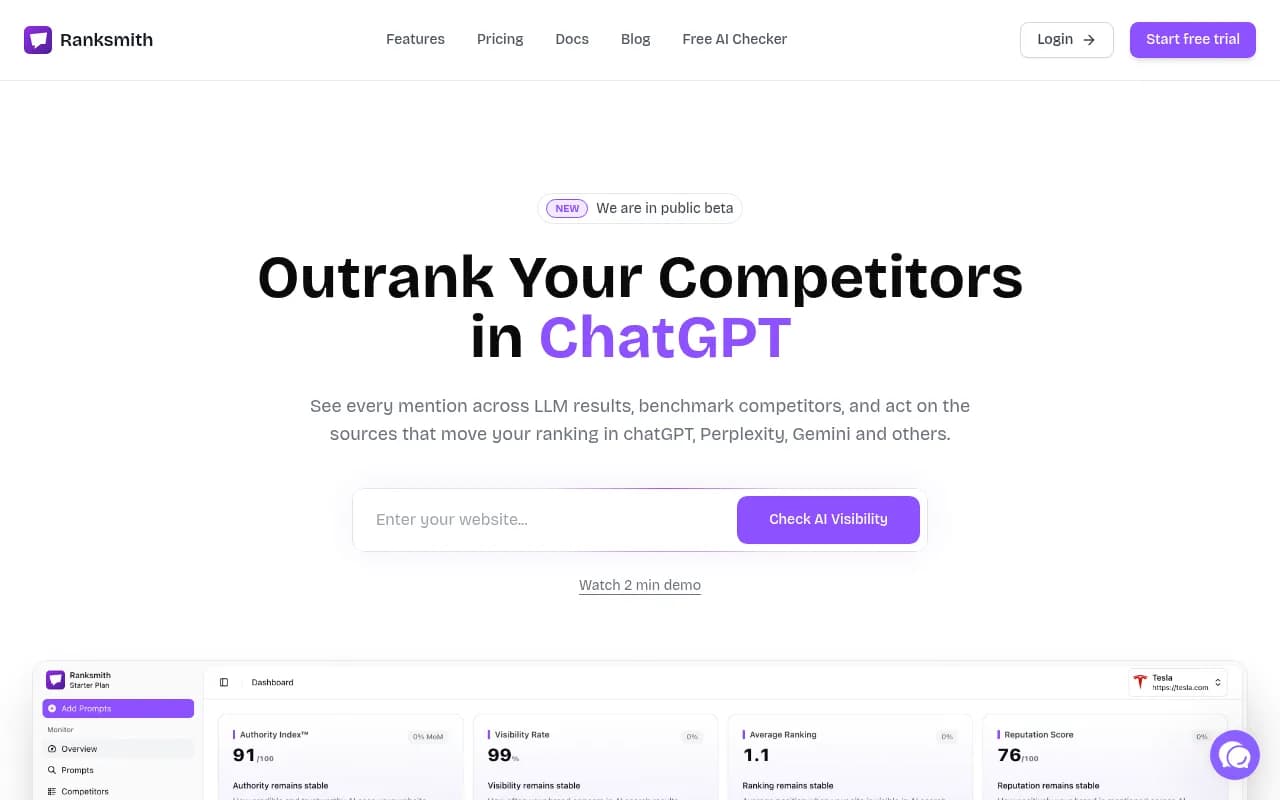
Ranksmith positions itself as a GEO (Generative Engine Optimization) platform built around turning LLM results into a measurable growth channel. It monitors brand mentions, positions, and sentiment across ChatGPT, Perplexity, Gemini, Grok, Claude, and Google AI Overviews, then surfaces the specific citations and sources driving those results. The core idea is a performance score per prompt that blends visibility rate, average position, and link rate -- so you can prioritize which prompts to work on first rather than staring at a wall of raw data.
It's currently in public beta, which means the product is moving fast but also that some rough edges are expected.
Bear AI
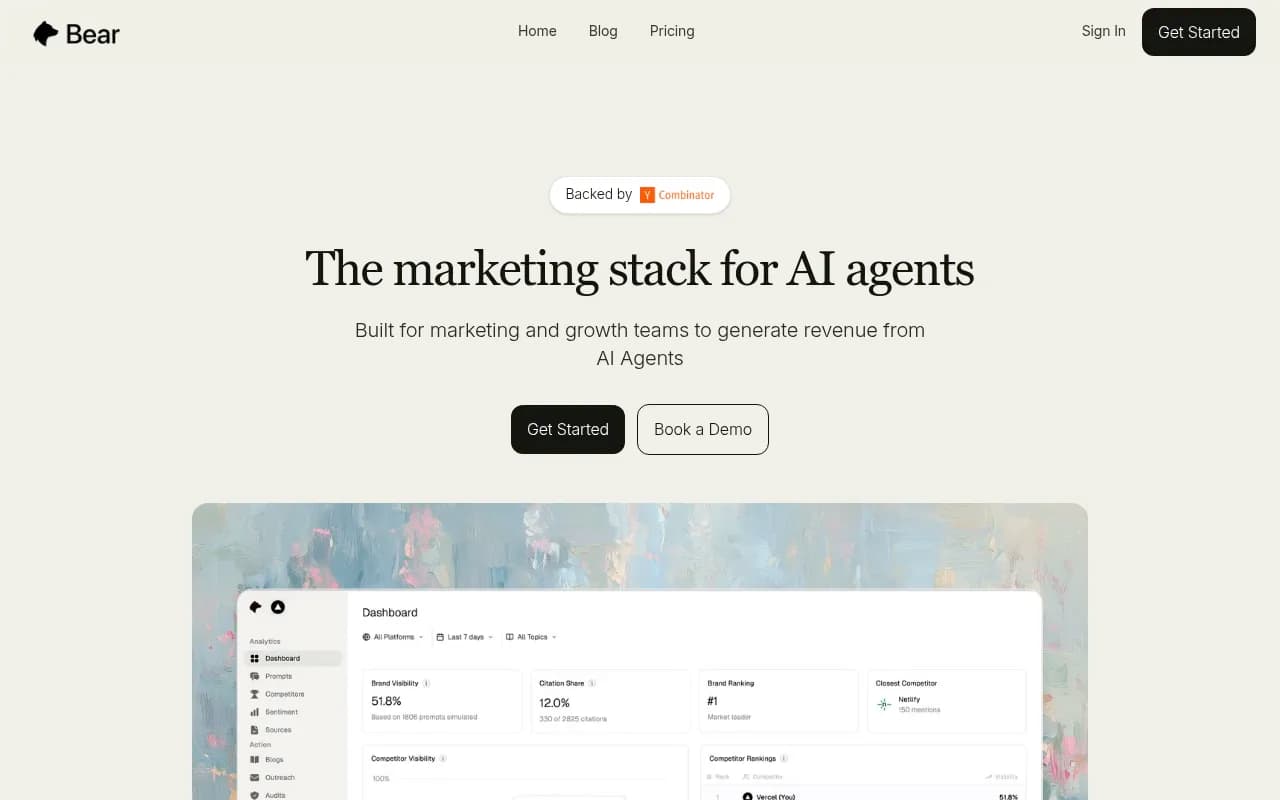
Bear AI describes itself as "the marketing stack for AI agents" -- a broader framing than pure GEO monitoring. It's backed by Y Combinator and targets marketing and growth teams who want to not just track AI visibility but actually convert that visibility into revenue. The platform covers brand monitoring across ChatGPT, Claude, Perplexity, Google AI, and Gemini, and adds capabilities like AI-optimized blog generation, automated PR outreach, and visitor identification from AI traffic sources.
The catch: the $100/mo Basic plan only covers GPT-5. Getting full multi-model coverage means going to Enterprise with custom pricing, which makes it harder to evaluate cost upfront.
Side-by-side comparison
| Feature | Ranksmith | Bear AI |
|---|---|---|
| Starting price | $69/mo | $100/mo |
| Free trial | 7-day, no credit card | Not clearly stated |
| AI models (entry plan) | 2 models | GPT-5 only |
| AI models (max) | 6 models | All major LLMs (Enterprise) |
| Prompts (entry plan) | 25 | 30 |
| Prompts (max) | 150 (Enterprise) | Unlimited (Enterprise) |
| Competitor benchmarking | Yes -- share of voice, position, sentiment | Yes -- brand mentions, trending prompts |
| Content generation | No | Yes -- 2 blogs/mo (Basic) |
| PR outreach automation | No | Yes |
| Visitor identification from AI | No | Yes |
| Citation/source tracking | Yes -- detailed | Yes |
| Performance scoring per prompt | Yes -- blended score | Not clearly advertised |
| Annual billing discount | 20% | Not stated |
| Current status | Public beta | Active (YC-backed) |
| Target user | SEO/marketing teams | Marketing & growth teams |
Head-to-head feature deep-dive
Prompt tracking and prioritization
Ranksmith's approach here is genuinely useful. Every tracked prompt gets a performance score that combines current position, mention rate, and link rate across models. You can filter by category, model, and region, which means you're not just looking at a list of prompts -- you're looking at a ranked queue of what to fix first. That's a real time-saver for teams with limited bandwidth.
Bear AI shows trending prompts and tracks which ones are driving traffic, but the emphasis is more on discovery (what are people asking AI about in my category?) than on scoring and prioritization. It's a different angle -- useful for finding new prompt opportunities, less useful for systematically improving existing ones.
Verdict: Ranksmith wins on prioritization depth. Bear AI wins on prompt discovery.
AI model coverage
| Plan | Ranksmith | Bear AI |
|---|---|---|
| Entry | 2 models ($69/mo) | GPT-5 only ($100/mo) |
| Mid-tier | 4 models ($149/mo) | Not published |
| Top published plan | 6 models ($549/mo) | Unlimited (Enterprise, custom) |
This is Bear AI's biggest weakness at the entry level. Paying $100/mo and only getting GPT-5 coverage is a real limitation -- Perplexity and Google AI Overviews are driving significant traffic for many brands right now, and you'd need to upgrade to Enterprise to track them. Ranksmith gives you 2 models at $69/mo and scales up predictably.
Verdict: Ranksmith is clearly better here for anyone not on an Enterprise budget.
Competitive intelligence
Both tools let you track competitors' AI visibility. Ranksmith's implementation looks more structured -- you get share of voice over time, average ranking comparisons, sentiment tracking, and a side-by-side benchmark table. It also claims to surface new entrants automatically, which is a nice touch for competitive monitoring.
Bear AI covers competitor mentions and trending prompts in your category, but the depth of the competitive benchmarking isn't as clearly articulated on their site. It feels more like a supporting feature than a core one.
Verdict: Ranksmith has the edge on competitive benchmarking depth.
Content generation and outreach
This is where Bear AI pulls ahead. The platform generates AI-optimized blog posts (2/month on Basic) and automates PR outreach -- two things Ranksmith doesn't do at all. Ranksmith gives you strategy recommendations and maps them to specific sources (G2, Reddit, LinkedIn, press), but you still have to execute those plays yourself.
Bear AI's visitor identification feature is also worth calling out. If an AI model recommends your brand and someone clicks through to your site, Bear AI can identify that visitor and flag them as high-intent. That's a meaningful step toward connecting AI visibility to actual pipeline, not just rankings.
Verdict: Bear AI wins on action-taking and revenue attribution.
Metrics and reporting
Ranksmith tracks four core KPIs: AI Visibility Rate, Average AI Ranking, Reputation Score, and an AI Authority Index. You get trend deltas and share of voice over time. It's a clean, well-defined measurement framework.
Bear AI's reporting centers on traffic from AI sources and how that traffic converts. The framing is more revenue-oriented ("generate revenue from AI agents") which suits growth teams but may feel less structured for SEO-focused users who want clean ranking metrics.
Verdict: Depends on your goal. Ranksmith for ranking metrics; Bear AI for revenue metrics.
Ease of getting started
Ranksmith's 7-day free trial with no credit card required is a genuine advantage. You can poke around the product, set up prompts, and see real data before committing. The AI-suggested prompts feature also lowers the barrier for teams who aren't sure where to start.
Bear AI's onboarding path is less clear from the public site. There's a "Get Started" button that goes straight to sign-up, but no obvious free trial offer. For a $100+/mo tool, that's a friction point.
Verdict: Ranksmith is easier to evaluate before buying.
Pricing comparison
| Plan | Ranksmith | Bear AI |
|---|---|---|
| Entry | $69/mo (25 prompts, 2 models) | $100/mo (30 prompts, GPT-5 only) |
| Mid | $149/mo (est., 4 models) | Not published |
| Pro/Growth | $299/mo (est.) | Not published |
| Enterprise | $549/mo (150 prompts, 6 models) | Custom pricing (unlimited prompts, all models) |
| Annual discount | 20% | Not stated |
| Free trial | 7 days, no CC required | Not clearly stated |
Bear AI's pricing structure has a significant transparency problem. Only two tiers are publicly listed -- Basic at $100/mo and Enterprise at custom pricing -- with nothing in between. That makes it hard to plan a budget or understand what you're getting as you scale. Ranksmith publishes a full pricing ladder, which is much easier to work with.
Pros and cons
Ranksmith
Pros:
- More affordable entry point ($69/mo vs $100/mo)
- Multi-model coverage from the start (2 models on Basic, up to 6)
- Strong competitive benchmarking with share of voice, position, and sentiment
- Clear prompt prioritization with blended performance scores
- 7-day free trial, no credit card
- 20% annual billing discount
- Transparent, published pricing across all tiers
Cons:
- Still in public beta -- expect some instability
- No built-in content generation
- No PR outreach automation
- No visitor identification from AI traffic
- 150 prompts max even on Enterprise -- may be limiting for large brands
Bear AI
Pros:
- Built-in blog generation (AI-optimized content)
- PR outreach automation included
- Visitor identification from AI sources -- connects visibility to leads
- YC-backed with active development
- Trending prompt discovery for finding new opportunities
- Revenue-first framing suits growth teams
Cons:
- Basic plan is GPT-5 only -- very limited model coverage for $100/mo
- Opaque pricing between Basic and Enterprise
- No clear free trial offer
- Competitive benchmarking depth is less clear than Ranksmith's
- No published prompt performance scoring system
Who should pick which tool
Pick Ranksmith if:
- You want multi-model monitoring without paying Enterprise prices
- Your team is SEO-focused and wants clean ranking metrics (visibility rate, average position, share of voice)
- Competitive benchmarking is a priority -- you need to track multiple rivals systematically
- You want to evaluate the tool risk-free before committing
- Budget matters and you need a predictable pricing ladder
Pick Bear AI if:
- You're a growth or demand-gen team and want to connect AI visibility directly to leads and revenue
- Content generation and PR outreach are part of your workflow -- having them in one platform saves tool-switching
- You're primarily focused on ChatGPT/GPT-5 traffic (the Basic plan covers this well)
- You're willing to pay Enterprise pricing for full model coverage and unlimited prompts
- Visitor identification from AI sources is a capability you genuinely need
A note on the broader GEO landscape
Both tools are competing in a space that's moving fast. If you're evaluating GEO platforms more broadly, it's worth knowing that Promptwatch covers a lot of the ground both tools are working toward -- including crawler logs, content gap analysis, AI-generated content, and traffic attribution -- and has been doing it at scale across 6,700+ brands.

That said, Ranksmith and Bear AI each have their own angles worth considering depending on your team's priorities.
Final verdict
Ranksmith and Bear AI are solving related but distinct problems. Ranksmith is the better pure monitoring and benchmarking tool -- more models, cleaner metrics, better pricing transparency, and a free trial that actually lets you test it. Bear AI is the better choice if you want to act on AI visibility data immediately: generate content, run outreach, and identify which AI-referred visitors are worth following up with.
For most teams starting out with GEO, Ranksmith's lower entry price and multi-model coverage make it the safer first bet. Bear AI makes more sense once you've validated that AI search is driving real traffic and you need tools to convert it -- though the lack of pricing transparency between Basic and Enterprise is a real frustration that Bear AI should fix.