Key takeaways
- Hall AI has a genuine free tier (no email required) and lower entry cost; Ranksmith starts at $69/mo with a 7-day trial but no permanent free plan.
- Ranksmith's competitor intelligence is more structured -- share of voice, average position, sentiment, and automatic new-entrant detection all in one view. Hall covers these but with less depth.
- Hall AI covers 8 AI platforms out of the box on all plans; Ranksmith's model coverage scales with your plan (2 on Starter, up to 6 on Enterprise).
- Hall's agent analytics (real-time AI crawler observation) is a standout feature Ranksmith doesn't clearly match.
- Ranksmith has a more explicit "act on it" layer -- strategy recommendations tied to specific sources (G2, Reddit, LinkedIn, press) and a prompt performance scoring system. Hall is stronger on the monitoring and crawl-insight side.
- Neither tool includes built-in AI content generation; if you want to close the loop from gap analysis to content creation, you'd need a complementary platform.
Overview
Ranksmith
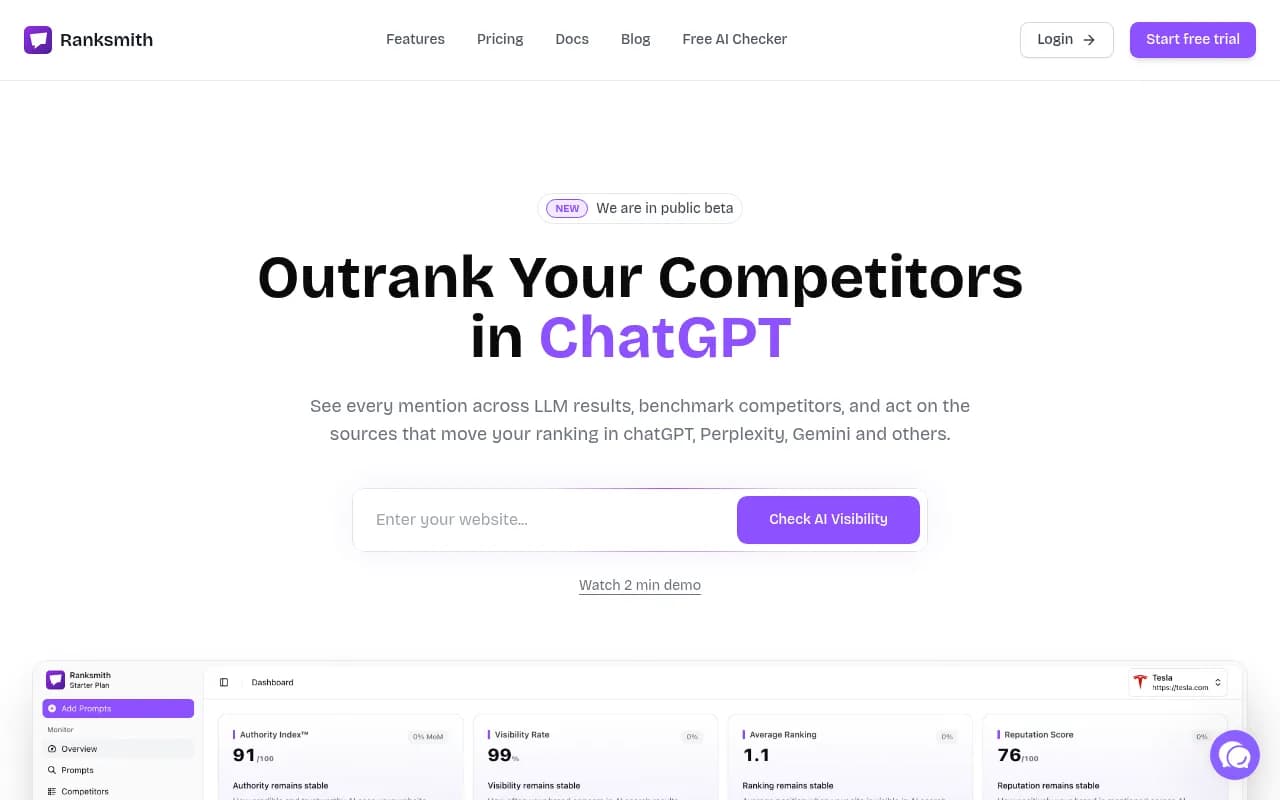
Ranksmith is a GEO/AEO platform built around the idea that AI search visibility should be measurable and actionable. It tracks your brand across ChatGPT, Perplexity, Gemini, Grok, and Claude, then computes a set of KPIs -- Visibility Rate, Average Ranking, Reputation Score, and an AI Authority Index -- that give you something concrete to report on. The standout angle is its prompt prioritization system: every tracked prompt gets a performance score blending position, mention rate, and link rate, so you can see which prompts are worth chasing first. It's still in public beta, which means the product is moving fast but also that rough edges exist.
Hall AI
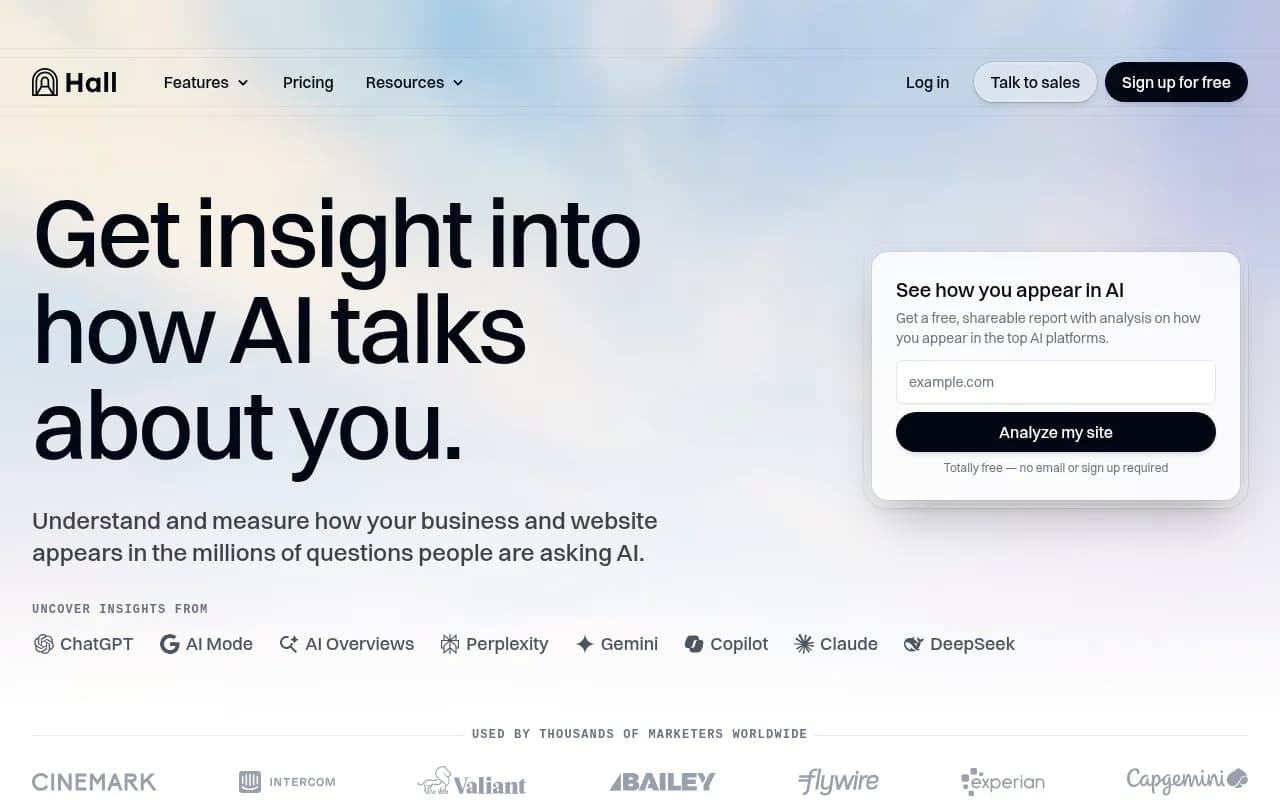
Hall AI takes a more accessible entry point. The free shareable report (no email, no sign-up) is genuinely useful for a first look at how you appear across AI platforms, and it's a smart acquisition move. Beyond that, Hall monitors brand mentions, sentiment, and citations across 8 AI platforms, and its agent analytics feature -- watching how AI crawlers actually browse your site -- is something most GEO tools don't offer at all. Hall feels more like a monitoring and diagnostic tool, while Ranksmith leans harder into the "here's what to do next" direction.
Side-by-side comparison
| Feature | Ranksmith | Hall AI |
|---|---|---|
| Free tier | No (7-day trial, no CC) | Yes (free report, no sign-up) |
| Starting price | $69/mo | Free / low paid tier |
| AI models covered | 2-6 (scales with plan) | 8 (all plans) |
| Prompt tracking | Yes, with performance scoring | Yes |
| Competitor benchmarking | Yes (share of voice, position, sentiment) | Yes (share of voice, sentiment) |
| Citation/source tracking | Yes | Yes |
| AI crawler/agent analytics | Not clearly available | Yes (core feature) |
| Strategy recommendations | Yes (source-level playbooks) | Not prominently featured |
| Prompt prioritization scoring | Yes | Not clearly available |
| Sentiment tracking | Yes | Yes |
| Reddit/community tracking | Mentioned (strategy layer) | Not prominently featured |
| Annual billing discount | 20% | Unknown |
| Public beta status | Yes | No |
| Free shareable report | No | Yes |
Head-to-head feature deep-dive
Prompt tracking and prioritization
Ranksmith's approach here is one of its clearest strengths. Every prompt gets a composite performance score that blends current position, mention rate, and link rate across models. You can filter by category, model, region, and topic to build a priority queue. This is genuinely useful when you're managing 50+ prompts and need to know where to spend time first.
Hall tracks prompts and shows you how your brand appears in AI conversations, but the prioritization layer is less developed. You get visibility and sentiment data per prompt, but there's no equivalent scoring system that ranks prompts by opportunity size.
Verdict: Ranksmith wins on prompt prioritization depth.
Competitor intelligence
Ranksmith has a dedicated competitor intelligence module that tracks mentions, average ranking, share of voice, and sentiment for any rival across LLM results. It also surfaces new entrants automatically -- useful if you're in a fast-moving category where new competitors appear regularly.
Hall includes share of voice and sentiment comparisons against competitors, but the feature set appears less structured. You can see how competitors appear relative to you, but the side-by-side benchmarking table and automatic new-entrant detection that Ranksmith offers aren't clearly present.
Verdict: Ranksmith has the edge on competitor intelligence.
AI model coverage
| AI platform | Ranksmith (Starter) | Ranksmith (Enterprise) | Hall AI |
|---|---|---|---|
| ChatGPT | Yes | Yes | Yes |
| Perplexity | Yes | Yes | Yes |
| Gemini | No | Yes | Yes |
| Claude | No | Yes | Yes |
| Grok | No | Yes | Yes |
| Google AI Overviews | No | Yes | Yes |
| Google AI Mode | No | No | Yes |
| Copilot | No | Yes | Yes |
| DeepSeek | No | No | Yes |
Hall AI covers 8 platforms on every plan. Ranksmith's Starter plan only covers 2 models, which is a real limitation if you care about Gemini or Claude from day one. You'd need the $549/mo Enterprise plan to get close to Hall's breadth.
Verdict: Hall AI wins on model coverage, especially at lower price points.
AI crawler and agent analytics
This is Hall's most differentiated feature. It lets you watch how AI crawlers (the bots that power real-time retrieval in tools like Perplexity and ChatGPT) actually browse your site -- which pages they read, how often they return, and how that crawl activity connects to what gets cited in AI conversations. It's the kind of diagnostic data that helps you understand why certain pages get cited and others don't.
Ranksmith tracks citations and sources, and its strategy layer maps recommendations to specific source types (G2, Reddit, LinkedIn, press). But real-time crawler observation isn't a feature it clearly offers.
Verdict: Hall AI wins on crawler/agent analytics.
Strategy and recommendations
Ranksmith is more explicit about telling you what to do. Its "act on sources that change rankings" feature identifies which citations are driving your position and maps them to specific plays -- outreach to a G2 reviewer, a Reddit thread, a press mention. You execute the play, then watch the metrics respond. This closes the loop between data and action more directly than most monitoring tools.
Hall's monitoring data is strong, but the platform doesn't appear to have an equivalent recommendation engine. You'd need to interpret the data yourself and decide what to do next.
Worth noting: if you want to go further and actually generate content optimized for AI citation, neither Ranksmith nor Hall does that natively. Promptwatch covers that angle with a built-in AI writing agent that creates articles grounded in citation data.

Verdict: Ranksmith wins on actionability and recommendations.
Ease of entry and accessibility
Hall's free report (no email, no sign-up) is a genuinely low-friction way to see your AI visibility for the first time. It's shareable, which makes it useful for pitching clients or convincing internal stakeholders. Ranksmith requires signing up for a 7-day trial, which is still low-friction but not quite as instant.
For ongoing use, Hall's free tier means small teams or solo marketers can get real value without spending anything. Ranksmith's $69/mo Starter is reasonable but not free.
Verdict: Hall AI wins on accessibility and entry cost.
Pricing comparison
| Plan | Ranksmith | Hall AI |
|---|---|---|
| Free | No | Yes (free report, no sign-up) |
| Starter / Entry | $69/mo (25 prompts, 2 models) | Low paid tier (exact price not public) |
| Mid-tier | $149/mo (50 prompts, 4 models) | Mid-tier (pricing not public) |
| Pro | $299/mo (100 prompts, 5 models) | -- |
| Enterprise | $549/mo (150 prompts, 6 models) | -- |
| Annual discount | 20% | Unknown |
| Free trial | 7 days, no credit card | Free tier available |
Ranksmith's pricing is transparent and tiered by prompt volume and model count. The 20% annual discount is meaningful at higher tiers. Hall's paid pricing isn't publicly listed, which makes direct comparison harder -- but the free entry point is a real differentiator.
Pros and cons
Ranksmith
Pros:
- Clear KPI framework (Visibility Rate, Rankings, Reputation, Authority Index) makes reporting straightforward
- Prompt performance scoring helps prioritize where to focus
- Strong competitor intelligence with automatic new-entrant detection
- Source-level strategy recommendations (G2, Reddit, LinkedIn, press) give you concrete next steps
- Transparent, tiered pricing with a 7-day no-CC trial
Cons:
- No free tier -- you have to commit to a trial
- Model coverage on the Starter plan is limited to just 2 models
- Still in public beta, so the product is evolving and some rough edges exist
- No built-in AI crawler analytics
- No content generation capability
Hall AI
Pros:
- Free shareable report with no email or sign-up required -- genuinely useful for first impressions and client pitches
- Covers 8 AI platforms on all plans, including DeepSeek and Google AI Mode
- Agent analytics (real-time AI crawler observation) is a standout feature
- Lower barrier to entry for small teams and solo marketers
- Connects crawl activity to citation data, which helps diagnose why pages do or don't get cited
Cons:
- Pricing for paid plans isn't publicly listed, making budget planning harder
- Competitor intelligence is less structured than Ranksmith's
- No prompt prioritization scoring system
- Strategy recommendations aren't a prominent feature -- you interpret the data yourself
- No content generation capability
Who should pick which tool
Pick Ranksmith if:
- You're a marketing or SEO team that needs structured KPIs to report to stakeholders
- Competitor benchmarking is a priority and you want automatic new-entrant detection
- You want a clear "what to do next" layer, not just monitoring data
- You're comfortable with a paid plan and want transparent, predictable pricing
- Prompt prioritization matters to you -- you're tracking many prompts and need to know which to act on first
Pick Hall AI if:
- You want to start for free and share a report without signing up
- AI crawler analytics are important -- you want to see how AI bots actually browse your site
- You need broad model coverage (8 platforms) without paying for a higher-tier plan
- You're a smaller team or agency that wants accessible monitoring before committing to a paid tool
- You're in the early stages of GEO and want a diagnostic starting point
Final verdict
These two tools are closer in spirit than they are in execution. Both track brand mentions, sentiment, and citations across AI platforms. But they diverge in meaningful ways: Ranksmith is the better choice if you want structured KPIs, competitor intelligence depth, and a recommendation layer that tells you what to actually do. Hall AI is the better choice if you want broad model coverage from day one, real-time crawler analytics, and a free entry point that doesn't require a credit card or even an email address.
For most teams with a budget and a need to prove ROI, Ranksmith's reporting framework and prompt prioritization will feel more useful day-to-day. For teams just getting started with GEO, or those who specifically care about how AI agents crawl their site, Hall AI is the more practical starting point.