Key takeaways
- Niche B2B markets are actually better positioned for AI citation than high-volume consumer categories -- less noise, more specific queries, fewer competitors creating structured answers
- ChatGPT and other AI models cite sources that answer specific questions clearly, not sources with the most backlinks or traffic
- The strategy is different from traditional SEO: you're writing for AI synthesis, not for click-through rates
- Tracking your AI visibility is now a real discipline -- tools exist specifically to show you which prompts your competitors get cited for and you don't
- The action loop is: find the gaps, create content that answers those exact questions, then watch citations accumulate
Here's the uncomfortable truth about niche B2B SEO in 2026: if your total addressable market is 800 companies, you probably can't justify a traditional content marketing program. The keyword volumes are too low, the competition for links is too thin, and the ROI math never quite works out.
But something interesting happened when AI search took off. The same characteristics that made niche B2B markets bad for traditional SEO -- specific terminology, narrow use cases, expert-level questions -- make them good for AI citation.
ChatGPT doesn't care that only 50 people per month search for "ISO 27001 compliance automation for mid-market logistics companies." When someone asks that question, it needs an answer. If your site is the only place that answers it clearly, you get cited. Every time.
This guide is about exploiting that dynamic.
Why small markets are actually an advantage in AI search
Traditional SEO is a volume game. You need enough search traffic to justify the content investment, enough competing pages to build links against, enough data to optimize. Niche B2B markets fail on all three counts.
AI search flips this. When Gartner predicted a 25% decline in traditional search volume by 2026, that was bad news for consumer brands fighting over high-volume queries. For niche B2B players, it's almost irrelevant -- you never had the volume to begin with. What you have is specificity.
AI models like ChatGPT synthesize answers from sources they trust. They're not ranking pages in a list; they're constructing a response and then citing the sources that informed it. In a niche market, the competition for those citations is thin. A mid-size logistics software vendor competing for "warehouse management system" citations is fighting hundreds of well-funded competitors. The same vendor competing for "bonded warehouse compliance tracking for 3PL operators" might be fighting... nobody.
The question is how to make sure you're the source that gets cited when those specific queries come in.
Understanding how ChatGPT actually selects sources
Before you can optimize for AI citation, you need a rough mental model of how it works.
ChatGPT (and most other AI search engines) retrieves information in two ways: from its training data and from real-time web retrieval. For B2B queries, real-time retrieval matters more because the questions tend to be current, specific, and technical -- exactly the kind of thing that changes faster than training data can keep up with.
When it retrieves content, it's looking for a few things:
Clarity of answer. Does your page directly answer the question being asked? Not obliquely, not after three paragraphs of preamble -- does it answer it? AI models favor what researchers call "content-answer fit." If someone asks how to calculate churn for a SaaS company with annual contracts, a page that opens with a direct formula and explanation will outperform a page that eventually gets there after discussing the history of SaaS metrics.
Domain authority, but not as much as you think. There's data showing that sites with over 32,000 referring domains are roughly 3.5x more likely to be cited by ChatGPT than lower-authority sites. That sounds discouraging for smaller B2B brands. But here's the nuance: in niche categories, the authority bar is lower because the competition is thinner. A site with 500 referring domains might be the highest-authority source on a specific compliance topic. Relative authority within a topic matters more than absolute domain authority.
Structured, machine-readable content. AI models parse content differently than humans read it. Headers, numbered lists, definition-style explanations, and FAQ formats all make it easier for AI to extract and attribute specific answers. A wall of prose is harder to cite than a clearly structured Q&A.
Freshness. For B2B topics tied to regulations, software capabilities, or market conditions, AI models weight recent content more heavily. A 2024 article about SOC 2 compliance requirements is less useful than one updated in 2026.
The content strategy for niche B2B AI visibility
Map the questions your buyers actually ask AI
This is where most B2B marketers go wrong. They start with keyword research, find that their niche has no volume, and give up. Instead, start with the questions.
Think about the last five deals your sales team closed. What did those buyers need to understand before they could make a decision? What objections came up? What comparisons did they ask for? What regulations or standards did they mention?
Those are your prompts. Not keywords -- prompts. Full questions, the way a buyer would actually type them into ChatGPT.
For a company selling temperature monitoring software to pharmaceutical cold chains, that might look like:
- "What are the FDA 21 CFR Part 11 requirements for temperature logging in pharmaceutical cold storage?"
- "How do I validate a temperature monitoring system for GMP compliance?"
- "What's the difference between continuous monitoring and periodic sampling for vaccine storage?"
None of these have meaningful search volume. All of them are exactly what a pharmaceutical operations manager would ask ChatGPT before starting a vendor evaluation.
Build answer-first content for each prompt
Once you have your list of prompts, the content strategy is straightforward: write pages that answer each one directly and completely.
"Answer-first" means the answer comes in the first 100 words, not after a lengthy introduction. It means using the exact terminology your buyers use, not SEO-softened language. It means being specific enough that the answer is actually useful -- not "it depends" hedging that forces the reader to keep searching.
For technical B2B topics, this often means:
- Definitions with examples (not just dictionary-style definitions)
- Step-by-step processes with numbered lists
- Comparison tables for "X vs Y" queries
- Specific numbers, thresholds, and standards cited with sources
- FAQ sections that address follow-up questions
The goal is to make your page the most complete, most specific answer to that question on the public web. In a niche market, that's often not as hard as it sounds.
Create content that covers the full decision journey
B2B buyers don't just ask one question. They ask a sequence of questions as they move from "I have a problem" to "I'm ready to buy." AI search accelerates this journey because buyers can get answers to multiple questions in a single session.
Your content strategy should map to that journey:
- Awareness-stage questions: "What is [problem category]?" or "Why does [problem] happen?"
- Evaluation questions: "How do I choose between [approach A] and [approach B]?"
- Vendor questions: "What should I look for in a [product category] vendor?"
- Implementation questions: "How long does [solution type] implementation take?"
- Compliance/risk questions: "What are the risks of not addressing [problem]?"
If you have content that answers questions at every stage, you get cited at every stage. That means your brand appears repeatedly as a buyer works through their research -- which is far more valuable than a single high-ranking keyword.
Technical setup: making your content AI-readable
Good content that's hard for AI to parse won't get cited. Here's the technical side.
Structured data and schema markup
FAQ schema, HowTo schema, and Article schema all help AI models understand the structure of your content. For B2B content, FAQ schema is particularly useful because it explicitly marks up question-answer pairs -- exactly the format AI models are looking for.
Clear heading hierarchy
Your H2s and H3s should be descriptive enough that an AI reading only the headings can understand what the page covers. "Introduction" and "Conclusion" are useless. "How to calculate the ROI of [your product category]" is useful.
Avoid content that's locked behind forms
AI crawlers can't fill out lead capture forms. If your best technical content is gated, it won't get cited. This is a real tension for B2B marketers who use gated content as a lead gen mechanism. The answer isn't to ungate everything -- it's to have ungated versions of your most answer-rich content, with gated deep-dives for buyers who want more.
Keep your site crawlable
This sounds obvious, but many B2B sites have technical issues that prevent AI crawlers from accessing content: JavaScript-heavy pages that don't render properly, robots.txt rules that block crawlers, slow load times that cause crawlers to time out. A basic technical audit is worth doing before you invest heavily in content.
Building authority in a niche market
The authority problem is real for small B2B brands. You can't manufacture 32,000 referring domains. But you can build the kind of topical authority that matters for AI citation.
Go deep on a narrow topic
AI models recognize topical authority. A site that has 50 pages covering every angle of pharmaceutical cold chain compliance will be treated as more authoritative on that topic than a site with one page on it, even if the latter has more overall domain authority. Depth beats breadth in niche markets.
Get cited in the places AI models trust
AI models don't just cite your website. They cite industry publications, Reddit threads, YouTube videos, LinkedIn articles, and third-party review sites. For niche B2B markets, the relevant sources are often:
- Industry association publications
- Trade press and vertical media
- Analyst reports (even brief mentions)
- Peer review platforms like G2 or Capterra
- Technical forums and community discussions
Getting your perspective, data, or product mentioned in these sources creates a web of citations that AI models can draw on. It's not just about your own website.
Publish original data
Original research is one of the most reliable ways to earn citations from AI models. If you survey 200 logistics managers about their compliance challenges and publish the results, that data becomes a citable source. AI models prefer citing primary data over secondary analysis.
Even small-scale original research works in niche markets. A survey of 50 customers, a benchmark analysis of your platform's data, a case study with specific numbers -- these all give AI models something concrete to cite.
Tracking your AI visibility in niche B2B markets
You can't improve what you can't measure. For niche B2B AI visibility, the measurement challenge is that standard analytics tools don't capture AI referral traffic well, and you need to know which specific prompts are driving (or not driving) citations.
This is where purpose-built AI visibility tools become genuinely useful. Promptwatch is built specifically for this -- it tracks how AI models respond to specific prompts, shows you where competitors are getting cited and you're not, and helps you identify the content gaps that are costing you citations.

The answer gap analysis is particularly valuable for niche B2B: you can see the exact prompts where a competitor is being cited and you're invisible, then create content to close those gaps. That's a much more efficient use of content resources than guessing.
For teams that want to start simpler, a few other tools are worth knowing about:


Here's a quick comparison of what to look for:
| Tool | Prompt tracking | Gap analysis | Content generation | Crawler logs | Best for |
|---|---|---|---|---|---|
| Promptwatch | Yes | Yes | Yes | Yes | Full optimization loop |
| Profound | Yes | Partial | No | No | Monitoring + some analysis |
| AthenaHQ | Yes | No | No | No | Monitoring only |
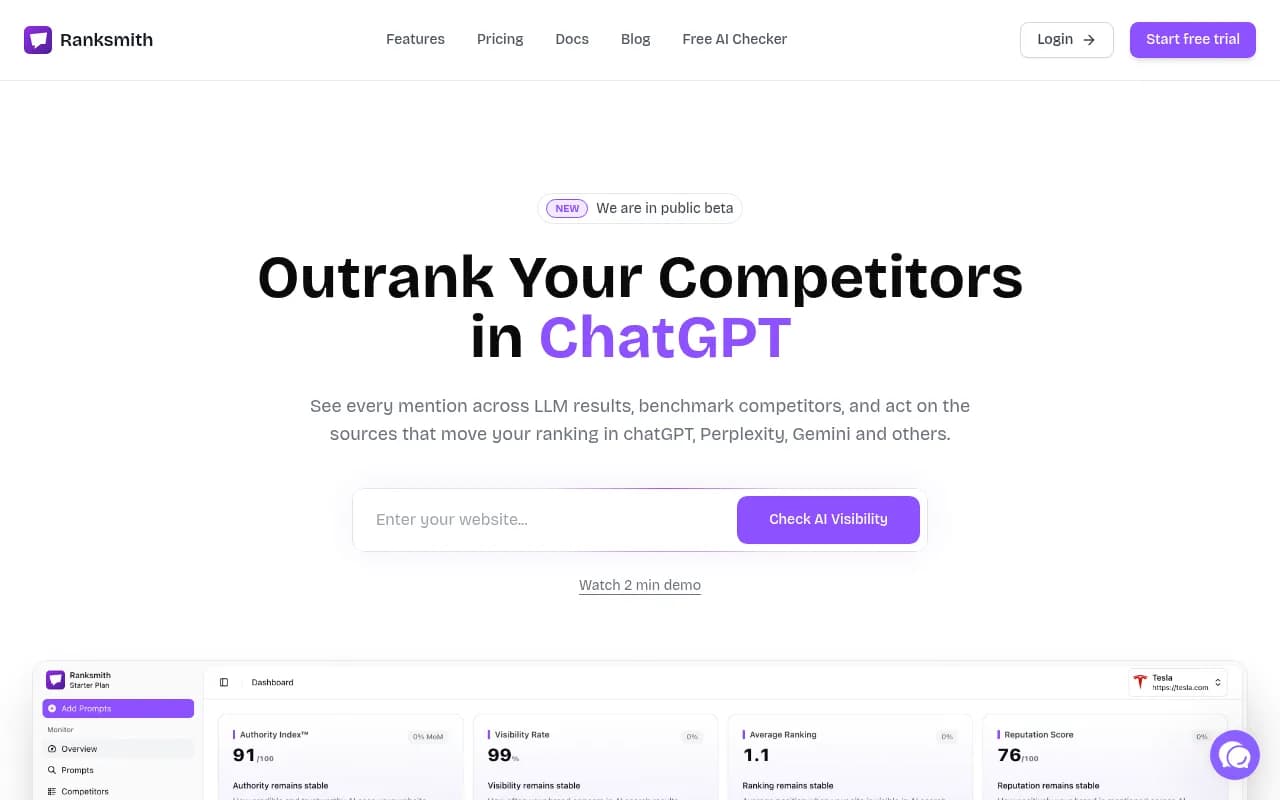
| Ranksmith | Yes | Yes | No | No | Actionable insights |
| Otterly.AI | Yes | No | No | No | Basic monitoring |
The difference between monitoring-only tools and optimization tools matters more in niche B2B than anywhere else. When you have a small number of high-value prompts to win, you need to know exactly what's missing and fix it fast -- not just watch a dashboard.

The prompt research process, step by step
Here's a practical workflow for identifying and prioritizing the prompts you should be targeting.
Step 1: Interview your sales team. Ask them to write down the last ten questions prospects asked before signing. These are real buyer prompts.
Step 2: Mine your support tickets and onboarding calls. The questions new customers ask are often the same questions prospects ask AI before they ever contact you.
Step 3: Check competitor content. What topics do your competitors write about? What questions do their FAQ pages answer? These are signals about what buyers are asking.
Step 4: Test the prompts yourself. Type your candidate prompts into ChatGPT, Perplexity, and Claude. See who gets cited. If it's not you, that's a gap. If it's nobody, that's an opportunity.
Step 5: Prioritize by buyer intent. Not all prompts are equal. A prompt that signals active vendor evaluation ("what should I look for in a [product category] vendor") is worth more than a general awareness prompt. Weight your content investment accordingly.
Step 6: Track and iterate. Once you publish content targeting specific prompts, monitor whether citations follow. This takes time -- typically weeks to months -- but the pattern is measurable.
Common mistakes niche B2B marketers make
Writing for search volume that doesn't exist. If you're still doing keyword research and filtering out anything under 100 monthly searches, you're optimizing for the wrong thing. Prompt-based content strategy doesn't require search volume.
Being too generic to be useful. The temptation in B2B content is to write broad, authoritative-sounding pieces that appeal to the widest possible audience. For AI citation, this backfires. Specific, narrow answers get cited. Generic overviews don't.
Ignoring the offsite citation ecosystem. Your website alone isn't enough. AI models triangulate across multiple sources. If you're not appearing in industry publications, review platforms, and community discussions, you're leaving citations on the table.
Not updating content. A 2023 article about a topic that's changed since then will get deprioritized by AI models in favor of fresher sources. Set a schedule to review and update your most important answer pages at least annually.
Measuring only website traffic. If you're judging your AI visibility strategy by Google Analytics sessions, you'll miss most of what's happening. AI referral traffic is growing but still underreported. Citation rate -- how often your brand appears in AI answers -- is the metric that matters.
Putting it together: a 90-day plan
If you're starting from scratch, here's a realistic 90-day approach:
Days 1-30: Research and audit. Map your 20-30 most important buyer prompts. Test each one in ChatGPT, Perplexity, and Claude. Document who gets cited and what those pages look like. Identify your top 5 gaps -- prompts where competitors get cited and you don't.
Days 31-60: Content creation. Write answer-first pages targeting your top 5 gaps. Each page should be comprehensive, structured, and specific. Add FAQ schema. Make sure the pages are crawlable.
Days 61-90: Distribution and tracking. Promote your new content through your industry channels. Submit to relevant publications. Set up tracking to monitor AI citations. Measure whether your new pages start appearing in AI answers.
This isn't a one-time project. The niche B2B AI visibility game is ongoing -- prompts evolve, competitors adapt, AI models update their retrieval behavior. But the fundamentals don't change: answer specific questions clearly, build topical depth, and track what's working.
The brands that win in niche B2B AI search in 2026 won't be the ones with the biggest content budgets. They'll be the ones that understood their buyers' questions better than anyone else -- and made sure AI models knew it.