Key takeaways
- Google AI Overviews now appear on roughly 89% of healthcare-related queries, making AI citation strategy a core part of any medical marketing plan.
- Google and ChatGPT define "trustworthy" healthcare sources very differently: Google favors elite hospital systems (33% of citations), while ChatGPT leans on government sources like CDC and NIH (27%).
- YMYL compliance isn't a checklist -- it's a continuous signal. Credentials, author bios, review dates, and structured data all contribute to whether Google's quality raters (and its AI) trust your content.
- The gap between monitoring your AI visibility and actually improving it is where most healthcare brands stall. Tracking which prompts you're missing is the starting point, not the finish line.
Why AI Overviews matter more in healthcare than anywhere else
Healthcare search is the highest-stakes category on the internet. When someone types "symptoms of a pulmonary embolism" or "is metformin safe during pregnancy," they're not browsing -- they're making decisions that affect their health. Google knows this, which is why healthcare falls squarely under YMYL (Your Money or Your Life) and gets evaluated by the strictest quality standards the algorithm applies.
The numbers make the urgency clear. According to BrightEdge research from late 2025, AI Overviews appear on approximately 89% of healthcare-related queries. That's not a niche feature anymore -- it's the default experience for patients searching for anything medical. If your content isn't being cited in those overviews, you're invisible at the exact moment someone is deciding whether to book an appointment, trust a diagnosis, or choose a treatment.
What makes this harder for healthcare brands is that AI Overviews don't just reward good SEO. They reward institutional trust signals that most smaller practices and health brands haven't built yet.
How Google evaluates healthcare content: E-E-A-T and YMYL explained
Google's quality evaluation framework, E-E-A-T (Experience, Expertise, Authoritativeness, Trustworthiness), applies to all content -- but for YMYL categories like healthcare, the bar is significantly higher. A recipe blog can recover from thin content. A medical site publishing inaccurate dosage information is a different problem entirely, and Google treats it that way.
Here's what each signal actually means in practice for healthcare brands.
Experience
This is the "first E" that Google added in late 2022, and it matters a lot in medicine. Experience means demonstrating that the person writing or reviewing the content has real, firsthand involvement with the topic. For a medical practice, this means:
- Physician-authored or physician-reviewed content, not just "reviewed by our team"
- Case studies, patient outcomes (anonymized appropriately), and clinical observations
- Content that reflects the nuance of actual clinical practice rather than textbook summaries
A cardiologist writing about atrial fibrillation management should write differently than a general health writer summarizing a study. That difference is detectable -- by human quality raters and, increasingly, by AI systems trained on authoritative medical literature.
Expertise
Credentials need to be visible and verifiable. This means:
- Named authors with medical degrees, board certifications, and specialty training clearly listed
- Author bio pages that link to professional profiles (LinkedIn, hospital directories, medical board listings)
- Content that matches the claimed expertise -- a dermatologist's page about skin cancer should reflect dermatology-level knowledge, not WebMD-level summaries
Authoritativeness
This is largely an off-site signal. What do other authoritative sources say about you? Are you cited by medical journals, referenced by other hospital systems, mentioned in health news? Do you have backlinks from .edu, .gov, or established medical organization domains?
For smaller practices, this is the hardest signal to build -- but it's also the most durable once established.
Trustworthiness
Google has said explicitly that trustworthiness is the most important of the four signals. In healthcare, this translates to:
- Accurate, up-to-date information with visible review dates
- Clear disclosure of who wrote and reviewed the content
- Transparent about what you do and don't know
- No misleading claims, exaggerated outcomes, or fear-based marketing tactics
- HTTPS, clear privacy policies, and accessible contact information
The citation gap: how Google AI Overviews pick healthcare sources
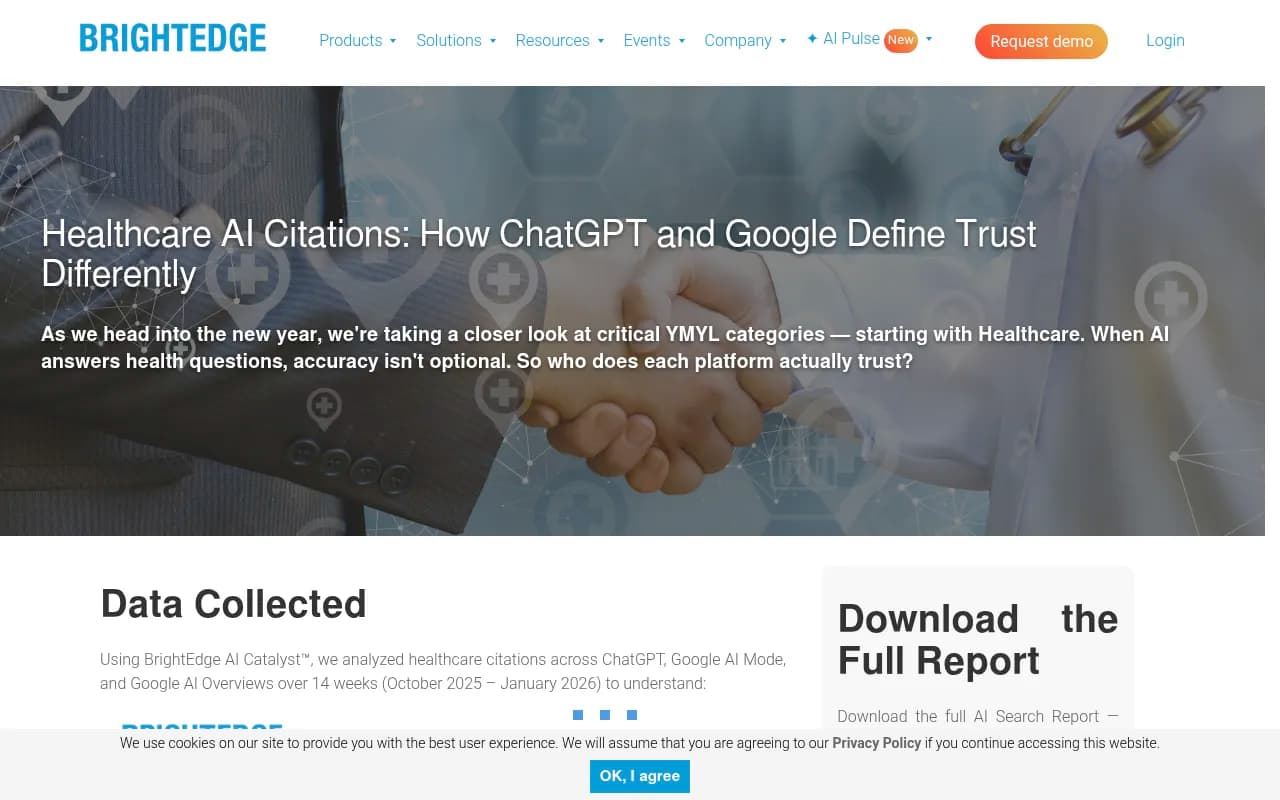
BrightEdge analyzed healthcare citations across ChatGPT, Google AI Mode, and Google AI Overviews over 14 weeks (October 2025 through January 2026). The findings reveal something that most healthcare marketers haven't fully absorbed yet: different AI platforms trust completely different types of sources.
| Source type | ChatGPT | Google AI Overviews |
|---|---|---|
| Government (.gov) | 27% | 10% |
| Elite hospital systems | 1% | 33% |
| Medical specialty orgs | 17% | 2% |
| Consumer health media | 7% | 6% |
The contrast is stark. Google AI Overviews cite elite hospital systems (major academic medical centers, nationally-ranked health systems) at 33% of the time -- and government sources only 10% of the time. ChatGPT does the opposite: 27% government sources, just 1% elite hospital systems.
What this means practically:
- If you're trying to appear in Google AI Overviews, you need to position your content alongside or in reference to the same sources Google already trusts -- Mayo Clinic, Cleveland Clinic, Johns Hopkins, major academic medical centers.
- If you're trying to appear in ChatGPT responses, aligning your content with CDC, NIH, and FDA guidance is more important.
- Neither platform relies heavily on consumer health media. Popular health information sites get 6-7% of citations across both platforms. This is not where the citations are going.
For most healthcare brands, the implication is that you can't just publish good content and wait. You need to understand which platform is sending you traffic, what that platform's citation preferences look like, and build your content strategy around those specific trust signals.
Promptwatch tracks citation patterns across all major AI platforms, including Google AI Overviews, ChatGPT, and Perplexity -- so you can see exactly where your content is being cited and where competitors are getting picked up instead.

Building medical authority signals that Google's AI actually reads
Structured author credentials
Google's quality raters use author information to assess E-E-A-T. So does the AI that generates overviews. The practical requirements:
- Every piece of medical content needs a named author with credentials listed inline (not just in a footer bio)
- Use Schema.org
Personmarkup for authors, includinghonorificSuffix(MD, DO, PhD),hasCredential, andaffiliation - Link author names to dedicated bio pages that include: medical school, residency, board certifications, current practice affiliation, and any published research
A page that says "Written by Dr. Sarah Chen, MD, FACC, Board-Certified Cardiologist at [Hospital Name]" with a linked bio page signals something very different from "Written by our medical team."
Medical review and date signals
Content freshness matters in healthcare because guidelines change. A page about diabetes management written in 2021 may contain outdated HbA1c targets. Google knows this, and AI Overviews are more likely to cite content that shows it's been reviewed recently.
Best practices:
- Add a "Medically reviewed by [Name, Credentials]" line with a review date, separate from the publication date
- Use
dateModifiedin your Schema markup and keep it accurate - Set a review schedule for clinical content -- at minimum annually, more often for rapidly evolving topics
Schema markup for healthcare content
Structured data helps AI systems understand what your content is about and who produced it. For healthcare, the most useful schema types are:
MedicalWebPagewithmedicalAudienceandlastReviewedpropertiesPhysicianorMedicalOrganizationfor practice and provider pagesFAQPagefor symptom and treatment Q&A content -- this format maps well to how AI Overviews present informationArticlewith full author and organization markup
None of this is a magic citation trigger. But it reduces ambiguity about what your page is, who wrote it, and when it was reviewed -- which matters when an AI system is deciding whether to include your content in a health-related response.
Building authoritative backlinks in healthcare
The off-site authority signals that matter most for Google AI Overviews in healthcare:
- Links from hospital systems, medical schools, and academic medical centers
- Citations in medical association publications or continuing education resources
- Mentions in health journalism (not just press releases -- actual editorial coverage)
- Listings in physician directories (Doximity, Healthgrades, Zocdoc) with consistent NAP data
- Guest content on established medical platforms with author attribution
This is slow work. There's no shortcut to getting a link from a major academic medical center. But it's the kind of authority that compounds -- and it's what separates practices that get cited in AI Overviews from those that don't.
Content strategy: what AI Overviews actually want to cite
Answer the question directly, then go deeper
AI Overviews are built to give users a complete answer without requiring a click. That sounds like bad news for traffic, but it's actually a signal about what content gets cited: pages that answer questions clearly and completely.
The structure that works:
- Direct answer to the query in the first 1-2 sentences
- Supporting context (mechanism, evidence, caveats)
- Practical guidance (when to see a doctor, what to expect, treatment options)
- Sources and references
This isn't just good UX -- it's the format that AI systems can most easily extract and attribute.
Cover the full topic, not just the keyword
Google's AI systems evaluate topical completeness. A page about "type 2 diabetes symptoms" that only covers the most common symptoms will lose to a page that also addresses atypical presentations, differences by age group, when symptoms warrant emergency care, and how symptoms differ from type 1.
This is where content gap analysis becomes genuinely useful. The question isn't "what keywords do I want to rank for?" -- it's "what questions are patients asking about this topic that my current content doesn't answer?"
Avoid the consumer health media trap
The BrightEdge data shows that consumer health media (think popular health information sites) gets only 6-7% of AI citations in healthcare. These sites have been optimizing for traditional SEO for years, but AI systems are passing them over in favor of institutional sources.
For healthcare brands, this is actually an opportunity. You're not competing with WebMD for AI citations -- you're competing with hospital system content. And hospital system content, while authoritative, is often written for a general audience and doesn't reflect the specific clinical expertise of individual specialists.
A board-certified orthopedic surgeon writing about ACL reconstruction outcomes can produce content that's more clinically specific and experientially grounded than what a major hospital system publishes for a general audience. That specificity is a differentiator.
FAQ and Q&A content maps directly to AI Overview format
AI Overviews frequently pull from FAQ sections because the format matches how they present information. For every major clinical topic you cover, build a FAQ section that addresses:
- What is [condition]?
- What causes [condition]?
- What are the symptoms?
- How is it diagnosed?
- What are the treatment options?
- When should I see a doctor?
- What questions should I ask my doctor?
Use FAQPage schema. Keep answers concise but complete. Update them when clinical guidelines change.
Technical compliance: what Google's crawlers need to see
Page speed and Core Web Vitals
Google's ranking systems consider page experience, and AI Overviews are more likely to cite pages that meet Core Web Vitals thresholds. For healthcare sites, common issues include:
- Large unoptimized images (medical photography, infographics)
- Heavy third-party scripts (patient portal integrations, scheduling widgets)
- Render-blocking JavaScript
Run regular technical audits. Tools like Screaming Frog are good for crawl-level issues.
HTTPS and security signals
Every page on a healthcare site should be served over HTTPS. This is table stakes, but it's worth auditing -- especially for older practice websites that may have mixed content issues.
Accessibility and structured navigation
Healthcare sites serve patients with disabilities, and accessibility signals also matter to Google. Proper heading hierarchy, alt text for medical images, and accessible forms all contribute to overall page quality.
Monitoring your AI visibility in healthcare search
Publishing great content is necessary but not sufficient. You need to know whether it's actually being cited, which prompts are triggering citations, and where competitors are appearing instead of you.
This is where most healthcare marketing teams hit a wall. Traditional SEO tools show you keyword rankings. They don't show you whether your cardiology department page is being cited when someone asks ChatGPT about heart failure symptoms, or whether a competitor's content is appearing in Google AI Overviews for the queries you care most about.
Platforms like Promptwatch track AI citations across Google AI Overviews, ChatGPT, Perplexity, Gemini, and other AI search engines -- and importantly, they show you the gaps: which prompts your competitors are being cited for that you're not. That gap analysis is where the actual optimization work begins.
For enterprise healthcare systems with large content operations, BrightEdge AI Catalyst offers deep citation analysis specifically designed for YMYL categories.
A practical YMYL compliance checklist for healthcare brands
Use this as a starting audit framework before publishing or updating clinical content.
| Signal | What to check |
|---|---|
| Author credentials | Named author, credentials listed inline, linked bio page |
| Medical review | Reviewer name, credentials, and review date visible |
| Schema markup | MedicalWebPage, Physician/MedicalOrganization, FAQPage where applicable |
| Content freshness | dateModified accurate, review schedule in place |
| Source citations | References to clinical guidelines, peer-reviewed research, or authoritative institutions |
| Topical completeness | Covers the full question, not just the primary keyword |
| Technical health | HTTPS, Core Web Vitals passing, no crawl errors |
| Off-site authority | Backlinks from .edu, .gov, hospital systems, medical associations |
| Accuracy | Content aligned with current clinical guidelines (check against CDC, NIH, relevant specialty org) |
| Transparency | Clear about limitations, when to seek care, no misleading claims |
The honest reality for smaller healthcare brands
If you're a single-specialty practice or a regional health system, you're not going to out-cite Mayo Clinic in Google AI Overviews overnight. The institutional authority signals that Google's AI favors take years to build.
But there are realistic wins available:
- Local and condition-specific queries where major hospital systems don't have deep content
- Specialty-specific topics where your clinical expertise is genuinely deeper than what generalist health sites publish
- Patient experience content (what to expect during a procedure, recovery timelines, questions to ask your surgeon) where firsthand clinical experience is the differentiator
The practices that will build durable AI visibility in healthcare are the ones treating content as a clinical communication channel -- not a marketing exercise. That means named physicians, current guidelines, honest acknowledgment of uncertainty, and content that actually helps patients make better decisions.
That's what Google's trust bar is measuring. It's also, not coincidentally, what good medicine looks like.