Key takeaways
- ChatGPT doesn't rank pages -- it cites sources. For "how to" queries, your goal is to become the source it pulls from, not to appear in a list of links.
- Tutorial content structured with clear step-by-step formatting, direct answers, and machine-readable headings gets cited significantly more often than long-form prose.
- Off-page authority matters more than most people expect. Sites with 32,000+ referring domains are roughly 3.5x more likely to be cited by ChatGPT than lower-authority sites (SE Ranking, 2026).
- Tracking AI citations requires different tools than traditional rank trackers -- you need to monitor actual model responses, not just SERP positions.
- The biggest gap most brands have isn't content quality -- it's content coverage. Competitors are getting cited for prompts you haven't even thought to target yet.
Why "how to" queries are a different beast in AI search
When someone types "how to migrate a WordPress site" into ChatGPT, they're not looking for a list of links. They want an answer. ChatGPT synthesizes one from whatever sources it trusts most -- and if your tutorial isn't in that pool, you simply don't exist for that user.
This is fundamentally different from Google. On Google, you can rank position 3 and still get clicks. In ChatGPT, there's no position 3. The model either cites you or it doesn't. And for "how to" queries specifically, the stakes are high because these are high-intent, action-oriented searches. People asking "how to" questions are ready to do something. They convert.
According to Growth Memo's April 2026 data, ChatGPT's top recommendation becomes the user's actual choice 74% of the time. In 88% of AI Mode sessions, users never leave the answer pane to check external sources. That's a winner-take-most dynamic, and tutorial content sits right at the center of it.
The good news: "how to" content is actually one of the easiest content types to optimize for AI citation -- if you understand what the models are looking for.
How ChatGPT selects sources for tutorial queries
Before you can optimize, you need to understand the pipeline.
ChatGPT operates in two modes. When web search is off, it draws from training data -- everything it ingested before its knowledge cutoff. When web search is on (the default for most users in 2026), it queries Bing in real time, reads the top results, and synthesizes a response with inline citations.
For "how to" queries specifically, the model is looking for content that:
- Answers the question directly and completely without requiring the reader to piece together context from multiple sections
- Uses structured formatting that can be parsed cleanly (numbered steps, clear headings, short paragraphs)
- Comes from a domain with enough authority that the model "trusts" the source
- Matches the specific framing of the prompt -- not just the topic, but the angle and intent
That last point is worth dwelling on. ChatGPT doesn't just look for content about a topic. It looks for content that answers the specific question the user asked. A tutorial titled "WordPress Migration Guide" might cover the same ground as "How to migrate a WordPress site without losing SEO," but the second one is far more likely to be cited for that specific prompt because it matches the intent precisely.
The tutorial content optimization framework
Step 1: Map the actual prompts people are using
Most SEO keyword research surfaces head terms like "WordPress migration" or "how to migrate WordPress." But ChatGPT users phrase things differently. They ask full questions: "How do I migrate my WordPress site to a new host without downtime?" or "What's the safest way to move a WordPress site?"
Your first job is to build a prompt map -- a list of the actual questions your target audience is asking AI models. There are a few ways to do this:
- Ask ChatGPT itself what questions people ask about your topic. It'll give you a surprisingly useful list.
- Use a GEO platform to see which prompts competitors are currently getting cited for. Tools like Promptwatch have an Answer Gap Analysis feature that shows you exactly which prompts your competitors appear in that you don't.

- Look at "People also ask" boxes in Google -- these often mirror how people phrase questions to AI models.
- Check Reddit threads in your niche. The way people phrase questions in r/Wordpress or r/webdev is very close to how they prompt ChatGPT.
Once you have your prompt map, prioritize by two factors: how often the prompt is asked (volume) and how competitive it is (difficulty). High-volume, lower-difficulty prompts are your quick wins.
Step 2: Structure your tutorial for machine extraction
This is where most tutorials fail. They're written for humans scrolling through a page, not for AI models trying to extract a clean answer. Here's what actually works:
Use a direct answer at the top. Before you get into the steps, give a one or two sentence summary of what the tutorial covers and what the reader will be able to do. This is the "inverted pyramid" approach -- lead with the conclusion, then support it. AI models frequently pull this summary paragraph as their cited answer.
Number your steps explicitly. Don't use vague headings like "Getting started" or "The process." Use "Step 1: Install the migration plugin" or "Step 3: Update your DNS records." Numbered steps are easy for models to extract and present in a structured response.
Keep each step self-contained. A reader (or an AI model) should be able to understand what to do in step 3 without needing to re-read steps 1 and 2. Avoid forward references like "as we'll see later" or backward references like "remember from step 1."
Use H2 and H3 headings that mirror the prompt. If you're targeting "how to set up Google Analytics 4," your H2 should literally say "How to set up Google Analytics 4" -- not "GA4 setup process" or "Getting started with analytics." The heading match matters.
Include a quick-reference summary or table. A table summarizing the steps, or a "what you'll need" list at the top, gives AI models a clean, structured block to cite. Models love tables.
Write short paragraphs. Three to four sentences maximum. Long paragraphs are hard for models to parse cleanly. Break them up.
Step 3: Build the authority signals that make models trust you
Here's the uncomfortable truth: even perfectly structured tutorial content won't get cited if your domain doesn't have enough authority. SE Ranking's 2026 research found that sites with over 32,000 referring domains are 3.5x more likely to be cited by ChatGPT than lower-authority sites. That's a massive gap.
You can't manufacture domain authority overnight, but you can work on the signals that matter most for AI citation:
Brand mentions on trusted sites. ChatGPT's training data includes a huge amount of content from Reddit, Wikipedia, major publications, and industry blogs. If your brand is mentioned positively and frequently in those places, the model builds a stronger association between your brand and your topic area. Guest posts, PR coverage, and community participation all contribute here.
Backlinks from authoritative domains. The overlap between traditional SEO and AI search optimization is real here. High-quality backlinks remain one of the strongest signals that a domain is trustworthy.
Consistent entity presence. Make sure your brand name, your authors, and your company are clearly defined across your site. Use schema markup for your organization, your authors (with credentials), and your articles. AI models use entity recognition to assess expertise.
Author credentials. For tutorial content especially, the E-E-A-T signals matter. Who wrote this? What's their experience? A tutorial written by "Staff Writer" is less likely to be cited than one written by a named author with a bio that demonstrates relevant expertise.
Step 4: Optimize for the specific "how to" query patterns
Not all "how to" queries are the same. There are a few distinct patterns, and each needs slightly different treatment:
| Query pattern | Example | What the model wants |
|---|---|---|
| Step-by-step process | "How to set up a VPN" | Numbered steps, clear prerequisites, expected outcome |
| Troubleshooting | "How to fix 404 errors in WordPress" | Diagnosis first, then solutions in order of likelihood |
| Comparison within a task | "How to choose between X and Y" | Criteria-based comparison, clear recommendation |
| Conceptual how-to | "How does X work" | Clear explanation, analogy, then practical application |
| Tool-specific | "How to use [tool] to do X" | Tool-specific steps, screenshots or descriptions of UI elements |
For step-by-step process queries, the numbered step format is non-negotiable. For troubleshooting queries, lead with the most common cause first -- models tend to mirror this structure in their responses. For comparison queries, a table is your best friend.
Step 5: Cover the full topic cluster, not just one page
One of the most consistent patterns in AI citation data is that models prefer to cite sources that cover a topic comprehensively. A single tutorial page rarely gets cited as often as a site that has ten interconnected tutorials on the same topic.
This is topical authority at work. If your site has tutorials on every aspect of WordPress migration -- the basic process, migrating without downtime, migrating to specific hosts, troubleshooting common errors, post-migration SEO checks -- the model builds a stronger association between your site and WordPress migration as a topic.
Build topic clusters deliberately. For each "how to" topic you want to own, map out the full range of related questions and create a page for each one. Link them together with clear internal links. The goal is to be the most complete resource on the topic, not just the best single page.
The content format checklist for AI-cited tutorials
Before publishing any tutorial, run through this checklist:
- Does the page title match the exact phrasing of the target prompt?
- Is there a direct answer or summary in the first 100 words?
- Are steps numbered with descriptive labels?
- Are headings written as questions or "how to" phrases where appropriate?
- Is each step self-contained and actionable?
- Is there a table, list, or structured summary that can be extracted cleanly?
- Are paragraphs three to four sentences or fewer?
- Is there author information with demonstrated expertise?
- Is schema markup in place (HowTo schema is particularly relevant here)?
- Does the page link to related tutorials in the same topic cluster?
HowTo schema deserves special mention. It's a structured data format specifically designed for tutorial content, and it explicitly signals to crawlers (including AI crawlers) that this page contains step-by-step instructions. Use it. It won't guarantee citation, but it removes friction.
Tracking whether your tutorials are actually getting cited
Here's where a lot of teams fall down. They optimize their content, publish it, and then have no idea whether it's working. Traditional rank tracking tools show you Google positions -- they don't show you whether ChatGPT is citing your page.
You need visibility into actual AI model responses. That means:
- Running your target prompts through ChatGPT, Perplexity, and other models regularly to see if your content appears
- Tracking which pages on your site are being cited and how often
- Monitoring when AI crawlers visit your pages (which tells you whether the models are even reading your content)
- Watching for changes in AI referral traffic in your analytics
This is exactly what GEO platforms are built for. Promptwatch, for example, tracks citations across 10 AI models, shows you which pages are being cited and by which models, and logs when AI crawlers like ChatGPT's bot visit your site. The crawler log data is particularly useful for tutorial content -- if you can see that ChatGPT crawled your page but isn't citing it, that's a signal the content needs structural work.
For teams that want to start simpler, there are lighter-weight options worth knowing about:
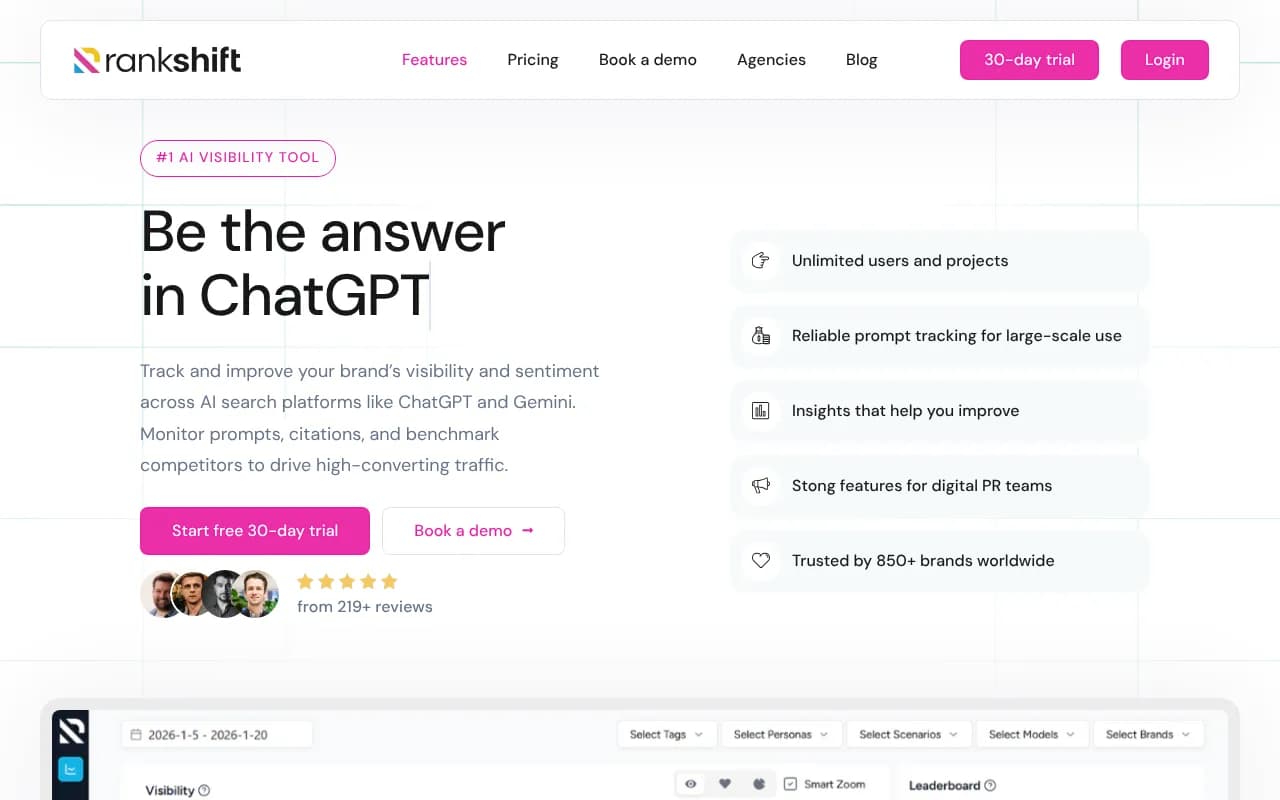


These tools give you a baseline view of AI citation rates without the full feature set of a platform like Promptwatch. Good starting points if you're just getting into AI visibility tracking.
The off-page work that most tutorial creators ignore
On-page optimization gets most of the attention, but off-page signals drive a disproportionate share of AI citation success. Here's what actually moves the needle:
Reddit presence. ChatGPT's training data includes enormous amounts of Reddit content. If people in relevant subreddits are recommending your tutorials, linking to them, or citing them as authoritative sources, that signal feeds directly into how much the model trusts your domain for that topic. Participate genuinely in communities. When your tutorial is relevant, share it. Don't spam -- Reddit communities will bury you if you do.
YouTube tutorials. AI models increasingly cite video content, and YouTube tutorials that reference your written guides create a citation loop. A YouTube video that says "for the full written guide, check out [your site]" creates both a backlink and a brand mention in a context the model treats as authoritative.
Third-party listicles and roundups. When a "best tutorials for X" article on a high-authority site includes your tutorial, that's a strong signal. These listicles are heavily cited by AI models when users ask for recommendations. Getting into them is worth real effort.
Wikipedia and knowledge base mentions. If your content is cited on Wikipedia or in industry knowledge bases, that's one of the strongest possible signals for AI trust. It's hard to engineer, but worth pursuing through legitimate means -- contributing to Wikipedia articles in your area of expertise, for example.
A realistic timeline and what to expect
Getting cited by ChatGPT for "how to" queries isn't instant. Here's a rough timeline based on what practitioners are seeing in 2026:
- Week 1-2: Publish optimized tutorial with proper structure, schema markup, and internal linking
- Week 2-4: AI crawlers (you can see these in server logs or through a GEO platform) begin visiting the page
- Month 1-2: If the content is strong and the domain has reasonable authority, initial citations start appearing in AI responses
- Month 2-4: Citations become more consistent as the model's training or retrieval cache updates
- Month 3-6: Topic cluster effect kicks in -- as you publish more related tutorials, citation rates for the whole cluster improve
The timeline compresses significantly if your domain already has strong authority. For newer or lower-authority domains, the off-page work described above is what bridges the gap.
Putting it together: the practical workflow
Here's the end-to-end workflow in plain terms:
- Pick a "how to" topic cluster you want to own
- Map the specific prompts people use (not just keywords)
- Audit what competitors are being cited for using a GEO tool
- Identify the gaps -- prompts where no one is being cited well, or where you could do better
- Write tutorials that match the exact prompt phrasing, use numbered steps, include a direct answer upfront, and cover the topic completely
- Add HowTo schema markup
- Build the off-page signals: Reddit presence, backlinks, brand mentions on authoritative sites
- Track citations using an AI visibility platform
- Iterate based on what's working -- which pages are getting cited, which prompts are still gaps
The brands winning in AI search right now aren't doing anything magical. They're being systematic about a process that most of their competitors are still ignoring. Tutorial content is one of the clearest opportunities in that process -- the query type is well-defined, the optimization signals are knowable, and the tracking is getting better every month.
Start with one topic cluster. Get cited for it. Then expand.