Key takeaways
- The average page cited in Google AI Overviews is 1,282 words (Ahrefs, 174K pages studied), and short content under 1,000 words accounts for 53.4% of all AI Overview citations.
- A separate Presence AI study found citation rates peak at 64% for pages between 3,000 and 4,999 words, suggesting longer content can win -- but only when it earns its length.
- 44.2% of all AI citations are extracted from the first 30% of a page, so where you put your best information matters as much as how much you write.
- After Google I/O 2026, top-10 organic results now account for only 38% of AI Overview citations, down from 76% in July 2025. Ranking alone no longer guarantees a citation.
- Tracking which of your pages actually get cited -- and which don't -- is the only reliable way to know if your content strategy is working.
The "write longer" advice has been floating around SEO circles for years. Hit 2,000 words. No, 3,000. Actually, make it 5,000 and add a FAQ section. The logic always felt intuitive: more content means more chances to match a query, more signals of depth, more reason for Google to trust you.
Then AI Overviews arrived and scrambled everything.
Now the question isn't just whether Google ranks your page. It's whether an AI model reads your page and decides to cite it in a generated answer. Those are two different problems, and the data on content length tells a genuinely complicated story.
Let me walk through what the research actually says -- because it's more interesting than most takes suggest.
What the Ahrefs study found
Ahrefs analyzed 174,000 pages that appeared in AI Overview citations and came back with a finding that surprised a lot of people: the average cited page is 1,282 words long.
That's not a long article. That's roughly the length of a detailed product page or a focused how-to guide.
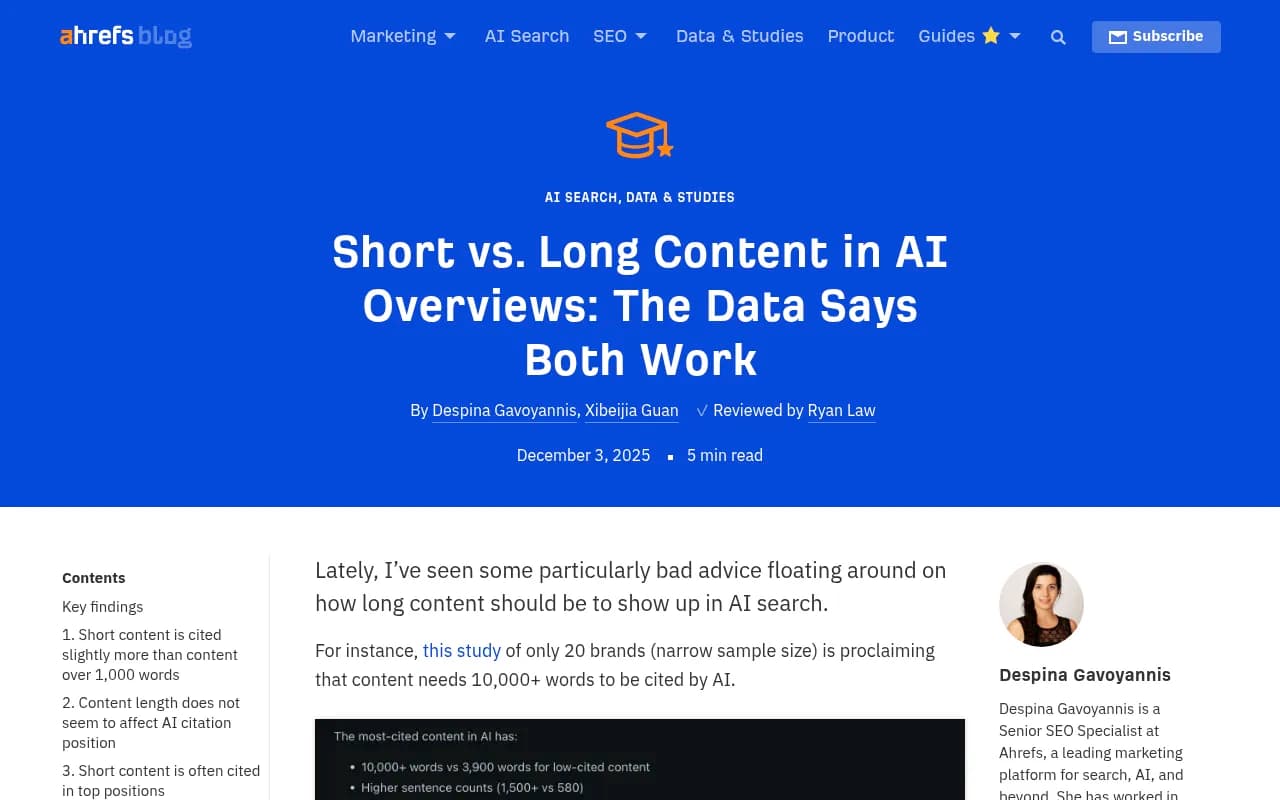
The study also found that short content (under 1,000 words) is cited slightly more than content over 1,000 words, and that content length has essentially no correlation with citation position -- the Spearman correlation between word count and citation rank was r = 0.04, which is about as close to zero as you can get.
So if you're writing 4,000-word articles specifically to rank higher in AI Overviews, the data doesn't support that strategy.
But there's a catch.
The Presence AI study tells a different story
A 2026 study from Presence AI looked at citation rates (not just whether a page appeared, but how often it got cited) and found a different pattern:
- Pages between 3,000 and 4,999 words had a citation rate of 64%
- Once you cross 7,500 words, the citation rate drops to 58%
- Very short pages had notably lower citation rates
This seems to contradict the Ahrefs data, but it actually doesn't -- the two studies are measuring different things. Ahrefs looked at the average length of pages that appear in citations. Presence AI looked at the rate at which pages of different lengths earn citations.
Think of it this way: lots of short pages exist on the web, and some of them get cited. But if you're specifically trying to build a page that earns citations, longer and more comprehensive content performs better -- up to a point.
The sweet spot appears to be somewhere between 3,000 and 5,000 words. After that, you're likely adding length without adding value, and citation rates start to slip.
The 53.4% short-content puzzle
Status Labs added another layer to this by analyzing citation distribution:
- 53.4% of all AI Overview citations go to pages under 1,000 words
- 30.6% go to pages between 1,000 and 2,000 words
- Pages above 2,000 words account for the remainder
At first glance, this looks like a strong argument for short content. But it reflects the composition of the web more than a preference by AI models. The internet has far more short pages than long ones. If 80% of pages are under 1,000 words, getting 53% of citations isn't necessarily impressive -- it might actually mean short pages are underperforming relative to their prevalence.
The honest answer is that we don't have clean data on citation rate by length across a representative sample of the entire web. What we do have suggests that length alone is a weak predictor either way.
Where the content actually gets extracted from
Here's the finding I find most useful in practice: 44.2% of all AI citations are extracted from the first 30% of a page (Wix/Evertune study, May 2026).
That changes how you should think about content structure. AI models aren't necessarily reading your entire article and rewarding you for the depth of your section on "advanced considerations." They're often pulling from your introduction, your first few headers, your opening summary.
This means:
- Put your direct answer early. Don't bury the lead behind three paragraphs of context-setting.
- Use clear headers in the first third of your article that match the language of the query.
- Don't save your best content for a "conclusion" that AI models may never reach.
The implication for long-form content is that you can write 4,000 words, but if the first 1,200 words are vague or generic, you're probably not getting cited regardless of total length.
How query length changes the picture
One more variable worth understanding: the length of the query has a strong effect on whether AI Overviews appear at all.
According to SEOProfy's 2026 analysis:
| Query length | AI Overview appearance rate |
|---|---|
| 1 word | 9.5% |
| 3 words | 14.0% |
| 5 words | 27.6% |
| 7+ words | 46.4% |
Longer, more specific queries trigger AI Overviews far more often. And longer queries tend to be answered by more specific, detailed content. So if your target keywords are conversational or question-based ("how do I fix X when Y happens"), longer content that thoroughly addresses the nuance is probably a better fit than a 500-word overview.
Short content wins more often for short, direct queries. Long content wins more often for complex, multi-part questions. Neither is universally better.
The Google I/O 2026 shift you can't ignore
Any discussion of AI Overviews content strategy in 2026 has to acknowledge what happened after Google I/O in May 2026.
Ahrefs data from March 2026 confirmed that top-10 organic results now account for only 38% of AI Overview citations, down from 76% in July 2025. That's a 50% relative drop in eight months.
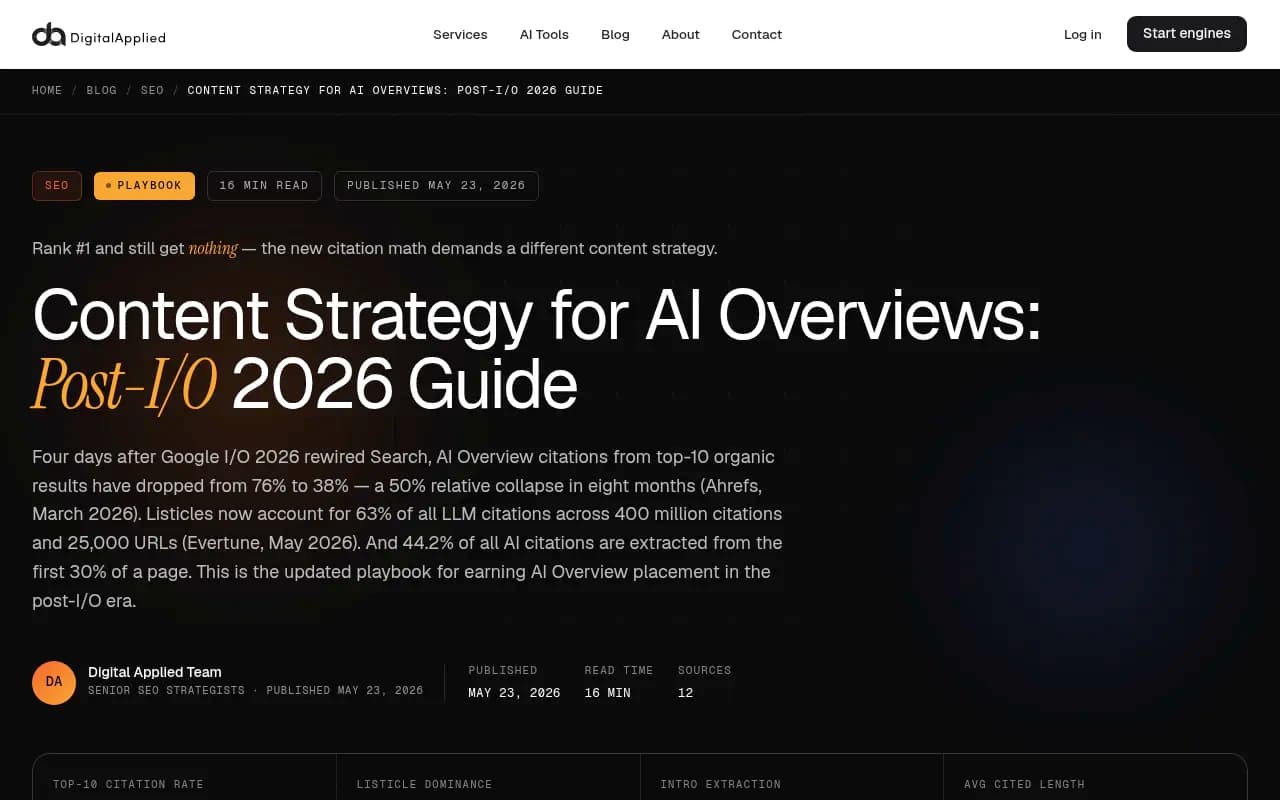
What this means practically: you can rank #1 in organic search and still not appear in the AI Overview for that query. Google is pulling citations from a much wider pool of sources than it used to -- including pages that don't rank in the top 10 at all.
This is both unsettling and interesting. It means content that directly and clearly answers a specific question can earn an AI citation even without strong domain authority or a high organic ranking. But it also means your existing rankings give you less protection than they used to.
Evertune's analysis of 400 million citations found that listicles now account for 63% of all LLM citations. That's a format signal worth paying attention to -- structured, scannable content with clear enumerated points appears to be what AI models find easiest to extract and cite.
What this means for your content strategy
Pulling all of this together, here's what the data actually supports:
Don't write long content for length's sake
The Ahrefs correlation of r = 0.04 between word count and citation position is about as clear a signal as you'll get: adding words doesn't move the needle on its own. Content that earns citations tends to be specific, direct, and well-structured -- not just long.
Do write comprehensive content for complex queries
The Presence AI citation rate data (64% for 3,000-4,999 word pages) suggests that for competitive, nuanced topics, thorough coverage does help. The key is that every section should add something -- a specific data point, a concrete example, a step that wasn't covered before. Padding a 1,500-word article to 4,000 words with filler text is not the same as writing a genuinely comprehensive 4,000-word article.
Front-load your best content
Given that 44.2% of citations come from the first 30% of a page, treat your opening section like a standalone answer. If someone only reads the first third of your article, they should still get the core answer. The rest of the article can add depth, nuance, and supporting detail.
Match format to query type
Listicles dominate AI citations right now (63% of LLM citations per Evertune). For "best X" or "how to Y" queries, a numbered or bulleted structure is probably worth prioritizing over flowing prose. For deep technical or research-oriented queries, longer prose with clear headers may work better.
Track what's actually getting cited
Most content never gets cited at all, even after 30 days. Neil Patel's team noted this after analyzing 1,500+ pages -- the majority simply don't appear in AI Overviews regardless of length or quality. If you're not tracking which of your pages earn citations and which don't, you're making content decisions without feedback.
Tools like Promptwatch track exactly which pages get cited in AI Overviews and other AI search engines, how often, and by which models -- so you can see what's working instead of guessing.

For tracking AI Overview visibility specifically, a few other tools are worth knowing about:

A practical content length framework for 2026
Based on the data, here's a rough framework for deciding how long to make a piece:
| Content type | Query intent | Recommended length | Format |
|---|---|---|---|
| Definition / FAQ | Short, direct query | 500-900 words | Short prose or Q&A |
| How-to guide | Procedural, 3-5 words | 1,000-2,000 words | Numbered steps |
| Comparison / "best X" | Research intent | 2,000-3,500 words | Listicle with table |
| Deep analysis / study | Long-tail, complex | 3,000-5,000 words | Structured headers |
| Technical documentation | Specific, niche | 1,500-4,000 words | Headers + code blocks |
The upper bound on "deep analysis" content is deliberate. The Presence AI data shows citation rates start declining above 7,500 words, and practically speaking, content that long often includes sections that don't add much. If you're at 5,000 words and considering whether to add another 2,500, ask whether those 2,500 words answer a question that isn't already covered -- not whether they make the article feel more authoritative.
The bottom line
The data doesn't support a simple "longer is better" or "shorter is better" conclusion. What it supports is something more specific:
- Short, focused content (under 1,000 words) can and does earn AI citations, especially for direct queries.
- Comprehensive content in the 3,000-5,000 word range earns citations at a higher rate, making it a better bet for competitive topics.
- Structure and front-loading matter more than raw word count -- 44.2% of citations come from the first 30% of a page.
- After Google I/O 2026, ranking in the top 10 no longer guarantees an AI Overview citation, which means content quality and directness matter more than ever.
The most honest advice: write the length that genuinely answers the question, put your best content first, use clear structure, and track which pages actually earn citations so you can learn from what works.
If you're not measuring AI visibility yet, you're making content decisions based on organic rankings that now account for less than half of what gets cited.