Key takeaways
- Structured, answer-first content formats (guides, comparison tables, FAQ clusters, listicles with context) consistently outperform thin or unstructured pages in both ChatGPT citations and Google AI Overviews.
- GEO tools reveal that AI models don't just reward keyword density -- they reward depth, credibility signals, and content that directly resolves a user's intent.
- The formats that work best share a common trait: they're easy for AI to parse, extract, and quote without needing to rewrite the source.
- Citation frequency accounts for roughly 35% of AI answer inclusions, according to GEO research from Stackmatix -- meaning being cited elsewhere matters as much as your own content structure.
- Tracking which of your pages actually get cited (and which don't) is the only reliable way to know if your format choices are working.
Why format matters more than you think
Most SEO advice focuses on what to say. GEO data is increasingly revealing that how you say it -- the structure, the format, the way you organize information -- is what determines whether an AI model quotes you or skips you entirely.
Google AI Overviews now reaches over 2.5 billion monthly active users, and AI Mode has passed 1 billion. ChatGPT processes hundreds of millions of queries daily. These aren't niche channels anymore. They're where a significant chunk of your potential customers are forming opinions and making decisions before they ever visit your site.
The problem is that most content wasn't built with AI citation in mind. It was built to rank in traditional search, which rewards different things. AI models don't scroll through a page looking for the best paragraph -- they parse structure, extract direct answers, and cross-reference credibility signals. If your content isn't organized to support that process, it gets passed over.
GEO tools have made this visible in a way that wasn't possible before. By tracking which pages get cited across ChatGPT, Perplexity, Google AI Overviews, and other models, you can see patterns in what works. And those patterns point clearly to specific formats.
The formats GEO data consistently surfaces
Comprehensive how-to guides with clear H2/H3 structure
Long-form guides that walk through a topic step by step are among the most-cited content types in AI responses. But length alone isn't the reason -- it's the structure. AI models extract answers from headings and the paragraphs directly beneath them. A guide with clear H2 sections like "How to do X" and "What happens when Y" gives AI an easy map to follow.
What makes these work:
- Each section answers a discrete question, not just a subtopic
- The opening paragraph of each section contains the core answer (don't bury the lead)
- Headings use natural language that mirrors how people actually ask questions
- The guide covers the topic deeply enough that AI doesn't need to look elsewhere to complete its answer
Thin how-to content -- 500-word articles that gesture at a topic without resolving it -- gets skipped. AI models seem to prefer sources that can be cited as authoritative rather than as one of many partial answers.
Comparison and "vs." pages
Comparison content performs exceptionally well in both ChatGPT and AI Overviews. When someone asks "What's the difference between X and Y?" or "Which tool is better for Z?", AI models want a source that directly addresses that question. A well-structured comparison page with a clear table, explicit pros and cons, and a stated recommendation is almost exactly what they're looking for.
The table format is particularly valuable here. AI models can extract tabular data cleanly and present it in their responses. A comparison table with clear column headers and concise cell content is one of the most citable formats you can publish.
Example structure that works:
| Format | AI citation rate | Best for |
|---|---|---|
| Comparison tables | High | Decision-stage queries |
| Step-by-step guides | High | How-to and process queries |
| FAQ clusters | Medium-high | Informational and clarification queries |
| Opinion/editorial pieces | Low-medium | Brand awareness, not direct citation |
| Thin listicles (no context) | Low | Rarely cited |
FAQ clusters and question-answer blocks
FAQ sections have been around forever, but they've taken on new importance in the AI era. When you structure content as explicit question-and-answer pairs, you're essentially pre-formatting your content for AI extraction. The model doesn't have to interpret what your page is about -- you've told it directly.
The key is that each answer needs to be self-contained. An answer that says "As mentioned above..." or "See the previous section for context" is useless to an AI model pulling a single response. Every answer should stand alone.
FAQ clusters also help with what GEO researchers call "query fan-outs" -- the way a single user prompt branches into multiple sub-queries that an AI model resolves in parallel. If your FAQ covers not just the main question but the natural follow-up questions, you increase the chance of being cited across multiple parts of the AI's response.
Definitive listicles with context
Not all listicles are equal. A list of "10 tools for X" with one-line descriptions rarely gets cited. A list of "10 tools for X" where each item includes what it does, who it's for, a key limitation, and a concrete use case is a different thing entirely.
AI models cite listicles when the list items are substantive enough to be useful on their own. The format signals that the content is organized and scannable, but the substance is what earns the citation.
Listicles that work well tend to:
- Include 6-15 items (not 50 -- that signals low-effort padding)
- Give each item 2-4 sentences of genuine context
- Be clearly opinionated about which options are best for which use cases
- Include a comparison table or summary section
Data-backed research and original statistics
Original data is one of the most reliable citation triggers across all AI models. When your page contains a specific statistic -- especially one that isn't available elsewhere -- AI models have a strong reason to cite you as the source.
This doesn't mean you need to run expensive research studies. Even internal data, survey results from your own customers, or analysis of publicly available datasets can produce citable statistics. The key is that the data needs to be specific, sourced, and presented clearly.
Research from GEO analysis suggests that brands actively optimizing for AI search see citation rates 2-3x higher than those relying on traditional SEO alone. That gap is partly explained by content format choices.
What GEO tools actually reveal about format performance
The shift from guessing to knowing happened when GEO monitoring tools became capable of tracking citations at the page level. Instead of asking "is our content good?", you can now ask "which specific pages are being cited by ChatGPT, and what do they have in common?"
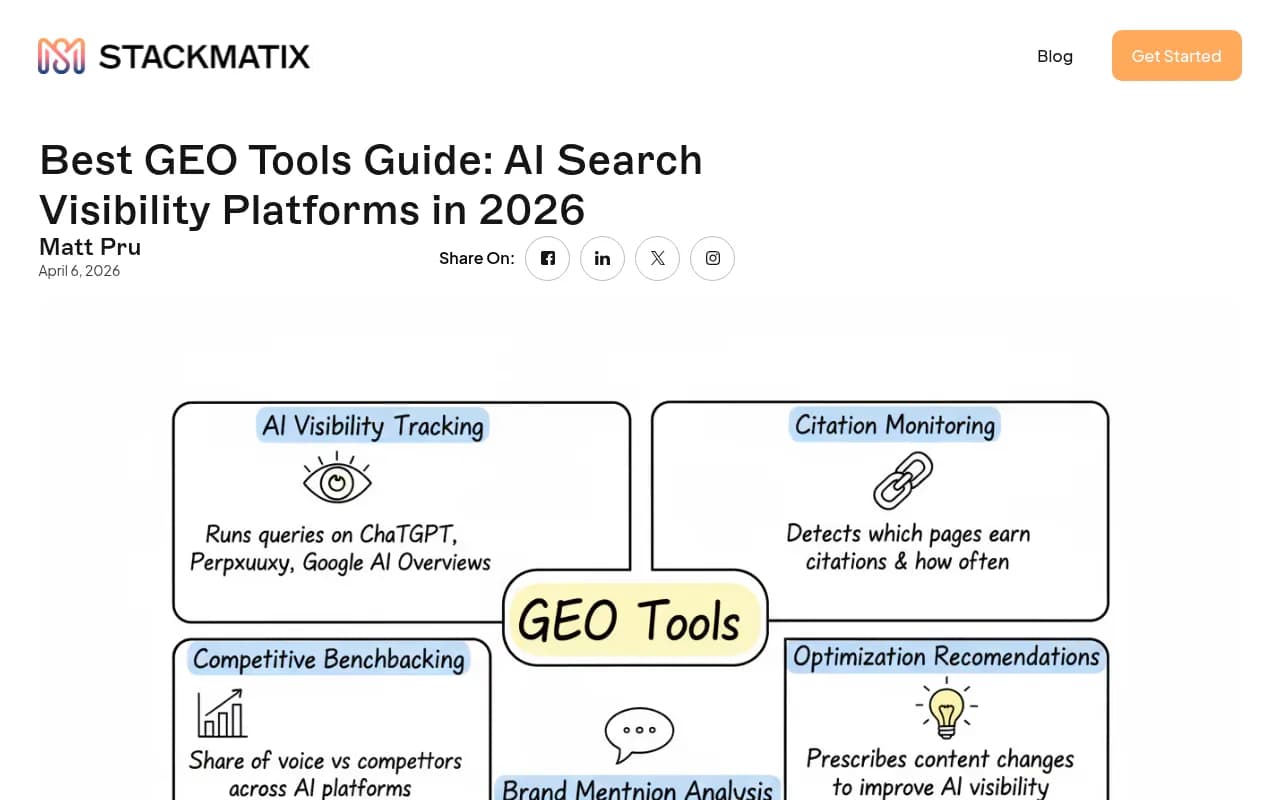
Tools in this space vary significantly in what they can tell you. Some track whether your brand appears in AI responses. Others go deeper and show you which pages are being cited, how often, and by which models. The latter is far more useful for format optimization because it lets you run a real experiment: publish content in different formats, track citation rates, and iterate.
Promptwatch takes this further with page-level citation tracking and AI crawler logs that show exactly which pages AI agents are reading, how often they return, and when a page moves from "crawled" to "cited." That kind of data makes format testing concrete rather than theoretical.

For teams that want to understand format performance at scale, a few tools are worth knowing:
SE Ranking has an AI Overview tracker that monitors which of your pages appear in Google AI Overviews for target keywords. It's useful for Google-specific format testing.
Semrush has added AI visibility features to its toolkit, though its prompt tracking uses fixed prompts rather than dynamic real-user queries.
AthenaHQ monitors AI visibility across multiple models and is useful for brand-level tracking, though it's more monitoring-focused than optimization-focused.

Otterly.AI is a lighter-weight option for teams that want basic citation monitoring without a large platform investment.

Profound offers solid tracking across AI search engines with a clean interface for brand and page-level visibility.

The ranking signals that cut across both ChatGPT and AI Overviews
Despite being different systems built by different companies, ChatGPT and Google AI Overviews share some common citation preferences. GEO research and practitioner data point to a consistent set of signals:
E-E-A-T signals embedded in content
Google's AI Overviews draw heavily from its core ranking systems, including its evaluation of Experience, Expertise, Authoritativeness, and Trustworthiness. ChatGPT and other LLMs have their own versions of this -- they're trained to prefer sources that demonstrate credibility.
In practice, this means:
- Author bylines with real credentials (not just a name)
- Specific citations to data sources within the content
- Publication dates that are recent or clearly updated
- Content that acknowledges nuance and limitations rather than making sweeping claims
Schema markup
Structured data helps AI models understand what your content is. FAQ schema, HowTo schema, and Article schema all make it easier for AI to extract and categorize your content correctly. This is one of the more technical format choices, but it has a measurable impact on AI Overview inclusion.
Topical depth and internal linking
AI models prefer sources that cover a topic comprehensively. A single well-written page is good. A cluster of related pages that link to each other and cover a topic from multiple angles is better. This signals that your site is a genuine authority on the subject rather than a one-off page.
Page speed and crawlability
This sounds basic, but AI crawlers behave differently from Googlebot. Some models crawl less frequently and are more sensitive to slow load times or crawl errors. If your pages aren't being crawled reliably, they can't be cited. Monitoring AI crawler behavior -- which pages they visit, how often, what errors they encounter -- is something most teams haven't thought about yet.
Format mistakes that hurt AI citation rates
A few patterns consistently show up in content that gets ignored by AI models:
Burying the answer. Content that spends three paragraphs on background before getting to the point is hard for AI to cite accurately. The answer should be in the first 1-2 sentences of each section.
Vague claims without specifics. "Many experts believe..." and "Studies show..." without actual citations are signals that the content isn't authoritative. AI models are trained to prefer specific, sourced claims.
Walls of text with no structural breaks. Content without headings, lists, or tables is harder to parse. Even if the substance is good, the format works against citation.
Over-optimized keyword stuffing. LLMs don't respond to keyword density the way old-school SEO did. Repeating a phrase 15 times in an article doesn't help -- it can actually signal low quality.
Content that requires context to understand. If a section of your page only makes sense if you've read the previous section, it can't be cited in isolation. Self-contained sections are more citable.
Building a format testing workflow
The most effective approach to format optimization isn't to read a guide like this one and then rewrite all your content. It's to build a feedback loop:
- Pick 10-20 pages that target prompts you care about
- Track which of those pages are currently being cited in AI responses (and which aren't)
- Identify the format differences between the cited and uncited pages
- Update the uncited pages to match the format patterns of the cited ones
- Track whether citation rates improve over 4-8 weeks
This is exactly the kind of workflow that GEO platforms are built to support. The gap between "we think our content is good" and "we can see which pages are being cited and why" is the gap between guessing and optimizing.
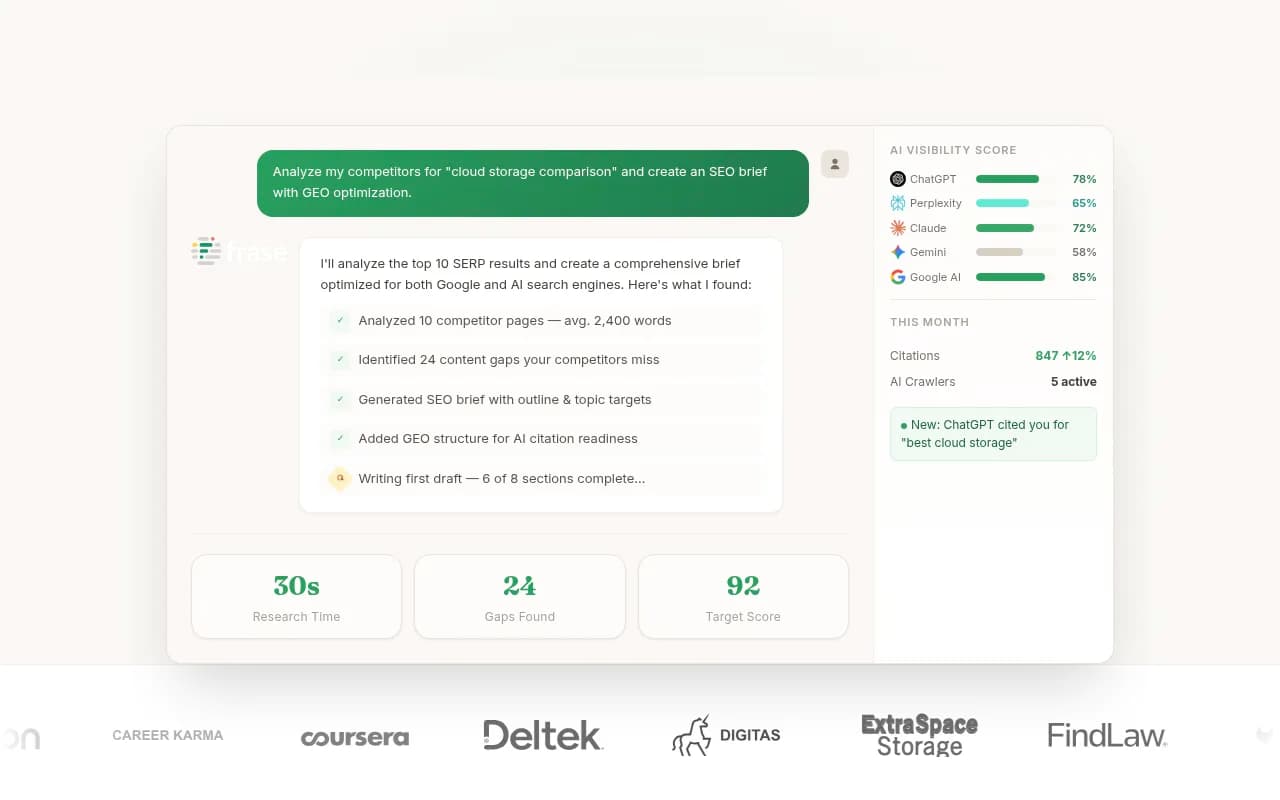
Tools like Frase and Clearscope can help with the content optimization side -- identifying what topics and questions your pages should cover to match AI expectations.
For content creation that's grounded in actual prompt data and citation patterns, Surfer SEO has built out AI-era content workflows that go beyond traditional keyword optimization.
A practical format checklist
Before publishing any piece of content you want to rank in AI search, run through this:
- Does the page have a clear H2/H3 structure where each section answers a discrete question?
- Does each section's opening sentence contain the core answer (not the setup)?
- Is there at least one comparison table if the content involves multiple options?
- Are there FAQ-style question-and-answer blocks for the most common follow-up questions?
- Does the content include specific data points with clear attribution?
- Is there schema markup (FAQ, HowTo, or Article) implemented?
- Are author credentials visible and specific?
- Is the page part of a topical cluster with relevant internal links?
- Can each major section be understood without reading the rest of the page?
Nine "yes" answers doesn't guarantee citation. But it puts you in a significantly better position than most of the content competing for the same prompts.
The bottom line
Format is no longer a secondary consideration in content strategy. For AI search specifically, it's often the deciding factor between being cited and being invisible. The good news is that the formats AI models prefer -- structured guides, comparison tables, FAQ clusters, data-backed listicles -- are also formats that human readers find useful. You're not optimizing for machines at the expense of people. You're building content that's genuinely clear and useful, which is what both audiences want.
The teams that are pulling ahead in AI visibility right now aren't necessarily producing more content. They're producing content that's easier to cite, tracking which pages actually get cited, and iterating on the format patterns that work. That feedback loop is the real competitive advantage.