Key takeaways
- Traditional rank position means almost nothing in AI search. The metrics that matter are citation rate, share of voice, AI referral traffic, and AI-sourced conversion value.
- "Reference rate" -- the share of AI responses for a given query set that mention your brand -- is the closest GEO equivalent to organic click-through rate.
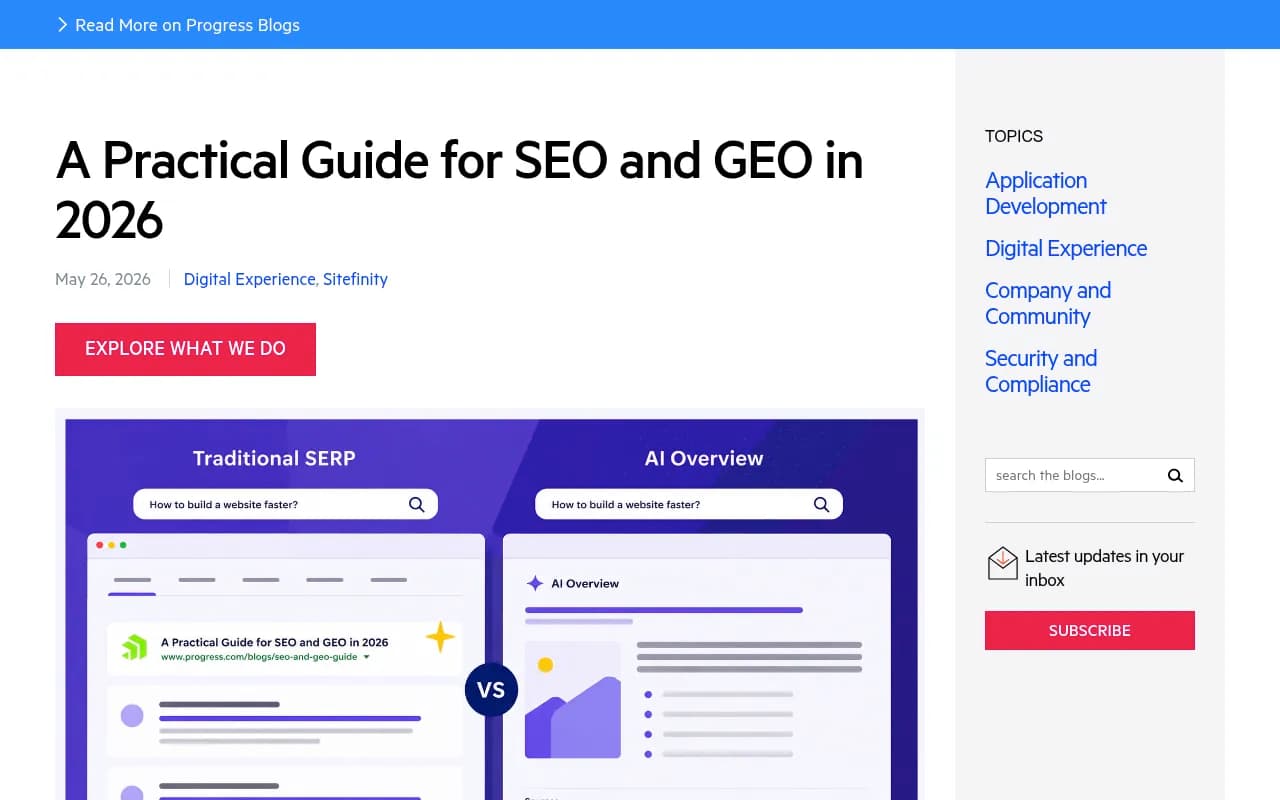
- Getting cited inside a Google AI Overview earns 35% more clicks than holding a traditional organic ranking alone, according to Seer Interactive data.
- Most GEO tools stop at monitoring. The ones worth paying for also help you close the gaps they find.
- Crawler logs and page-level citation tracking are what separate serious platforms from basic dashboards.
Why traditional rank tracking fails in AI search
If you've been running SEO for any length of time, you know the rhythm: check positions, watch impressions in Search Console, celebrate when you move from #4 to #2. That model made sense when search results were a ranked list and position directly predicted clicks.
AI search doesn't work that way.
When someone asks ChatGPT a question, there's no position 1 through 10. There's a synthesized answer, and either your brand is cited in it or it isn't. When Google's AI Overview fires at the top of a results page, the blue links below it may never be seen -- Seer Interactive found that pages cited inside an AI Overview earn 35% more clicks than a traditional organic ranking, while pages sitting below an AI Overview without a citation lose roughly 61% of their expected traffic.
That's not a ranking problem. That's a citation problem. And citation requires completely different metrics to measure.
The good news: the GEO measurement framework is actually pretty clean once you understand it. There are four core metrics, a few supporting signals, and a handful of tools that track them well. Let's go through all of it.
The four core GEO metrics
These come from practitioners who've been working through what actually maps to business outcomes. Think of them as a funnel: awareness, share, traffic, revenue.
Citation rate (reference rate)
This is the foundational GEO metric. Citation rate measures what share of AI responses, for a defined set of prompts, mention or cite your brand. Some practitioners call it "reference rate" -- same concept.
If you track 100 prompts relevant to your category and your brand appears in 23 of the AI-generated answers, your citation rate is 23%. That number is your baseline. Everything else is measured against it.
Citation rate varies significantly by AI model. You might have a 40% citation rate in Perplexity and 12% in ChatGPT for the same prompt set. That gap tells you something specific: either ChatGPT's training data doesn't include enough of your content, or the pages you have aren't structured in a way that ChatGPT's retrieval prefers. Both are fixable problems.
AI share of voice
Share of voice goes one level up. Instead of asking "how often am I cited?", it asks "when AI models answer questions in my category, what percentage of citations go to me versus my competitors?"
If you and three competitors are all being cited across 100 prompts, and you appear in 30 of them while the top competitor appears in 55, your share of voice is 30% and theirs is 55%. That competitive context is what makes share of voice useful for prioritization -- it tells you where the ceiling is and who you're chasing.
AI referral traffic
Citation rate and share of voice are visibility metrics. AI referral traffic is where visibility connects to your website.
This is traffic that arrives from AI platforms -- ChatGPT, Perplexity, Gemini, Claude -- when users click through from a cited source. It shows up in your analytics as referral traffic from domains like chat.openai.com, perplexity.ai, or gemini.google.com.
The volume is still modest compared to organic search for most sites, but the quality is often high. Users who click through from an AI citation have already received a synthesized answer and decided they want more depth from your specific page. Bounce rates tend to be lower and time-on-page tends to be higher than average organic traffic.
AI-sourced conversion value
The final metric connects the chain to revenue. Of the traffic arriving from AI citations, how much converts -- and what's it worth?
This requires proper attribution setup. You need to tag AI referral sources in your analytics and connect them to conversion events. It's more work than the other three metrics, but it's the only way to answer the question that actually matters to leadership: "Is our investment in GEO generating revenue?"
Supporting metrics worth tracking
The four core metrics cover the funnel. These supporting signals help you diagnose why the funnel looks the way it does.
Prompt coverage: How many of the prompts relevant to your category does your content actually address? Gaps in prompt coverage directly predict gaps in citation rate.
Sentiment in citations: When AI models do mention your brand, is the framing positive, neutral, or negative? A high citation rate with negative framing is worse than a moderate citation rate with positive framing.
Citation position: Some tools track where in an AI response your brand appears -- early citations carry more weight than mentions buried in the fifth paragraph of a long answer.
Model-by-model breakdown: Your visibility in ChatGPT, Perplexity, Google AI Overviews, and Claude can differ dramatically. Tracking by model helps you prioritize where to focus content efforts.
Crawler activity: Which AI crawlers are hitting your pages, how often, and are they encountering errors? This is the technical layer underneath citation rate -- if AI crawlers can't read your pages cleanly, citation rate will suffer regardless of content quality.
How GEO tools actually measure these metrics
The mechanics vary by platform, but most GEO tools follow a similar approach: they run your tracked prompts through AI models on a regular schedule, parse the responses, and record whether your brand was cited, where, and in what context.
The better platforms do this against the actual user-facing interfaces -- not just API calls -- because the answers users see can differ from what the API returns. This matters especially for Google AI Overviews, which have their own retrieval logic separate from the Gemini API.
Here's a comparison of what different tool categories actually measure:
| Metric | Basic monitoring tools | Mid-tier GEO platforms | Full GEO platforms |
|---|---|---|---|
| Citation rate | Yes | Yes | Yes |
| Share of voice | Sometimes | Yes | Yes |
| AI referral traffic | No | Sometimes | Yes |
| Model-by-model breakdown | Sometimes | Yes | Yes |
| Crawler/agent logs | No | Rarely | Yes |
| Content gap analysis | No | No | Yes |
| Conversion attribution | No | No | Yes |
| Content generation | No | No | Yes |
The gap between "basic monitoring" and "full GEO platform" is significant. Basic tools tell you your citation rate went from 18% to 22%. A full platform tells you why it changed, which pages drove the improvement, which prompts you're still losing, and what content you need to create to close the remaining gaps.
Tools for measuring GEO progress
There are a lot of options in this space now. Here's an honest breakdown of what different tools are good for.
For comprehensive tracking and optimization
Promptwatch is the platform I'd point most marketing teams toward first. It tracks across 10 AI models (ChatGPT, Perplexity, Google AI Overviews, Claude, Gemini, Grok, DeepSeek, Copilot, Meta AI, Mistral), but the real differentiator is what happens after the tracking. The Answer Gap Analysis shows you exactly which prompts competitors are visible for that you're not -- not just a list of gaps, but the specific content your site is missing. Content Agents then generate articles and briefs grounded in that prompt data. The crawler logs show you which AI agents are hitting your pages and whether they're encountering errors. That full loop -- find gaps, create content, track results -- is what makes it an optimization platform rather than a dashboard.

For enterprise teams with existing SEO infrastructure, BrightEdge has added solid AI visibility tracking to its platform. It's expensive but integrates well with existing workflows.
Profound has a strong feature set for tracking brand visibility across AI search engines, with good competitive comparison tools.

For mid-market teams
Otterly.AI is one of the more affordable options for teams that primarily need citation monitoring without the full optimization stack.

Peec AI handles multi-language tracking well, which matters if you're operating across markets.

GEO Metrics tracks share of voice, domain citations, average position, and accuracy rate across ChatGPT, Gemini, Perplexity, and other models. Good for teams that want clear GEO-specific dashboards.
For tracking AI referral traffic
AIClicks focuses specifically on the traffic side -- tracking clicks from AI platforms and connecting them to your analytics.
LLM Clicks is another option in this space, purpose-built for citation-to-click tracking.
For technical crawler monitoring
DarkVisitors tracks AI agents and bots hitting your website, which is useful for understanding which AI crawlers are indexing your content and at what frequency.
For traditional SEO teams adding GEO
SE Ranking has added an AI visibility toolkit to its existing SEO platform, which makes it a reasonable option for teams that don't want to manage a separate GEO tool.
Semrush has added some AI visibility features, though its approach uses fixed prompts rather than dynamic tracking, which limits how well it captures real-world AI search behavior.
Setting up your GEO measurement baseline
Before you can track progress, you need a baseline. Here's a practical setup process.
Step 1: Define your prompt set
Start with 30-50 prompts that represent how your target customers actually ask questions in your category. These shouldn't be keyword-style queries ("best project management software") -- they should be conversational prompts ("what's a good project management tool for a remote team of 10?").
Include prompts at different stages of the funnel: awareness-level questions, comparison questions, and specific brand-name queries. The mix matters because AI models behave differently across these categories.
Step 2: Run your baseline measurement
Run all your prompts through your chosen GEO tool and record:
- Your citation rate per model
- Your share of voice vs. top 3 competitors
- Which specific pages are being cited
- Which prompts return zero citations for your brand
That last category -- the zero-citation prompts -- is your immediate priority list.
Step 3: Check your AI referral traffic
Go into your analytics and filter for referral traffic from AI platforms. Even if the volume is small, establish the baseline now. In six months, you want to be able to show the trend line.
Step 4: Audit your crawler logs
If your GEO platform supports it, check which AI crawlers are hitting your site and whether they're encountering errors (4xx, 5xx responses, blocked by robots.txt). Crawler errors are often the simplest fix with the biggest citation impact.
The Google AI Overviews measurement problem
Google AI Overviews deserve special mention because they're measured differently from other AI platforms.
Unlike ChatGPT or Perplexity, AI Overviews appear inside Google Search results. That means your traditional Google Search Console data is relevant -- but it doesn't tell you whether you were cited inside an AI Overview or just ranked below one.
Conductor's analysis found that 25.11% of searches triggered an AI Overview in Q1 2026, up from 13.14% in March 2025. In commercial verticals, BrightEdge puts the figure closer to 48%. At that scale, the distinction between "cited in the AI Overview" and "ranked below it" is a major traffic difference.
The tools that handle this best are the ones that actually simulate searches in the Google interface and parse whether your domain appears as a cited source inside the AI Overview box -- not just whether you rank on the page.
What good GEO progress actually looks like
One thing worth setting expectations on: GEO progress is slower than traditional SEO, and the feedback loop is less direct.
When you publish a new page optimized for a traditional keyword, you might see ranking movement within days. With GEO, the cycle is longer: publish content, wait for AI crawlers to index it, wait for models to incorporate it into their responses, then see citation rate move. The full cycle can take 4-8 weeks.
That's why crawler log data is so valuable. It lets you see the intermediate steps -- "the Perplexity crawler hit this page three times last week" -- before you see the citation rate change. It turns a black box into something you can actually diagnose.
A realistic improvement trajectory for a brand starting from scratch:
- Months 1-2: Establish baseline, fix crawler errors, identify top 10 gap prompts
- Months 2-4: Publish content targeting gap prompts, see initial citation rate movement
- Months 4-6: Citation rate measurably up, AI referral traffic trend visible
- Month 6+: Share of voice data shows competitive movement
That's not slow for a new channel. It's just different from what SEO teams are used to.
The metric that ties it all together
If you had to pick one number to report to leadership, make it AI share of voice for your core prompt set. It captures both your absolute performance (citation rate) and your competitive position, it's easy to explain, and it moves in response to the right actions.
Citation rate tells you how you're doing. Share of voice tells you how you're doing relative to the competition. AI referral traffic tells you whether it's driving real behavior. Conversion value tells you whether it's worth the investment.
Track all four. Start with share of voice for the executive summary.
The tools are good enough now that measurement isn't the hard part. The hard part is acting on what you find -- which is why the platforms that close the loop from measurement to content creation to tracking are worth the premium over basic monitoring dashboards.