Key takeaways
- Ranksmith starts at $69/month with a 7-day free trial and no credit card required. Bluefish starts around $4,000/month on annual contracts. These tools are not competing for the same budget.
- Bluefish is purpose-built for Fortune 500 marketing teams with dedicated support, infosec compliance, and custom enterprise workflows. Ranksmith is built for self-serve teams who want to get started fast.
- Both tools cover AI monitoring and competitor benchmarking, but Bluefish goes deeper on brand influence, AI commerce tracking, and custom audience segmentation -- capabilities that Ranksmith doesn't offer.
- Ranksmith's prompt prioritization and source-level recommendations give smaller teams a clear action path without needing a dedicated analyst or account manager.
- If you're an SMB, agency, or growth-stage company, Bluefish's pricing makes it a non-starter. If you're a Fortune 500 brand with a serious AI marketing budget, Ranksmith may feel too lightweight.
- Neither tool includes built-in AI content generation or crawler log analysis -- if those matter to you, you'll need to look elsewhere.
Overview
Ranksmith
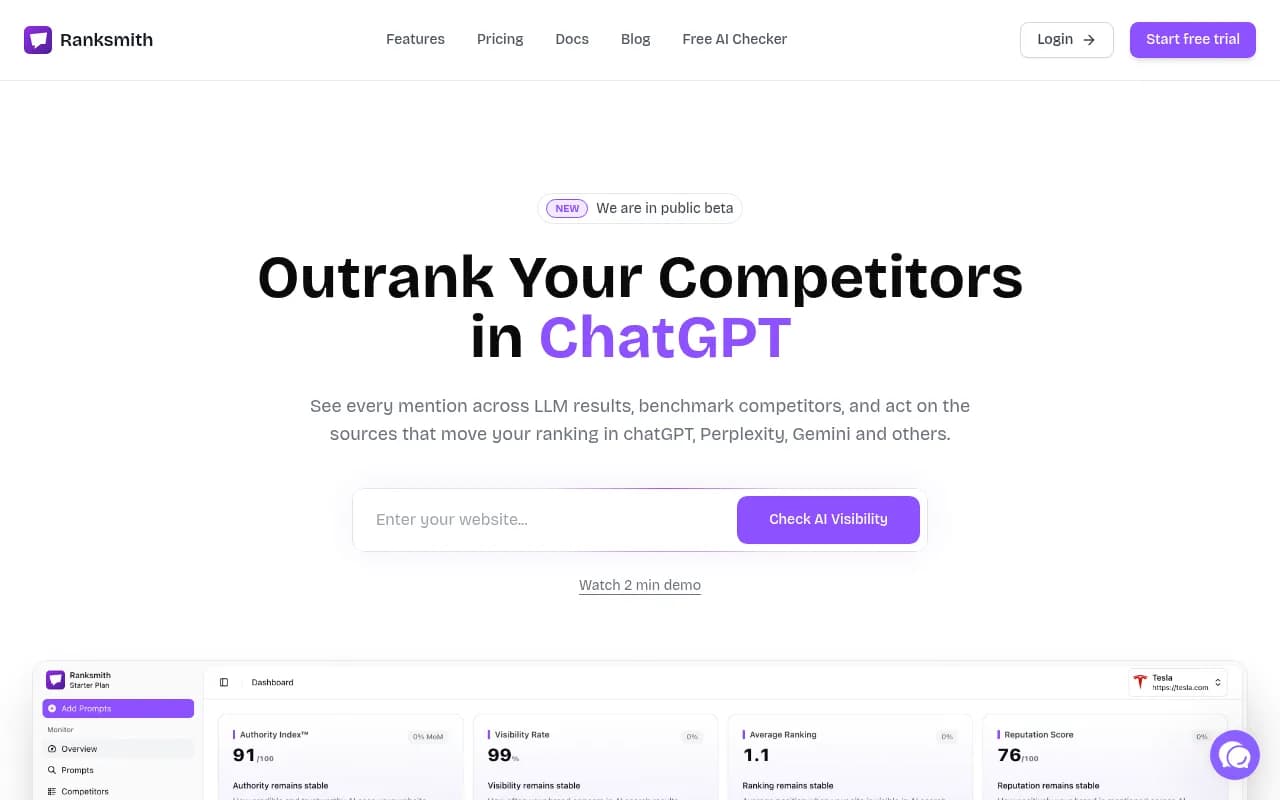
Ranksmith is a self-serve GEO (Generative Engine Optimization) platform that tracks how brands appear across AI search engines like ChatGPT, Perplexity, Gemini, Grok, and Claude. It's currently in public beta and targets marketing teams, SEO professionals, and agencies who want to monitor AI visibility, benchmark competitors, and get actionable recommendations without a lengthy onboarding process.
The core pitch is straightforward: set up your prompts, see where your brand appears (and where it doesn't), benchmark against competitors, and act on the citation sources that actually influence rankings. Pricing is transparent and accessible, starting at $69/month.
Bluefish
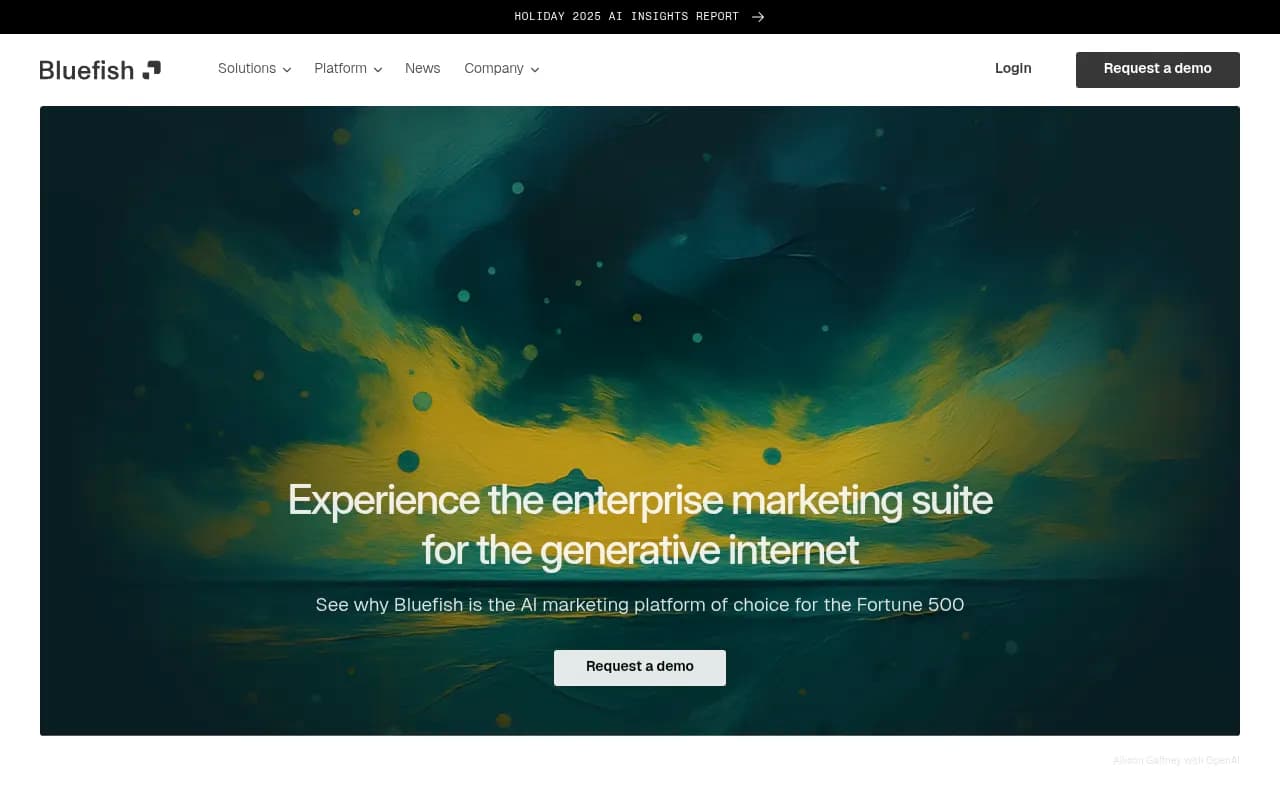
Bluefish positions itself as the AI marketing platform for the Fortune 500. It's an enterprise-grade suite covering AI monitoring, GEO optimization, measurement, and AI commerce tracking. The platform is designed for large marketing teams that need deep customization, infosec compliance, and dedicated support -- not a self-serve dashboard you spin up in an afternoon.
Bluefish's differentiator is depth: custom audience segmentation, campaign ROI measurement in the AI channel (their "Collections" feature), and a focus on understanding how AI models "think" about your brand, not just whether you appear. The tradeoff is price and accessibility -- you need to book a demo and sign an annual contract to get in.
Side-by-side comparison
| Feature | Ranksmith | Bluefish |
|---|---|---|
| Starting price | $69/month | ~$4,000/month |
| Free trial | 7-day, no credit card | No (demo required) |
| Target audience | SMBs, agencies, growth teams | Fortune 500, enterprise |
| AI models monitored | 2-6 (plan-dependent) | ChatGPT, Perplexity, Gemini + others |
| Competitor benchmarking | Yes | Yes |
| Prompt management | Yes, with AI suggestions | Yes, custom/tailored |
| Source/citation tracking | Yes | Yes |
| AI commerce tracking | No | Yes |
| Custom audience segmentation | No | Yes |
| Campaign ROI measurement | No | Yes (Collections feature) |
| Infosec/enterprise compliance | Not mentioned | Yes |
| Content generation | No | No |
| AI crawler logs | No | No |
| Self-serve setup | Yes | No (sales-led) |
| Annual billing discount | 20% | Standard (annual contracts) |
| Public pricing | Yes | No |
Head-to-head feature deep-dive
Pricing and accessibility
This is where the two tools diverge most sharply. Ranksmith has four public tiers:
| Plan | Price | Prompts | Models |
|---|---|---|---|
| Starter | $69/month | 25 | 2 |
| Growth | $149/month | 50 | 4 |
| Pro | $299/month | 100 | 6 |
| Enterprise | $549/month | 150 | 6 |
Annual billing saves 20% across all plans. There's a 7-day free trial with no credit card required, which means you can actually test the product before committing.
Bluefish doesn't publish pricing. Based on available information, plans start around $4,000/month on annual contracts. The exact cost depends on the number of brands, markets, and features you need -- which means a sales conversation before you see any numbers.
Verdict: Ranksmith wins on accessibility by a wide margin. Bluefish's pricing is only realistic for enterprise marketing budgets.
Monitoring and coverage
Both tools monitor the major AI search engines -- ChatGPT, Perplexity, Gemini, and others. Ranksmith also covers Grok and Claude explicitly. The depth of monitoring differs though.
Ranksmith tracks brand mentions, position, links, and sentiment in AI responses. It computes metrics like Visibility Rate, Average AI Ranking, Reputation Score, and an AI Authority Index. You can filter by model, region, and category.
Bluefish goes deeper on the "how AI thinks" angle -- it's not just tracking whether you appear, but trying to model the factors that influence AI recommendations. Their Super Bowl ad study (published February 2026) showed they can measure how offline marketing campaigns affect AI visibility, which is a genuinely interesting capability.
Verdict: Bluefish has more analytical depth for brands that need it. Ranksmith covers the core metrics well for most use cases.
Competitor intelligence
Ranksmith lets you track competitors' share of voice, average position, and sentiment across AI models. You can benchmark side-by-side and see where competitors are getting cited. The platform also surfaces new entrants automatically.
Bluefish offers similar competitor benchmarking but with more customization -- custom audiences, tailored prompt sets, and deeper segmentation. For a Fortune 500 brand operating in multiple markets with complex competitive landscapes, that flexibility matters.
Verdict: Bluefish has more depth here, but Ranksmith's competitor tracking is solid for most teams.
Actionability and recommendations
Ranksmith's "Act on sources" feature is one of its more useful angles. It identifies which citations (G2, Reddit, LinkedIn, press) are driving rankings and maps them to specific plays -- outreach, community engagement, PR campaigns. You can then track whether those actions moved your metrics.
Bluefish's actionability comes through automation workflows and custom measurement frameworks. Their Collections feature lets you measure the ROI of digital marketing campaigns specifically in the AI channel, which is a more sophisticated attribution model.
Neither tool generates content for you. If you want to actually create articles or pages optimized for AI citation, you'll need a separate tool. For teams that want to close that loop, Promptwatch combines AI visibility tracking with built-in content generation and answer gap analysis -- worth knowing about if content creation is part of your workflow.

Verdict: Ranksmith gives clearer tactical next steps for smaller teams. Bluefish's automation and attribution are more powerful but require more setup and expertise.
Enterprise features and compliance
Bluefish is explicit about passing infosec reviews, which matters for large organizations with procurement and security requirements. It's built for enterprise data teams with custom segmentation and integration options.
Ranksmith doesn't mention infosec compliance or enterprise-grade security features. For a Fortune 500 brand, that's likely a dealbreaker before you even get to features.
Verdict: Bluefish wins here, and it's not close.
Ease of use and onboarding
Ranksmith is self-serve. You sign up, start a free trial, import or generate prompts, and you're tracking within minutes. The platform suggests prompts based on your brand, which lowers the barrier for teams that don't have a GEO strategy already mapped out.
Bluefish requires a demo request and sales process. That's not inherently bad -- enterprise tools often need configuration and onboarding support -- but it means you can't evaluate the product on your own timeline.
Verdict: Ranksmith is faster to get started with. Bluefish's sales process is appropriate for its target customer but frustrating for anyone who just wants to explore.
Pricing comparison
| Plan | Ranksmith | Bluefish |
|---|---|---|
| Entry-level | $69/month (25 prompts, 2 models) | ~$4,000/month (custom) |
| Mid-tier | $149-$299/month | Custom |
| Enterprise | $549/month | Custom (annual contract) |
| Free trial | 7 days, no credit card | None |
| Annual discount | 20% | Standard annual contracts |
| Pricing transparency | Public | Quote-based |
Pros and cons
Ranksmith
Pros:
- Transparent, accessible pricing starting at $69/month
- 7-day free trial with no credit card required
- Fast self-serve setup with AI-suggested prompts
- Clear action recommendations tied to specific citation sources
- Covers Grok and Claude alongside the major models
- Prompt prioritization by performance score helps teams focus
Cons:
- Currently in public beta -- expect some rough edges
- No content generation or AI crawler logs
- Limited to 6 models even on the top plan
- No enterprise compliance features mentioned
- Lower-tier plans cap out at 2 models, which limits breadth
- No AI commerce tracking
Bluefish
Pros:
- Built specifically for enterprise scale and complexity
- AI commerce tracking is a genuinely differentiated feature
- Collections feature measures campaign ROI in the AI channel
- Passes infosec reviews -- important for large organizations
- Deep customization for audiences, prompts, and measurement
- Dedicated support and expertise for enterprise teams
Cons:
- Starting around $4,000/month makes it inaccessible for most companies
- No public pricing -- requires a sales conversation to evaluate
- No free trial
- No content generation capabilities
- Sales-led process slows down evaluation
- Overkill for teams that just need basic AI visibility tracking
Who should pick which tool
Choose Ranksmith if:
- You're an SMB, agency, or growth-stage company with a real but limited budget
- You want to get started quickly without a sales process
- You need core AI visibility metrics -- mentions, position, sentiment, share of voice
- You want clear, tactical recommendations on which sources to target
- You're running a client account and need affordable multi-brand tracking
Choose Bluefish if:
- You're a Fortune 500 brand with a dedicated AI marketing budget
- You need enterprise compliance and security for procurement approval
- You want to measure how offline campaigns (TV, events, Super Bowl ads) affect AI visibility
- You need custom audience segmentation across multiple markets
- You have a team of analysts who can work with a sophisticated platform
Final verdict
Ranksmith and Bluefish are not really competing for the same customer. Ranksmith is a capable, affordable AI visibility tracker that gives smaller teams a fast path to monitoring and acting on their AI search presence. Bluefish is an enterprise marketing suite with a price tag to match -- it offers genuine depth and differentiation for large brands, but it's simply not accessible for most companies.
If you're reading this comparison trying to decide between the two, the answer probably comes down to budget. Under $1,000/month? Ranksmith. Running a Fortune 500 marketing team with a serious AI channel budget? Bluefish is worth the conversation. Everyone else should look at what they actually need before assuming enterprise depth is worth enterprise pricing.