Key takeaways
- AIClicks is cheaper at every tier and gives you more prompts per dollar, especially at scale (300+ prompts for $499/mo vs Ranksmith's 150 prompts for $549/mo).
- Ranksmith's free trial lasts 7 days (no credit card); AIClicks only gives you 3 days -- a real difference if you need time to evaluate properly.
- Ranksmith has a more developed KPI framework: AI Authority Index, Visibility Rate, Average AI Ranking, and Reputation Score with trend deltas. AIClicks leans on a simpler action-plan workflow.
- AIClicks has a 4.9/5 rating on G2 and explicitly serves 1,000+ brands and agencies, making it the more proven option in terms of public social proof.
- Both tools are primarily monitoring and recommendation platforms -- neither generates content for you. If you need AI content creation alongside tracking, you'll want to look elsewhere.
- Ranksmith is still in public beta, which means the product is actively evolving -- that's a risk and an opportunity depending on your tolerance for rough edges.
Overview
Ranksmith
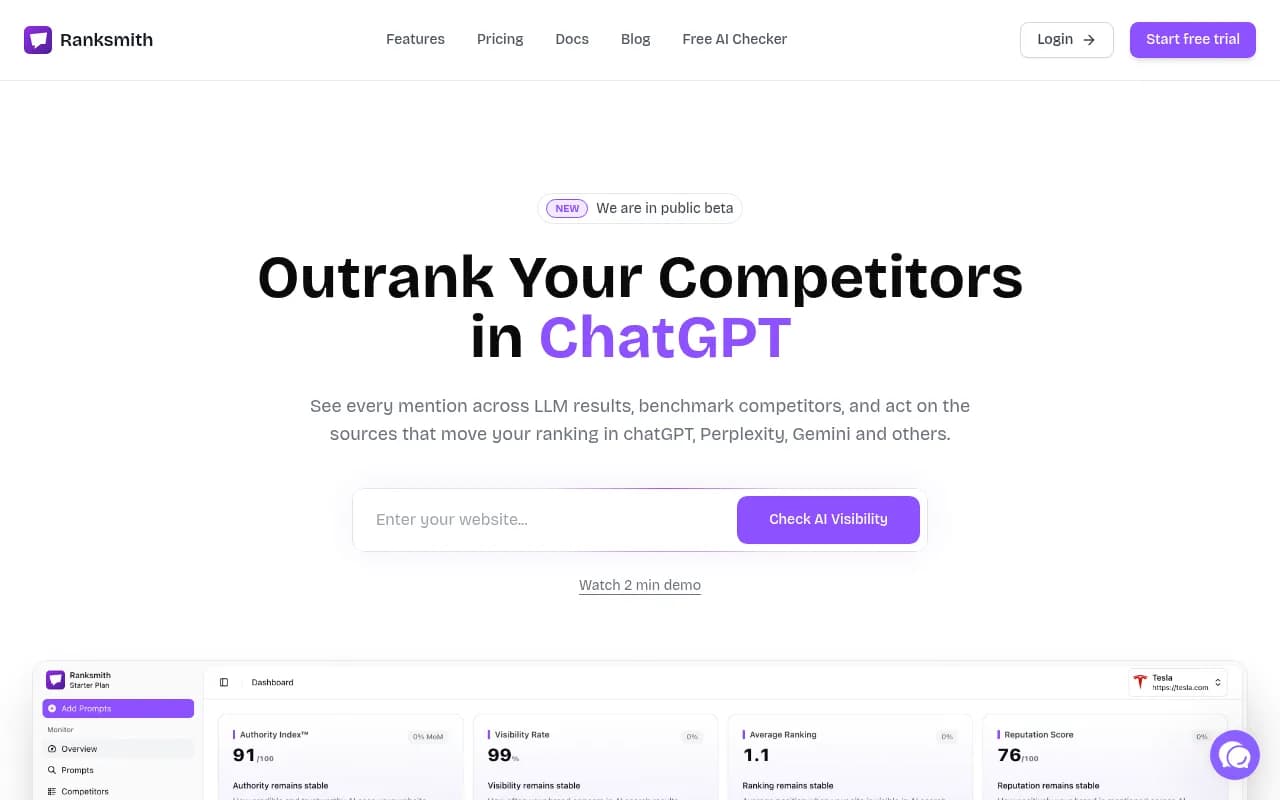
Ranksmith is a GEO (Generative Engine Optimization) platform that tracks your brand's presence across AI search engines -- ChatGPT, Perplexity, Gemini, Grok, and Claude -- and turns that data into a prioritized action queue. It's currently in public beta, which shows in the product: the feature set is solid but still maturing. The standout angle is its performance scoring system. Every tracked prompt gets a score blending current position, mention rate, and link rate, so you can filter for quick wins instead of staring at raw data. Competitor benchmarking is a first-class feature here -- you can track share of voice, average position, and sentiment for rivals side by side.
AIClicks
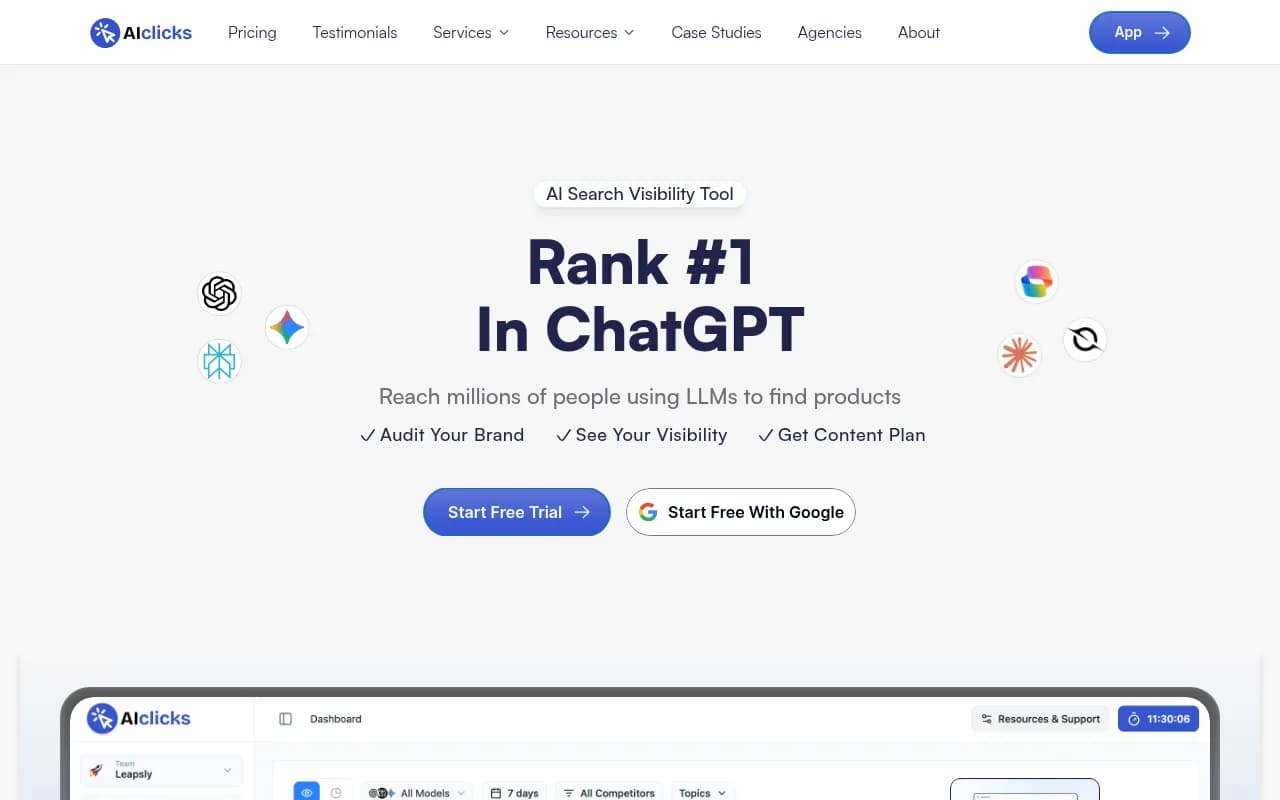
AIClicks takes a slightly different approach: it frames everything as a 4-step formula (enter your URL, discover prompts, track visibility, get an action plan). The pitch is that you drop in your website and the tool does the heavy lifting -- finding the prompts your buyers actually ask, monitoring how you appear, and surfacing recommendations. It's used by 1,000+ brands and agencies and holds a 4.9/5 on G2, which is genuinely impressive for a tool in this space. The agency angle is more explicit here, with custom pricing for multi-client workflows.
Side-by-side comparison
| Feature | Ranksmith | AIClicks |
|---|---|---|
| Starting price | $69/mo | $59/mo |
| Entry-level prompts | 25 | 30 |
| Max prompts (top plan) | 150 (Enterprise) | 300+ (Business) |
| AI models covered | Up to 6 (Enterprise) | ChatGPT, Perplexity, Gemini + others |
| Free trial | 7 days, no credit card | 3 days |
| Annual discount | 20% | Not specified |
| Competitor tracking | Yes | Yes |
| Source/citation analysis | Yes | Yes |
| Custom prompt import | Yes | Yes |
| AI-suggested prompts | Yes | Yes |
| Sentiment tracking | Yes | Yes |
| Share of voice | Yes | Yes |
| Automation agents | No | Yes |
| Agency/custom pricing | Not prominently | Yes |
| G2 rating | Not listed | 4.9/5 |
| Product status | Public beta | Generally available |
Head-to-head feature deep-dive
Prompt management and prioritization
Ranksmith's approach here is one of its stronger suits. Every prompt gets a performance score that blends position, mention rate, and link rate across the AI models you're tracking. You can tag prompts by model, category, and topic, then filter to find the highest-leverage items. The idea is that you're not just tracking everything equally -- you're building a priority queue. That's genuinely useful when you have dozens of prompts and limited time.
AIClicks handles prompt discovery differently. You drop in your URL and the tool surfaces prompts your buyers are actually asking AI tools. It's a more automated starting point, which is great if you're new to GEO and don't have a prompt list ready. You can also import your own. The tradeoff is that Ranksmith's scoring system gives you a clearer sense of which prompts to act on first, while AIClicks' approach is more "here's what exists, now here's your action plan."
Verdict: Ranksmith wins on prompt prioritization depth. AIClicks wins on prompt discovery automation for newcomers.
Competitor intelligence
Both tools track competitor mentions, positions, and share of voice across AI responses. Ranksmith lets you benchmark side by side on a single table -- mentions, average ranking, visibility -- and claims to detect new entrants automatically. The competitor heatmap-style view is a practical feature for anyone running regular competitive audits.
AIClicks covers competitor mentions and analysis too, but the website doesn't detail the same level of structured benchmarking. Based on available information, Ranksmith has the edge here in terms of how systematically it presents competitive data.
Verdict: Ranksmith has a more structured competitor benchmarking setup.
Source and citation analysis
This is where both tools overlap significantly. Ranksmith identifies which citations (G2, Reddit, LinkedIn, press) are driving your rankings and maps strategy recommendations to those sources. The idea is that you see a source moving your visibility, then execute targeted outreach or PR, then watch the metrics respond.
AIClicks also identifies sources driving citations and frames this as a core part of its action plan. The language on their site suggests they track which external sources influence AI recommendations, which is the same underlying mechanic.
Neither tool goes as deep as platforms that analyze hundreds of millions of citations across the web (Reddit threads, YouTube videos, domain-level patterns). For that kind of depth, Promptwatch operates at a different scale with 880M+ citations analyzed -- worth knowing if citation intelligence is your primary need.

Verdict: Roughly tied. Both identify actionable sources; neither goes especially deep on citation volume or cross-platform source analysis.
KPIs and reporting
Ranksmith has built out a named KPI framework: AI Authority Index, AI Visibility Rate, Average AI Ranking, and Reputation Score. These come with trend deltas and share of voice over time. Having named, trackable metrics makes it easier to report progress to stakeholders -- you can say "our AI Authority Index went from X to Y this quarter" rather than showing raw mention counts.
AIClicks' reporting centers on the action plan output and visibility tracking, but doesn't appear to have the same named KPI system. The G2 reviews suggest the dashboard is clean and easy to understand, which matters for day-to-day use.
Verdict: Ranksmith has a more developed reporting framework. AIClicks may be simpler to navigate.
Automation and workflow
AIClicks explicitly mentions "automate with agents" as one of its three core actions. This is a differentiator -- the idea that you can automate parts of the monitoring and optimization workflow rather than doing everything manually. The specifics of what the agents do aren't fully detailed on the public site, but the positioning suggests AIClicks is investing in reducing manual work.
Ranksmith doesn't mention automation agents. Its workflow is more manual: review the priority queue, identify the play, execute it, track the result. That's a solid loop, but it requires more hands-on time.
Verdict: AIClicks wins on automation potential. Ranksmith's workflow is more manual.
Ease of getting started
AIClicks wins on onboarding simplicity. Drop in a URL, let the tool crawl, get prompts suggested automatically. It's designed to get you to value quickly without requiring you to know what prompts to track upfront.
Ranksmith offers AI-suggested prompts too, but the platform feels more oriented toward users who already have a sense of what they want to track. The tagging and categorization system is powerful once you're set up, but adds friction at the start.
Verdict: AIClicks is easier to get started with. Ranksmith rewards users who invest time in setup.
Pricing comparison
| Plan | Ranksmith | AIClicks |
|---|---|---|
| Starter | $69/mo (25 prompts, 2 models) | $59/mo (30 prompts) |
| Mid-tier | ~$149-$249/mo (estimated) | ~$149-$249/mo (estimated) |
| Business/Pro | Not specified | $499/mo (300+ prompts) |
| Enterprise | $549/mo (150 prompts, 6 models) | Custom pricing |
| Annual discount | 20% | Not specified |
| Free trial | 7 days, no credit card | 3 days |
| Agency pricing | Not prominently offered | Yes, custom |
A few things stand out here. At the entry level, AIClicks gives you 30 prompts for $59 vs Ranksmith's 25 prompts for $69 -- not a massive difference, but AIClicks is better value. At the top end, the gap is more significant: AIClicks' $499/mo Business plan includes 300+ prompts, while Ranksmith's $549/mo Enterprise caps at 150 prompts. If prompt volume matters to you (and it usually does at scale), AIClicks is considerably cheaper per prompt at higher tiers.
Ranksmith's 7-day no-credit-card trial is a meaningful advantage over AIClicks' 3-day window. Seven days is enough time to actually run some prompts, see results, and make an informed decision. Three days is tight.
Pros and cons
Ranksmith
Pros:
- Strong KPI framework with named, trackable metrics (AI Authority Index, Reputation Score, etc.)
- 7-day free trial with no credit card required
- Solid competitor benchmarking with side-by-side tables
- Prompt prioritization scoring helps focus effort on high-impact items
- 20% annual discount
Cons:
- Still in public beta -- expect rough edges and evolving features
- More expensive per prompt at scale vs AIClicks
- No automation agents
- Less social proof (no G2 rating listed, smaller known user base)
- Agency/multi-client workflows not prominently supported
AIClicks
Pros:
- More prompts per dollar, especially at higher tiers
- 4.9/5 on G2 with 1,000+ brands and agencies using it
- Automation agents reduce manual workflow
- Easier onboarding (URL-first, auto prompt discovery)
- Explicit agency and custom pricing
Cons:
- Only 3-day free trial
- KPI framework less developed than Ranksmith's named metrics
- Competitor benchmarking details less clear from public information
- Annual discount terms not clearly specified
Who should pick which tool
Pick Ranksmith if:
- You want a structured KPI framework to report AI visibility progress to stakeholders
- You need more time to evaluate before committing (7-day trial matters)
- Competitor benchmarking is a core part of your workflow
- You're comfortable with a beta product and want to grow with the platform
Pick AIClicks if:
- You're new to GEO and want a tool that gets you to value quickly without a lot of setup
- You're managing multiple client accounts and need agency-friendly pricing
- Prompt volume is important -- you need 200+ prompts tracked affordably
- You want automation to reduce manual monitoring work
- Social proof and a proven user base matter to your decision
Final verdict
These two tools are closer than their marketing suggests. Both track brand mentions across AI search engines, both analyze sources and competitors, and both give you recommendations. The real differences come down to a few concrete things: AIClicks is cheaper at scale and has more social proof; Ranksmith has a better KPI framework and a longer trial period.
If you're a solo marketer or small team just getting started with GEO, AIClicks' simpler onboarding and lower price point make it the easier first choice. If you're building a reporting workflow and need named metrics you can track over time, Ranksmith's framework is more developed -- just be aware you're buying into a beta product.
Neither tool generates content for you or closes the full optimization loop from gap analysis to published article to traffic attribution. For teams that need that end-to-end workflow, both tools are monitoring solutions, not optimization platforms.