Key Takeaways
- Gauge focuses exclusively on AI visibility and competitive intelligence -- no traditional SEO features. Atomic AGI combines AI search tracking with full Google SEO analytics, technical audits, and workflow automation in one platform.
- Pricing: Gauge starts at $99/mo (100 prompts, ChatGPT only), Atomic AGI has a free tier and paid plans from $10/mo. Gauge's Growth plan ($599/mo) is significantly more expensive than Atomic's equivalent.
- Atomic AGI includes AI agents and workflow automation for content generation, technical fixes, and reporting. Gauge provides strategic recommendations but no built-in automation layer.
- Gauge covers 7 AI engines (ChatGPT, Claude, Gemini, Perplexity, Copilot, AI Mode, AI Overviews). Atomic AGI tracks 5 (ChatGPT, Perplexity, Gemini, Claude, Google).
- If you're managing both traditional SEO and AI visibility and want everything in one dashboard, Atomic AGI makes more sense. If you only care about AI search and want deep competitive analysis, Gauge is more specialized.
- Both platforms are relatively new (2024-2025 launches) and still building out features. Neither has the citation depth or content gap analysis of more mature platforms like Promptwatch.

Overview
Gauge: AI visibility and competitive intelligence
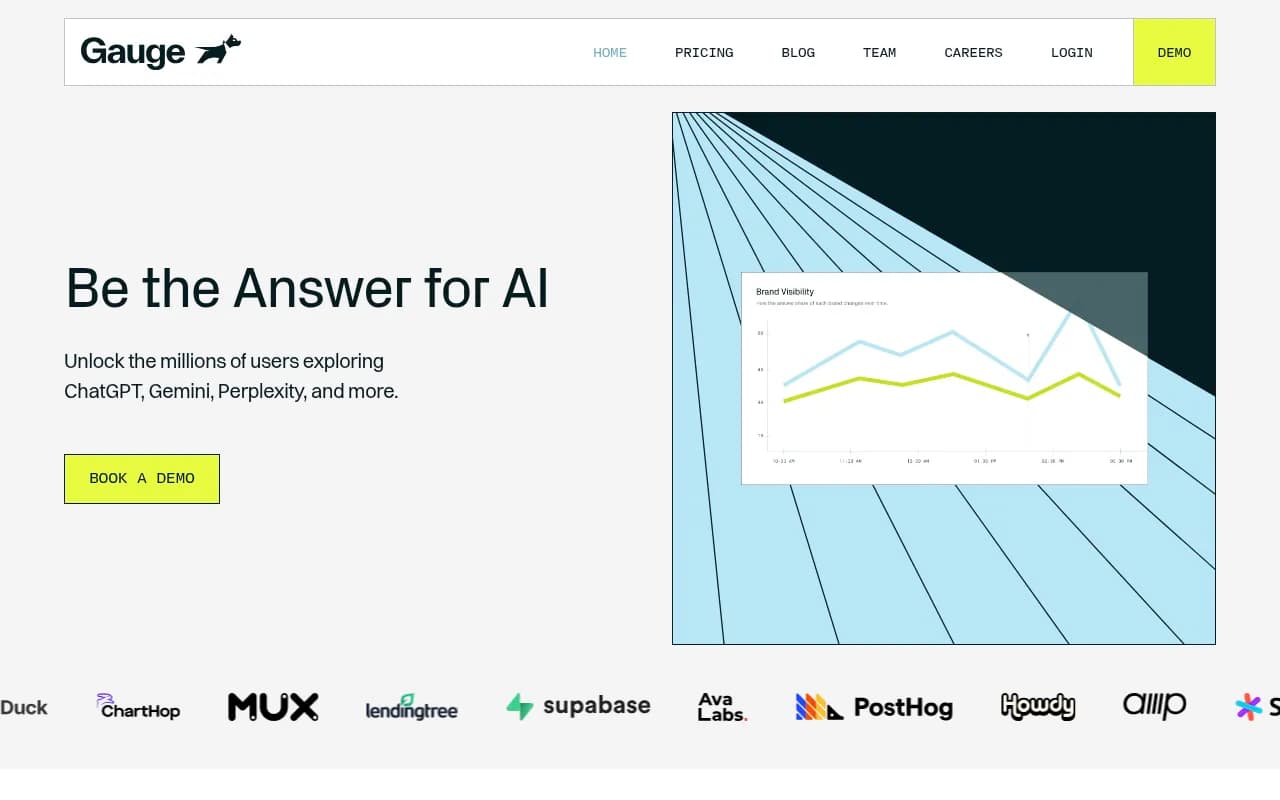
Gauge launched in 2024 as a dedicated AI visibility platform. It tracks how your brand appears across ChatGPT, Claude, Gemini, Perplexity, Copilot, AI Mode, and AI Overviews. The pitch is simple: see where you're mentioned, understand what content is being cited, compare yourself to competitors, and get clear recommendations to improve.
Gauge positions itself as a strategic tool -- not just a tracker. The interface is built around competitive benchmarking and gap analysis. You pick your competitors, Gauge shows you where they're winning, and gives you onsite and offsite recommendations to close the gap.
It's a pure-play AI visibility tool. No traditional SEO features, no Google Search Console integration, no technical audits. Just AI search.
Atomic AGI: All-in-one SEO platform with AI search tracking
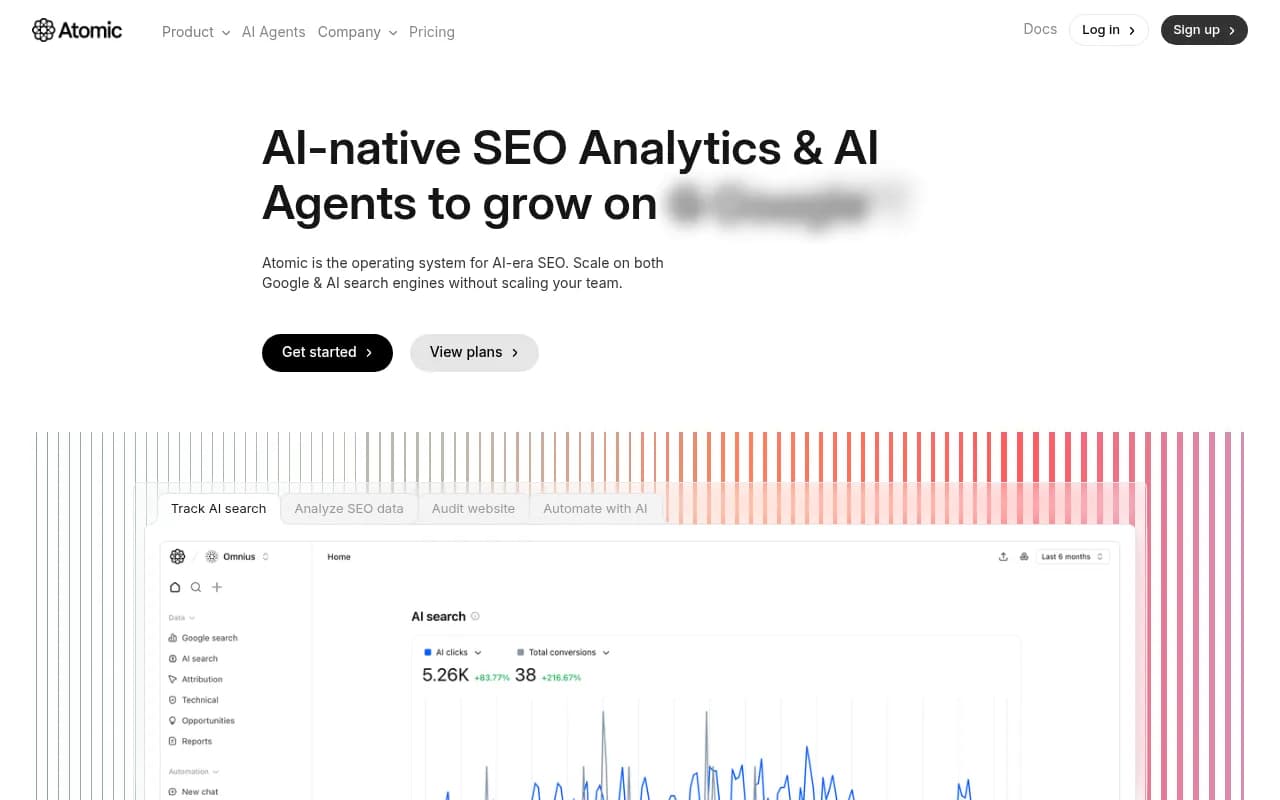
Atomic AGI takes a different approach. It's a full SEO platform that happens to include AI search tracking. You get Google analytics, technical audits, keyword research, backlink analysis, rank tracking, content optimization -- the whole traditional SEO stack. AI search monitoring (ChatGPT, Perplexity, Gemini, Claude, Google AI) is one module among many.
The differentiator is automation. Atomic AGI includes AI agents that can generate content, fix technical issues, build reports, and execute workflows. The idea is to replace multiple tools (Ahrefs, Screaming Frog, ChatGPT, Zapier) with one platform that does everything and automates the repetitive parts.
Atomic AGI launched in late 2024 and is positioning itself as the "operating system for AI-era SEO." It's targeting teams that want to scale organic growth without scaling headcount.
Side-by-Side Comparison
| Feature | Gauge | Atomic AGI |
|---|---|---|
| AI engines tracked | 7 (ChatGPT, Claude, Gemini, Perplexity, Copilot, AI Mode, AI Overviews) | 5 (ChatGPT, Perplexity, Gemini, Claude, Google AI) |
| Traditional SEO features | None | Full suite (rank tracking, audits, backlinks, keywords) |
| Competitive analysis | Core feature -- built around competitor benchmarking | Available but not the main focus |
| Content generation | Manual recommendations, 3-18 articles/mo depending on plan | AI agents generate content, no hard limits |
| Workflow automation | No | Yes -- AI agents execute tasks and workflows |
| Technical audits | No | Yes -- full site audits with automated fixes |
| Free tier | No | Yes |
| Starting price | $99/mo (100 prompts, ChatGPT only) | $10/mo (Starter plan) |
| Mid-tier price | $599/mo (600 prompts, all models) | Not disclosed but significantly lower |
| Prompt limits | 100-600 depending on plan | No hard prompt limits mentioned |
| API access | Not mentioned | Yes |
| Multi-language support | Not mentioned | Yes |
User interface and workflow
Gauge: Clean, competitive-focused dashboard
Gauge's interface is organized around three tabs: Track, Understand, Act. You start by adding your brand and competitors. The Track view shows you where each brand is mentioned across AI engines. Understand gives you breakdowns of what content is being cited and where the gaps are. Act provides specific recommendations.
The competitive angle is front and center. Every view shows you vs your competitors. The heatmaps and comparison charts make it easy to see who's winning for specific queries.
The workflow is: monitor visibility → identify gaps → get recommendations → implement changes → monitor again. It's a manual loop -- you have to take the recommendations and execute them yourself.
Atomic AGI: Dense, all-in-one workspace
Atomic AGI's interface is more complex because it's doing more. The main dashboard shows Google rankings, AI search visibility, technical issues, and workflow status all in one view. You can drill into AI search tracking, but it's one section among many.
The AI agents are the interesting part. You can set up workflows like "audit site weekly and create Slack report" or "generate content briefs for declining pages." The agents run in the background and surface results in the dashboard.
The workflow is: connect data sources → set up agents and workflows → review automated outputs → adjust and iterate. It's more of a platform you configure once and let run, vs a tool you check manually.
AI search tracking depth
Gauge: More engines, competitive focus
Gauge tracks 7 AI engines vs Atomic's 5. The extra coverage includes Copilot and AI Mode, which matter if you're targeting Microsoft or Google's AI features specifically.
The tracking is query-based. You define a list of prompts (100-600 depending on plan), Gauge runs them across all engines, and shows you who gets mentioned. You can see which specific content is being cited and how often.
The competitive benchmarking is the real value. Gauge shows you exactly where competitors are visible and you're not. The gap analysis is more detailed than Atomic's.
What's missing: no citation volume data, no prompt difficulty scoring, no query fan-outs. You're working with a fixed list of prompts you define manually.
Atomic AGI: Fewer engines, integrated with SEO data
Atomic AGI tracks 5 engines (no Copilot or AI Mode). The tracking is integrated with traditional SEO data, so you can see AI visibility alongside Google rankings for the same keywords.
The advantage is correlation. You can see if pages that rank well in Google also get cited in AI search, or if there's a disconnect. This helps prioritize optimization work.
The disadvantage is less depth on the AI side. Atomic doesn't emphasize competitive analysis or gap identification the way Gauge does. It's more about tracking your own visibility over time.
Content generation and recommendations
Gauge: Manual recommendations, limited article generation
Gauge gives you onsite and offsite recommendations based on the gap analysis. Onsite: create content about X, optimize page Y for Z. Offsite: target these affiliates, engage with these Reddit threads.
The recommendations are specific but you have to execute them yourself. Gauge doesn't write the content for you.
The paid plans include article generation (3 articles/mo on Starter, 18 articles/mo on Growth). This is a separate feature, not integrated with the recommendations. You get a fixed number of AI-written articles per month, presumably optimized for AI search.
Atomic AGI: AI agents generate and optimize content
Atomic AGI's AI agents can generate content briefs, write articles, optimize existing pages, and create meta descriptions. There's no hard limit on articles -- it's part of the automation layer.
The agents use your SEO data to prioritize. For example: "generate content briefs for the top 20 keywords where we rank 11-20" or "rewrite meta descriptions for pages with low CTR."
The content quality is a question mark. AI-generated content from any platform needs human review. Atomic's advantage is integration -- the agents pull from your actual ranking data and technical audit results, so the output is grounded in real gaps.
Pricing comparison
| Plan | Gauge | Atomic AGI |
|---|---|---|
| Free tier | No | Yes (limited features) |
| Entry plan | $99/mo: 100 prompts, ChatGPT only, 3 articles | $10/mo: Starter plan (details not public) |
| Mid-tier | $599/mo: 600 prompts, all 7 models, 18 articles | Not disclosed but significantly lower |
| Enterprise | Custom pricing | Custom pricing |
| Annual discount | Not mentioned | Likely available |
Gauge is significantly more expensive. The Starter plan at $99/mo only tracks ChatGPT, which limits usefulness. You need the $599/mo Growth plan to track all engines.
Atomic AGI's pricing is more accessible. The free tier lets you test the platform. The $10/mo entry point is low enough for small businesses or solo marketers.
The value calculation depends on what you're replacing. If Gauge replaces a dedicated AI monitoring tool, $599/mo might be reasonable. If Atomic AGI replaces Ahrefs ($99-999/mo) + Screaming Frog ($259/yr) + ChatGPT ($20/mo) + Zapier ($20-50/mo), it's a good deal.
Technical capabilities and integrations
Gauge: Limited technical features
Gauge doesn't do technical SEO. No site audits, no crawling, no schema analysis. It's purely about AI visibility.
Integrations aren't prominently mentioned on the site. Presumably you can export data, but there's no API or webhook access mentioned.
This is fine if you're using Gauge alongside other tools. But it means you're managing multiple dashboards.
Atomic AGI: Full technical suite with API
Atomic AGI includes a full technical audit engine. It crawls your site, identifies issues (broken links, slow pages, missing meta tags, schema errors), and the AI agents can auto-fix some of them.
The platform has API access, so you can build custom integrations or pull data into other tools. Multi-language support means you can track AI visibility in different markets.
The automation layer is the differentiator. You can set up workflows that run on a schedule -- weekly audits, daily rank checks, automated reporting to Slack or email.
Pros and cons
Gauge pros:
- Focused exclusively on AI visibility -- no feature bloat
- Strong competitive analysis and benchmarking
- Tracks 7 AI engines including Copilot and AI Mode
- Clear, actionable recommendations
- Clean interface designed around the AI visibility workflow
Gauge cons:
- Expensive -- $599/mo to track all engines
- No traditional SEO features -- you need other tools
- No automation or AI agents
- Limited article generation (18/mo max)
- Prompt limits feel restrictive (100-600 depending on plan)
- No free tier to test before committing
Atomic AGI pros:
- All-in-one platform -- AI search + traditional SEO + automation
- AI agents automate repetitive tasks
- Free tier available
- Much cheaper entry point ($10/mo vs $99/mo)
- Full technical audit and optimization features
- API access for custom integrations
- No hard prompt limits
Atomic AGI cons:
- Tracks fewer AI engines (5 vs 7)
- AI search tracking is less detailed than Gauge's
- Competitive analysis is not the main focus
- More complex interface -- steeper learning curve
- Newer platform (launched late 2024) -- still building out features
Who should pick which tool
Pick Gauge if:
- You only care about AI visibility and don't need traditional SEO features
- Competitive intelligence is your top priority -- you need to know exactly where competitors are winning
- You're willing to pay $599/mo for comprehensive AI engine coverage
- You prefer a focused tool that does one thing well over an all-in-one platform
- You have other tools for SEO and just need AI visibility tracking
Pick Atomic AGI if:
- You're managing both traditional SEO and AI visibility and want one dashboard
- You want automation and AI agents to reduce manual work
- Budget is a constraint -- you need a lower entry point
- You value technical audits and workflow automation alongside AI tracking
- You're comfortable with a more complex platform that requires setup
Consider alternatives if:
- You need deep citation analysis and content gap identification: Promptwatch offers 880M+ citations analyzed, prompt volumes, difficulty scoring, and an AI writing agent that generates content grounded in real citation data. It's the only platform rated as a "Leader" across all GEO categories in 2026 comparisons.
- You're an agency managing multiple clients: Both Gauge and Atomic AGI offer custom enterprise pricing, but Promptwatch's agency plans include white-label reporting and multi-client management.
- You need Reddit and YouTube tracking: Neither Gauge nor Atomic AGI emphasizes social source monitoring. Promptwatch surfaces Reddit discussions and YouTube videos that influence AI recommendations.
Final verdict
These are fundamentally different tools solving different problems.
Gauge is a specialized AI visibility platform. It does one thing -- track and analyze brand mentions across AI engines -- and does it well. The competitive analysis is strong, the interface is clean, and the recommendations are actionable. But it's expensive and you'll need other tools for traditional SEO.
Atomic AGI is an all-in-one SEO platform that includes AI search tracking as one feature among many. It's cheaper, more comprehensive, and includes automation that can save hours of manual work. But the AI search tracking is less detailed and competitive analysis is not the main focus.
If you're a brand or agency that only cares about AI visibility and has budget for specialized tools, Gauge is the better fit. If you're a marketing team managing both Google SEO and AI search on a tighter budget, Atomic AGI gives you more value per dollar.
For most teams in 2026, the all-in-one approach makes more sense. AI search is important but it's not the only channel. Having everything in one platform -- Google rankings, AI visibility, technical audits, automation -- reduces tool sprawl and makes it easier to see the full picture. Atomic AGI wins on value and versatility. Gauge wins on depth and focus.