Key Takeaways
- Gauge offers transparent pricing starting at $99/mo (Starter) vs Omnia's request-only pricing model -- Gauge is easier to budget for small teams
- Both platforms track the same core AI engines (ChatGPT, Perplexity, Gemini, Copilot), but Gauge includes Claude and AI Overviews in all plans while Omnia's coverage details are less clear
- Gauge's Starter plan limits you to ChatGPT-only tracking with 100 prompts, making Omnia potentially better for teams that need multi-model monitoring from day one
- Gauge provides built-in content generation (3-18 articles/month depending on plan) while Omnia focuses on insights and roadmaps without explicit article creation
- Omnia emphasizes "step-by-step AI visibility roadmaps" that map tracking data to content creation, technical SEO, and placement -- more strategic guidance vs Gauge's toolkit approach
- For teams that want a complete action loop (track, analyze, create content, optimize), Promptwatch offers the most integrated workflow with 880M+ citations analyzed, Answer Gap Analysis, and an AI writing agent that generates content engineered to rank in AI search

Overview
Omnia
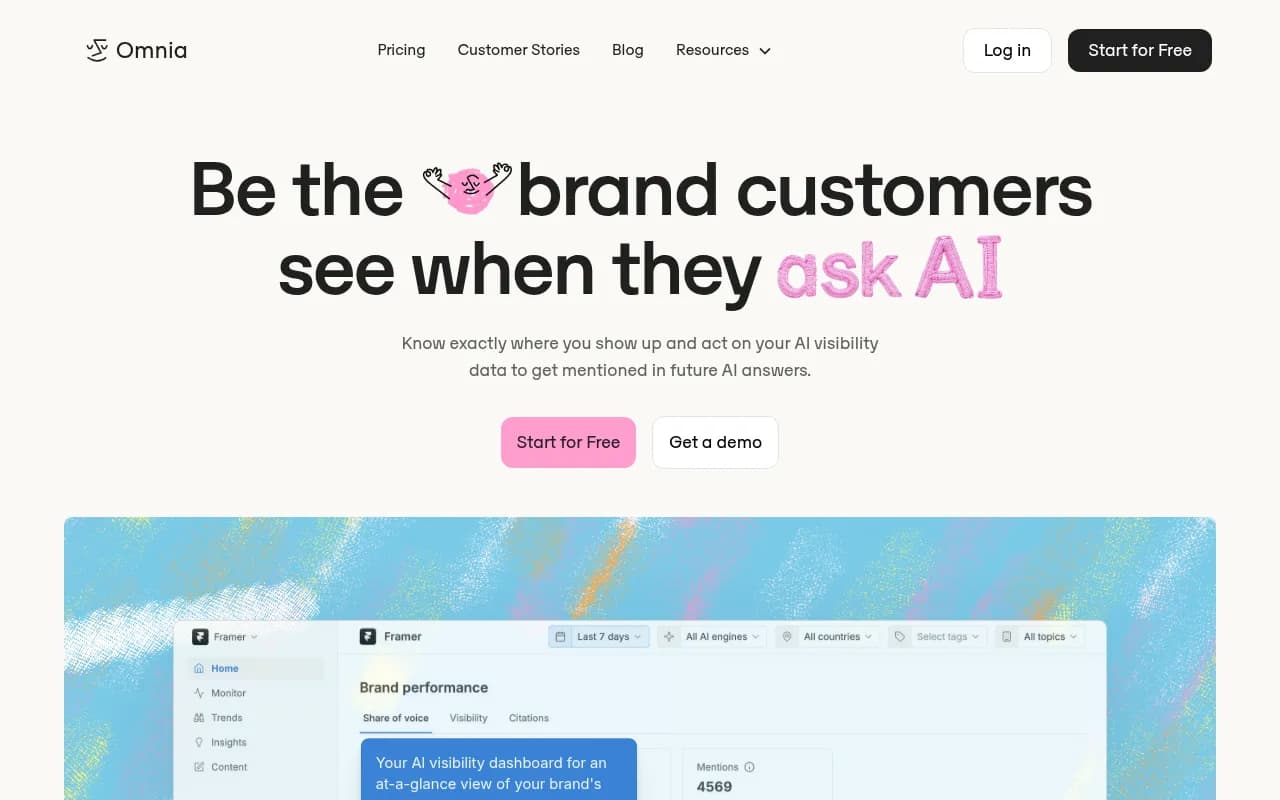
Omnia positions itself as AI visibility software built for SEO and marketing experts. The platform monitors citations and mentions across major AI engines and translates tracking data into actionable roadmaps. Omnia's pitch centers on helping brands understand their competitive position through share of voice analytics, then providing step-by-step guidance on content creation, technical SEO, and content placement to fill visibility gaps. Trusted by brands like Exoticca, Ironhack, and Growth Hackers, Omnia targets teams that want strategic direction alongside their monitoring data.
Gauge
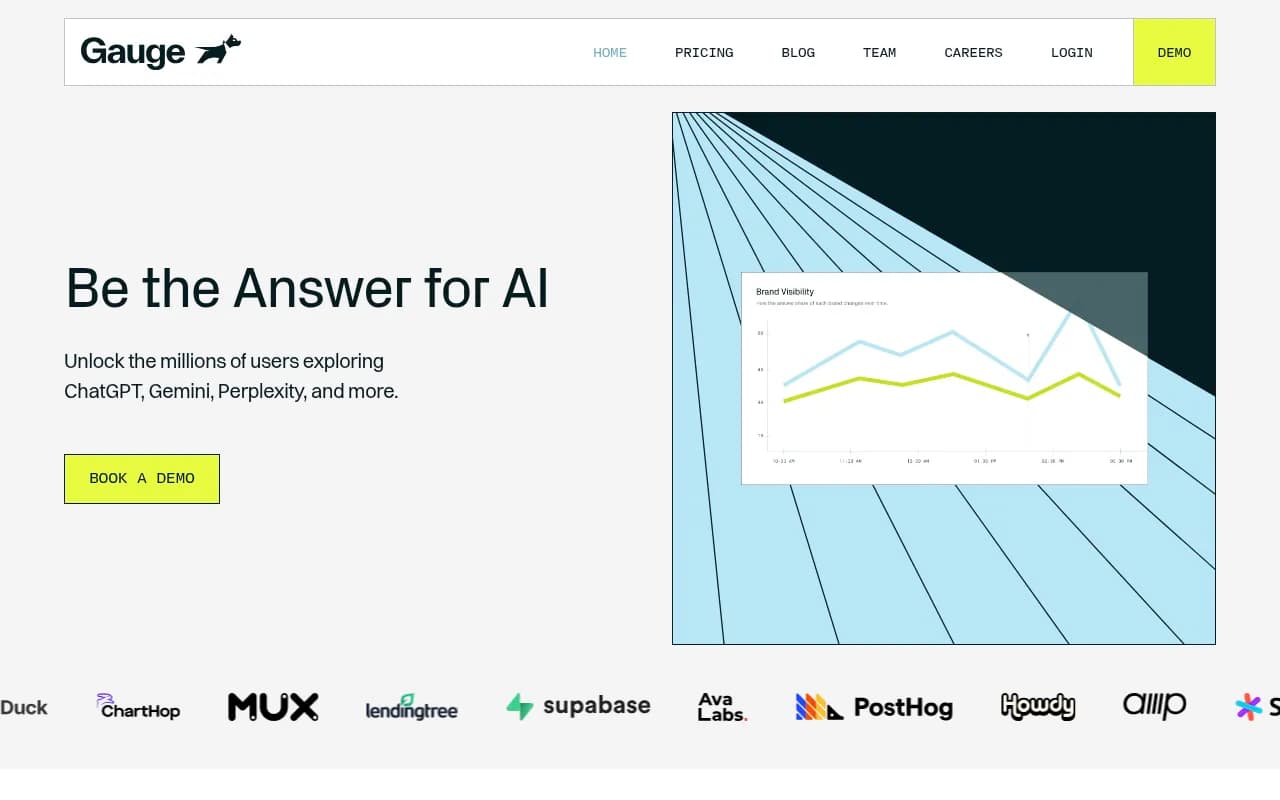
Gauge describes itself as a complete toolkit for AI visibility and GEO (Generative Engine Optimization). The platform tracks brand mentions across ChatGPT, Claude, Gemini, Perplexity, Copilot, AI Mode, and AI Overviews. Gauge's three-step workflow -- Track, Understand, Act -- promises to show you where you're mentioned, analyze citation gaps vs competitors, and deliver clear onsite/offsite recommendations. Used by companies like MotherDuck, Supabase, and Howdy, Gauge targets teams that want both monitoring and actionable optimization guidance.
Side-by-Side Comparison
| Feature | Omnia | Gauge |
|---|---|---|
| Pricing transparency | Request-only | Public ($99-$599/mo + Enterprise) |
| Free trial | Yes | Yes (freemium model) |
| AI models tracked | ChatGPT, Perplexity, Gemini, Copilot (confirmed) | ChatGPT, Claude, Gemini, Perplexity, Copilot, AI Mode, AI Overviews |
| Starter plan limitations | Unknown | ChatGPT-only, 100 prompts, 3 articles |
| Content generation | Not explicitly mentioned | 3-18 articles/mo (plan-dependent) |
| Competitor benchmarking | Share of voice analytics | Gap analysis vs competitors |
| Citation tracking | Yes | Yes |
| Actionable roadmaps | Step-by-step visibility roadmaps | Onsite/offsite recommendations |
| Prompt discovery | Real customer questions | Not explicitly mentioned |
| Target audience | SEO/marketing experts | Brands wanting complete toolkit |
| Enterprise options | Available | Custom pricing |
Pricing
This is where the two platforms diverge sharply.
| Plan | Omnia | Gauge |
|---|---|---|
| Free tier | Free trial (details unclear) | Freemium (limited features) |
| Starter | Not disclosed | $99/mo (100 prompts, ChatGPT only, 3 articles) |
| Mid-tier | Pro Plan (pricing on request) | $599/mo Growth (600 prompts, all models, 18 articles) |
| Enterprise | Custom pricing | Custom pricing |
Omnia keeps pricing behind a request form, which signals they're targeting larger teams or prefer custom deals. Gauge publishes clear tiers, making it easier to evaluate fit without a sales call. The catch: Gauge's $99 Starter plan only tracks ChatGPT, so you'll need the $599 Growth plan to monitor all AI engines. If you need multi-model tracking from the start, Omnia might offer better entry pricing -- but you won't know until you ask.
AI model coverage
Both platforms track the big players: ChatGPT, Perplexity, Gemini, and Copilot. Gauge explicitly lists Claude, AI Mode (Google's conversational search), and AI Overviews (Google's AI-generated search summaries) as part of their coverage. Omnia's website confirms the core four but doesn't detail whether Claude or Google's AI search features are included.
Gauge's Starter plan restricts you to ChatGPT-only monitoring, which is a meaningful limitation if your audience uses multiple AI assistants. Omnia's free trial and Pro Plan coverage aren't specified on the website, so you'll need to confirm what's included at each tier.
Verdict: Gauge wins on transparency and breadth (7 AI engines listed), but only if you're on the Growth plan or higher. Omnia's coverage is less clear but likely comparable at the Pro level.
Prompt discovery and monitoring
Omnia emphasizes discovering "real questions customers are asking about your industry or product." Their interface shows a "Trends" view that surfaces the prompts you should be monitoring. This is valuable for teams that don't know where to start -- Omnia tells you what questions matter.
Gauge focuses on tracking the prompts you define, with limits based on your plan (100 prompts on Starter, 600 on Growth). The platform doesn't highlight prompt discovery as a core feature, which means you'll need to know what to track or rely on their recommendations.
Verdict: Omnia has a clearer prompt discovery story. Gauge assumes you already know your target prompts or will figure them out through their analysis.
Competitive benchmarking
Both platforms offer competitor analysis, but they frame it differently.
Omnia provides "share of voice analytics" -- a percentage-based view of how often your brand appears vs competitors across AI engines. Their interface shows topic-level share of voice with popovers that break down the numbers. This is useful for executive reporting and tracking relative position over time.
Gauge talks about "gap analysis" -- showing what content is cited, what's missing, and how you stack up against competitors. The emphasis is on identifying specific content gaps rather than aggregate share metrics.
Verdict: Omnia is better for high-level competitive positioning. Gauge is better for tactical content gap identification. Pick based on whether you need boardroom metrics or editor-level action items.
Actionable insights and roadmaps
This is where both platforms claim to go beyond monitoring.
Omnia's standout feature is its "step-by-step AI visibility roadmap." The platform translates tracking data into concrete actions: content creation tasks, technical SEO fixes, and content placement strategies. Each action is mapped to fill your brand's real gaps. This is strategic guidance, not just a list of problems.
Gauge provides "clear onsite and offsite recommendations to own your category." Their "Act" tab promises to tell you what to do, but the specifics are less detailed on the website. The platform includes content generation (3-18 articles per month depending on plan), which is a direct action tool Omnia doesn't explicitly offer.
Verdict: Omnia wins on strategic roadmap clarity. Gauge wins on built-in content creation. If you want someone to tell you the plan, pick Omnia. If you want someone to help you execute the plan, pick Gauge.
Content generation
Gauge includes AI-powered article generation in all paid plans: 3 articles/month on Starter, 18 articles/month on Growth. This is a meaningful differentiator -- you can go from insight to published content without leaving the platform.
Omnia's roadmaps include "content creation" as a recommended action, but there's no mention of built-in article generation. You'll get the strategy, but you'll need to write (or use another tool to write) the content yourself.
Verdict: Gauge has the edge if you want an all-in-one workflow. Omnia is better if you have a content team and just need direction.
User interface and workflow
Both platforms follow a similar three-step structure:
- Omnia: Discover prompts → Monitor visibility → Act on roadmap
- Gauge: Track mentions → Understand gaps → Act on recommendations
Omnia's screenshots show a clean, data-focused interface with trend charts, share of voice breakdowns, and insight detail views. The design feels polished and executive-friendly.
Gauge's website shows less of the actual interface, but the messaging emphasizes a "complete toolkit" with multiple features (content audit, affiliate targeting, Reddit engagement). This suggests a more feature-rich, potentially complex interface.
Verdict: Hard to judge without hands-on use, but Omnia seems more streamlined while Gauge seems more comprehensive. Your preference depends on whether you want simplicity or depth.
Integration and reporting
Neither platform details integrations or API access on their public websites. Both likely offer some level of data export for enterprise customers, but you'll need to ask.
For teams that need deep integration with existing SEO workflows, Promptwatch offers Looker Studio integration and a full API for custom reporting and automation.
Pros and cons
Omnia pros
- Strong prompt discovery -- tells you what questions to monitor
- Share of voice analytics for executive reporting
- Step-by-step visibility roadmaps with strategic guidance
- Clean, polished interface based on screenshots
- Free trial available
Omnia cons
- No public pricing -- requires sales contact
- AI model coverage unclear beyond core four engines
- No built-in content generation
- Less transparency overall on feature details
Gauge pros
- Transparent pricing with clear feature breakdowns
- Tracks 7 AI engines including Claude and Google AI features
- Built-in content generation (3-18 articles/mo)
- Freemium model lets you test before committing
- Clear onsite/offsite recommendations
Gauge cons
- Starter plan is ChatGPT-only, forcing most teams to $599/mo Growth plan
- Prompt discovery not emphasized -- assumes you know what to track
- Less detail on strategic roadmap vs tactical recommendations
- Interface complexity unclear from public materials
Who should pick Omnia
Pick Omnia if you:
- Need help discovering which prompts matter for your industry
- Want share of voice metrics for competitive positioning
- Prefer strategic roadmaps over tactical task lists
- Have a content team and just need direction on what to create
- Don't mind request-based pricing and sales conversations
- Value a streamlined, executive-friendly interface
Omnia is the better fit for marketing leaders who want to understand the landscape and get a plan, then hand off execution to their team.
Who should pick Gauge
Pick Gauge if you:
- Want transparent pricing you can budget for immediately
- Need to track Claude and Google AI features (AI Mode, AI Overviews)
- Want built-in content generation to act on insights faster
- Prefer a freemium model to test before committing
- Are comfortable defining your own prompt list
- Want a comprehensive toolkit vs a focused strategy platform
Gauge is the better fit for hands-on SEO teams that want monitoring, analysis, and content creation in one place.
Alternative: Promptwatch for end-to-end AI visibility
If you're evaluating Omnia and Gauge, you should also look at Promptwatch -- especially if you want the complete action loop from discovery to content creation to optimization.
Promptwatch is the only platform rated as a "Leader" across all GEO categories in a 2026 comparison of 12 platforms. The difference: most competitors (including Omnia and Gauge) focus on monitoring and recommendations. Promptwatch closes the loop with Answer Gap Analysis (shows exactly which prompts competitors rank for but you don't), an AI writing agent that generates content grounded in 880M+ citations analyzed, and page-level tracking that connects visibility to actual traffic and revenue.
You get prompt discovery, multi-model tracking (10 AI engines including ChatGPT, Claude, Perplexity, Gemini, DeepSeek, Grok, Meta AI, Mistral, Copilot, and Google AI Overviews), competitor heatmaps, Reddit/YouTube insights, ChatGPT Shopping tracking, AI crawler logs, and content generation -- all in one platform. Pricing starts at $99/mo (Essential) with 50 prompts and 5 articles, $249/mo (Professional) with 150 prompts and 15 articles, or $579/mo (Business) with 350 prompts and 30 articles.
If Omnia's roadmaps and Gauge's toolkit both appeal to you, Promptwatch combines the strategic guidance with the execution tools.
Final verdict
Omnia and Gauge are both solid AI visibility platforms, but they serve different needs.
Omnia is the strategic advisor. It discovers prompts for you, benchmarks your share of voice, and delivers step-by-step roadmaps that tell you what to fix. Best for marketing leaders who want the plan, not the tools.
Gauge is the execution toolkit. It tracks more AI engines (when you're on Growth plan), generates content for you, and gives you tactical recommendations. Best for hands-on SEO teams that want to monitor and act in one place.
The decision comes down to this: Do you need someone to tell you the strategy (Omnia) or do you need someone to help you execute it (Gauge)? If you want both -- discovery, monitoring, content creation, and optimization in a single integrated workflow -- Promptwatch is worth a look.