Key Takeaways
- Gauge offers more content creation tools -- 3-18 AI-generated articles per month depending on plan, while LLM Pulse focuses purely on monitoring and analytics
- LLM Pulse is significantly cheaper -- starts at €49/mo (roughly $52) for 40 prompts vs Gauge's $99/mo for 100 prompts, though Gauge includes ChatGPT-only tracking and content generation at that tier
- Model coverage differs by plan -- Gauge's Starter plan only tracks ChatGPT, while LLM Pulse's Starter includes ChatGPT, Perplexity, Gemini, Google AI Mode, and AI Overviews from day one
- Gauge positions itself as a complete toolkit with onsite/offsite recommendations and strategic roadmaps, while LLM Pulse emphasizes speed ("setup in 2 minutes") and straightforward analytics
- Both platforms track 10+ AI models at higher tiers -- enterprise/scale plans cover the same core models (ChatGPT, Perplexity, Gemini, Claude, Copilot, Grok, DeepSeek, Meta AI)
- Neither platform offers a truly free tier -- both require paid plans after trial periods (14 days for LLM Pulse, unclear for Gauge)
Overview
Gauge
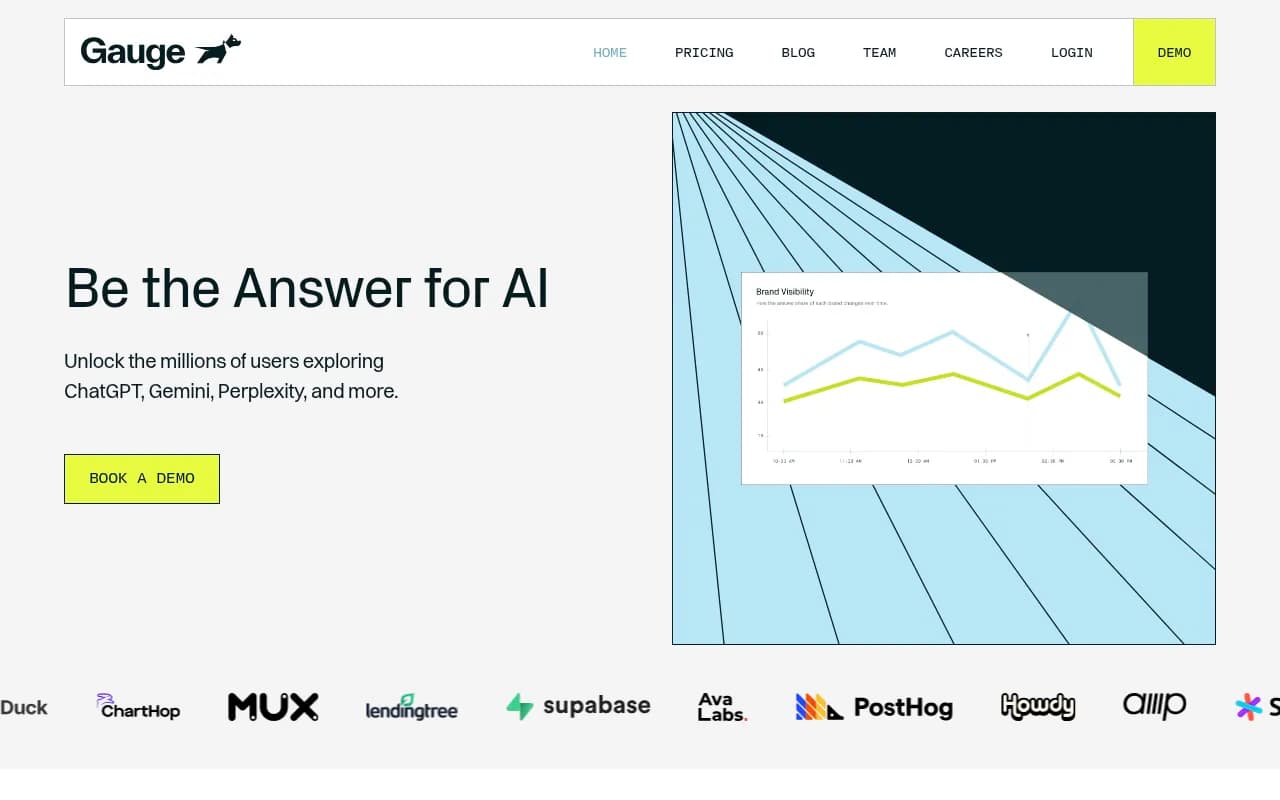
Gauge markets itself as "strategic competitive intelligence for AI visibility" -- a platform that doesn't just show you where you appear in AI search results, but gives you a roadmap to improve. The pitch is built around a three-step loop: track mentions across AI engines, understand what's being cited (and what's missing), then take action with clear onsite and offsite recommendations. Gauge emphasizes its content generation capabilities, with plans including 3-18 AI-written articles per month to help fill visibility gaps.
The platform targets teams that want an all-in-one solution -- monitoring plus optimization plus content creation. Pricing starts at $99/mo for a Starter plan (100 prompts, ChatGPT only, 3 articles), jumps to $599/mo for Growth (600 prompts, all models, 18 articles), with custom Enterprise pricing above that.
LLM Pulse
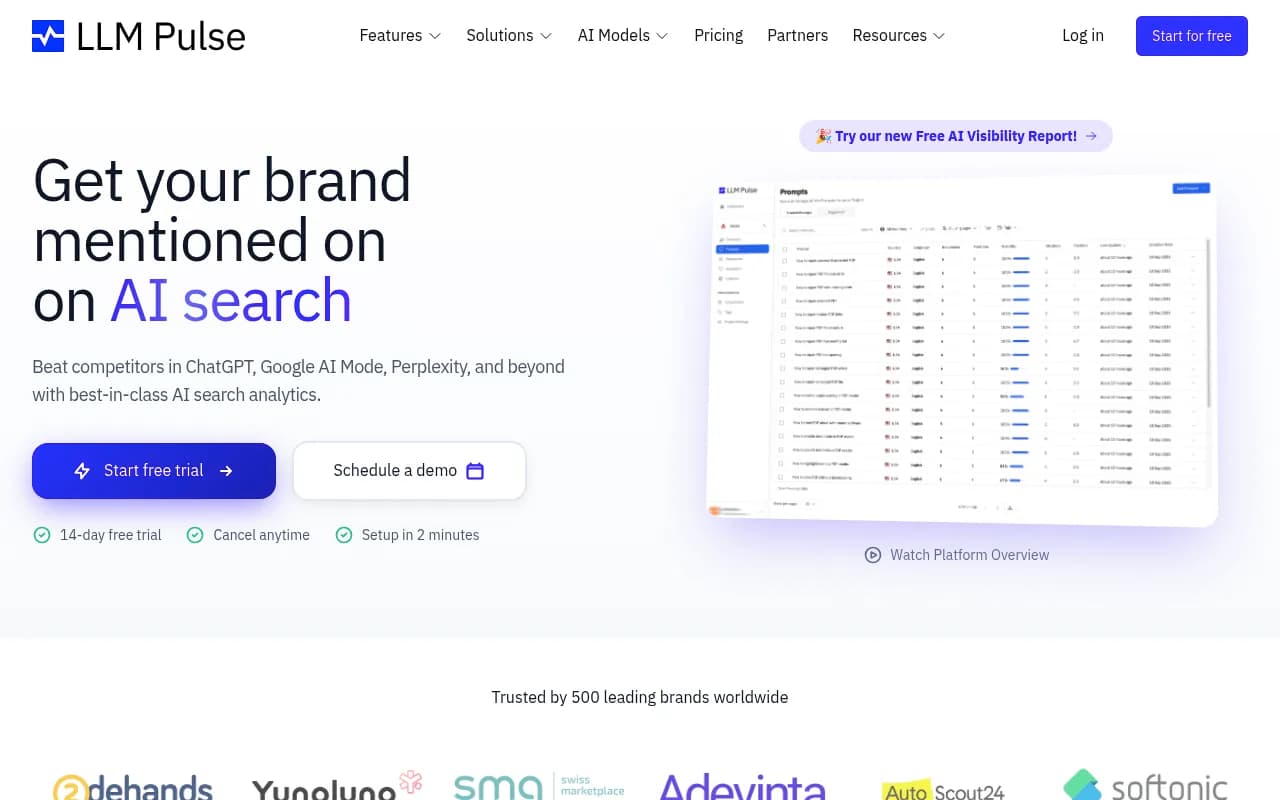
LLM Pulse positions itself as "your radar in the world of generative AI" -- a straightforward tracking and analytics platform for monitoring brand visibility across major AI models. The focus is on speed and simplicity: "setup in 2 minutes," 14-day free trial, and clear visibility metrics (visibility score, citation rate, sentiment, share of voice). LLM Pulse tracks 500+ brands and emphasizes knowing "what AI says about you before your customers do."
The platform is lighter on content creation features but covers more models out of the gate even at lower price points. Pricing starts at €49/mo (~$52) for 40 prompts with full model coverage (ChatGPT, Perplexity, Gemini, Google AI Mode, AI Overviews), scales to €99/mo for 100 prompts, and €299/mo for 300 prompts. Annual billing saves 17%.
Side-by-Side Comparison
| Feature | Gauge | LLM Pulse |
|---|---|---|
| Starting price | $99/mo (100 prompts) | €49/mo (~$52, 40 prompts) |
| Free trial | Not clearly stated | 14 days |
| Models at entry tier | ChatGPT only | ChatGPT, Perplexity, Gemini, Google AI Mode, AI Overviews |
| Total models tracked | 7+ (all models at Growth tier) | 10+ (enterprise models include Claude, Copilot, Grok, DeepSeek, Meta AI) |
| Content generation | 3-18 articles/month depending on plan | Not included |
| Citation analysis | Yes | Yes |
| Competitor benchmarking | Yes | Yes (share of voice) |
| Sentiment tracking | Not explicitly mentioned | Yes |
| Optimization recommendations | Yes (onsite/offsite roadmaps) | Yes (AI-powered content recommendations) |
| Setup time | Not specified | "2 minutes" |
| Annual discount | Not mentioned | 17% |
| Target audience | Teams wanting full toolkit + content creation | Teams wanting fast setup + analytics focus |
Model coverage and tracking
This is where the two platforms diverge most sharply at the entry level.
Gauge's Starter plan ($99/mo) only tracks ChatGPT. You get 100 prompts monitored across that single model, plus 3 AI-generated articles. To unlock Perplexity, Gemini, Claude, Copilot, AI Mode, and AI Overviews, you need to jump to the Growth plan at $599/mo -- a 6x price increase.
LLM Pulse's Starter plan (€49/mo) includes ChatGPT, Perplexity, Gemini, Google AI Mode, and AI Overviews from day one. That's five models for half the price, though you only get 40 prompts vs Gauge's 100. Enterprise models (Claude, Copilot, Grok, DeepSeek, Meta AI) are gated behind higher tiers for both platforms.
The trade-off: Gauge bundles content generation into every plan, while LLM Pulse is purely monitoring and analytics. If you just want to track visibility across multiple models without paying for content creation, LLM Pulse's entry point is far more accessible.
Content creation and optimization
Gauge's differentiator is its built-in content generation. Every plan includes AI-written articles:
- Starter: 3 articles/month
- Growth: 18 articles/month
- Enterprise: custom volume
The platform promises "clear onsite and offsite recommendations" and a strategic roadmap to "own your category." This positions Gauge as an optimization platform, not just a tracker -- similar to how Promptwatch approaches AI visibility with its Answer Gap Analysis and built-in content generation.

LLM Pulse takes a different approach. It offers "AI-powered content recommendations" to improve how you appear in LLM responses, but doesn't generate articles for you. The platform shows you what's missing and suggests improvements, but leaves the actual content creation to your team or other tools.
Verdict: If you want a platform that both tracks and creates content, Gauge is the obvious pick. If you have content resources in-house and just need visibility data, LLM Pulse's analytics-first approach (and lower price) makes more sense.
Pricing breakdown
| Plan | Gauge | LLM Pulse |
|---|---|---|
| Entry tier | Starter: $99/mo<br>100 prompts, ChatGPT only, 3 articles | Starter: €49/mo (~$52)<br>40 prompts, 5 models |
| Mid tier | Growth: $599/mo<br>600 prompts, all models, 18 articles | Growth: €99/mo (~$105)<br>100 prompts, 5 models |
| High tier | Enterprise: custom pricing | Scale: €299/mo (~$318)<br>300 prompts, 5 models |
| Enterprise models | Included in Growth tier | Separate enterprise tier (pricing not public) |
| Annual discount | Not mentioned | 17% |
| Free trial | Not clearly stated | 14 days |
The pricing gap is stark. LLM Pulse's €99/mo Growth plan gets you 100 prompts across 5 models for roughly $105/mo. Gauge's equivalent -- 100 prompts on a single model (ChatGPT) -- costs $99/mo. To get multi-model tracking with Gauge, you're paying $599/mo for 600 prompts.
Gauge's pricing makes sense if you value the bundled content generation (18 articles/month at $599/mo could justify the cost if you'd otherwise pay a writer or use another AI content tool). But if you're purely tracking visibility, LLM Pulse delivers more model coverage for less money at every tier.
Analytics and insights
Both platforms cover the core visibility metrics:
Gauge emphasizes competitive intelligence -- tracking how your brand stacks up against competitors, analyzing what content is cited vs what's being left out, and identifying gaps where your brand is invisible. The platform promises "complete control over your AI presence" with detailed reports on the current AI landscape for your brand.
LLM Pulse breaks down its analytics into four areas:
- Visibility score (how often you're mentioned)
- Citation rate (how often your content is sourced)
- Sentiment (positive/negative/neutral framing)
- Share of voice (your mentions vs competitors)
LLM Pulse also highlights "detailed responses" -- showing the exact words AI uses to describe you so you can spot inaccuracies or negative framing before customers see it.
Both platforms offer citation analysis (which sources AI trusts) and competitor benchmarking. The main difference is presentation: Gauge leans into strategic roadmaps and actionable recommendations, while LLM Pulse emphasizes speed and clarity ("know what AI says about you before your customers do").
User experience and setup
LLM Pulse explicitly markets "setup in 2 minutes" and a 14-day free trial with no credit card required. The pitch is frictionless onboarding -- sign up, add your prompts, start tracking.
Gauge doesn't specify setup time but emphasizes its "complete toolkit" and offers a demo call for teams that want a "full deep dive" on current AI presence. The positioning suggests a more consultative approach -- less self-serve, more strategic partnership.
If you want to get up and running fast without talking to sales, LLM Pulse is the clearer path. If you want guidance on building an AI visibility strategy, Gauge's demo-first approach might be worth the extra friction.
Pros and cons
Gauge pros
- Built-in content generation (3-18 articles/month depending on plan)
- Strategic roadmaps and clear onsite/offsite recommendations
- Comprehensive toolkit positioning (track + analyze + act)
- Growth plan includes all models + substantial content creation
Gauge cons
- Starter plan only tracks ChatGPT (single model for $99/mo)
- Steep price jump to Growth tier ($599/mo)
- No clear free trial or annual discount mentioned
- Setup process less transparent (demo-focused)
LLM Pulse pros
- Much cheaper entry point (€49/mo vs $99/mo)
- Starter plan includes 5 models (ChatGPT, Perplexity, Gemini, AI Mode, AI Overviews)
- 14-day free trial, setup in 2 minutes
- 17% annual discount available
- Clear sentiment tracking and detailed response analysis
LLM Pulse cons
- No built-in content generation
- Lower prompt limits at each tier (40/100/300 vs 100/600/custom)
- Enterprise models (Claude, Copilot, Grok, etc.) require separate tier
- Less emphasis on strategic roadmaps and optimization guidance
Who should pick which tool
Pick Gauge if:
- You want a platform that both tracks visibility and generates content to fix gaps
- You have budget for the Growth plan ($599/mo) and want 600 prompts + 18 articles/month
- You value strategic guidance and onsite/offsite recommendations over self-serve analytics
- You're willing to start ChatGPT-only at the entry tier and scale up later
- You want a consultative relationship (demo calls, deep dives) rather than instant self-serve access
Pick LLM Pulse if:
- You have content creation handled in-house and just need visibility tracking
- You want multi-model coverage (5+ models) at an affordable entry price (€49/mo)
- You prefer fast self-serve setup (2 minutes) over demo calls
- You're tracking fewer than 300 prompts and don't need enterprise models like Claude or Copilot
- You want clear sentiment analysis and detailed response tracking without paying for bundled content generation
Consider both if:
- You're tracking 100-300 prompts and want to compare LLM Pulse's €99-299/mo analytics-only approach vs Gauge's $599/mo all-in-one toolkit
- You're evaluating whether bundled content generation (Gauge) is worth the premium over separate tracking (LLM Pulse) + your own content resources
Final verdict
Gauge and LLM Pulse solve the same core problem -- tracking brand visibility in AI search -- but with different philosophies.
Gauge is an all-in-one platform for teams that want monitoring, analysis, and content creation in a single tool. The bundled articles and strategic roadmaps justify the higher price if you'd otherwise pay for separate content generation. But the Starter plan's ChatGPT-only limitation and the steep jump to $599/mo for multi-model tracking make it a tough sell for budget-conscious teams.
LLM Pulse is a focused analytics platform for teams that want visibility data without paying for content creation they don't need. The €49/mo entry point with 5 models is hard to beat, and the 14-day trial + 2-minute setup removes friction. The trade-off: you're on your own for content optimization beyond recommendations.
For most teams just starting with AI visibility tracking, LLM Pulse's lower price and broader model coverage at the entry tier make it the safer bet. For teams with budget and a need for ongoing content generation, Gauge's Growth plan delivers a complete toolkit that could replace multiple tools. Neither is a clear winner -- it depends entirely on whether you value bundled content creation enough to pay the premium.