Key Takeaways
- Gauge costs $99/mo (Starter) vs Peec AI's €89/mo (~$95) -- nearly identical entry pricing, but Gauge includes content generation while Peec AI doesn't
- Gauge monitors 7 AI models; Peec AI tracks ChatGPT, Perplexity, and Gemini -- Gauge has broader coverage including Claude, Copilot, AI Overviews, and AI Mode
- Peec AI emphasizes multi-language tracking and clean dashboards; Gauge focuses on competitive intelligence and actionable optimization roadmaps
- Neither platform offers content gap analysis, AI crawler logs, or Reddit/YouTube tracking -- both are monitoring-first tools
- Gauge's Growth plan ($599/mo) includes 18 AI-generated articles; Peec AI has no content creation features at any tier
- For pure visibility tracking with multi-language support, Peec AI wins. For strategic competitive analysis with content generation, Gauge is stronger.
Overview
Gauge
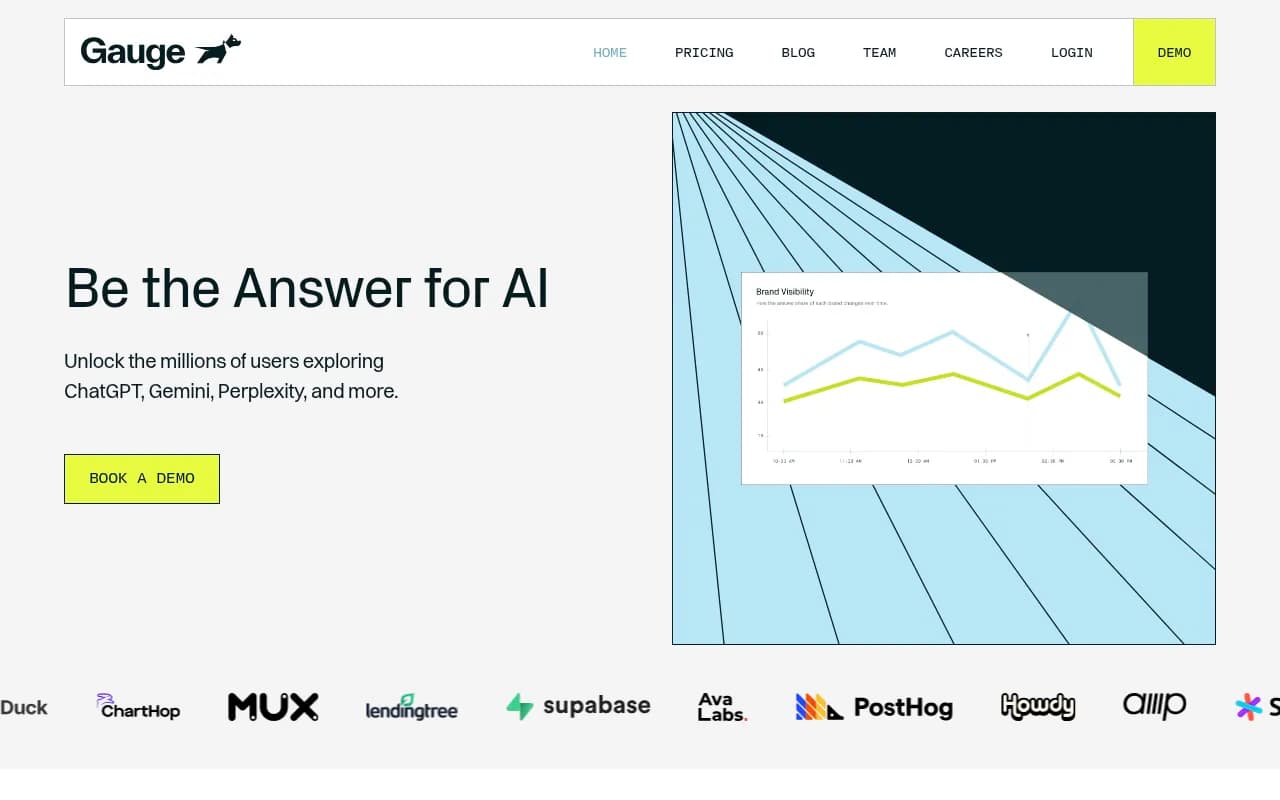
Gauge positions itself as a strategic competitive intelligence platform for AI visibility. It tracks how your brand shows up across ChatGPT, Claude, Gemini, Perplexity, Copilot, AI Mode, and AI Overviews, then gives you clear recommendations to improve. The pitch: don't just monitor -- understand what's missing and fix it. Gauge includes content generation in its Growth and Enterprise plans, which sets it apart from most tracking-only competitors. Pricing starts at $99/mo for the Starter plan (100 prompts, ChatGPT only, 3 articles/month) and scales to $599/mo for Growth (600 prompts, all models, 18 articles/month). Enterprise pricing is custom.
Peec AI

Peec AI is a multi-language AI search analytics platform built for marketing teams. It tracks brand performance across ChatGPT, Perplexity, and Gemini with a focus on three core metrics: Visibility, Position, and Sentiment. The interface is clean and dashboard-heavy -- you get charts, competitor benchmarks, and the ability to add custom prompts and organize them with tags. Peec AI supports tracking across all countries and languages, which is a standout feature if you're operating globally. Pricing starts at €89/mo ($95) for Starter, €199/mo ($213) for Professional, and custom pricing for Enterprise. Free trial available. Over 1,500 marketing teams reportedly use it.
Side-by-Side Comparison
| Feature | Gauge | Peec AI |
|---|---|---|
| Starting price | $99/mo (Starter) | €89/mo (~$95, Starter) |
| Free trial | Yes | Yes |
| AI models tracked | 7 (ChatGPT, Claude, Gemini, Perplexity, Copilot, AI Mode, AI Overviews) | 3 (ChatGPT, Perplexity, Gemini) |
| Multi-language support | Not emphasized | Yes, all languages |
| Multi-region tracking | Yes | Yes, all countries |
| Custom prompts | Yes | Yes, with tagging |
| Competitor benchmarking | Yes, strategic focus | Yes, visibility comparison |
| Content generation | Yes (3-18 articles/mo depending on plan) | No |
| Content gap analysis | No | No |
| AI crawler logs | No | No |
| Reddit/YouTube tracking | No | No |
| Sentiment analysis | Not highlighted | Yes, core metric |
| Position tracking | Yes | Yes, core metric |
| API access | Not mentioned | Not mentioned |
| Target audience | Brands, agencies focused on competitive strategy | Marketing teams, global brands |
Head-to-head feature deep-dive
AI model coverage
Gauge tracks seven AI models: ChatGPT, Claude, Gemini, Perplexity, Copilot, AI Mode, and AI Overviews. That's solid breadth -- you're covered for the major consumer-facing AI search engines plus Microsoft's ecosystem.
Peec AI monitors three: ChatGPT, Perplexity, and Gemini. It's the core trio, but you're missing Claude (which has a growing user base), Copilot (important for enterprise), and Google's AI Mode and AI Overviews (critical for search visibility).
Verdict: Gauge wins on coverage. If you need to track Claude or Microsoft's AI products, Peec AI doesn't support them.
Multi-language and multi-region tracking
Peec AI makes multi-language support a headline feature. You can track prompts in any language, across all countries, and the platform handles it without friction. This is a real advantage if you're a global brand or agency managing clients in multiple markets.
Gauge supports multi-region tracking but doesn't emphasize language flexibility in the same way. The focus is more on competitive intelligence within a single market.
Verdict: Peec AI is the better choice for international teams. If you're tracking brand visibility in French, German, Spanish, Japanese, etc., Peec AI is built for that workflow.
Core metrics and analytics
Peec AI organizes everything around three metrics: Visibility (share of chats mentioning your brand), Position (where you rank in AI responses), and Sentiment (how AI perceives your brand). The dashboard shows trends over time, competitor comparisons, and breakdowns by model. It's clean and easy to scan.
Gauge also tracks visibility and position, but the emphasis is on competitive intelligence -- what content is being cited, what's missing, and how you stack up against competitors. The platform gives you "clear onsite and offsite recommendations" to improve, which suggests more prescriptive guidance than Peec AI's descriptive dashboards.
Verdict: Peec AI is better for teams that want clean, metric-focused dashboards. Gauge is better if you want strategic recommendations alongside the data.
Content generation
Gauge includes AI-generated content in its Growth plan (18 articles/month) and Starter plan (3 articles/month). This is a big differentiator -- you're not just tracking visibility, you're getting content to help improve it.
Peec AI has no content generation features. It's purely a monitoring and analytics tool.
Verdict: Gauge wins decisively here. If you want to close the loop from insights to action, Gauge gives you content. Peec AI leaves you to figure that part out on your own.
Competitor benchmarking
Both platforms support competitor tracking. Peec AI shows competitor visibility percentages in a clean visual format -- you can see at a glance how you compare to 3-5 competitors.
Gauge takes a more strategic approach, analyzing what content competitors are getting cited for and where you're falling short. The pitch is "Find the gaps where your brand is invisible."
Verdict: Tie, but with different strengths. Peec AI is better for quick visual comparisons. Gauge is better for understanding why competitors are winning.
User interface and experience
Peec AI's interface is polished and dashboard-heavy. You get charts, trend lines, and a "Quick Actions" sidebar. The design feels modern and the data flows smoothly. Users report no downtime issues.
Gauge's interface is functional but less visually refined based on available screenshots. The focus is on delivering insights and recommendations rather than aesthetic polish.
Verdict: Peec AI has the cleaner, more intuitive interface. If UX matters to your team, Peec AI feels more finished.
Prompt management
Both platforms let you add custom prompts. Peec AI includes a tagging system to organize prompts, which is useful if you're tracking dozens or hundreds of queries across different campaigns or product lines.
Gauge supports custom prompts but doesn't highlight organizational features like tagging.
Verdict: Peec AI's tagging system gives it a slight edge for teams managing large prompt sets.
What's missing from both
Neither Gauge nor Peec AI offers:
- AI crawler logs (real-time tracking of AI bots hitting your site)
- Content gap analysis (identifying specific topics/angles you're missing)
- Reddit or YouTube tracking (social sources that influence AI recommendations)
- Traffic attribution (connecting AI visibility to actual website visits)
- API access for custom integrations
These are table-stakes features in more advanced platforms. If you need any of these, tools like Promptwatch cover the full optimization loop -- crawler logs, gap analysis, content generation grounded in citation data, and traffic attribution.

Pricing comparison
| Plan | Gauge | Peec AI |
|---|---|---|
| Free trial | Yes | Yes |
| Starter | $99/mo (100 prompts, ChatGPT only, 3 articles) | €89/mo (~$95, details not public) |
| Mid-tier | -- | €199/mo Professional (~$213, details not public) |
| Growth/Pro | $599/mo (600 prompts, all models, 18 articles) | -- |
| Enterprise | Custom pricing | Custom pricing |
Peec AI's public pricing is less transparent -- the website lists Starter and Professional tiers but doesn't break down what you get at each level beyond the price. Gauge is more explicit: you know exactly how many prompts and articles you're getting.
Both platforms are in the same ballpark at the entry level (~$95-99/mo). Gauge's Growth plan at $599/mo is expensive but includes content generation. Peec AI's Professional tier at ~$213/mo is cheaper but doesn't include content creation, so you're paying less but getting less.
Pros and cons
Gauge pros
- Broader AI model coverage (7 models vs 3)
- Includes content generation (3-18 articles/month)
- Strategic competitive intelligence focus
- Clear optimization recommendations
- Transparent pricing with explicit feature breakdowns
Gauge cons
- More expensive at the Growth tier ($599/mo)
- Interface less polished than Peec AI
- Multi-language support not emphasized
- Starter plan limited to ChatGPT only
Peec AI pros
- Strong multi-language and multi-region support
- Clean, intuitive dashboard design
- Sentiment analysis as a core metric
- Prompt tagging for organization
- Lower mid-tier pricing (€199/mo vs $599/mo)
- Used by 1,500+ marketing teams
Peec AI cons
- Only tracks 3 AI models (missing Claude, Copilot, AI Mode, AI Overviews)
- No content generation features
- Less transparent pricing details
- More descriptive than prescriptive -- shows you data but doesn't tell you what to do
Who should pick which tool
Pick Gauge if:
- You need to track Claude, Copilot, or Google's AI Mode/Overviews
- You want content generation included in your subscription
- You're focused on competitive intelligence and strategic positioning
- You prefer explicit recommendations over raw dashboards
- You're willing to pay more for a broader feature set
Pick Peec AI if:
- You're tracking brand visibility in multiple languages and regions
- You prioritize a clean, easy-to-use dashboard
- You only need to monitor ChatGPT, Perplexity, and Gemini
- You want sentiment analysis as a core metric
- You're managing a large set of prompts and need tagging/organization
- You prefer a lower mid-tier price point
Consider alternatives if:
- You need AI crawler logs, content gap analysis, or Reddit/YouTube tracking -- both Gauge and Peec AI are monitoring-only tools that don't cover the full optimization loop. Promptwatch is the only platform rated as a "Leader" across all GEO categories in 2026 comparisons, with crawler logs, 880M+ citations analyzed, content generation grounded in real data, and traffic attribution.
Final verdict
Gauge and Peec AI are both solid monitoring platforms, but they serve different needs. Peec AI is the better choice for global marketing teams that need multi-language tracking and a polished dashboard experience. Gauge is stronger for competitive strategists who want broader AI model coverage and content generation baked in.
Neither platform is a complete optimization solution -- both stop at monitoring and leave you to figure out the "what do I do about it" part on your own. Gauge takes a step toward action with content generation, but it's still missing crawler logs, gap analysis, and traffic attribution.
If you're choosing between these two: go with Peec AI if language support and UX matter most, or Gauge if you need Claude/Copilot tracking and want content included. If you need a platform that actually helps you fix visibility gaps instead of just showing them to you, look at tools built around the full action loop.