Key Takeaways
- Pricing gap is massive: Gauge starts at $99/mo with a free tier; Profound requires custom enterprise pricing (estimated $1,000-$3,000+/mo) with no public plans or trial
- Gauge focuses on competitive intelligence: Built around gap analysis and strategic roadmaps showing where competitors beat you in AI search. Profound emphasizes autonomous agents and workflow automation.
- Prompt volume data differs: Both track what people ask AI engines, but Profound's prompt volume feature is more prominent in their positioning. Gauge integrates it into competitive analysis.
- Content generation approach: Gauge includes AI article writing in all paid plans (3-18 articles/mo depending on tier). Profound's agent system is designed for autonomous content workflows but pricing per article isn't public.
- Model coverage: Gauge tracks 7 AI engines (ChatGPT, Claude, Gemini, Perplexity, Copilot, AI Mode, AI Overviews). Profound covers 9+ including Meta AI, Grok, and DeepSeek.
- Best for startups vs enterprises: Gauge's transparent pricing and freemium model work for smaller teams testing AI visibility. Profound targets established brands with dedicated AEO budgets (MongoDB, Ramp, Zapier are customers).
Overview
Gauge: Strategic competitive intelligence for AI visibility
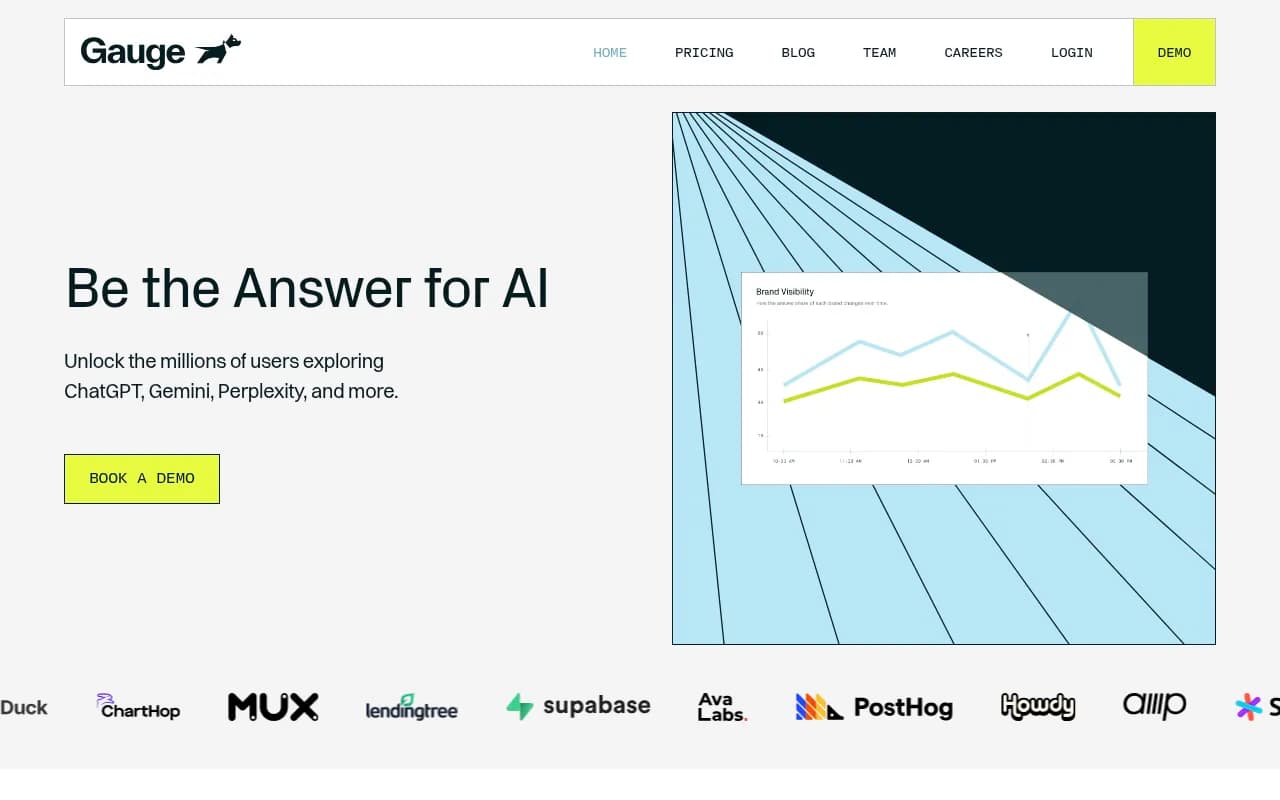
Gauge positions itself as a competitive intelligence platform for AI search. The core workflow: track where your brand appears across AI engines, analyze what competitors are doing better, then get clear onsite and offsite recommendations to close the gaps. It's built for marketing teams who want a strategic roadmap, not just monitoring dashboards. Pricing is transparent with a freemium entry point, making it accessible to startups and mid-market companies testing the AI visibility waters.
Customers include MotherDuck, Supabase, and several B2B SaaS brands. Gauge launched in 2024 and has focused on making competitive gap analysis the centerpiece of their platform.
Profound: Enterprise Answer Engine Optimization platform

Profound is an enterprise AEO platform used by MongoDB, Ramp, and Zapier. It combines visibility tracking across 9+ AI engines with autonomous marketing agents that can generate content, research FAQs, and execute workflows without constant human input. The pitch: scale your AI presence without scaling headcount. Profound also runs Zero Click conferences and publishes the Profound Index research on AI search trends.
Pricing is custom enterprise only -- no public tiers, no free trial. This signals they're targeting established brands with serious AEO budgets, not startups experimenting with $100/mo tools.
Side-by-Side Comparison
| Feature | Gauge | Profound |
|---|---|---|
| Starting price | $99/mo (Starter plan) | Custom (est. $1,000-$3,000+/mo) |
| Free tier | Yes (limited features) | No |
| Free trial | Yes | No |
| AI engines tracked | 7 (ChatGPT, Claude, Gemini, Perplexity, Copilot, AI Mode, AI Overviews) | 9+ (adds Meta AI, Grok, DeepSeek) |
| Prompt volume data | Included in Growth plan ($599/mo) | Yes, prominent feature |
| Competitive analysis | Core feature -- gap analysis and roadmaps | Available but not primary focus |
| Content generation | 3-18 AI articles/mo depending on plan | Autonomous agents (pricing unclear) |
| AI crawler analytics | Not mentioned | Yes (Agent Analytics feature) |
| Shopping tracking | Not mentioned | Yes (ChatGPT Shopping feature) |
| Integrations | Not specified | API, developer docs available |
| Target customer | Startups, mid-market B2B SaaS | Enterprise brands with dedicated AEO teams |
| Public customers | MotherDuck, Supabase, Howdy, AMP | MongoDB, Ramp, Zapier |
Pricing comparison
| Plan | Gauge | Profound |
|---|---|---|
| Free tier | Yes (limited prompts, ChatGPT only) | None |
| Starter | $99/mo (100 prompts, ChatGPT only, 3 articles) | N/A |
| Growth/Mid-tier | $599/mo (600 prompts, all models, 18 articles) | N/A |
| Enterprise | Custom pricing | Custom (estimated $1,000-$3,000+/mo) |
The pricing gap here is the story. Gauge has transparent tiers starting at $99/mo with a freemium option for testing. Profound doesn't publish pricing at all -- you have to book a demo and go through enterprise sales. Based on their customer base (MongoDB, Ramp) and feature set, industry estimates put Profound's entry point around $1,000-$3,000/mo minimum, possibly higher for larger deployments.
If you're a startup or small marketing team with a $500-$1,000/mo budget for AI visibility, Gauge is the only realistic option here. Profound is built for companies that can commit five figures annually to AEO.
Model coverage and tracking depth
Gauge tracks 7 AI engines: ChatGPT, Claude, Gemini, Perplexity, Copilot, Google AI Mode, and Google AI Overviews. That covers the major consumer-facing AI search experiences most brands care about. The Starter plan ($99/mo) only tracks ChatGPT, which is limiting -- you need the Growth plan ($599/mo) to monitor all models.
Profound covers 9+ engines, adding Meta AI, Grok (X's AI), and DeepSeek to the mix. For brands with global reach or who want comprehensive coverage of every AI platform, Profound's broader net matters. But for most B2B SaaS companies, the core 7 that Gauge tracks are the ones driving actual traffic.
Both platforms let you track custom prompts relevant to your category. Gauge's Starter plan caps you at 100 prompts; Growth gives you 600. Profound doesn't publish prompt limits, which likely means they're negotiated per contract.
Verdict: Profound wins on breadth of model coverage. Gauge covers the essentials and is transparent about what you get at each tier.
Competitive intelligence and gap analysis
This is where Gauge differentiates. The platform is built around competitive gap analysis -- it shows you which prompts your competitors are visible for but you're not, what content they have that you're missing, and gives you a strategic roadmap to close those gaps. The UI emphasizes competitor comparisons and actionable next steps.
Profound has competitive tracking (you can see how your brand stacks up against rivals), but it's not the centerpiece of their pitch. Their focus is more on autonomous agents and workflow automation. You can analyze competitors, but Profound positions itself as a full-stack marketing platform, not a competitive intelligence tool.
If your primary goal is "figure out why competitors are beating us in AI search and fix it," Gauge's entire product is designed around that question. Profound can answer it, but you're paying for a lot of other capabilities too.
Verdict: Gauge wins for teams who want competitive intelligence as the core feature. Profound is better if you want competitive data as one piece of a larger AEO workflow.
Content generation and optimization
Gauge includes AI-generated articles in all paid plans: 3 articles/mo on Starter ($99/mo), 18 articles/mo on Growth ($599/mo). These are grounded in the competitive gap analysis -- the system identifies missing content, then helps you create it. It's a straightforward "find gaps, fill gaps" loop.
Profound takes a different approach with autonomous marketing agents. Their agent system can scrape web pages, research FAQs on Perplexity, generate AEO-optimized content, and publish it -- all in an automated workflow. The demo on their homepage shows an "AEO-Optimized FAQ Generator" agent running through multiple steps without human input. This is more sophisticated than Gauge's article generation, but also more complex to set up and likely more expensive.
Profound doesn't publish how many articles you get per month or what the per-article cost is. That's negotiated in the enterprise contract.
Verdict: Gauge is simpler and more transparent -- you know exactly how many articles you're getting. Profound's agent system is more powerful for teams that want to automate entire content workflows, but you're paying enterprise prices for that automation.
Prompt volume data and search intelligence
Both platforms offer prompt volume data -- estimates of how many people are asking specific questions to AI engines. This is critical for prioritizing which prompts to optimize for.
Profound makes this a headline feature. Their "Prompt Volumes" page says "See what millions of people ask AI, and align strategy with demand." It's positioned as a core pillar of their platform alongside Answer Engine Insights and Agents.
Gauge includes prompt volume data in the Growth plan ($599/mo), but it's integrated into the competitive analysis workflow rather than being a standalone feature. You see prompt volumes in the context of "here's what people are asking, here's where competitors rank, here's where you don't."
Both approaches work. Profound's is better if you want to explore prompt data independently and build strategy from scratch. Gauge's is better if you want prompt data served up in the context of competitive gaps.
Verdict: Tie. Different philosophies, both effective.
AI crawler analytics and technical insights
Profound has an "Agent Analytics" feature that tracks how AI crawlers interact with your website -- which pages they visit, how often, what errors they encounter. This is valuable for technical SEO teams who want to optimize how AI engines discover and index their content.
Gauge doesn't mention AI crawler analytics in their public materials. Their focus is on the output (what AI engines say about you) rather than the technical input (how they crawl your site).
If you're also tracking how your brand appears in AI search results and want to understand the technical side of AI discoverability, Promptwatch offers real-time AI crawler logs alongside visibility tracking -- worth considering as a complement to either platform.

Verdict: Profound wins for teams that want technical crawler insights. Gauge focuses on strategic output.
Shopping and e-commerce tracking
Profound has a dedicated "Shopping" feature for tracking how your brand appears in ChatGPT's shopping recommendations and product carousels. This matters for e-commerce brands and any company selling products that might show up in AI-powered shopping experiences.
Gauge doesn't mention shopping tracking. Their customer base (B2B SaaS companies like MotherDuck and Supabase) generally aren't selling physical products, so this makes sense.
Verdict: Profound wins for e-commerce and product-focused brands. Gauge is built for B2B SaaS and service companies.
Integrations and developer tools
Profound has public developer docs and an API. They also run a partner program for agencies and have integrations listed on their site. This signals a mature platform built for enterprise workflows and custom integrations.
Gauge doesn't mention integrations or API access in their public materials. For a platform at their price point ($99-$599/mo), this isn't surprising -- they're focused on being a standalone tool, not a piece of a larger martech stack.
Verdict: Profound wins for enterprises that need API access and custom integrations.
User experience and learning curve
Gauge's website and positioning suggest a simpler, more focused product. Three-step workflow: Track, Understand, Act. The UI screenshots show clean dashboards with competitive comparisons front and center. This looks like a tool you can start using productively within a day or two.
Profound's positioning as a "full stack marketing platform" with autonomous agents suggests more complexity. The agent builder screenshot on their homepage shows a multi-step workflow with inputs, outputs, and logic branches. This is powerful but requires more setup and learning. Profound also offers "Profound University" for education, which signals they know there's a learning curve.
Verdict: Gauge is faster to get value from. Profound is more powerful but requires more investment in setup and training.
Customer base and social proof
Profound's customer logos are impressive: MongoDB, Ramp, Zapier. These are well-known, well-funded companies with sophisticated marketing teams. Profound also publishes research (Profound Index, AEO Report) and runs industry conferences (Zero Click SF & NY), which builds credibility.
Gauge's customers are smaller but still credible: MotherDuck, Supabase, Howdy, AMP. These are growing B2B SaaS companies, which aligns with Gauge's positioning as a tool for startups and mid-market teams.
Verdict: Profound has stronger enterprise social proof. Gauge's customer base matches their target market.
Pros and cons
Gauge pros
- Transparent pricing starting at $99/mo with a free tier
- Competitive gap analysis is the core feature, not an add-on
- Clear roadmaps showing exactly what to fix
- AI article generation included in all paid plans
- Fast to set up and start getting value
- Built for startups and mid-market teams
Gauge cons
- Only 7 AI engines tracked (vs Profound's 9+)
- No AI crawler analytics
- No shopping tracking for e-commerce brands
- Starter plan only tracks ChatGPT (need Growth for all models)
- No public API or integrations
- Smaller customer base and less brand recognition
Profound pros
- Tracks 9+ AI engines including Meta AI, Grok, DeepSeek
- Autonomous marketing agents for workflow automation
- AI crawler analytics for technical optimization
- Shopping tracking for e-commerce brands
- API and developer docs for custom integrations
- Strong enterprise customer base (MongoDB, Ramp, Zapier)
- Publishes industry research and runs conferences
Profound cons
- No public pricing -- requires enterprise sales process
- Estimated $1,000-$3,000+/mo minimum, possibly much higher
- No free trial or freemium tier to test before committing
- More complex setup and steeper learning curve
- Competitive intelligence isn't the primary focus
- Overkill for small teams or companies just starting with AI visibility
Who should choose Gauge
Pick Gauge if:
- You're a startup or mid-market company with a marketing budget under $10,000/mo
- Your primary goal is understanding why competitors beat you in AI search and fixing it
- You want transparent pricing and the ability to start small (free tier or $99/mo)
- You need a tool that's fast to set up and doesn't require weeks of onboarding
- Your target customers primarily use ChatGPT, Claude, Gemini, and Perplexity (the core 7 engines Gauge tracks)
- You want AI article generation included without paying extra
- You're a B2B SaaS company focused on thought leadership and category positioning
Gauge is the right call for teams who want a focused, affordable tool that does one thing really well: competitive AI visibility intelligence.
Who should choose Profound
Pick Profound if:
- You're an enterprise with a dedicated AEO team and a five-figure annual budget for AI visibility
- You want autonomous marketing agents that can execute workflows without constant human input
- You need comprehensive coverage of 9+ AI engines including Meta AI, Grok, and DeepSeek
- AI crawler analytics and technical optimization matter to your strategy
- You're an e-commerce brand that needs shopping tracking in ChatGPT and other AI platforms
- You need API access and custom integrations with your existing martech stack
- You want a full-stack marketing platform, not just a competitive intelligence tool
- You're willing to go through an enterprise sales process and negotiate custom pricing
Profound is built for established brands that are serious about owning their category in AI search and have the budget to match.
Final verdict
These platforms serve different markets. Gauge is a focused competitive intelligence tool with transparent pricing ($99-$599/mo) built for startups and mid-market teams. Profound is an enterprise AEO platform with autonomous agents and comprehensive features, priced for companies with serious budgets ($1,000-$3,000+/mo estimated).
If you're testing AI visibility for the first time or have a limited budget, Gauge is the obvious choice. If you're MongoDB or Ramp with a dedicated AEO team and enterprise needs, Profound makes sense.
The pricing gap alone decides this for most teams. Gauge gives you a free tier to test, then $99/mo to get started with real tracking. Profound requires an enterprise sales conversation before you see a price. That's not better or worse -- it's just targeting a completely different customer.
For competitive AI visibility intelligence at a startup-friendly price, Gauge wins. For enterprise-scale AEO with autonomous agents and comprehensive coverage, Profound wins. Pick based on your budget and how much complexity you actually need.