Key Takeaways
- Pricing gap is massive: Bluefish starts around $4,000/month with annual contracts, while Gauge offers a free tier and paid plans from $99-$599/month. Budget determines viability for most teams.
- Target audience split: Bluefish is built for Fortune 500 marketing teams with dedicated AI visibility budgets. Gauge targets mid-market brands, agencies, and startups that need results without enterprise overhead.
- Feature depth vs accessibility: Bluefish provides deeper customization (custom audiences, tailored prompts, advanced segmentation) but requires sales demos and onboarding. Gauge offers self-service signup with actionable insights out of the box.
- AI model coverage differs: Gauge tracks 7 AI engines including ChatGPT, Claude, Gemini, Perplexity, Copilot, AI Mode, and AI Overviews. Bluefish focuses on ChatGPT and Perplexity with "agentic commerce" tracking.
- Content generation included: Gauge bundles AI content creation in all paid plans (3-18 articles/month depending on tier). Bluefish positions optimization as a separate service layer.
- Enterprise vs growth-stage fit: If you're passing infosec reviews and managing multiple brands across global markets, Bluefish makes sense. If you need to prove ROI before scaling up, Gauge gets you started faster.
Overview
Bluefish: Enterprise AI marketing platform
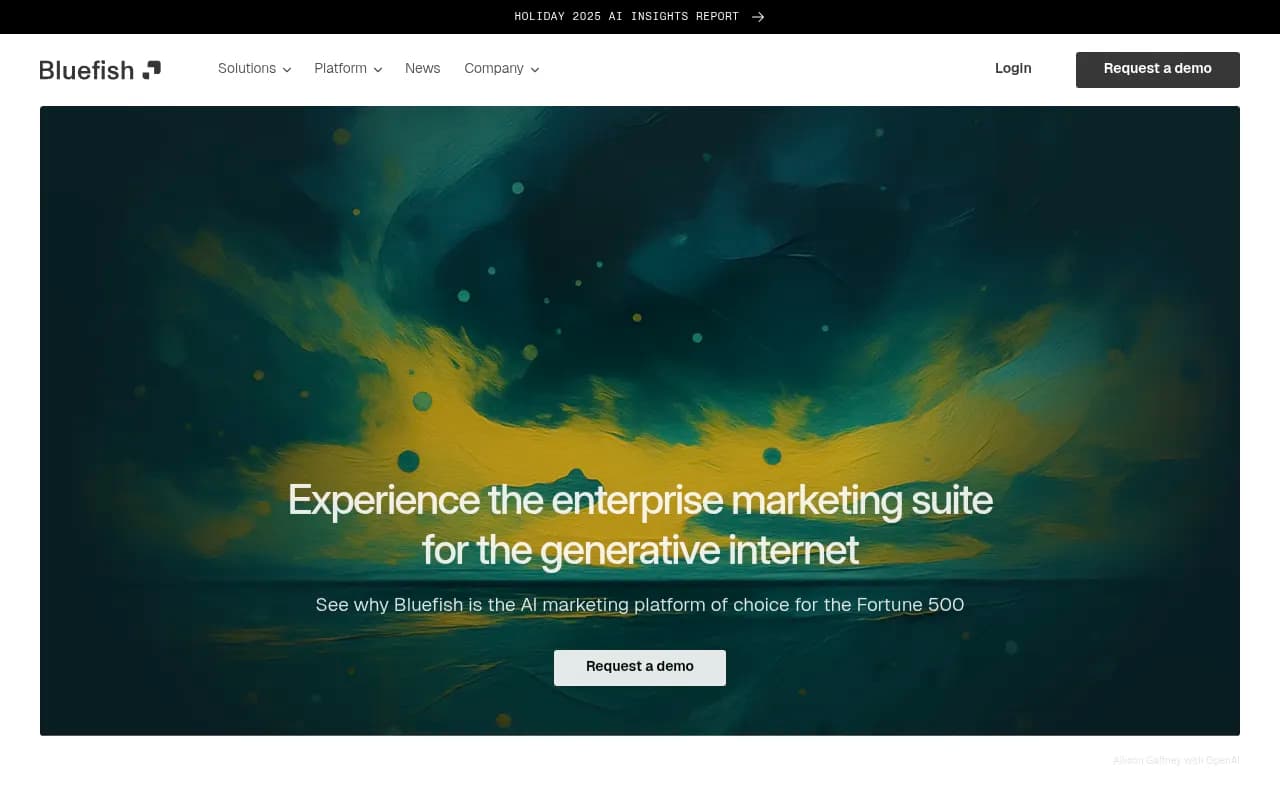
Bluefish positions itself as "the AI marketing platform of choice for the Fortune 500." It's an enterprise-grade solution designed for large marketing teams that need deep control over brand presence across AI search engines and what they call "agentic commerce" -- AI-driven product recommendations and shopping experiences.
The platform emphasizes influence and control beyond basic visibility metrics. Bluefish's pitch centers on understanding how AI "thinks" and optimizing for impact, not just share-of-voice. They consistently pass enterprise infosec reviews and offer custom data segmentation that competitors can't match.
Pricing starts around $4,000/month with custom enterprise plans based on number of brands, markets, and features. Annual contracts are standard. No free trial or self-service signup -- you go through a sales demo process.
Gauge: Strategic competitive intelligence for AI visibility
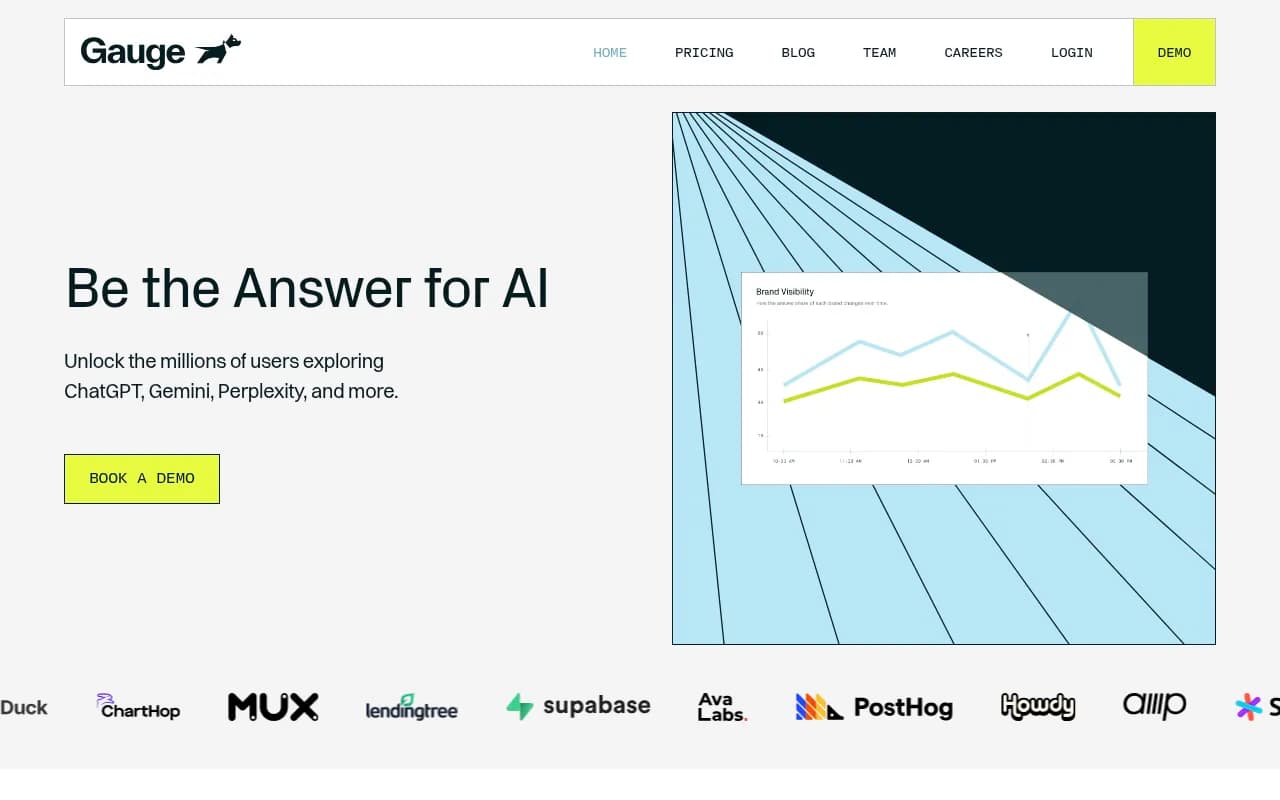
Gauge takes a different approach: make AI visibility accessible to brands that don't have Fortune 500 budgets. It's a freemium platform that tracks your brand against competitors across 7 AI engines and provides clear roadmaps to improve visibility.
The core workflow is track → understand → act. Gauge monitors AI-generated answers, analyzes what content gets cited (and what doesn't), then gives you onsite and offsite recommendations to close the gaps. Content generation is built into paid plans -- you're not just monitoring, you're creating optimized content based on the data.
Pricing is transparent: Starter at $99/month (100 prompts, ChatGPT only, 3 articles), Growth at $599/month (600 prompts, all models, 18 articles), and custom Enterprise pricing. Free tier available. You can sign up and start tracking immediately without talking to sales.
Side-by-Side Comparison
| Feature | Bluefish | Gauge |
|---|---|---|
| Starting price | ~$4,000/month | Free tier; $99/month paid |
| Free tier | No | Yes |
| Self-service signup | No (sales demo required) | Yes |
| AI models tracked | ChatGPT, Perplexity, agentic commerce | ChatGPT, Claude, Gemini, Perplexity, Copilot, AI Mode, AI Overviews (7 total) |
| Content generation | Separate service/add-on | Included (3-18 articles/month) |
| Competitive analysis | Advanced with custom audiences | Yes, built-in competitor tracking |
| Custom prompts | Yes, tailored prompt sets | Yes, custom prompt monitoring |
| Target audience | Fortune 500, enterprise marketing teams | Mid-market brands, agencies, startups |
| Onboarding | Dedicated support, infosec reviews | Self-service or guided demo |
| Data export/API | Advanced customization for data teams | Standard export capabilities |
| Contract terms | Annual contracts standard | Monthly or annual billing |
| Prompt volume | Custom based on needs | 100-600+ prompts depending on plan |
Pricing comparison
The pricing structures are fundamentally different, reflecting their target markets.
| Plan | Bluefish | Gauge |
|---|---|---|
| Free | Not available | Yes (limited features) |
| Entry tier | ~$4,000/month (quote-based) | $99/month (Starter: 100 prompts, ChatGPT only, 3 articles) |
| Mid tier | Custom quote | $599/month (Growth: 600 prompts, all models, 18 articles) |
| Enterprise | Custom (higher than entry) | Custom quote |
| Contract | Annual standard | Monthly or annual (annual discount available) |
| Setup/onboarding | Included in enterprise pricing | Self-service or optional guided setup |
Bluefish doesn't publish pricing because every deal is customized based on number of brands, markets, features, and data volume. The $4,000/month starting point is an estimate based on market positioning -- actual enterprise contracts likely run higher.
Gauge's transparent pricing makes it easy to budget and start small. The Starter plan at $99/month is a real entry point for brands testing AI visibility. Growth at $599/month gives you full model coverage and enough prompts for serious competitive tracking.
Target audience and positioning
Who Bluefish is for
Bluefish explicitly targets Fortune 500 brands and large enterprises. Their website features testimonials from OpenAI partnerships and emphasizes passing infosec reviews "with ease." This is a platform built for:
- Marketing teams with dedicated AI visibility budgets (five figures/month minimum)
- Brands managing multiple product lines or sub-brands across global markets
- Organizations that need custom data segmentation and advanced performance frameworks
- Teams that value white-glove support and strategic consulting as part of the package
- Companies where procurement processes require formal RFPs, security audits, and annual contracts
If you're a category leader in a competitive market and generic datasets aren't enough, Bluefish positions itself as the depth-and-control option. The trade-off is cost and complexity.
Who Gauge is for
Gauge targets the 99% of brands that aren't Fortune 500:
- Mid-market companies ($10M-$500M revenue) that need AI visibility without enterprise overhead
- Digital agencies managing AI optimization for multiple clients
- Startups and growth-stage companies that need to prove ROI before scaling up
- Marketing teams that want to start tracking today, not after a 3-month procurement cycle
- Brands that need content generation bundled in, not as a separate service
Gauge's self-service model and transparent pricing make it accessible. You can sign up, connect your brand, and start seeing where you're invisible in AI search within hours. The built-in content creation tools mean you're not just monitoring -- you're fixing the gaps.
AI model coverage
Bluefish's AI channel focus
Bluefish emphasizes "AI search and agentic commerce." Their primary focus is ChatGPT and Perplexity, with a strong emphasis on tracking product recommendations and shopping experiences within AI interfaces. The "agentic commerce" angle is unique -- they're tracking when your brand appears in AI-driven purchase flows, not just informational queries.
This makes sense for their enterprise audience: consumer brands care deeply about appearing in ChatGPT Shopping or Perplexity's product recommendations. Bluefish's depth here is a differentiator.
The trade-off: less explicit coverage of other AI models. Their marketing doesn't highlight Claude, Gemini, or Copilot tracking the way Gauge does.
Gauge's multi-model approach
Gauge tracks 7 AI engines explicitly:
- ChatGPT (OpenAI)
- Claude (Anthropic)
- Gemini (Google)
- Perplexity
- Copilot (Microsoft)
- AI Mode (Google)
- AI Overviews (Google)
This breadth matters if you want a complete picture of AI visibility. Different audiences use different AI tools -- B2B buyers might default to Copilot, while consumers lean on ChatGPT or Perplexity. Gauge gives you visibility across the landscape.
The Growth plan ($599/month) includes all 7 models. The Starter plan ($99/month) is ChatGPT-only, which is a reasonable entry point since ChatGPT dominates usage.
Feature depth: Monitoring and analytics
Bluefish's enterprise analytics
Bluefish emphasizes going "beyond superficial metrics" with tools that help marketers understand how AI "thinks." Their platform includes:
- Custom audience segmentation (tailor tracking to specific customer personas)
- Tailored prompt sets (not just generic queries -- prompts that match your actual customer journey)
- Advanced performance frameworks (define and track metrics that matter to your business)
- Deep data customization for data teams (export, segment, and analyze in ways competitors can't match)
- "Influence" metrics beyond visibility and share-of-voice
The emphasis is on control and differentiation. In competitive categories, Bluefish argues that generic prompt datasets miss the nuances that matter. Their custom approach requires more setup but delivers more relevant insights.
The downside: this depth requires dedicated resources. You need someone on your team who can define custom audiences, build tailored prompt sets, and interpret advanced analytics. It's not plug-and-play.
Gauge's actionable insights
Gauge focuses on making insights actionable without requiring a data science team. Key features:
- Competitive tracking (see how your brand stacks up against competitors across all prompts)
- Citation analysis (what content is being cited, what's being left out)
- Gap identification (find the specific prompts where your brand is invisible)
- Clear recommendations (onsite and offsite actions to improve visibility)
- Content audit tools (evaluate existing pages for AI optimization)
- Affiliate and social source tracking (target high-value affiliates, engage with Reddit discussions)
The philosophy is "stop prompting and start measuring." Gauge gives you a complete toolkit without overwhelming you. The interface is designed for marketers who need to take action today, not analysts building custom dashboards.
For most teams, this is the right balance. You get the insights you need without the complexity overhead.
Content generation and optimization
Bluefish's optimization approach
Bluefish positions optimization as part of their broader "AI Optimization (GEO)" offering, but it's not clear from their public materials whether content generation is included in base pricing or a separate service. Their marketing emphasizes "automated optimization workflows" and "tailored measurement frameworks," which suggests they help you optimize existing content rather than generate new content at scale.
For enterprise clients, this might mean strategic consulting: Bluefish tells you what to fix, your content team executes. That works if you have in-house resources.
Gauge's built-in content creation
Gauge bundles AI content generation into every paid plan:
- Starter ($99/month): 3 articles/month
- Growth ($599/month): 18 articles/month
- Enterprise: Custom volume
This is a significant differentiator. Gauge doesn't just show you where you're invisible -- it helps you create the content that fills those gaps. The content is grounded in citation data and competitive analysis, not generic SEO filler.
The workflow: Gauge identifies prompts where competitors are visible but you're not → you generate optimized content targeting those prompts → you track whether your visibility improves. It's a closed loop.
For teams without dedicated content resources, this is huge. You're not stuck with a monitoring dashboard and a to-do list -- you're actually fixing the problem.
Ease of use and onboarding
Bluefish's enterprise onboarding
Bluefish requires a sales demo to get started. There's no self-service signup or free trial. The onboarding process includes:
- Initial demo and needs assessment
- Custom pricing quote based on your requirements
- Infosec review (if required by your organization)
- Contract negotiation (annual terms standard)
- Dedicated onboarding and training
This makes sense for enterprise software. Large organizations need formal procurement processes, and Bluefish's team provides white-glove support. The trade-off is time: expect weeks or months from first contact to launch, depending on your internal processes.
Once you're in, you have dedicated support and strategic guidance. For a $4,000+/month platform, that's expected.
Gauge's self-service model
Gauge lets you sign up and start tracking immediately. The onboarding flow:
- Create account (free tier or paid plan)
- Connect your brand and competitors
- Define your prompt set (or use Gauge's recommendations)
- Start monitoring
You can be tracking AI visibility within an hour. No sales calls required (though demos are available if you want guidance). The interface is designed for self-service -- clear dashboards, actionable recommendations, and built-in help.
For teams that need to move fast or prove value before committing budget, this is the right approach. You can start on the free tier, validate that AI visibility matters for your brand, then upgrade to a paid plan.
Integration and data capabilities
Bluefish's data team features
Bluefish emphasizes that "data teams get more ways to customize, segment, and optimize data in ways competitors can't match." This suggests robust API access, custom export formats, and integration with enterprise analytics stacks. Their marketing highlights:
- Advanced data customization
- Custom segmentation and filtering
- Integration with existing marketing measurement frameworks
- Ability to define and track custom metrics
For large organizations with dedicated data teams, these capabilities matter. You can pull Bluefish data into your data warehouse, combine it with other marketing metrics, and build custom dashboards in Looker, Tableau, or whatever BI tool you use.
The documentation and specifics aren't public -- you'd discuss integration requirements during the sales process.
Gauge's standard integrations
Gauge offers standard export capabilities and API access (details vary by plan). The focus is on making data accessible without requiring a data engineering team. You can export reports, track performance over time, and share insights with stakeholders.
For most teams, this is sufficient. You don't need a custom data pipeline -- you need to see where you're invisible and what to do about it. Gauge delivers that without the integration complexity.
Support and strategic guidance
Bluefish's enterprise support
At $4,000+/month, Bluefish includes dedicated support and strategic consulting. Their marketing emphasizes "deep expertise" and helping teams "focus on metrics that matter." This likely includes:
- Dedicated account manager
- Strategic guidance on AI visibility strategy
- Custom reporting and analysis
- Ongoing optimization recommendations
For enterprise clients, this level of support justifies the price. You're not just buying software -- you're buying expertise and partnership.
Gauge's support model
Gauge offers tiered support:
- Free tier: Self-service documentation and community support
- Paid plans: Email support and optional guided demos
- Enterprise: Dedicated support and strategic guidance
For most users, the self-service model works. The platform is designed to be intuitive, and the recommendations are clear. If you need more hands-on help, the Enterprise tier adds that layer.
The trade-off: you're more on your own with Gauge, especially on lower-tier plans. That's fine if you have internal marketing expertise and just need the data and tools.
Pros and cons
Bluefish pros
- Built for enterprise scale with robust infosec and compliance
- Deep customization: custom audiences, tailored prompts, advanced segmentation
- Strong focus on agentic commerce and AI-driven product recommendations
- Dedicated support and strategic consulting included
- Designed for competitive categories where generic data isn't enough
- Data team features for custom integration and analysis
Bluefish cons
- Pricing starts around $4,000/month -- prohibitive for most brands
- No free trial or self-service signup
- Requires sales demo and likely weeks/months to get started
- Less explicit coverage of AI models beyond ChatGPT and Perplexity
- Content generation not clearly included in base pricing
- Overkill for brands that don't need enterprise-level customization
Gauge pros
- Transparent pricing with free tier and plans from $99-$599/month
- Self-service signup -- start tracking within hours
- Tracks 7 AI models including ChatGPT, Claude, Gemini, Perplexity, Copilot, AI Mode, AI Overviews
- Content generation included in all paid plans (3-18 articles/month)
- Actionable recommendations without requiring a data science team
- Complete toolkit: monitoring, competitive analysis, content creation, optimization
- Built for mid-market brands, agencies, and startups
Gauge cons
- Less customization than Bluefish for enterprise-specific needs
- Support is more self-service on lower-tier plans
- May lack the strategic consulting layer that large enterprises expect
- Prompt volume caps (100-600) might be limiting for very large brands
- Less emphasis on agentic commerce tracking compared to Bluefish
Who should pick which tool
Choose Bluefish if:
- You're a Fortune 500 brand or large enterprise with a dedicated AI visibility budget
- You need custom audiences, tailored prompts, and advanced data segmentation
- Agentic commerce (AI-driven product recommendations) is critical to your business
- You require formal infosec reviews and annual contracts
- You have a data team that will build custom integrations and dashboards
- You value strategic consulting and white-glove support as part of the package
- Generic prompt datasets miss the nuances that matter in your competitive category
- You're managing multiple brands across global markets
Choose Gauge if:
- You need AI visibility without enterprise overhead or five-figure monthly costs
- You want to start tracking today, not after a 3-month procurement cycle
- You need content generation bundled in, not as a separate service
- You're a mid-market brand, agency, or startup proving ROI before scaling up
- You want visibility across 7 AI models, not just ChatGPT and Perplexity
- You need actionable recommendations without requiring a data science team
- You prefer transparent pricing and self-service signup
- You're managing AI visibility for multiple clients (agency use case)
If you're also looking to track how AI crawlers interact with your website and optimize content at a deeper level, Promptwatch offers crawler log analysis and content gap identification that complements either platform.

Final verdict
Bluefish and Gauge serve fundamentally different markets. Bluefish is the enterprise Cadillac -- deep customization, strategic consulting, and a price tag to match. Gauge is the accessible Tesla -- full-featured, self-service, and designed for teams that need results without enterprise complexity.
For 95% of brands, Gauge is the right choice. The $99-$599/month pricing is realistic, the 7-model coverage is comprehensive, and the built-in content generation closes the loop from insight to action. You can start tracking today and prove value before committing serious budget.
Bluefish makes sense if you're a Fortune 500 brand with complex needs and the budget to match. The custom audiences, tailored prompts, and agentic commerce focus deliver differentiation in competitive categories. But you're paying for depth and consulting, not just software.
The decision comes down to budget and organizational complexity. If you need to pass infosec reviews and manage multiple brands across global markets, talk to Bluefish. If you need to track AI visibility, generate optimized content, and improve your presence without enterprise overhead, sign up for Gauge.