Key Takeaways
- Gauge is significantly cheaper -- $99/mo starter vs AthenaHQ's $295/mo minimum, making it more accessible for smaller teams and solo marketers
- AthenaHQ has stronger enterprise positioning with case studies showing 2-12.6% Share of Voice growth in 60 days, plus clients like ZoomInfo, Coinbase, and Sofi
- Gauge includes content generation (3-18 articles/mo depending on plan) while AthenaHQ focuses purely on monitoring and recommendations
- Both cover 7-8 AI models including ChatGPT, Perplexity, Claude, Gemini, and Google AI Overviews -- no meaningful difference in LLM coverage
- AthenaHQ emphasizes executive dashboards and ROI tracking for CMO-level reporting, while Gauge targets hands-on GEO practitioners who want to create content
- Neither offers a free trial -- Gauge has a freemium tier (ChatGPT only), AthenaHQ requires paid commitment upfront
Overview
Gauge
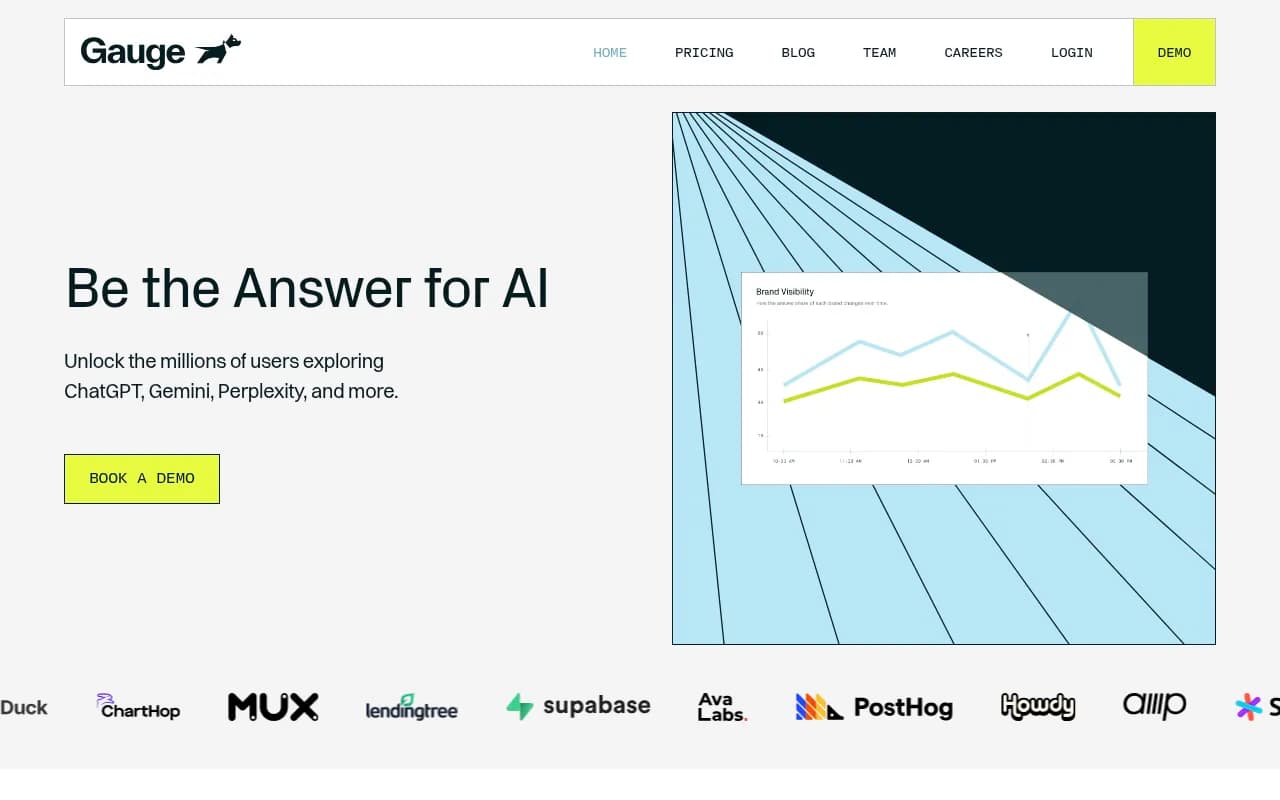
Gauge positions itself as a "strategic competitive intelligence" platform for AI visibility. The core pitch: track your brand across AI engines, understand where competitors are beating you, and get clear roadmaps to close the gap. What sets Gauge apart is the built-in content generation -- you're not just seeing reports, you're getting articles written to improve your visibility.
The platform covers ChatGPT, Claude, Gemini, Perplexity, Copilot, AI Mode, and AI Overviews. Pricing starts at $99/mo for 100 prompts (ChatGPT only) and scales to $599/mo for 600 prompts across all models. Each plan includes a monthly article quota generated by Gauge's AI writer.
AthenaHQ

AthenaHQ calls itself an "end-to-end AEO & GEO platform" and leans heavily into enterprise credibility. The client list (ZoomInfo, Coinbase, Sofi, Volkswagen) and case studies showing measurable Share of Voice gains position it as the choice for marketing teams with budget and executive buy-in.
The platform tracks 8+ LLMs and emphasizes executive-level dashboards, ROI tracking, and cross-platform visibility management. Pricing starts at $295/mo for self-serve or $95/mo annual. No free trial. Featured in Forbes and WSJ for its approach to "post-Google era" brand management.
Side-by-Side Comparison
| Feature | Gauge | AthenaHQ |
|---|---|---|
| Starting price | $99/mo (freemium available) | $295/mo ($95/mo annual) |
| Free trial | No (freemium tier exists) | No |
| AI models tracked | 7 (ChatGPT, Claude, Gemini, Perplexity, Copilot, AI Mode, AI Overviews) | 8+ (same core models) |
| Content generation | Yes (3-18 articles/mo) | No |
| Prompt tracking | 100-600+ prompts/mo | Not publicly specified |
| Competitor analysis | Yes | Yes |
| Citation source analysis | Yes | Yes |
| Executive dashboards | Basic | Advanced (ROI tracking, CMO-level) |
| Target audience | GEO practitioners, content teams | Enterprise marketing teams, CMOs |
| Case studies | Not prominently featured | Yes (2-12.6% SOV growth) |
| Reddit/social tracking | Mentioned | Not emphasized |
| API access | Not mentioned | Not mentioned |
Pricing comparison
| Plan | Gauge | AthenaHQ |
|---|---|---|
| Entry tier | Freemium (ChatGPT only, limited) | None |
| Starter/Self-serve | $99/mo (100 prompts, ChatGPT only, 3 articles) | $295/mo (details not public) |
| Mid-tier | $599/mo (600 prompts, all models, 18 articles) | $95/mo annual (unclear what this includes) |
| Enterprise | Custom pricing | Custom pricing |
Gauge's pricing is transparent and tiered by prompt volume and model access. AthenaHQ's pricing is murkier -- the $295/mo self-serve and $95/mo annual figures don't map to clear feature sets on their site. The annual pricing likely requires a commitment, which explains the lower monthly rate.
AI model coverage
Both platforms cover the same core AI engines: ChatGPT, Claude, Gemini, Perplexity, Google AI Overviews, and Copilot. Gauge lists 7 models explicitly. AthenaHQ claims "8+" but doesn't break them down on the homepage.
In practice, this is a wash. The models that matter for brand visibility in 2026 are ChatGPT (dominant), Perplexity (growing), Google AI Overviews (high intent), and Claude/Gemini (enterprise use). Both platforms cover these. Neither tracks niche models like Grok, DeepSeek, or Mistral -- if you need that level of coverage, you're looking at tools like Promptwatch which monitors 10+ LLMs.

Verdict: Tie. Both cover the models that matter.
Content generation and optimization
This is where Gauge separates itself. Every plan includes AI-generated articles -- 3/mo on Starter, 18/mo on Growth. The idea: Gauge identifies gaps in your AI visibility, then writes content to fill those gaps. You're not just seeing a report that says "you're invisible for X prompt" -- you're getting a draft article optimized for that prompt.
AthenaHQ doesn't offer content generation. It gives you "automated content optimization recommendations" and "citation source analysis" -- essentially telling you what to write and where to publish -- but you're on your own for execution.
For small teams or solo marketers, Gauge's content generation is a huge time-saver. For larger teams with dedicated writers, AthenaHQ's recommendation-only approach might be fine (and avoids the risk of generic AI-written content).
Verdict: Gauge wins for teams that want to move fast and don't have dedicated content resources. AthenaHQ wins for teams that want control over content quality and have writers in-house.
Competitive intelligence and tracking
Both platforms emphasize competitor tracking. Gauge's homepage highlights "analyze what content is cited, what's being left out, and how your brand stacks up against competitors." AthenaHQ lists "competitor analysis" and "sentiment analysis" as core features.
AthenaHQ has the edge here in presentation. The case studies showing 2-12.6% Share of Voice growth in 60 days suggest they've built strong benchmarking and progress tracking. The "executive AI visibility dashboard" with ROI tracking is aimed at CMOs who need to justify GEO spend.
Gauge's competitive intelligence is less polished in the marketing materials, but the "strategic competitive intelligence" tagline suggests it's a core focus. The lack of case studies makes it harder to assess real-world impact.
Verdict: AthenaHQ has better proof points for competitive tracking, especially for enterprise buyers who need to show results to executives.
User interface and workflow
Gauge's homepage shows a three-step workflow: Track, Understand, Act. The "Act" step includes "clear onsite and offsite recommendations to own your category." The interface screenshots suggest a clean, modern design focused on actionable insights.
AthenaHQ emphasizes "unified command center for all GEO activities" and "end-to-end GEO workflow management." The homepage shows role-based views (AEO/GEO Manager, CMO, SEO, PR, Content Marketing, Brand Marketing), suggesting a more complex, multi-user platform.
For solo users or small teams, Gauge's simpler workflow is probably easier to navigate. For larger teams with multiple stakeholders, AthenaHQ's role-based dashboards and executive reporting make more sense.
Verdict: Gauge for simplicity, AthenaHQ for multi-user teams with complex reporting needs.
Target audience and positioning
Gauge targets "GEO practitioners" -- people who are hands-on with content creation and optimization. The content generation feature, lower price point, and freemium tier all point to a self-serve, practitioner-focused tool.
AthenaHQ targets enterprise marketing teams and executives. The client logos (ZoomInfo, Coinbase, Sofi), case studies, and emphasis on ROI tracking position it as a platform you buy after getting executive buy-in and budget approval.
Verdict: Different audiences. Gauge is for doers, AthenaHQ is for teams with budget and stakeholders.
Reporting and analytics
AthenaHQ's "Executive AI Visibility Dashboard" with "ROI tracking for AI optimization efforts" is built for presenting to leadership. The homepage emphasizes "strategic oversight" and "investment decisions."
Gauge's analytics are less detailed in the marketing materials. The focus is on "clear roadmaps" and "actionable insights" rather than executive-level reporting.
If you need to justify GEO spend to a CMO or CFO, AthenaHQ's reporting is designed for that. If you're a practitioner who just needs to know what to fix, Gauge's simpler approach is probably sufficient.
Verdict: AthenaHQ for executive reporting, Gauge for practitioner-level insights.
Pros and cons
Gauge pros
- Much cheaper entry point ($99/mo vs $295/mo)
- Includes content generation (3-18 articles/mo)
- Freemium tier available (ChatGPT only)
- Clear three-step workflow (Track, Understand, Act)
- Transparent pricing with defined feature tiers
Gauge cons
- Less enterprise credibility (no big-name case studies)
- Simpler reporting (not built for executive dashboards)
- Freemium tier is ChatGPT-only (limited value)
- Newer/less established in the market
AthenaHQ pros
- Strong enterprise positioning (ZoomInfo, Coinbase, Sofi clients)
- Case studies showing measurable SOV growth (2-12.6% in 60 days)
- Advanced executive dashboards and ROI tracking
- Featured in Forbes and WSJ
- Role-based views for multi-user teams
AthenaHQ cons
- Much higher starting price ($295/mo)
- No free trial or freemium option
- Pricing details are unclear/not transparent
- No content generation (recommendations only)
- Requires more setup and stakeholder buy-in
Who should pick which tool
Pick Gauge if:
- You're a solo marketer, small team, or startup with limited budget
- You want to create content quickly and don't have dedicated writers
- You need a simple, actionable tool without complex reporting
- You're willing to trade enterprise polish for lower cost and faster execution
- You want to test AI visibility tracking without a big commitment (freemium tier)
Pick AthenaHQ if:
- You're an enterprise marketing team with budget and executive buy-in
- You need to justify GEO spend with ROI tracking and executive dashboards
- You have dedicated content writers and just need strategic recommendations
- You want proven case studies and brand credibility (Forbes, WSJ features)
- You're managing AI visibility across multiple stakeholders and need role-based views
Consider Promptwatch if:
- You need deeper AI visibility tracking (10+ models including Grok, DeepSeek, Mistral)
- You want crawler logs showing how AI engines discover your content
- You need content gap analysis that shows exactly which prompts competitors rank for but you don't
- You want Reddit/YouTube tracking and ChatGPT Shopping monitoring
- You need both monitoring and content generation with 880M+ citations analyzed
Final verdict
Gauge and AthenaHQ are solving the same problem -- AI visibility tracking -- for different buyers.
Gauge is the practitioner's tool. It's cheaper, simpler, and includes content generation. If you're a marketer who needs to improve AI visibility without a big budget or complex approval process, Gauge gets you moving fast. The $99/mo entry point and freemium tier lower the barrier to entry significantly.
AthenaHQ is the enterprise platform. It's more expensive, more polished, and built for teams that need to justify spend to executives. The case studies, client logos, and ROI tracking make it easier to get buy-in. If you're presenting to a CMO and need proof that GEO works, AthenaHQ's positioning gives you ammunition.
Neither is objectively better -- they're optimized for different contexts. Small teams with tight budgets should start with Gauge. Enterprise teams with stakeholders and reporting requirements should look at AthenaHQ. Both will track your AI visibility across the models that matter; the difference is in price, content generation, and how you present results internally.