Key Takeaways
- Gauge costs 2x more but includes AI content generation -- Starter at $99/mo (ChatGPT only) vs Hall's free tier and lower entry pricing. Gauge Growth ($599/mo) bundles 18 AI-written articles per month; Hall focuses purely on monitoring and insights.
- Hall offers a genuinely free tier with shareable reports -- no credit card, no email gate. Gauge's free trial requires sign-up and converts to paid.
- Both track 7+ AI models, but Gauge adds prompt volume estimates -- Hall covers ChatGPT, Perplexity, Claude, Gemini, Copilot, AI Overviews, AI Mode, DeepSeek. Gauge matches this but layers on prompt difficulty scoring and query fan-outs to help prioritize.
- Gauge positions itself as a strategic roadmap tool -- "competitive intelligence" with clear onsite/offsite recommendations. Hall leans into real-time agent analytics and ease of use for startups.
- Citation tracking works differently -- Gauge shows content gaps (what competitors rank for that you don't). Hall shows which of your pages AI models actually cite, with agent crawl logs to connect the dots.
- If you need content creation bundled in, Gauge is the play. If you want affordable monitoring with agent analytics, Hall wins.
Overview
Gauge
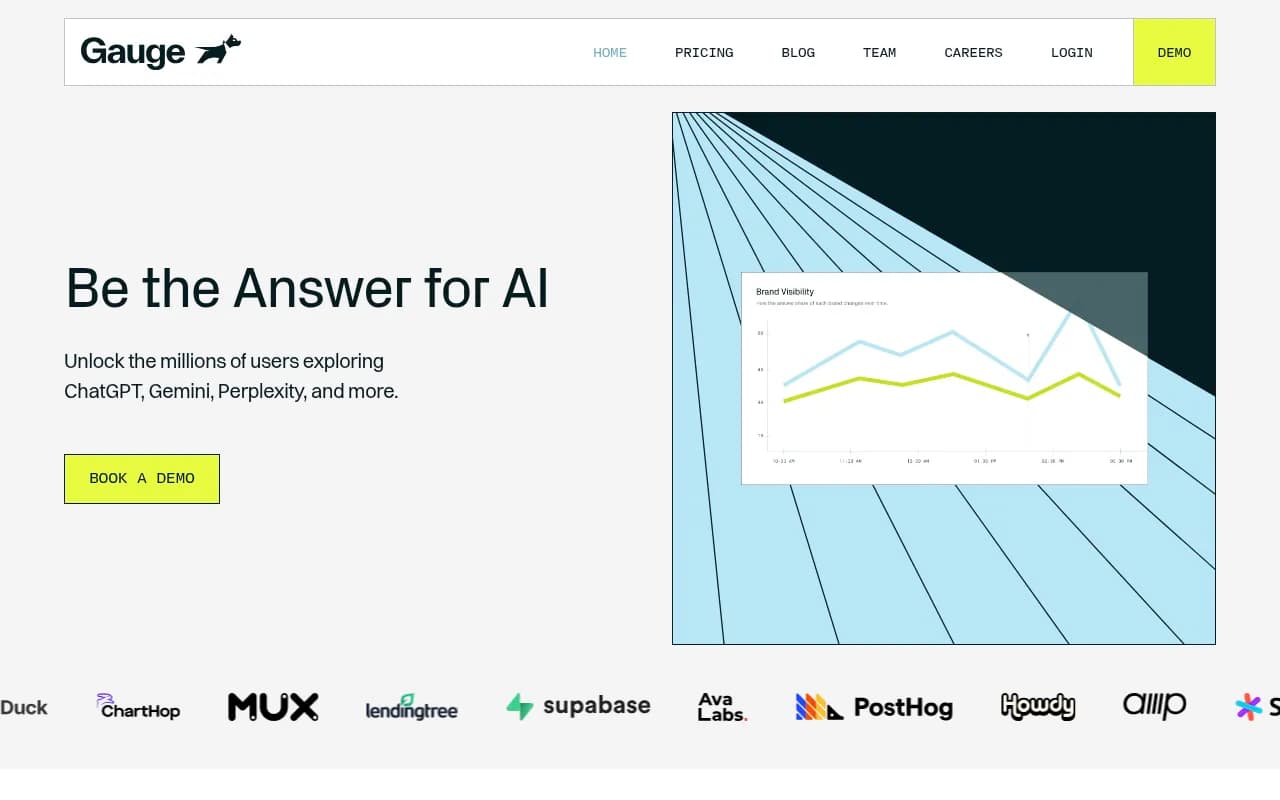
Gauge calls itself a "strategic competitive intelligence" platform for AI visibility. It tracks how your brand shows up across ChatGPT, Claude, Gemini, Perplexity, Copilot, AI Mode, and AI Overviews -- then gives you a roadmap to improve. The pitch: don't just monitor, act. Gauge bundles AI content generation into its Growth and Enterprise tiers, writing articles grounded in citation data to help you rank in AI search. Pricing starts at $99/mo for 100 prompts (ChatGPT only), jumping to $599/mo for 600 prompts across all models and 18 articles per month. Used by MotherDuck, Supabase, and other tech brands.
Hall AI

Hall is a GEO/AEO monitoring platform that tracks brand mentions, citations, and sentiment across the same AI engines. The angle here is simplicity and accessibility -- Hall offers a free tier with shareable reports (no email required) and emphasizes real-time agent analytics. You can see exactly how AI crawlers browse your site, which pages they read, and how that connects to citations in AI responses. Pricing isn't publicly listed but positions as affordable for startups and agencies. Thousands of marketers use it, per their site. No content generation -- Hall is pure tracking and insight.
Side-by-Side Comparison
| Feature | Gauge | Hall AI |
|---|---|---|
| Free tier | Trial only (requires sign-up) | Yes, with shareable reports, no email gate |
| Starting price | $99/mo (100 prompts, ChatGPT only) | Not listed publicly, likely $50-150/mo |
| AI models tracked | ChatGPT, Claude, Gemini, Perplexity, Copilot, AI Mode, AI Overviews (7) | ChatGPT, Claude, Gemini, Perplexity, Copilot, AI Mode, AI Overviews, DeepSeek (8) |
| AI content generation | ✓ (3-18 articles/mo depending on plan) | ✗ |
| Citation tracking | ✓ (shows what's cited + content gaps) | ✓ (shows which pages cited) |
| Agent/crawler analytics | Not emphasized | ✓ (real-time logs, connects to citations) |
| Prompt intelligence | ✓ (volume estimates, difficulty scores, query fan-outs) | Not mentioned |
| Competitor analysis | ✓ (share of voice, positioning) | ✓ (share of voice, sentiment) |
| Sentiment tracking | Not emphasized | ✓ |
| Onsite/offsite recommendations | ✓ (strategic roadmaps) | Not emphasized |
| Target audience | Mid-market tech brands, agencies | Startups, agencies, budget-conscious marketers |
| Setup complexity | Moderate (strategic focus) | Low (praised for ease of use) |
Pricing: Gauge charges more, Hall hides the numbers
Gauge publishes its pricing openly. Hall doesn't, which makes direct comparison tricky -- but user reviews and positioning suggest Hall undercuts Gauge significantly at the entry level.
| Plan | Gauge | Hall AI |
|---|---|---|
| Free | Trial only | Yes (shareable reports, no sign-up) |
| Starter/Entry | $99/mo: 100 prompts, ChatGPT only, 3 articles | Likely $50-150/mo (exact pricing unlisted) |
| Growth/Mid | $599/mo: 600 prompts, all models, 18 articles | Unknown |
| Enterprise | Custom pricing | Custom pricing |
Gauge's Starter plan is a tough sell -- $99/mo for ChatGPT-only tracking feels steep when Hall offers a free tier across all models. The value proposition shifts at Growth tier: if you need AI-written content bundled in, $599/mo for 600 prompts + 18 articles starts to make sense. Hall's pricing opacity is frustrating but user reviews consistently mention affordability, suggesting it's positioned well below Gauge for pure monitoring.
Worth noting: if you're also looking to track how your brand shows up in AI search results with more advanced optimization tools, Promptwatch sits in a similar price range to Gauge Growth but includes crawler logs, 880M+ citations analyzed, Reddit/YouTube tracking, and a tighter action loop (find gaps → generate content → track results).

AI model coverage: Hall edges ahead with DeepSeek
Both platforms cover the majors: ChatGPT, Claude, Gemini, Perplexity, Copilot, Google AI Mode, and AI Overviews. Hall adds DeepSeek to the mix, giving it 8 models vs Gauge's 7. In practice, this matters less than how each platform helps you act on the data.
Gauge layers prompt intelligence on top -- volume estimates, difficulty scores, and query fan-outs that show how one prompt branches into sub-queries. This helps you prioritize high-value, winnable prompts instead of guessing. Hall doesn't surface this level of prompt metadata, focusing instead on what AI models are actually saying about you right now.
Citation tracking: Different philosophies
Both platforms track citations, but the approach diverges.
Gauge shows you:
- Which content AI models cite when they mention your brand
- Content gaps -- prompts where competitors get cited but you don't
- What's missing from your site that would improve AI visibility
This feeds directly into Gauge's content generation feature. The platform identifies the gap, then helps you fill it with AI-written articles.
Hall shows you:
- Exactly which pages on your site get cited in AI responses
- How often each page is referenced
- Real-time agent crawl logs -- which AI crawlers hit your site, what they read, errors they encounter
Hall connects the dots between agent activity and citations. You can see that Perplexity's crawler read your pricing page 12 times last week, then trace that to citations in product comparison prompts. Gauge doesn't emphasize agent analytics at this level.
Content optimization: Gauge generates, Hall observes
This is the clearest split.
Gauge includes an AI writing agent that generates articles, listicles, and comparisons grounded in citation data. Growth plan gets you 18 articles per month. The content is engineered to rank in AI search -- not generic SEO filler. Gauge positions this as closing the loop: find the gap, create the content, track the results.
Hall doesn't generate content. It shows you the insights -- sentiment, share of voice, which pages get cited -- then leaves content creation to you. If you have a content team or use other tools for writing, Hall's monitoring-only approach keeps costs down. If you need the platform to also produce content, Gauge (or Promptwatch, which bundles similar capabilities) is the move.
Competitor analysis: Both deliver, different emphasis
| Feature | Gauge | Hall AI |
|---|---|---|
| Share of voice tracking | ✓ | ✓ |
| Sentiment analysis | Not emphasized | ✓ (highlighted feature) |
| Positioning insights | ✓ ("how you stack up") | ✓ |
| Strategic recommendations | ✓ (onsite/offsite roadmaps) | Not emphasized |
Gauge frames competitor analysis as "strategic intelligence" -- you get clear recommendations on what to do onsite (content gaps, page optimization) and offsite (affiliate targeting, social engagement). Hall surfaces the same share-of-voice data but leans harder on sentiment tracking. You can see not just how often AI mentions you vs competitors, but whether the tone is positive, neutral, or negative.
Ease of use: Hall wins on simplicity
User reviews consistently praise Hall for being easy to set up and navigate. The free shareable report (no email required) is a smart onboarding move -- you can see value before committing. Gauge's interface is more complex, reflecting its strategic positioning. You're not just looking at dashboards; you're working through roadmaps and content recommendations. This is powerful but requires more time investment upfront.
If you're a solo marketer or small team that wants quick answers, Hall's simplicity is an advantage. If you're a mid-market brand with a dedicated growth team, Gauge's depth is worth the learning curve.
Agent analytics: Hall's standout feature
Hall's real-time agent analytics are a differentiator. You can see:
- Which AI crawlers (ChatGPT, Perplexity, Claude, etc.) are hitting your site
- What pages they read and how long they spend
- Errors or access issues they encounter
- How agent activity correlates with citations in AI responses
This is valuable for debugging. If you're not showing up in Perplexity results, Hall's logs might reveal that Perplexity's crawler is getting blocked by your robots.txt or hitting 404s. Gauge doesn't emphasize this level of technical visibility.
Pros and cons
Gauge pros
- AI content generation bundled in (Growth and Enterprise tiers)
- Prompt intelligence (volume estimates, difficulty scores, query fan-outs)
- Strategic roadmaps with clear onsite/offsite recommendations
- Strong for mid-market brands that need a full optimization toolkit
Gauge cons
- Starter plan ($99/mo) only tracks ChatGPT -- poor value
- No genuinely free tier (trial requires sign-up)
- Higher price point overall
- Agent analytics not emphasized
Hall AI pros
- Free tier with shareable reports, no email gate
- Real-time agent/crawler analytics with detailed logs
- Praised for ease of use and fast setup
- Affordable pricing (exact numbers unlisted but positioned low)
- Sentiment tracking highlighted
Hall AI cons
- No content generation -- monitoring only
- Pricing not publicly listed (transparency issue)
- Less emphasis on strategic recommendations or roadmaps
- No prompt volume/difficulty data
Who should pick which tool
Pick Gauge if:
- You want AI content generation bundled into your GEO platform
- You need prompt intelligence (volume, difficulty, query fan-outs) to prioritize efforts
- You're a mid-market tech brand or agency managing multiple clients
- You value strategic roadmaps and clear onsite/offsite recommendations
- Budget allows for $599/mo+ (Growth tier is where Gauge shines)
Pick Hall AI if:
- You're a startup or small team on a tight budget
- You want a free tier to test before committing
- Real-time agent analytics and crawler logs matter to you
- You already have content creation covered (in-house team or other tools)
- Ease of use and fast setup are priorities
- Sentiment tracking is a key metric for your brand
Consider Promptwatch if:
- You want the action loop (find gaps → generate content → track results) that Gauge offers, but with deeper citation data (880M+ analyzed), Reddit/YouTube tracking, and ChatGPT Shopping monitoring
- You need crawler logs like Hall provides, plus page-level tracking and traffic attribution
- You're comparing multiple GEO platforms and want the most complete feature set in one place
Final verdict
Gauge and Hall serve different buyers. Gauge is a strategic platform for brands that want monitoring, content generation, and optimization roadmaps in one package. It costs more but delivers more -- if you use the content generation and prompt intelligence features. Hall is a monitoring specialist that does one thing well: show you how AI talks about your brand, with excellent agent analytics and an accessible free tier. It's the better pick for budget-conscious teams that already have content creation handled.
The deciding factor: do you need the platform to also write content for you? If yes, Gauge (or Promptwatch). If no, Hall's simplicity and price win.