Key Takeaways
- Gauge is a dedicated AI visibility platform with 600+ tracked prompts across 7 AI engines, while Ahrefs Brand Radar is a feature within the broader Ahrefs SEO suite with fixed prompts and limited customization
- Gauge costs $99/mo standalone (Starter) or $599/mo (Growth), while Brand Radar requires a full Ahrefs subscription starting at $129/mo -- but you're paying for the entire SEO toolkit, not just AI monitoring
- Gauge includes content generation (3-18 AI-written articles per month depending on plan) and actionable recommendations; Brand Radar is monitoring-only with no content creation or optimization features
- Brand Radar has no traffic attribution or visitor analytics -- you can't connect AI visibility to actual website traffic. Gauge doesn't mention this capability either in available data.
- If you need AI visibility tracking as your primary focus, Gauge offers more depth. If you're already using Ahrefs for SEO and want basic AI brand monitoring as a bonus feature, Brand Radar makes sense.
- Neither tool offers the full action loop that platforms like Promptwatch provide -- content gap analysis, AI crawler logs, and integrated content generation based on citation data.
Overview
Gauge: Dedicated AI visibility platform
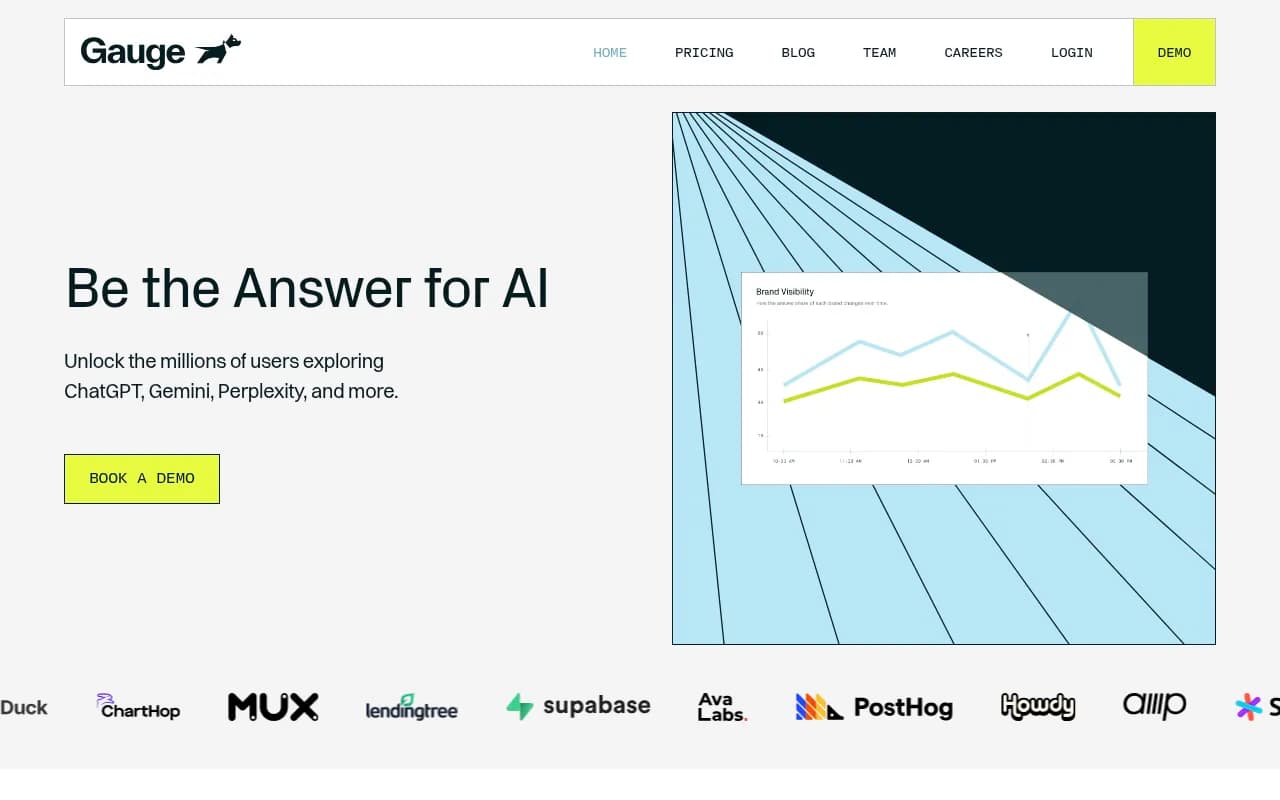
Gauge positions itself as a complete toolkit for AI search optimization. It tracks your brand across ChatGPT, Claude, Gemini, Perplexity, Copilot, AI Mode, and AI Overviews. The pitch is simple: track where you're mentioned, understand what's being cited (and what's missing), then take action to improve visibility.
The platform includes content generation -- Gauge's AI writes articles based on what it finds in the competitive landscape. Starter plan gets you 3 articles per month, Growth gets 18. It also provides onsite and offsite recommendations, though the specifics of what those look like aren't detailed in the available data.
Gauge launched relatively recently and is targeting brands that want AI visibility as a primary marketing channel, not just an afterthought.
Ahrefs Brand Radar: AI monitoring add-on to a traditional SEO platform
Ahrefs Brand Radar is a feature within the Ahrefs SEO platform. It monitors brand mentions across AI-powered search engines and traditional search. The key detail: it's not a standalone product. You need an Ahrefs subscription to access it, which means you're buying the entire Ahrefs toolkit (backlink analysis, keyword research, site audits, rank tracking, content explorer) and getting Brand Radar as part of the package.
Brand Radar uses fixed prompts -- Ahrefs decides what queries to track, you don't customize them. This is a zero-setup approach that works if the prompts Ahrefs chose happen to match your category, but it's limiting if you want to track specific competitor comparisons or niche queries.
Ahrefs has been the go-to SEO research tool for a decade. Brand Radar is their answer to the AI search shift, but it feels like an add-on rather than a core focus.
Side-by-side comparison
| Feature | Gauge | Ahrefs Brand Radar |
|---|---|---|
| Pricing | $99/mo Starter, $599/mo Growth, Enterprise custom | Included with Ahrefs ($129-$999/mo annual) |
| Standalone product | Yes | No -- requires full Ahrefs subscription |
| AI engines tracked | 7 (ChatGPT, Claude, Gemini, Perplexity, Copilot, AI Mode, AI Overviews) | Multiple AI engines (exact list not specified) |
| Prompt customization | Yes -- up to 600 prompts on Growth plan | No -- fixed prompts chosen by Ahrefs |
| Content generation | 3-18 AI-written articles/month depending on plan | None |
| Traffic attribution | Not mentioned | Not available |
| Competitor tracking | Yes | Yes |
| Actionable recommendations | Yes (onsite and offsite) | Limited |
| Free tier | Yes (limited) | No |
| Best for | Brands prioritizing AI visibility | Existing Ahrefs users wanting basic AI monitoring |
Pricing breakdown
| Plan | Gauge | Ahrefs (includes Brand Radar) |
|---|---|---|
| Entry tier | Starter $99/mo: 100 prompts, ChatGPT only, 3 articles | Lite $129/mo: Full SEO suite + Brand Radar |
| Mid tier | Growth $599/mo: 600 prompts, all 7 models, 18 articles | Standard $249/mo: Full SEO suite + Brand Radar |
| High tier | Enterprise: Custom pricing | Advanced $449/mo: Full SEO suite + Brand Radar |
| Top tier | -- | Enterprise $999/mo: Full SEO suite + Brand Radar |
The pricing comparison is tricky because you're comparing apples to oranges. Gauge is a focused AI visibility tool. Ahrefs is a comprehensive SEO platform where Brand Radar is one feature among dozens.
If you only care about AI search visibility, Gauge at $99/mo is cheaper than Ahrefs Lite at $129/mo. But if you need backlink analysis, keyword research, site audits, and rank tracking -- all core SEO work -- then Ahrefs delivers far more value for the money, and you get Brand Radar as a bonus.
Gauge's Growth plan at $599/mo is expensive for what it does. You're paying for 600 prompts and 18 articles per month. That's a steep jump from the $99 Starter tier.
Prompt coverage and customization
This is where the two tools diverge sharply.
Gauge lets you define your own prompts. The Starter plan tracks 100 prompts (ChatGPT only), and the Growth plan tracks 600 prompts across all seven AI engines. You decide what queries matter for your brand -- competitor comparisons, product category searches, specific use cases.
Ahrefs Brand Radar uses fixed prompts. Ahrefs has pre-selected a set of queries they think are relevant for brand monitoring, and that's what you get. No customization. This is fine if the prompts align with your category, but it's a black box -- you don't know what's being tracked until you're already subscribed.
The fixed-prompt approach is faster to set up (zero configuration), but it's also limiting. If your brand operates in a niche or you want to track specific long-tail queries, you're out of luck.
Gauge's 600-prompt limit on the Growth plan is generous compared to most competitors, but it's still a hard cap. If you need more, you're into Enterprise pricing.
Content generation and optimization
Gauge includes AI-written content as part of the platform. The Starter plan generates 3 articles per month, Growth generates 18. The idea is that Gauge analyzes the competitive landscape, identifies gaps, and writes content to fill those gaps.
The quality and usefulness of AI-generated content is always a question mark. Gauge doesn't provide examples or case studies showing what these articles look like or how well they perform. It's a nice feature to have, but without seeing the output, it's hard to judge whether it's genuinely useful or just filler.
Ahrefs Brand Radar has no content generation. It's purely a monitoring tool. You see where your brand is mentioned (or not mentioned), but you're on your own for creating content to improve visibility.
If you want a platform that helps you act on the data -- not just see the data -- Gauge has the edge here. But for deeper content optimization based on actual citation patterns and prompt volumes, tools like Promptwatch go further by grounding content generation in 880M+ analyzed citations and showing you exactly what's missing from your site.

AI engine coverage
Gauge explicitly tracks 7 AI engines: ChatGPT, Claude, Gemini, Perplexity, Copilot, AI Mode, and AI Overviews. That's a solid list covering the major players.
Ahrefs Brand Radar mentions tracking "AI-powered search engines" but doesn't specify which ones in the available data. Ahrefs is known for being thorough, so it's likely they cover the major engines, but the lack of transparency is frustrating.
Both tools are missing some of the newer entrants like DeepSeek, Grok, and Mistral. If you need comprehensive coverage across 10+ AI models, neither tool delivers that.
Competitor analysis
Both platforms let you track competitors alongside your own brand. You can see how your visibility stacks up and where competitors are winning.
Gauge provides "clear roadmaps" to improve visibility based on competitor analysis. The details are vague, but the implication is that you get specific recommendations -- publish this type of content, target these affiliates, engage with these Reddit threads.
Ahrefs Brand Radar shows competitor mentions but doesn't go as deep on actionable next steps. You see the data, but the analysis and recommendations are lighter.
For true competitor deep-dives -- understanding which pages are being cited, which Reddit threads are influencing AI responses, which YouTube videos are driving recommendations -- you need more than either of these tools provides.
Traffic attribution and ROI tracking
This is a major gap for both platforms.
Neither Gauge nor Ahrefs Brand Radar offers traffic attribution. You can see that your brand is mentioned in AI responses, but you can't connect that visibility to actual website visits or conversions. There's no code snippet, no Google Search Console integration, no server log analysis.
Without traffic attribution, you're flying blind on ROI. You're spending money to improve AI visibility, but you can't prove it's driving business results.
This is a critical missing piece. If you need to justify AI visibility spend to a CFO or CMO, you need attribution data.
Ease of use and setup
Ahrefs Brand Radar wins on setup simplicity. It's zero-configuration -- you turn it on, and it starts tracking. No need to define prompts or configure anything.
Gauge requires more upfront work. You need to decide which prompts to track, set up competitor monitoring, and configure your brand parameters. That's more flexible, but it's also more time-consuming.
Once you're past setup, both tools are straightforward dashboards. Ahrefs has the advantage of a mature, polished interface -- they've been refining their UX for years. Gauge is newer and the interface feels less refined based on available screenshots.
Integration with broader marketing workflows
Ahrefs Brand Radar sits inside the Ahrefs ecosystem. If you're already using Ahrefs for SEO, adding Brand Radar to your workflow is seamless. You're in the same tool, same login, same data model.
Gauge is a standalone platform. It doesn't integrate with other tools in your stack. No mention of API access, Looker Studio connectors, or webhooks. It's an island.
For agencies or larger marketing teams that need to pull data into custom dashboards or reporting systems, the lack of integrations is a problem.
Pros and cons
Gauge pros
- Dedicated AI visibility focus with 600+ customizable prompts
- Includes content generation (3-18 articles/month)
- Tracks 7 major AI engines explicitly
- Provides actionable onsite and offsite recommendations
- Standalone product -- no need to buy a full SEO suite
Gauge cons
- Expensive jump from Starter ($99) to Growth ($599)
- No traffic attribution or visitor analytics
- Limited integration options
- Newer platform with less proven track record
- AI-generated content quality is unknown
Ahrefs Brand Radar pros
- Included with Ahrefs subscription -- no extra cost if you're already a customer
- Zero-setup, fixed prompts make it easy to start
- Backed by Ahrefs' reputation and data infrastructure
- Part of a comprehensive SEO toolkit
- Polished, mature interface
Ahrefs Brand Radar cons
- Not a standalone product -- requires full Ahrefs subscription ($129-$999/mo)
- Fixed prompts with no customization
- No content generation or optimization features
- No traffic attribution
- Monitoring-only -- limited actionable recommendations
- Unclear which AI engines are tracked
Who should pick which tool
Choose Gauge if:
- AI visibility is your primary marketing focus, not an afterthought
- You want to define your own prompts and track specific competitor comparisons
- You need content generation built into the platform
- You're not already using Ahrefs and don't need traditional SEO tools
- You're willing to pay $599/mo for the Growth plan to get full functionality
Choose Ahrefs Brand Radar if:
- You're already an Ahrefs customer and want basic AI monitoring as a bonus feature
- You prefer zero-setup, fixed prompts over customization
- You need comprehensive SEO tools (backlinks, keywords, site audits) alongside AI monitoring
- You're comfortable with monitoring-only and will handle content creation separately
- You want a proven platform from an established company
Consider alternatives if:
- You need traffic attribution to prove ROI -- neither tool offers this
- You want deeper optimization features like AI crawler logs, citation analysis, or prompt volume data
- You need to track 10+ AI models including newer entrants like DeepSeek and Grok
- You want Reddit and YouTube tracking to understand what's influencing AI recommendations
- You need API access or integrations with your existing marketing stack
Final verdict
Gauge and Ahrefs Brand Radar serve different audiences.
Gauge is for brands that have decided AI visibility is a strategic priority and want a dedicated tool with customization and content generation. It's more expensive ($599/mo for full features) but offers more depth for AI-specific work.
Ahrefs Brand Radar is for existing Ahrefs users who want to add basic AI monitoring without buying another tool. It's monitoring-only with fixed prompts, but if you're already paying for Ahrefs, it's essentially free.
The bigger issue is that both tools are incomplete. No traffic attribution means you can't measure ROI. Limited actionable recommendations mean you're still figuring out what to do with the data. And neither tool goes deep on the mechanics of how AI engines work -- crawler logs, citation patterns, prompt volumes.
If you're serious about AI visibility, you'll likely need more than either of these tools provides. Gauge gets you further than Brand Radar for AI-specific work, but it's not a complete solution. Ahrefs Brand Radar is a nice-to-have feature if you're already in the Ahrefs ecosystem, but it's not worth buying Ahrefs just for Brand Radar.
Bottom line: Gauge wins for dedicated AI visibility work, Ahrefs Brand Radar wins for convenience if you're already a customer, and both fall short on attribution and deep optimization.