Key Takeaways
- Gauge is a dedicated AI visibility platform focused exclusively on tracking and improving brand presence across AI engines -- SearchAtlas bundles LLM visibility monitoring into a broader 60+ tool SEO suite
- SearchAtlas starts at $99/mo but LLM visibility is just one feature among many; Gauge's $99/mo Starter plan gives you 100 prompts and content generation focused entirely on AI search optimization
- Gauge covers 7 AI models (ChatGPT, Claude, Gemini, Perplexity, Copilot, AI Mode, AI Overviews) with deep citation analysis and competitor tracking -- SearchAtlas's LLM coverage details are less transparent
- Gauge provides actionable content gap analysis and generates articles specifically designed to rank in AI search results -- SearchAtlas's Atlas Brain is a conversational agent for general SEO tasks, not AI visibility optimization
- If you need a full SEO platform with traditional rank tracking, site audits, and keyword research plus some AI visibility monitoring, SearchAtlas makes sense. If your primary goal is owning your category in AI search engines, Gauge is purpose-built for that.
- SearchAtlas is better for agencies managing multiple clients across traditional SEO and AI visibility. Gauge is better for brands and marketing teams laser-focused on improving AI search presence.
Overview
Gauge: Strategic competitive intelligence for AI visibility
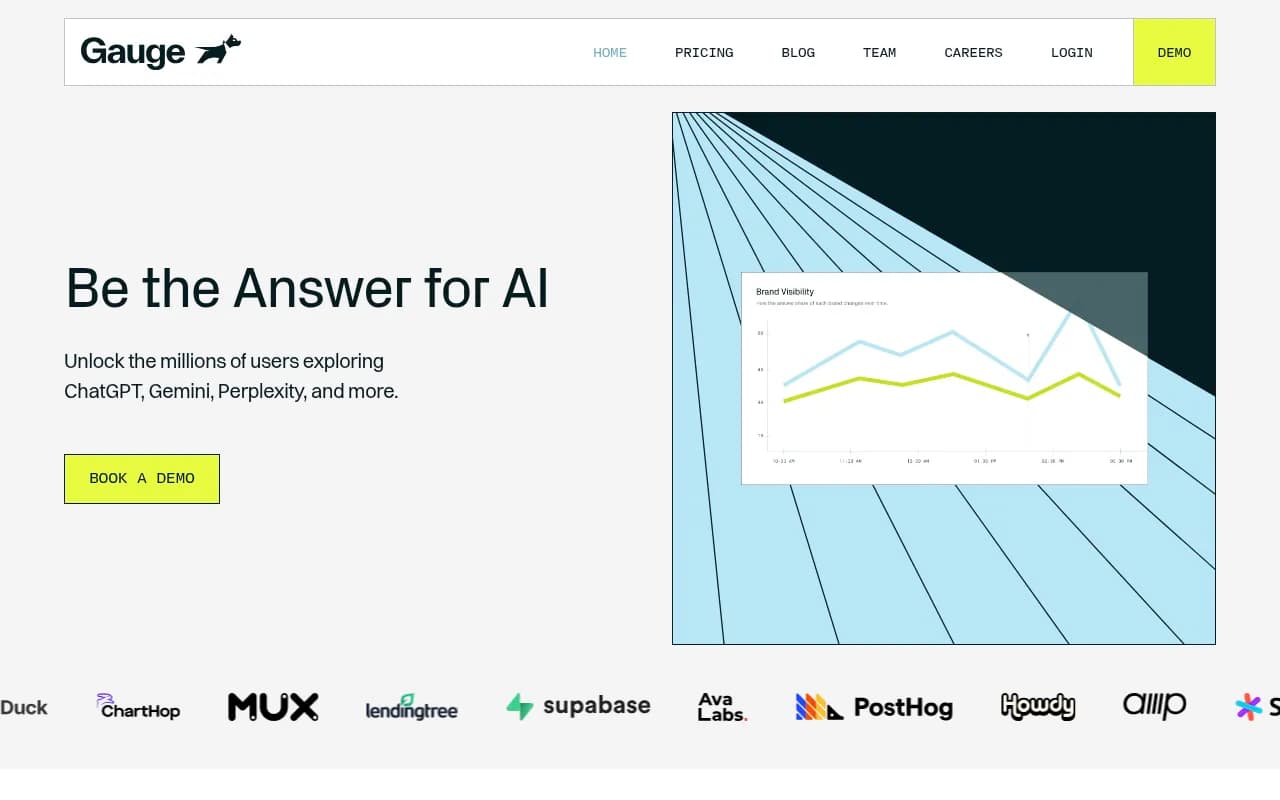
Gauge positions itself as a complete toolkit for AI visibility and Generative Engine Optimization (GEO). The platform tracks how your brand appears across ChatGPT, Claude, Gemini, Perplexity, Copilot, AI Mode, and AI Overviews. What sets Gauge apart is the action loop: it doesn't just show you where you're mentioned (or not mentioned) -- it analyzes what content is being cited, identifies gaps where competitors are visible but you're not, and then helps you create content specifically engineered to get cited by AI models.
The interface is built around three stages: Track (monitor AI-generated answers for brand mentions), Understand (analyze citation patterns and competitor visibility), and Act (get clear onsite and offsite recommendations). Gauge is used by brands like MotherDuck, Supabase, and Howdy.
SearchAtlas LLM Visibility: AI-powered SEO automation platform
SearchAtlas is an all-in-one SEO platform that includes LLM visibility monitoring as one feature within a 60+ tool suite. The headline feature is Atlas Brain, a conversational AI agent that automates SEO tasks -- you can ask it to generate content, run competitor analysis, build topical maps, identify technical issues, or create SEO reports. The platform covers traditional SEO (keyword research, site audits, rank tracking, backlink analysis, local SEO) alongside newer capabilities like AI visibility tracking and Google Ads management.
SearchAtlas targets agencies and brands managing multiple clients or properties. The LLM visibility component tracks brand mentions in AI chat outputs, but it's positioned as part of a broader SEO workflow rather than a standalone AI search optimization platform. Clients include Autotrader, Hyundai, and Penn.
Side-by-Side Comparison
| Feature | Gauge | SearchAtlas LLM Visibility |
|---|---|---|
| Primary focus | AI visibility & GEO optimization | All-in-one SEO platform with LLM tracking |
| AI models tracked | 7 (ChatGPT, Claude, Gemini, Perplexity, Copilot, AI Mode, AI Overviews) | Not clearly specified |
| Starting price | $99/mo (100 prompts, ChatGPT only, 3 articles) | $99/mo (Starter plan, includes all 60+ tools) |
| Content generation | AI-powered articles designed to rank in AI search | Atlas Brain generates SEO content (general purpose) |
| Competitor tracking | Deep competitor visibility analysis across AI engines | Competitor analysis for traditional SEO + some LLM tracking |
| Citation analysis | Detailed breakdown of what content AI models cite | Limited visibility into citation patterns |
| Content gap analysis | Core feature -- shows exactly what prompts competitors rank for | Not a primary feature |
| Traditional SEO tools | None (pure AI visibility focus) | 60+ tools (audits, rank tracking, backlinks, local SEO, etc.) |
| Conversational AI agent | No | Yes (Atlas Brain) |
| Free trial | Yes (free tier available) | 7-day free trial |
| Target audience | Brands focused on AI search optimization | Agencies and brands needing full SEO suite |
| Annual discounts | Not specified | Yes |
Head-to-head feature deep-dive
AI model coverage and tracking depth
Gauge explicitly tracks 7 AI engines: ChatGPT, Claude, Gemini, Perplexity, Copilot, AI Mode, and AI Overviews. The platform monitors AI-generated answers for brand mentions and provides detailed citation analysis -- you can see exactly which pages, sources, and content types AI models reference when they mention (or don't mention) your brand. The competitor tracking shows how your visibility stacks up against rivals across each model.
SearchAtlas includes LLM visibility monitoring but doesn't clearly specify which AI models it covers or how deep the tracking goes. The focus is on integrating AI visibility into a broader SEO workflow rather than providing granular citation-level analysis. If you need to know exactly why ChatGPT cited a competitor's blog post instead of yours, Gauge gives you that level of detail. SearchAtlas gives you a higher-level view.
Verdict: Gauge wins on AI model coverage transparency and citation depth. SearchAtlas's LLM tracking feels like a checkbox feature rather than a core capability.
Content optimization and generation
Gauge's content generation is purpose-built for AI search. The platform identifies content gaps (prompts where competitors are visible but you're not), then generates articles specifically designed to get cited by AI models. The output isn't generic SEO filler -- it's grounded in citation data and prompt analysis. Gauge's Growth plan includes 18 AI-generated articles per month.
SearchAtlas's Atlas Brain is a conversational AI agent that can generate content, but it's optimized for traditional SEO rather than AI visibility. You can ask it to write blog posts, create topical maps, or generate meta descriptions, but the content isn't specifically engineered to rank in ChatGPT or Perplexity. The platform includes 60+ SEO tools, so you get keyword research, content briefs, and optimization suggestions -- but the focus is on Google rankings, not AI citations.
Verdict: Gauge is the clear winner if your goal is content that ranks in AI search. SearchAtlas is better if you need general-purpose SEO content generation alongside traditional optimization tools.
Competitor intelligence
Gauge's competitor tracking is laser-focused on AI visibility. You can see exactly which prompts competitors rank for, what content they're getting cited for, and how their visibility compares to yours across each AI model. The platform identifies gaps where competitors are dominating and you're invisible, then provides actionable recommendations to close those gaps.
SearchAtlas offers competitor analysis for traditional SEO metrics (keyword rankings, backlink profiles, domain authority) plus some LLM visibility tracking. The competitor intelligence is broader but less granular for AI search specifically. If you want to know a competitor's backlink strategy and their AI visibility in one dashboard, SearchAtlas delivers. If you only care about AI search dominance, Gauge gives you more actionable insights.
Verdict: Gauge for AI-specific competitor intelligence, SearchAtlas for holistic SEO + AI competitor analysis.
Platform scope and integration
Gauge is a single-purpose platform. You get AI visibility tracking, content gap analysis, and AI-optimized content generation. That's it. No rank tracking, no site audits, no backlink analysis. The trade-off is depth -- every feature is designed to help you dominate AI search results.
SearchAtlas is a Swiss Army knife. You get 60+ tools covering keyword research, site audits, rank tracking, backlink analysis, local SEO, Google Ads management, and LLM visibility monitoring. The Atlas Brain conversational agent ties it all together, letting you ask questions and execute tasks across the entire platform. If you're managing traditional SEO alongside AI visibility, SearchAtlas keeps everything in one dashboard.
Verdict: Depends on your needs. Gauge if you want a dedicated AI visibility platform. SearchAtlas if you need an all-in-one SEO suite that happens to include LLM tracking.
User interface and workflow
Gauge's interface is built around the Track → Understand → Act workflow. You start by monitoring AI mentions, then analyze citation patterns and competitor gaps, then take action with content recommendations. The UI is focused and uncluttered -- every screen is designed to answer a specific question about your AI visibility.
SearchAtlas's interface is more complex because it's managing 60+ tools. The Atlas Brain conversational agent simplifies navigation -- you can ask it to run reports, generate content, or analyze competitors instead of clicking through menus. But the learning curve is steeper if you're only interested in LLM visibility. You'll spend time navigating past features you don't need.
Verdict: Gauge for simplicity and focus. SearchAtlas if you're comfortable with a more complex platform that offers broader capabilities.
Reporting and analytics
Gauge provides detailed reports on AI visibility trends, competitor performance, and citation analysis. You can see how your brand presence changes over time across each AI model, which content is getting cited, and where you're losing to competitors. The reports are designed for marketing teams and executives who need to understand AI search performance at a glance.
SearchAtlas includes comprehensive SEO reporting (rank tracking, traffic analysis, backlink reports, site audit summaries) plus LLM visibility metrics. The Atlas Brain can generate custom reports on demand. The reporting is more comprehensive overall but less granular for AI visibility specifically.
Verdict: Gauge for AI-focused reporting, SearchAtlas for holistic SEO + AI reporting.
Target audience and use cases
Gauge is built for brands and marketing teams that recognize AI search as a critical channel and want to dominate it. If you're a SaaS company competing for visibility in ChatGPT recommendations, or a B2B brand trying to own your category in Perplexity results, Gauge gives you the tools to make that happen. It's also a good fit for agencies specializing in AI visibility and GEO.
SearchAtlas targets agencies and brands managing multiple clients or properties across traditional SEO and emerging channels. If you need rank tracking, site audits, and backlink analysis alongside AI visibility monitoring, SearchAtlas keeps everything in one platform. It's better for teams that view LLM tracking as one component of a broader SEO strategy rather than the primary focus.
Verdict: Gauge for AI-first teams, SearchAtlas for full-service SEO teams.
Pricing comparison
| Plan | Gauge | SearchAtlas |
|---|---|---|
| Free tier | Yes (limited features) | 7-day free trial |
| Starter | $99/mo (100 prompts, ChatGPT only, 3 articles) | $99/mo (all 60+ tools, includes LLM visibility) |
| Mid-tier | $599/mo Growth (600 prompts, all models, 18 articles) | $199/mo Growth (expanded limits across all tools) |
| High-tier | Enterprise (custom pricing) | $399/mo Pro (full platform access) |
| Annual discounts | Not specified | Yes |
The pricing comparison is tricky because you're comparing a specialized tool (Gauge) to an all-in-one platform (SearchAtlas). At $99/mo, Gauge gives you 100 prompts and 3 AI-optimized articles focused entirely on AI visibility. SearchAtlas at $99/mo gives you access to 60+ SEO tools plus LLM visibility monitoring.
If you only care about AI search, Gauge's $99/mo plan is more valuable because every feature is purpose-built for that goal. If you need traditional SEO tools alongside AI visibility, SearchAtlas's $99/mo plan is a better deal because you get the full platform.
Gauge's $599/mo Growth plan (600 prompts, all AI models, 18 articles) is expensive compared to SearchAtlas's $199/mo Growth plan, but again, you're paying for depth vs breadth. Gauge's articles are specifically engineered to rank in AI search. SearchAtlas's content generation is general-purpose SEO.
Pros and cons
Gauge pros
- Purpose-built for AI visibility -- every feature is designed to help you rank in AI search
- Deep citation analysis shows exactly what content AI models reference
- Content gap analysis identifies specific prompts where competitors are visible but you're not
- AI-optimized content generation creates articles designed to get cited by ChatGPT, Claude, Perplexity, etc.
- Clear Track → Understand → Act workflow makes it easy to take action on insights
- Transparent AI model coverage (7 engines explicitly listed)
Gauge cons
- No traditional SEO tools (rank tracking, site audits, backlink analysis)
- Starter plan only covers ChatGPT ($99/mo for one AI model is steep)
- Growth plan at $599/mo is expensive compared to broader platforms
- Smaller user base and less established than all-in-one SEO platforms
SearchAtlas pros
- 60+ tools cover traditional SEO, local SEO, Google Ads, and LLM visibility in one platform
- Atlas Brain conversational agent simplifies complex SEO tasks
- Broader feature set makes it better value for agencies managing multiple clients
- Lower mid-tier pricing ($199/mo Growth plan vs Gauge's $599/mo)
- Established platform with larger user base and more reviews
SearchAtlas cons
- LLM visibility is a secondary feature, not the core focus
- Less transparency around which AI models are tracked and how deep the monitoring goes
- Content generation is optimized for traditional SEO, not AI search specifically
- Steeper learning curve due to platform complexity
- AI visibility insights are less granular than dedicated platforms
Who should pick which tool
Choose Gauge if:
- Your primary goal is dominating AI search results (ChatGPT, Perplexity, Claude, etc.)
- You want detailed citation analysis and competitor intelligence for AI visibility
- You need content specifically engineered to rank in AI engines, not just Google
- You're a SaaS company, B2B brand, or agency specializing in GEO
- You're willing to pay for depth and specialization in AI visibility
- You already have traditional SEO tools and just need AI search optimization
Choose SearchAtlas if:
- You need an all-in-one SEO platform that includes LLM visibility monitoring
- You're managing traditional SEO (rank tracking, audits, backlinks) alongside AI visibility
- You want a conversational AI agent to automate SEO tasks across 60+ tools
- You're an agency managing multiple clients with diverse SEO needs
- You prefer a broader platform at a lower price point over specialized depth
- You view AI visibility as one component of a holistic SEO strategy
If you're also looking to track how your brand shows up in AI search results with even more depth -- including crawler logs, Reddit/YouTube tracking, and prompt intelligence -- Promptwatch covers that angle with 880M+ citations analyzed and content generation grounded in real AI search data.

Final verdict
Gauge and SearchAtlas serve different audiences. Gauge is a scalpel -- precise, specialized, and purpose-built for AI visibility. SearchAtlas is a Swiss Army knife -- versatile, comprehensive, and designed for teams managing traditional SEO alongside emerging channels.
If you're a brand that recognizes AI search as a critical channel and wants to own your category in ChatGPT, Perplexity, and Claude, Gauge is the better choice. The citation analysis, content gap identification, and AI-optimized content generation are unmatched by broader platforms. You'll pay more for specialization, but the depth is worth it if AI visibility is your priority.
If you're an agency or brand managing multiple clients across traditional SEO and AI visibility, SearchAtlas makes more sense. You get 60+ tools, a conversational AI agent, and LLM tracking in one platform at a competitive price. The AI visibility features aren't as deep as Gauge, but the breadth of capabilities makes up for it if you need rank tracking, site audits, and backlink analysis alongside AI monitoring.
The one-liner: Gauge for AI search dominance, SearchAtlas for full-service SEO with AI visibility as a bonus feature.