Key Takeaways
- Gauge starts at $99/mo but locks you into ChatGPT-only tracking on the Starter plan -- Rankshift's €69/mo Starter includes all AI models from day one
- Rankshift offers 150 prompts/day (4,500/month) on its cheapest plan vs Gauge's 100 total prompts/month -- a 45x difference in tracking capacity
- Gauge includes AI content generation on all paid plans (3-18 articles/month depending on tier) -- Rankshift has no built-in content writer
- Both platforms track the same core AI models (ChatGPT, Perplexity, Claude, Gemini, AI Overviews) but Gauge adds Copilot and AI Mode coverage
- Rankshift emphasizes unlimited users and projects across all plans -- Gauge's user limits aren't publicly disclosed
- For teams that need high-volume prompt tracking without content generation, Rankshift delivers better value. For teams that want an all-in-one platform with content creation built in, Gauge makes more sense.
Overview
Both Gauge and Rankshift solve the same core problem: your brand is invisible in AI search results, and you have no idea why. When someone asks ChatGPT or Perplexity for product recommendations in your category, are you mentioned? Cited? Ignored entirely? These platforms give you the answer.
Gauge
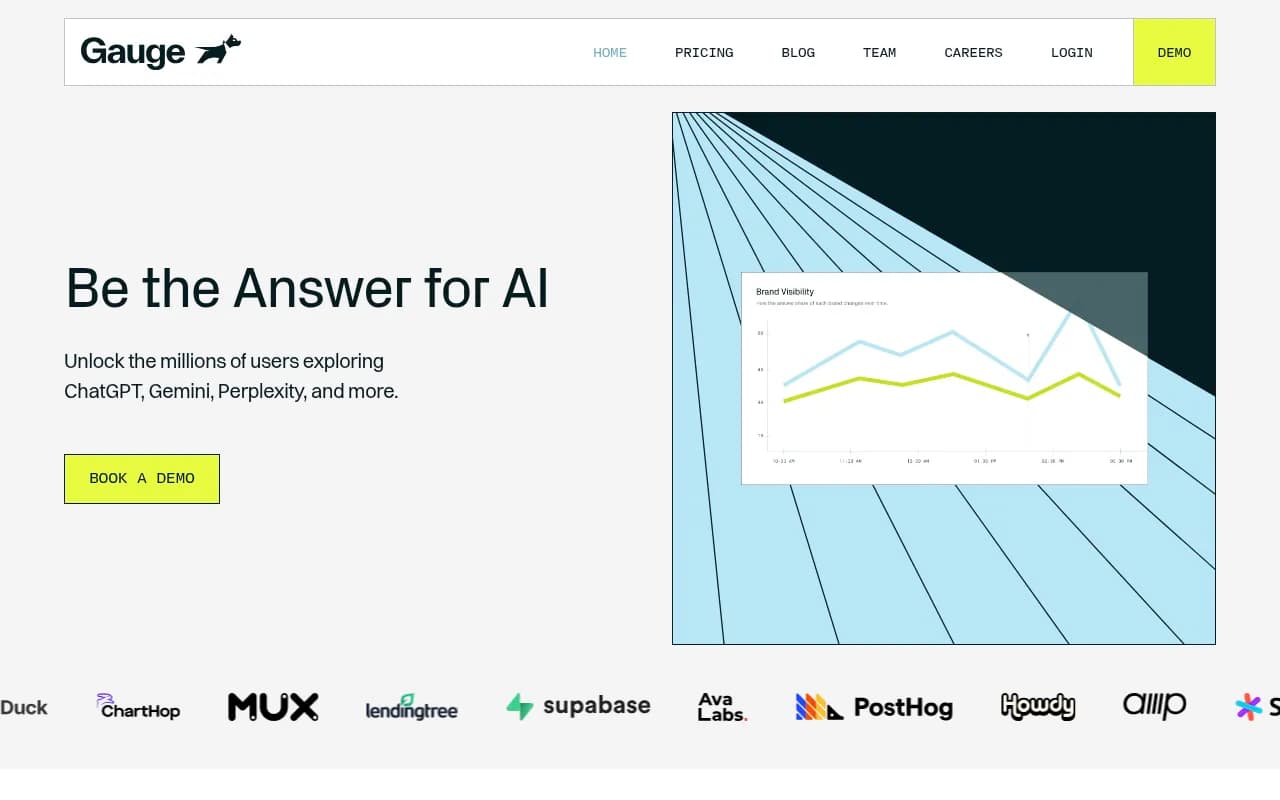
Gauge positions itself as a complete toolkit for AI visibility -- tracking, analysis, and action in one platform. The pitch is simple: see where you're mentioned across AI engines, understand what content is being cited (and what's missing), then use Gauge's built-in content generator to fill the gaps. It's aimed at marketing teams that want a single platform to handle the entire GEO workflow without stitching together multiple tools.
The platform monitors ChatGPT, Claude, Gemini, Perplexity, Copilot, AI Mode, and AI Overviews. Pricing starts at $99/mo for the Starter plan (100 prompts, ChatGPT only, 3 AI-generated articles) and scales to $599/mo for Growth (600 prompts, all models, 18 articles). There's a free tier for basic exploration.
Rankshift
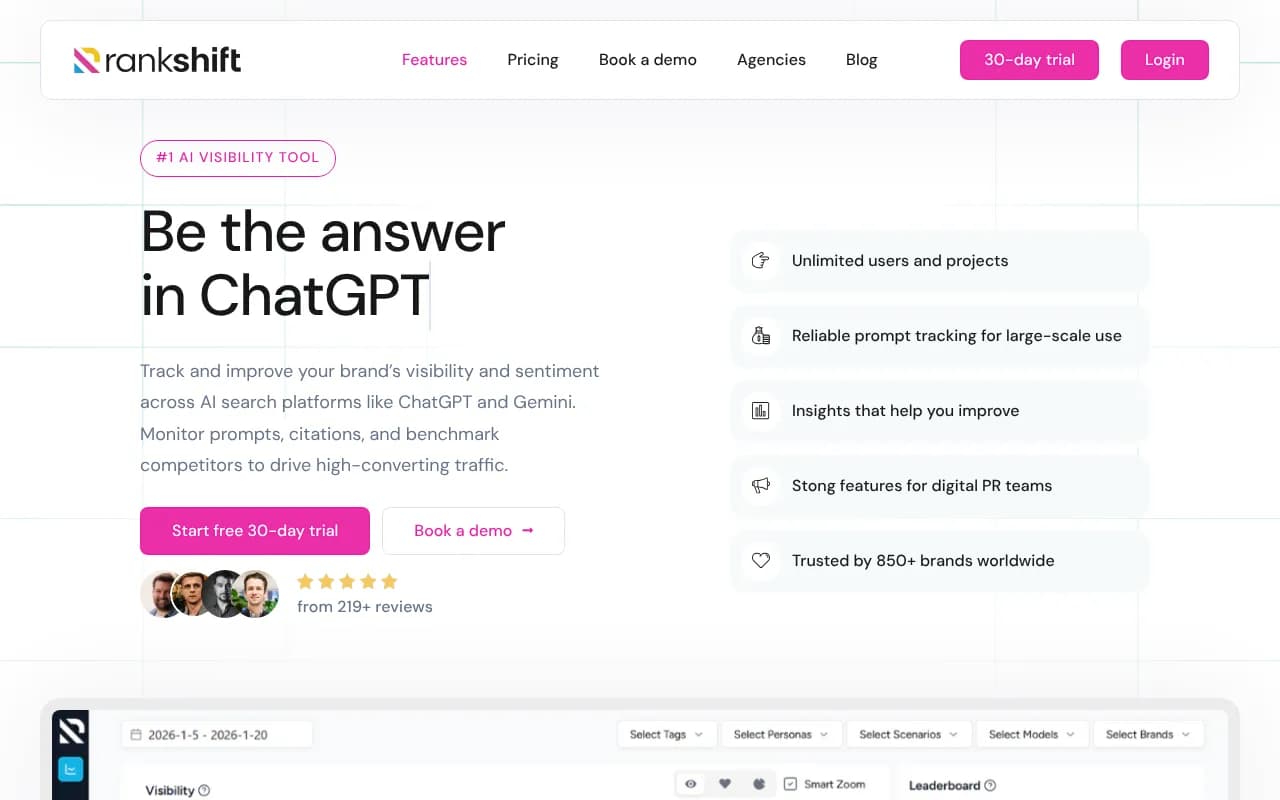
Rankshift takes a more focused approach: high-volume prompt tracking with unlimited users and projects baked into every plan. The platform is built for teams that need to monitor hundreds or thousands of prompts daily across multiple brands and clients. It tracks the same core AI models (ChatGPT, Perplexity, Claude, Gemini, AI Overviews) but doesn't include content generation -- the assumption is you'll handle content creation elsewhere.
Pricing starts at €69/mo for the Starter plan (150 prompts/day, 9,500 credits) and goes up to €359/mo for Business (850 prompts/day, 53,000 credits). Every plan includes unlimited users and projects, which matters for agencies and larger teams. There's a 30-day free trial and 10% off annual billing.
Side-by-Side Comparison
| Feature | Gauge | Rankshift |
|---|---|---|
| Starting price | $99/mo | €69/mo (~$73/mo) |
| Free tier | Yes (limited) | No (30-day trial) |
| Prompt volume (entry plan) | 100 prompts/month | 150 prompts/day (4,500/month) |
| AI models tracked | ChatGPT, Claude, Gemini, Perplexity, Copilot, AI Mode, AI Overviews | ChatGPT, Claude, Gemini, Perplexity, AI Overviews |
| Content generation | 3-18 articles/month (plan dependent) | None |
| Competitor tracking | Yes | Yes |
| Citation analysis | Yes | Yes |
| Unlimited users | Not specified | All plans |
| Unlimited projects | Not specified | All plans |
| API access | Not specified | Not specified |
| Best for | Teams wanting all-in-one tracking + content | High-volume tracking across multiple brands |
Prompt tracking capacity
This is where the two platforms diverge sharply.
Gauge's Starter plan gives you 100 prompts total per month. That's it. If you're monitoring 10 prompts across 5 AI models, you burn through your allocation in two days. The Growth plan bumps you to 600 prompts/month, which is better but still constraining if you're tracking a broad set of queries or running regular competitor benchmarks.
Rankshift's Starter plan gives you 150 prompts per day -- 4,500 per month. That's 45x more tracking capacity than Gauge's entry tier. The mid-tier plan (€149/mo) offers 400 prompts/day (12,000/month), and the Business plan goes to 850 prompts/day (25,500/month). If you need to track dozens of prompts across multiple brands, languages, or regions, Rankshift's volume advantage is decisive.
The trade-off: Rankshift uses a credit system on top of prompt limits. Each prompt costs credits depending on the AI model queried. Gauge's pricing is simpler -- you get X prompts, use them however you want.
Verdict: For high-volume tracking, Rankshift wins by a mile. Gauge's prompt limits feel tight unless you're on the $599/mo Growth plan.
AI model coverage
Both platforms cover the essential AI engines, but there are gaps.
Gauge tracks:
- ChatGPT
- Claude
- Gemini
- Perplexity
- Copilot
- AI Mode (Google's conversational search)
- AI Overviews (Google's AI-generated summaries)
Rankshift tracks:
- ChatGPT
- Claude
- Gemini
- Perplexity
- AI Overviews
Gauge has two models Rankshift doesn't: Copilot and AI Mode. If you need visibility into Microsoft's AI assistant or Google's conversational search interface, Gauge is the only option here. That said, Copilot and AI Mode represent a smaller share of AI search traffic compared to ChatGPT and Perplexity.
Neither platform tracks DeepSeek, Grok, Mistral, or Meta AI -- models that Promptwatch covers if you need broader LLM monitoring.

Verdict: Gauge has slightly broader coverage with Copilot and AI Mode, but the difference isn't huge for most use cases.
Content generation
This is Gauge's standout feature and Rankshift's biggest gap.
Gauge includes an AI content writer on every paid plan:
- Starter: 3 articles/month
- Growth: 18 articles/month
- Enterprise: custom volume
The content generator is designed to create articles optimized for AI citation based on the gaps Gauge identifies in your tracking data. You see which prompts your competitors rank for but you don't, and Gauge helps you write content to close those gaps. The articles are grounded in the citation data Gauge collects, so they're not generic SEO filler -- they're targeted at the specific queries and angles AI models are looking for.
Rankshift has no content generation. You get the tracking data, the competitor analysis, the citation breakdowns -- but you're on your own for creating content. If you already have a content team or use a separate tool for writing, this isn't a problem. If you want an all-in-one platform, it's a limitation.
Verdict: Gauge wins decisively if content generation matters to you. Rankshift assumes you'll handle content elsewhere.
Competitor analysis
Both platforms let you track competitors alongside your own brand, but the depth varies.
Gauge shows you:
- Which competitors are mentioned in AI responses for your target prompts
- What content is being cited from competitor sites
- Gaps where competitors are visible but you're not
- Recommendations for onsite and offsite actions to close the gap
Rankshift shows you:
- Competitor mention frequency across prompts
- Citation sources for competitor brands
- Visibility benchmarks (your brand vs competitors)
- Prompt-level breakdowns of who's winning
The core data is similar. Gauge leans more into actionable recommendations ("here's what to do about it"), while Rankshift gives you the raw data and assumes you'll figure out the strategy. If you want hand-holding, Gauge is friendlier. If you want flexibility to run your own analysis, Rankshift gives you more room.
Verdict: Tie. Both platforms deliver solid competitor tracking with slightly different philosophies.
Pricing comparison
| Plan | Gauge | Rankshift |
|---|---|---|
| Free tier | Yes (limited features) | No (30-day trial) |
| Entry plan | $99/mo (100 prompts, ChatGPT only, 3 articles) | €69/mo (~$73/mo, 150 prompts/day, all models, 9,500 credits) |
| Mid-tier | $599/mo (600 prompts, all models, 18 articles) | €149/mo (~$158/mo, 400 prompts/day, all models, 24,000 credits) |
| High-tier | Enterprise (custom pricing) | €359/mo (~$380/mo, 850 prompts/day, all models, 53,000 credits) |
| Annual discount | Not specified | 10% off |
| Users included | Not specified | Unlimited (all plans) |
| Projects included | Not specified | Unlimited (all plans) |
Gauge's pricing is straightforward but restrictive at the low end. The $99/mo Starter plan only tracks ChatGPT, which is a dealbreaker if you need multi-model coverage. You have to jump to $599/mo to get all models and meaningful prompt volume.
Rankshift's entry plan is cheaper and includes all AI models from the start. The prompt volume is vastly higher (4,500/month vs 100/month), and you get unlimited users and projects. The credit system adds complexity, but the raw capacity is better.
If you need content generation, Gauge's pricing makes sense -- you're paying for the AI writer on top of tracking. If you just need tracking, Rankshift delivers more for less.
Verdict: Rankshift offers better value for pure tracking. Gauge's pricing is justified if you use the content generator.
User limits and collaboration
Rankshift explicitly includes unlimited users and unlimited projects on every plan. This is huge for agencies managing multiple clients or larger teams with multiple stakeholders. You don't have to worry about seat limits or project caps.
Gauge doesn't publicly disclose user limits. The website emphasizes team collaboration but doesn't specify how many users are included at each tier. This is a red flag if you're managing multiple brands or working with a distributed team.
Verdict: Rankshift wins on transparency and flexibility. Unlimited users and projects is a clear advantage.
Ease of use
Both platforms advertise quick setup -- Rankshift claims 3 minutes, Gauge emphasizes "stop prompting and start measuring."
Gauge's interface is polished and beginner-friendly. The onboarding flow walks you through adding prompts, selecting AI models, and setting up competitor tracking. The recommendations are clear and actionable, which helps if you're new to GEO.
Rankshift's interface is more data-dense. You get detailed breakdowns of prompt performance, citation sources, and visibility scores, but the learning curve is steeper. The platform assumes you know what you're looking for and gives you the tools to dig deep.
If you want simplicity and guidance, Gauge is easier to pick up. If you want power and flexibility, Rankshift gives you more control.
Verdict: Gauge is friendlier for beginners. Rankshift is better for power users.
Pros and cons
Gauge pros
- Built-in AI content generation (3-18 articles/month)
- Tracks Copilot and AI Mode in addition to core models
- Clear, actionable recommendations for improving visibility
- Polished, beginner-friendly interface
- Free tier available for testing
Gauge cons
- Low prompt limits on Starter plan (100/month, ChatGPT only)
- Expensive jump to Growth plan ($599/mo) for multi-model tracking
- User limits not publicly disclosed
- Credit system not used, but prompt caps are tight
Rankshift pros
- High prompt volume even on entry plan (150/day = 4,500/month)
- All AI models included on every plan
- Unlimited users and projects across all tiers
- Cheaper entry point (€69/mo vs $99/mo)
- 10% discount on annual billing
Rankshift cons
- No content generation -- tracking only
- Credit system adds complexity on top of prompt limits
- Steeper learning curve for new users
- No free tier (30-day trial instead)
Who should pick which tool
Choose Gauge if:
- You want an all-in-one platform that handles tracking and content creation
- You're a small team (1-3 people) monitoring a focused set of prompts
- You need Copilot or AI Mode tracking specifically
- You prefer guided recommendations over raw data
- You're willing to pay $599/mo for meaningful multi-model tracking
Choose Rankshift if:
- You need high-volume prompt tracking (hundreds or thousands per month)
- You're an agency managing multiple clients or brands
- You already have a content creation workflow and just need tracking data
- You want unlimited users and projects without seat limits
- You prefer a data-dense interface with more control
Final verdict
Rankshift and Gauge solve the same problem but target different workflows.
Gauge is the better choice if you want a single platform that tracks AI visibility and helps you create content to improve it. The built-in AI writer is a genuine differentiator, and the interface is friendly enough for teams new to GEO. The downside: you're paying for features you might not need, and the prompt limits are tight unless you're on the $599/mo Growth plan.
Rankshift is the better choice if you need raw tracking capacity and already have a content strategy in place. The prompt volume is vastly higher, the pricing is more transparent, and unlimited users/projects make it a natural fit for agencies and larger teams. The downside: no content generation, and the interface assumes you know what you're doing.
For most teams, the decision comes down to one question: do you need the content generator? If yes, Gauge. If no, Rankshift delivers better value for pure tracking.