Key Takeaways
- Completely different tools: Gauge is an AI visibility monitoring platform (tracks brand mentions in ChatGPT, Perplexity, etc.). Search Party is an AI automation consultancy that embeds engineers to build custom workflow systems. They don't overlap.
- Price gap is massive: Gauge starts at $99/mo for self-service monitoring. Search Party runs $50k-$300k+ for custom engineering engagements. You're comparing a SaaS subscription to a consulting retainer.
- Gauge is for marketing teams tracking how AI search engines cite their brand and content. Search Party is for operations leaders drowning in repetitive internal processes.
- Speed to value: Gauge delivers insights in days (sign up, connect prompts, see reports). Search Party takes weeks to diagnose bottlenecks and months to deploy custom agents.
- DIY vs done-for-you: Gauge gives you data and recommendations -- you execute. Search Party builds and deploys the systems for you.
- If you need both: Use Gauge to monitor external AI visibility (how ChatGPT talks about your brand). Use Search Party to automate internal busywork (sales ops, data entry, workflow orchestration). They complement each other but solve unrelated problems.
Overview
Gauge: AI visibility monitoring for brands
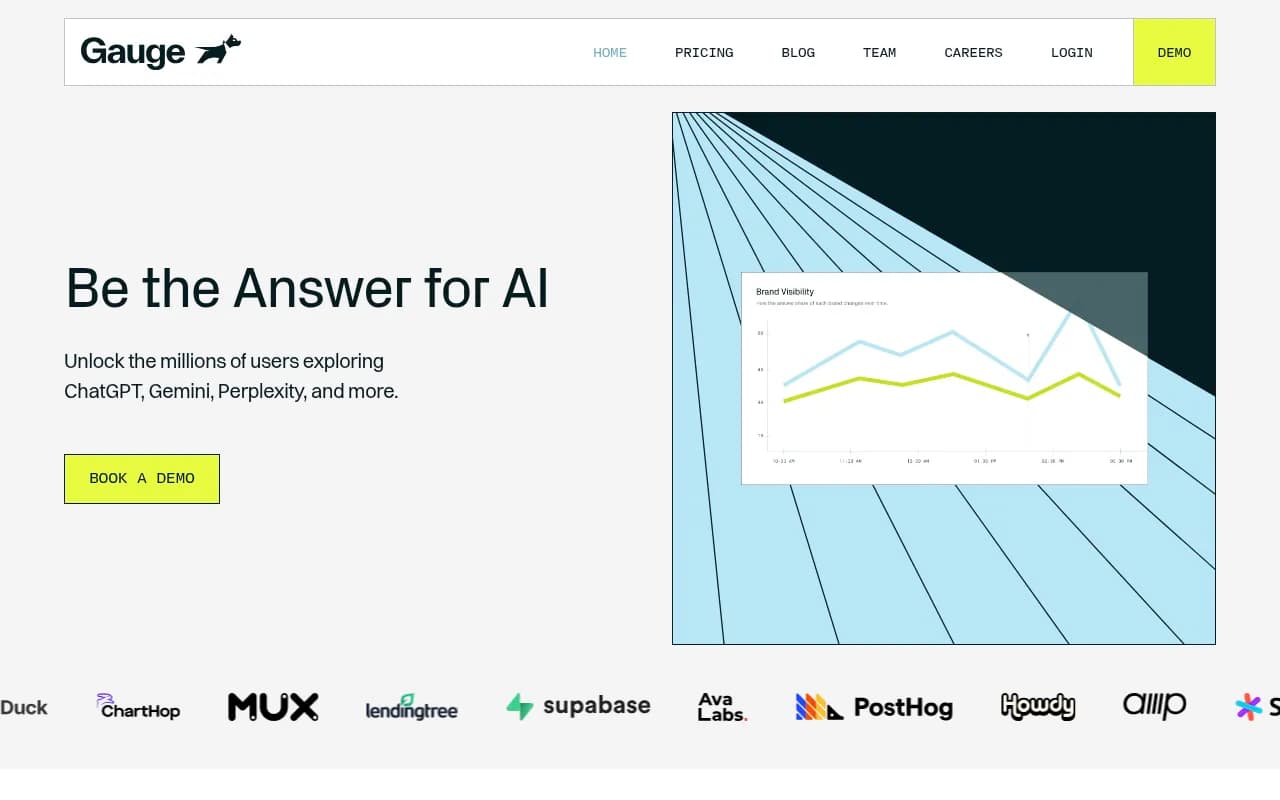
Gauge tracks how your brand appears across AI-powered search engines -- ChatGPT, Claude, Gemini, Perplexity, Copilot, AI Overviews. It monitors prompts, analyzes which content gets cited, compares you to competitors, and recommends onsite/offsite actions to improve visibility. The platform targets marketing and SEO teams who want to understand and optimize their presence in AI search results. Pricing starts at $99/mo for 100 prompts (ChatGPT only), scaling to $599/mo for 600 prompts across all models.
Search Party: Custom AI automation consultancy
Search Party is an AI implementation agency that embeds engineering teams into mid-market companies to eliminate repetitive work. They don't sell software -- they analyze your workflows, identify bottlenecks through employee interviews and metrics analysis, then build bespoke agentic systems using their DOE Framework. Think custom automation for sales ops, marketing workflows, data processing, and internal coordination. Engagements run $50k-$300k+ depending on scope. They target operations leaders and executives tired of throwing headcount at problems that AI could solve.
Side-by-Side Comparison
| Feature | Gauge | Search Party |
|---|---|---|
| Core function | AI visibility monitoring | Custom AI automation consulting |
| What it does | Tracks brand mentions in AI search | Builds workflow automation systems |
| Target user | Marketing/SEO teams | Operations/exec teams |
| Pricing model | Monthly SaaS subscription | Custom project-based retainer |
| Starting price | $99/mo | $50k-$300k+ per engagement |
| Free tier | Yes (limited) | No |
| Setup time | Days (self-service) | Weeks to months (custom build) |
| Delivery model | Software platform | Embedded engineering team |
| AI models tracked | ChatGPT, Claude, Gemini, Perplexity, Copilot, AI Overviews | N/A (builds custom agents) |
| Content generation | Yes (3-18 articles/mo depending on plan) | No (focuses on workflow automation) |
| Competitor analysis | Yes (built-in heatmaps) | No |
| Custom development | No | Yes (core offering) |
| Ongoing support | Email/chat support | Embedded team during engagement |
What problem are you actually solving?
This comparison only makes sense if you're clear on which problem you're trying to fix.
Gauge solves external AI visibility
You're worried about how AI search engines talk about your brand. When someone asks ChatGPT "best CRM for small businesses" or "alternatives to [competitor]", does your brand show up? Which content gets cited? Where are the gaps? Gauge monitors this, shows you what's missing, and helps you create content that AI models will cite. It's a marketing and SEO play.
If you're tracking AI search visibility, tools like Promptwatch cover similar ground with additional features like crawler logs and Reddit/YouTube tracking.

Search Party solves internal workflow chaos
Your team is drowning in repetitive tasks -- manual data entry, coordinating handoffs between systems, generating reports, processing forms, routing requests. Headcount is growing faster than revenue. Search Party interviews your employees, finds the bottlenecks, and builds custom AI agents to handle the busywork. It's an operations and efficiency play.
They're not selling you a dashboard. They're deploying engineers who build systems tailored to your specific workflows.
Pricing comparison
| Plan | Gauge | Search Party |
|---|---|---|
| Entry point | $99/mo (Starter: 100 prompts, ChatGPT only, 3 articles) | $50k+ (diagnostic + Phase 1 build) |
| Mid-tier | $599/mo (Growth: 600 prompts, all models, 18 articles) | $100k-$150k (multi-phase engagement) |
| Enterprise | Custom (higher prompt volumes, white-label) | $200k-$300k+ (complex multi-department automation) |
| Free trial | Yes | No (90-min validation call to assess fit) |
| Billing | Monthly or annual | Project-based milestones |
The price gap reflects fundamentally different offerings. Gauge is a self-service SaaS tool. Search Party is a consulting engagement with embedded engineers.
Feature deep-dive
Monitoring and tracking
Gauge: Built around continuous monitoring of AI search engines. You define prompts (e.g. "best project management tools"), and Gauge tracks how ChatGPT, Perplexity, Gemini, Claude, Copilot, and AI Overviews respond. It shows brand mentions, citation sources, competitor comparisons, and visibility scores over time. Page-level tracking shows which URLs get cited. The platform refreshes data regularly so you can spot trends.
Search Party: Doesn't monitor external AI engines. Instead, they analyze your internal metrics (headcount vs revenue, time spent on tasks) and interview employees to identify workflow bottlenecks. The "monitoring" happens during the diagnostic phase -- surveying teams to find where repetitive work is killing productivity.
Verdict: Completely different types of monitoring. Gauge watches external AI behavior. Search Party diagnoses internal inefficiency.
Content and optimization
Gauge: Includes AI-powered content generation tied to visibility gaps. If competitors rank for prompts you don't, Gauge's writing agent creates articles, listicles, and comparisons designed to get cited by AI models. The number of articles per month scales with your plan (3 on Starter, 18 on Growth). You also get onsite and offsite recommendations -- specific actions to improve AI visibility.
Search Party: No content generation for external audiences. They build internal automation systems -- agents that process data, route tasks, generate reports, coordinate workflows. The output is custom code and deployed systems, not blog posts.
Verdict: Gauge optimizes content for AI search. Search Party optimizes internal operations.
Competitor intelligence
Gauge: Strong competitor analysis features. Heatmaps show how your visibility stacks up against competitors across different prompts and AI models. You see which brands dominate specific queries, what content they're getting cited for, and where you have opportunities to outrank them.
Search Party: No competitor tracking. The focus is internal -- how your team compares to itself (current state vs potential state after automation).
Verdict: Gauge wins if you need competitive benchmarking for AI search. Search Party doesn't play in this space.
Custom development and implementation
Gauge: Zero custom development. It's a standardized SaaS platform. You configure prompts, connect your brand, and use the tools provided. No bespoke features.
Search Party: Custom development is the entire offering. They embed engineers who build systems tailored to your workflows using their DOE Framework. Every engagement is unique -- they're not deploying off-the-shelf software.
Verdict: Search Party is the only option if you need custom-built AI automation. Gauge doesn't do custom work.
Speed and setup
Gauge: Fast. Sign up, define your prompts and competitors, connect your website, and you're seeing data within days. The platform is self-service with guided onboarding.
Search Party: Slow by design. They start with a 90-minute validation call to assess ROI potential. If you move forward, Phase 1 (Bottleneck Mining) involves employee interviews, workflow analysis, and metrics review -- this takes weeks. Building and deploying custom agents takes additional months depending on complexity.
Verdict: Gauge delivers quick insights. Search Party is a long-term transformation project.
Team and support
Gauge: Standard SaaS support -- email, chat, documentation. You're using the platform independently. Enterprise plans may include onboarding calls or account management.
Search Party: Embedded engineering team during the engagement. You're working directly with their engineers and strategists throughout the diagnostic and build phases. Much more hands-on, but only during active projects.
Verdict: Search Party provides deeper collaboration, but only while you're paying for an engagement. Gauge offers ongoing support as long as you're subscribed.
Who should pick Gauge
- Marketing teams tracking brand visibility in AI search engines
- SEO professionals optimizing for ChatGPT, Perplexity, and AI Overviews
- Content strategists who need to understand what AI models cite and why
- Brands worried about competitors dominating AI-powered search results
- Companies that want actionable recommendations without custom engineering
- Teams with $99-$599/mo budgets for AI visibility monitoring
Gauge makes sense if your problem is external -- how the world (via AI search) perceives and discovers your brand.
Who should pick Search Party
- Mid-market companies where headcount is growing faster than revenue
- Operations leaders drowning in repetitive manual processes
- Executives tired of throwing people at problems that should be automated
- Teams with complex, multi-step workflows that off-the-shelf tools can't handle
- Companies willing to invest $50k-$300k+ for custom AI automation
- Organizations that need embedded engineering expertise, not just software
Search Party makes sense if your problem is internal -- wasted time on busywork that's killing morale and margin.
Pros and cons
Gauge pros
- Affordable entry point ($99/mo)
- Fast setup and time-to-value
- Tracks multiple AI models in one dashboard
- Built-in content generation tied to visibility gaps
- Competitor benchmarking and heatmaps
- Self-service platform (no consulting required)
Gauge cons
- No custom development or bespoke features
- Limited to AI visibility monitoring (doesn't solve internal workflow problems)
- Prompt limits on lower-tier plans
- Starter plan only tracks ChatGPT (need Growth for all models)
Search Party pros
- Custom-built systems tailored to your exact workflows
- Embedded engineering team (not just software)
- Deep diagnostic process (interviews, metrics analysis)
- Solves complex, multi-department automation challenges
- High-touch collaboration throughout engagement
Search Party cons
- Extremely expensive ($50k-$300k+ per engagement)
- Long timeline (weeks to months)
- No ongoing platform or subscription (project-based)
- Requires significant internal buy-in and coordination
- Not a fit for simple, off-the-shelf automation needs
Final verdict
Gauge and Search Party don't compete. They solve completely different problems for different buyers.
Pick Gauge if you're a marketing or SEO team that needs to monitor and optimize how AI search engines talk about your brand. It's affordable, fast, and purpose-built for AI visibility tracking.
Pick Search Party if you're an operations leader or executive who needs custom AI automation to eliminate internal busywork. It's expensive and slow, but it's the only option if off-the-shelf tools don't fit your workflows.
You could use both -- Gauge for external AI visibility, Search Party for internal automation -- but they're not substitutes for each other. One is a SaaS subscription, the other is a consulting retainer. Know which problem you're solving before you compare prices.