Key Takeaways
- Pricing gap: Otterly.AI starts at $29/mo for basic monitoring, while Gauge starts at $99/mo but includes content generation from day one
- Monitoring scope: Both track the major AI engines (ChatGPT, Perplexity, Google AI Overviews, Gemini, Copilot), but Gauge adds Claude to the mix
- Action vs observation: Gauge positions itself around taking action with built-in content recommendations and optimization roadmaps, while Otterly.AI focuses on monitoring with its GEO Audit tool for on-page analysis
- Prompt limits: Otterly.AI's entry tier caps you at 15 prompts/month, Gauge's starter gives you 100 prompts but restricts you to ChatGPT only
- Content generation: Gauge includes AI article generation in all paid plans (3-18 articles/month depending on tier), Otterly.AI doesn't offer content creation
- Best for budget: Otterly.AI wins if you just need basic visibility tracking and can work within tight prompt limits
Overview
Otterly.AI

Otterly.AI markets itself as the "#1 rated AI search monitoring platform" with a focus on affordability. The tool tracks brand mentions and website citations across ChatGPT, Perplexity, Google AI Overviews, Google AI Mode, Gemini, and Microsoft Copilot. Its standout feature is the GEO Audit tool, which analyzes 25+ on-page factors to identify what's preventing your site from earning more citations in AI responses. The pitch is straightforward: monitor where you show up, see what's being said, and understand which content gets cited.
Pricing starts at $29/mo for the Lite plan (15 prompts), $189/mo for Standard (100 prompts), and custom pricing for Premium (unlimited prompts). All plans come with a 14-day free trial.
Gauge
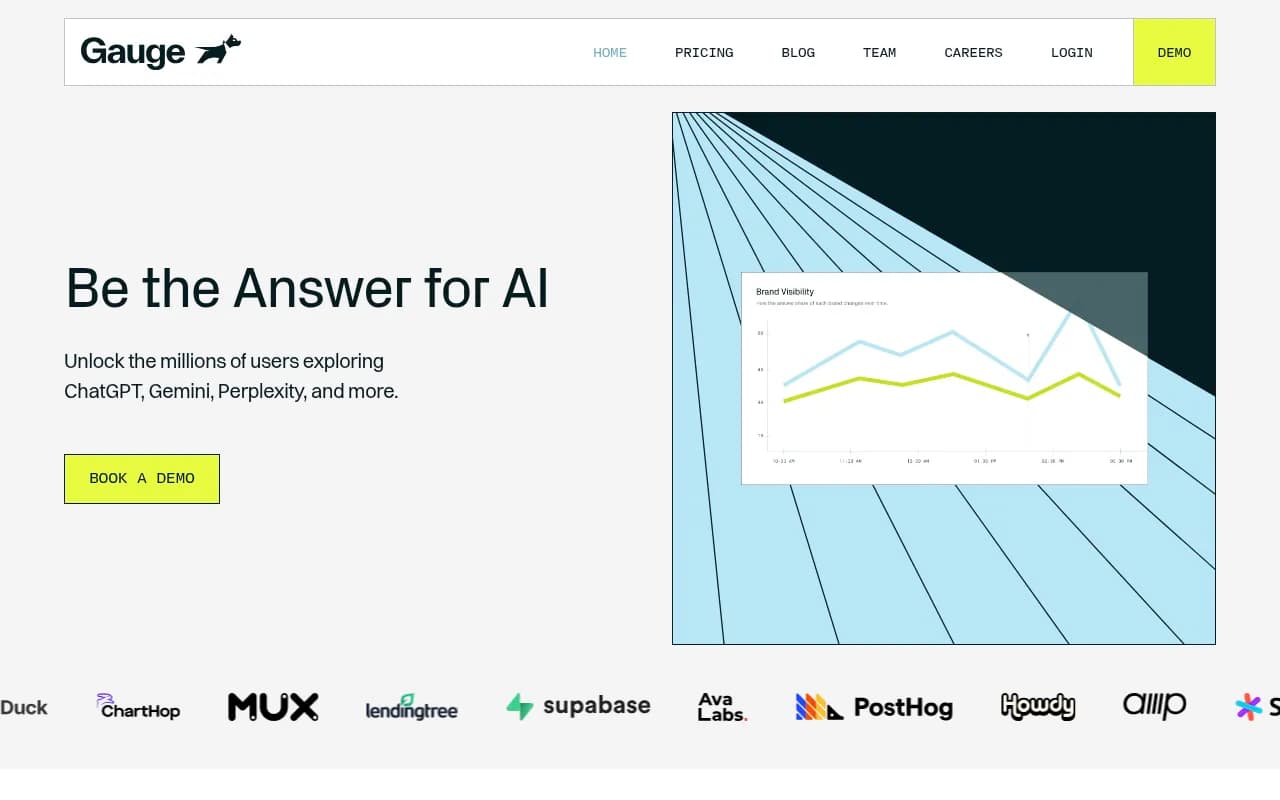
Gauge positions itself as a "complete toolkit" for AI visibility, built around a three-step loop: track mentions across AI engines, understand the gaps where your brand is invisible, then act on clear recommendations to improve. The platform monitors ChatGPT, Claude, Gemini, Perplexity, Copilot, AI Mode, and AI Overviews. What sets Gauge apart is its emphasis on competitive intelligence and actionable optimization -- it doesn't just show you the data, it translates findings into specific onsite and offsite recommendations.
Pricing: Starter plan at $99/mo (100 prompts, ChatGPT only, 3 articles), Growth at $599/mo (600 prompts, all models, 18 articles), and custom Enterprise pricing. A free tier exists but details are limited.
Side-by-Side Comparison
| Feature | Otterly.AI | Gauge |
|---|---|---|
| Starting price | $29/mo | $99/mo (or free tier with limits) |
| Free trial | 14 days | Free tier available |
| Entry-level prompts | 15/month | 100/month (ChatGPT only) |
| AI engines monitored | ChatGPT, Perplexity, Google AI Overviews, AI Mode, Gemini, Copilot (6 total) | ChatGPT, Claude, Gemini, Perplexity, Copilot, AI Mode, AI Overviews (7 total) |
| Content generation | None | 3-18 articles/month depending on plan |
| Optimization features | GEO Audit (25+ on-page factors) | Onsite/offsite recommendations, competitive gap analysis |
| Competitor tracking | Share of Voice tracking | Full competitive intelligence with gap analysis |
| Keyword research | AI keyword research for conversational prompts | Prompt discovery and targeting |
| Brand monitoring | Brand mentions and citation tracking | Brand mentions with competitive context |
| Mid-tier pricing | $189/mo (100 prompts) | $599/mo (600 prompts, all models) |
| Unlimited prompts | Custom Premium pricing | Enterprise custom pricing |
| API access | Not mentioned | Not mentioned |
Monitoring capabilities
Both tools cover the core AI search engines that matter in 2026, but with slight differences.
Otterly.AI monitors six platforms: ChatGPT, Perplexity, Google AI Overviews, Google AI Mode, Gemini, and Microsoft Copilot. The focus is on tracking brand mentions and website citations -- you see where your brand shows up, what's being said, and which pages get cited. The interface emphasizes Share of Voice metrics so you can compare your visibility against competitors.
Gauge adds Claude to the mix, giving you seven AI engines total. The monitoring layer is similar -- brand mentions, citation tracking, competitive benchmarking -- but Gauge wraps it in a framework of "track, understand, act." The platform highlights gaps where your brand is invisible and surfaces which competitors are winning for specific prompts.
Verdict: Gauge edges ahead slightly by including Claude, which is increasingly important for B2B and technical audiences. But if you don't care about Claude, the monitoring coverage is essentially equivalent.
Optimization and action tools
This is where the two platforms diverge most sharply.
Otterly.AI's main optimization feature is the GEO Audit tool. It analyzes 25+ on-page factors across the prompts you're tracking and tells you what's holding your site back from earning more citations. Think of it as a technical SEO audit but for AI search -- it identifies strengths and weaknesses in your existing content. The tool also offers AI keyword research to discover conversational prompts your audience is asking. But Otterly.AI stops there. It shows you the problems, but you're on your own to fix them.
Gauge takes a different approach. The platform is built around turning insights into action. After identifying where you're invisible, Gauge provides specific onsite recommendations (content to create, pages to optimize) and offsite recommendations (affiliates to target, social sources like Reddit to engage with). The Growth and Enterprise plans include AI-generated articles (18/month on Growth) that are supposedly grounded in the visibility data. Gauge also emphasizes competitive gap analysis -- showing you exactly which prompts competitors are winning and what content they have that you don't.
Verdict: Gauge wins here if you want a platform that helps you do something about the gaps. Otterly.AI's GEO Audit is useful for diagnosing issues, but it leaves the heavy lifting to you. Gauge's built-in content generation and recommendation engine make it more of an optimization platform than a monitoring dashboard.
If you're also looking to track AI visibility with more advanced optimization capabilities, Promptwatch offers a similar action-oriented approach with Answer Gap Analysis that shows exactly which prompts competitors rank for but you don't, plus an AI writing agent that generates content engineered to get cited by AI models.

Pricing breakdown
| Plan | Otterly.AI | Gauge |
|---|---|---|
| Free tier | None (14-day trial only) | Available (limits unclear) |
| Entry plan | Lite: $29/mo, 15 prompts | Starter: $99/mo, 100 prompts (ChatGPT only), 3 articles |
| Mid-tier | Standard: $189/mo, 100 prompts | Growth: $599/mo, 600 prompts (all models), 18 articles |
| High-end | Premium: Custom, unlimited prompts | Enterprise: Custom pricing |
| Annual discount | Not mentioned | Not mentioned |
Otterly.AI is clearly the budget option. $29/mo gets you in the door, though 15 prompts/month is tight if you're tracking multiple product categories or competitor sets. The Standard plan at $189/mo for 100 prompts is competitive, but you're still capped and there's no content generation included.
Gauge costs more upfront but gives you more to work with. $99/mo includes 100 prompts and 3 AI-generated articles, though you're restricted to ChatGPT monitoring only on the Starter plan. The Growth plan at $599/mo is a big jump, but you get 600 prompts across all AI engines plus 18 articles/month. If you're serious about AI visibility and want the optimization tools, the Growth plan makes sense. If you're just testing the waters, the Starter plan's ChatGPT-only limitation is frustrating.
Verdict: Otterly.AI wins on pure affordability. Gauge wins on value if you need the content generation and multi-model monitoring.
Competitive intelligence
Both platforms offer competitor tracking, but with different levels of depth.
Otterly.AI tracks Share of Voice -- you can see which brands get recommended and how often your brand appears relative to competitors. The platform shows you which websites get cited for each prompt, giving you a baseline to understand where you stand. But the competitive analysis is mostly observational. You see the data, you draw your own conclusions.
Gauge goes further with what it calls "competitive gap analysis." The platform identifies specific prompts where competitors are visible but you're not, then surfaces the content they have that's earning citations. This is closer to a roadmap -- here's what's missing, here's what your competitors did, here's what you should do. Gauge also highlights high-value affiliates and social sources (like Reddit threads) that influence AI recommendations, which most competitors ignore.
Verdict: Gauge provides more actionable competitive intelligence. Otterly.AI gives you the raw data, Gauge tells you what to do with it.
User experience and workflow
Otterly.AI's interface is straightforward. You enter prompts, the platform monitors AI responses, and you get dashboards showing brand mentions, citation counts, and Share of Voice metrics. The GEO Audit tool runs automatically on your tracked prompts and surfaces issues with your on-page content. The workflow is: monitor, audit, then go fix things yourself.
Gauge structures the experience around its three-step framework: track, understand, act. The dashboards show similar data (mentions, citations, competitive benchmarks), but the platform pushes you toward action with built-in recommendations and content generation. The workflow is: monitor, get recommendations, generate content or optimize pages based on those recommendations.
Neither platform is particularly complex. If you've used any SEO or analytics tool, you'll figure out both quickly. Gauge's emphasis on recommendations makes it slightly more guided, while Otterly.AI is more of a "here's the data, you decide" experience.
Verdict: Tie. It depends whether you want a guided experience (Gauge) or prefer to interpret the data yourself (Otterly.AI).
Keyword and prompt research
Otterly.AI includes AI keyword research to discover conversational prompts your audience is asking on ChatGPT, Perplexity, and Google. The idea is to uncover fresh keywords that guide your content strategy and help you capture demand before competitors. This is useful for expanding your prompt set beyond the obvious queries.
Gauge offers prompt discovery and targeting, though the specifics are less clear from the website. The platform identifies high-value prompts where you should be visible and shows you which prompts competitors are winning. The focus is less on broad keyword research and more on strategic prompt selection based on competitive gaps.
Verdict: Otterly.AI seems stronger on broad keyword discovery. Gauge is more focused on strategic prompt targeting based on competitive analysis. Different use cases.
Content generation
This is a major differentiator.
Otterly.AI doesn't generate content. The platform identifies gaps and audits your existing pages, but you're responsible for creating or optimizing content yourself.
Gauge includes AI-generated articles in all paid plans: 3/month on Starter, 18/month on Growth. The articles are supposedly grounded in the visibility data and designed to improve your AI search presence. This is a big time-saver if you're a small team or agency managing multiple clients. The quality and effectiveness of the generated content is hard to judge without using the platform, but having it built-in is a clear advantage over Otterly.AI's monitoring-only approach.
Verdict: Gauge wins decisively if content generation matters to you. Otterly.AI offers nothing here.
Pros and cons
Otterly.AI pros
- Most affordable entry point at $29/mo
- GEO Audit tool provides detailed on-page analysis (25+ factors)
- 14-day free trial to test before committing
- AI keyword research for discovering conversational prompts
- Clean Share of Voice tracking for competitive benchmarking
Otterly.AI cons
- No content generation -- you're on your own to create or optimize
- Entry plan's 15 prompts/month is very limiting
- Optimization features stop at diagnosis -- no actionable recommendations
- Doesn't monitor Claude (matters for some audiences)
- Premium pricing for unlimited prompts is opaque (custom only)
Gauge pros
- Built-in content generation (3-18 articles/month depending on plan)
- Actionable recommendations for onsite and offsite optimization
- Competitive gap analysis shows exactly where you're invisible
- Monitors Claude in addition to the other major AI engines
- Free tier available (though limits unclear)
- Emphasis on strategic action, not just monitoring
Gauge cons
- Higher starting price ($99/mo vs $29/mo)
- Starter plan restricts you to ChatGPT only -- frustrating limitation
- Big price jump from Starter to Growth ($99 to $599)
- Less transparent about specific features and capabilities on the website
- Content generation quality is unknown without testing
Who should pick which tool
Choose Otterly.AI if:
- You're on a tight budget and $29-189/mo is your range
- You just need visibility monitoring and basic competitive tracking
- You have in-house content resources and don't need AI-generated articles
- You want a detailed technical audit of your existing pages (GEO Audit)
- You're comfortable interpreting data and building your own optimization plan
- You're a solo marketer or small business testing AI visibility for the first time
Choose Gauge if:
- You want a platform that helps you take action, not just observe
- Content generation is valuable to you (saves time, scales faster)
- You need competitive gap analysis to prioritize what to fix first
- You're willing to pay more for optimization tools and recommendations
- You're tracking multiple competitors and need strategic intelligence
- You're an agency managing AI visibility for multiple clients
- Claude monitoring matters for your audience (B2B, technical, developer-focused)
Consider alternatives if:
- You need advanced features like crawler logs, Reddit/YouTube tracking, or traffic attribution -- neither Otterly.AI nor Gauge offers these. Tools like Promptwatch provide deeper optimization capabilities including Answer Gap Analysis, AI crawler monitoring, and page-level citation tracking with traffic attribution.
- You're an enterprise with complex multi-region or multi-language needs -- both platforms are better suited for mid-market and SMB use cases
Final verdict
Otterly.AI is the budget-conscious choice for teams that need basic AI visibility monitoring and can handle optimization themselves. Gauge is the action-oriented platform for teams that want recommendations, content generation, and competitive intelligence baked in.
The decision comes down to two questions: How much are you willing to spend, and do you need help creating content? If your answers are "not much" and "no," go with Otterly.AI. If your answers are "whatever it takes to win" and "yes, that would save us time," go with Gauge.
One-liner: Otterly.AI monitors and audits, Gauge monitors and acts.