Key takeaways
- Most AI citation tracking tools stop at monitoring -- they show you where you're invisible but don't help you fix it.
- Promptwatch is the only tool in this comparison that closes the full loop: find gaps, generate content, track results.
- Mentions.so and LLM Clicks are solid entry-level options for teams that just want basic brand mention tracking without the overhead.
- Radarkit and Xfunnel sit in the middle -- more capable than the lightweight tools, but still primarily monitoring-focused.
- If you're serious about improving your AI search visibility (not just measuring it), the gap between Promptwatch and the rest of this field is significant.
Citation tracking in AI search is one of those problems that sounds simple until you actually try to solve it. You want to know: when someone asks ChatGPT or Perplexity a question in your space, does your brand get mentioned? Does your website get cited? And if not, why not -- and what can you do about it?
The tools in this comparison all claim to answer those questions. But they answer them in very different ways, at very different depths. Some are genuinely useful. Some are dashboards that look impressive until you realize they can't tell you anything actionable. And one of them is built around actually fixing the problem, not just measuring it.
Let's get into it.
What "citation tracking" actually means in 2026
Before comparing tools, it's worth being precise about what we're measuring. When an AI model like ChatGPT or Perplexity answers a question, it often cites sources -- links to pages it pulled information from. It also mentions brands by name, recommends products, and surfaces specific companies as solutions to specific problems.
Citation tracking covers all of this: which URLs are being cited, how often, in response to which prompts, across which AI models. Share of voice is a related metric -- out of all the responses to prompts in your category, what percentage mention your brand?
These metrics matter because AI search is eating traditional search traffic. If you're not showing up in AI responses, you're losing visibility that doesn't show up in your Google Search Console data.
The tools below approach this problem from different angles.
The five tools, compared
Promptwatch
Promptwatch is the most complete platform in this comparison -- and it's not particularly close. Where the other tools are primarily monitoring dashboards, Promptwatch is built around an action loop: find the gaps in your AI visibility, create content to fill them, then track whether that content gets cited.

The citation tracking itself is strong. Promptwatch monitors 10 AI models (ChatGPT, Perplexity, Claude, Gemini, Google AI Overviews, Google AI Mode, Grok, DeepSeek, Copilot, and Mistral), tracks which specific pages on your site are being cited and how often, and gives you page-level attribution so you can connect citations to actual traffic. The dataset behind it -- over 1.1 billion citations, clicks, and prompts processed -- means the visibility scores are based on real data, not small samples.
What separates it from every other tool here is the Answer Gap Analysis. It shows you the specific prompts your competitors are visible for that you're not. Not vague category-level gaps -- the actual questions, with prompt volume data and difficulty scores attached. You can see exactly what content your site is missing.
Then there's the built-in AI writing agent, which generates articles, listicles, and comparison pages grounded in citation data. This isn't a generic content tool bolted on as an afterthought -- it's designed specifically to produce content that AI models want to cite.
Rounding it out: AI crawler logs (real-time data on which AI crawlers are hitting your pages and which errors they're encountering), Reddit and YouTube citation tracking, ChatGPT Shopping monitoring, and traffic attribution via GSC integration or server logs.
Pricing starts at $99/month for the Essential plan (1 site, 50 prompts, 5 articles). Professional is $249/month (2 sites, 150 prompts, crawler logs, state/city tracking). Business is $579/month for 5 sites and 350 prompts. A free trial is available.
The main limitation: it's more tool than some teams need. If you genuinely just want to check whether your brand shows up in ChatGPT responses once a week, Promptwatch has more depth than you'll use. But for any team that wants to actually move the needle on AI visibility, it's the right choice.
Xfunnel
Xfunnel positions itself as an AI search visibility platform with human expert support layered on top -- which is an interesting differentiator. The idea is that you're not just getting a dashboard, you're getting strategic guidance on what to do with the data.
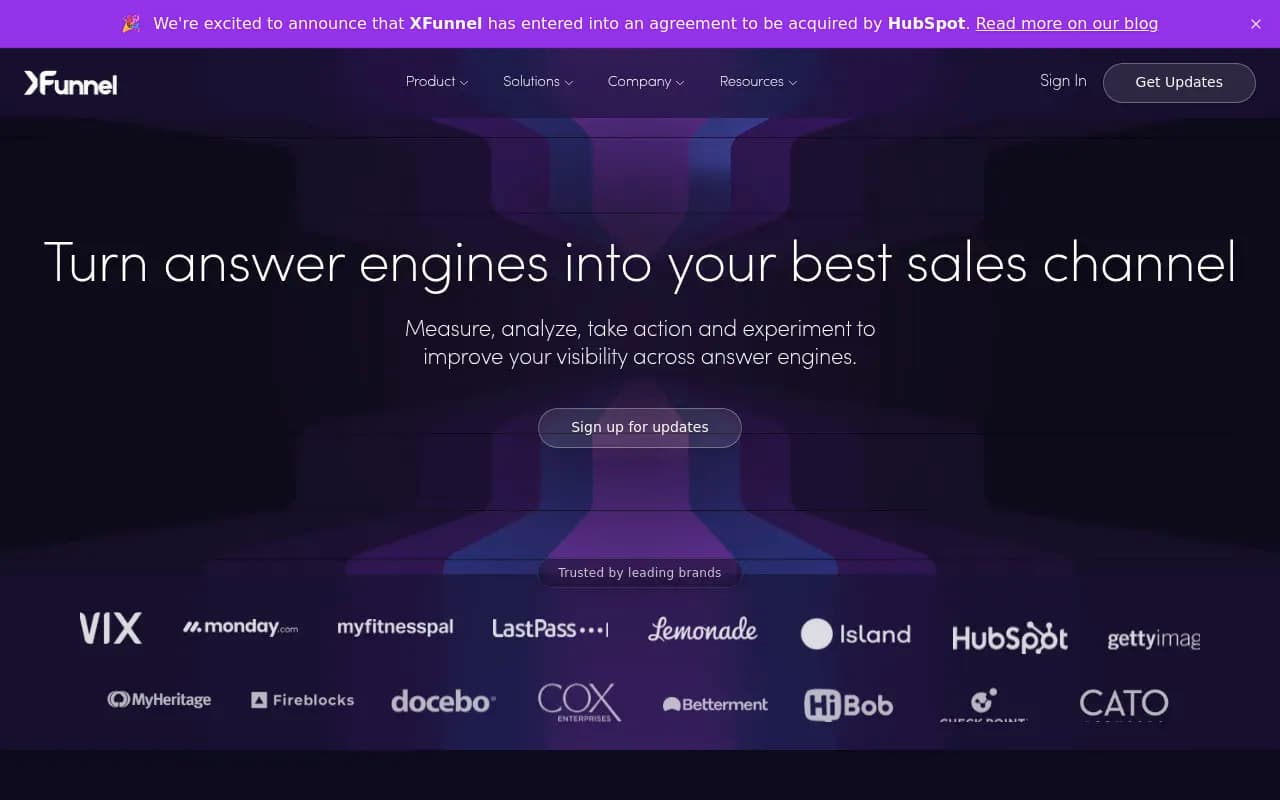
On the monitoring side, Xfunnel tracks brand mentions and citations across the major AI models, gives you share-of-voice metrics, and surfaces competitive comparisons. The human expert angle means you can get interpretation and recommendations alongside the raw data, which is genuinely useful for teams that don't have dedicated GEO expertise in-house.
The limitation is that the "action" layer is still largely human-mediated. You're getting advice, not automated gap analysis or content generation. That's fine if you want a consultative relationship with your AI visibility data, but it means the feedback loop is slower and the tool is harder to scale.
Pricing isn't publicly listed, which typically signals a higher price point aimed at mid-market and enterprise buyers.
Radarkit
Radarkit focuses on brand visibility tracking across AI search engines with a clean, accessible interface. It tracks mentions across ChatGPT, Perplexity, and a handful of other models, gives you share-of-voice data, and lets you monitor competitors side by side.
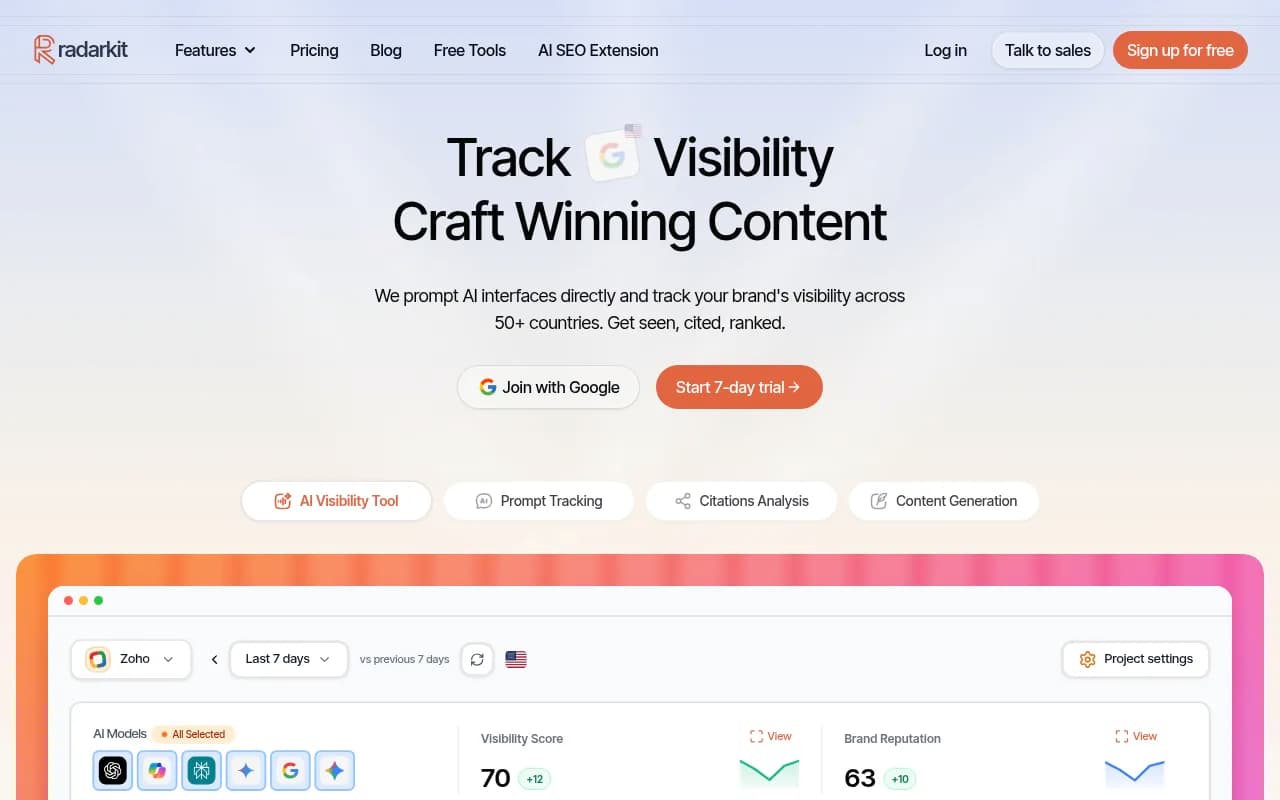
It's a solid monitoring tool. The UI is well-designed, setup is fast, and the data is presented clearly. For a small team that wants to get a quick read on their AI visibility without a lot of configuration overhead, Radarkit is easy to recommend.
The gap is depth. Radarkit doesn't have crawler logs, doesn't do content gap analysis, and doesn't generate content. It shows you the problem but doesn't help you solve it. For teams in research mode -- trying to understand their current AI visibility before committing to a full GEO strategy -- that's fine. For teams that want to actively improve, you'll hit the ceiling quickly.
Mentions.so
Mentions.so is the most lightweight option in this comparison. It's focused specifically on tracking brand mentions in AI responses -- a narrower scope than the other tools here, but executed cleanly.
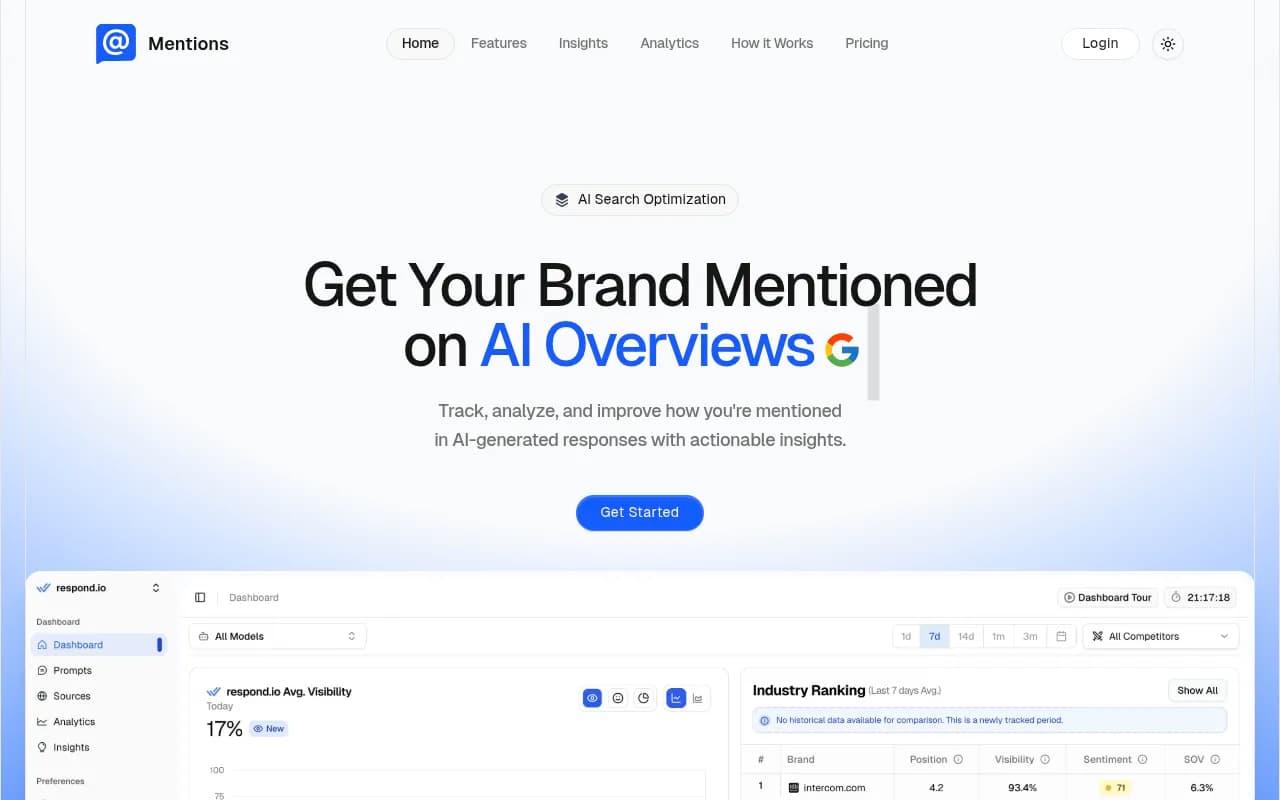
The core use case is simple: you set up your brand name and a few competitors, and Mentions.so monitors AI responses for those mentions. You get alerts when your brand is mentioned (or not mentioned) in responses to relevant prompts. It's closer to a brand monitoring tool than a full GEO platform.
For small businesses or solo operators who just want basic awareness of their AI presence without the complexity of a full platform, Mentions.so makes sense. The pricing is accessible. The setup is minimal.
What you don't get: prompt volume data, citation-level tracking (which specific pages are being cited), content gap analysis, crawler logs, or any optimization capabilities. It's a starting point, not a complete solution.
LLM Clicks
LLM Clicks takes a slightly different angle -- it focuses on tracking actual traffic from AI search engines to your website, not just mentions in AI responses. The distinction matters: a mention in a ChatGPT response doesn't always translate to a click, and LLM Clicks is specifically designed to measure the click-through side of the equation.
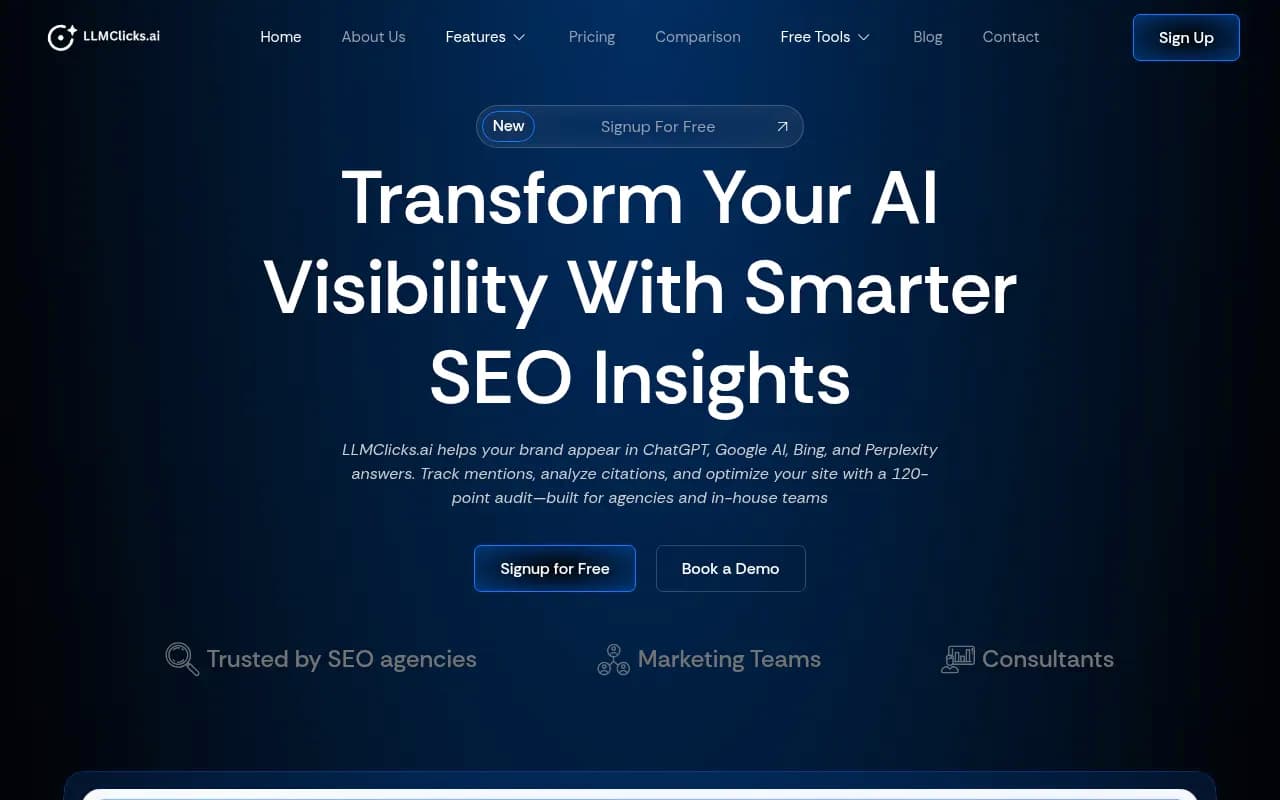
This makes it a useful complement to monitoring tools rather than a direct replacement. If you want to know how much traffic you're actually getting from Perplexity or ChatGPT, LLM Clicks gives you that data. It tracks referral traffic from AI sources, attributes it to specific pages, and shows you trends over time.
The limitation is the flip side of its focus: it doesn't tell you about mentions where users didn't click, doesn't do share-of-voice analysis, and doesn't help you understand why you're or aren't getting cited. It measures the output (traffic) but not the underlying visibility.
For teams that already have a monitoring tool and want to add traffic attribution, LLM Clicks fills a specific gap. As a standalone citation tracking solution, it's incomplete.
Feature comparison
| Feature | Promptwatch | Xfunnel | Radarkit | Mentions.so | LLM Clicks |
|---|---|---|---|---|---|
| Brand mention tracking | Yes | Yes | Yes | Yes | Partial |
| Citation tracking (page-level) | Yes | Yes | Yes | No | Yes |
| Share of voice | Yes | Yes | Yes | No | No |
| Competitor analysis | Yes | Yes | Yes | Basic | No |
| AI models covered | 10 | Multiple | Multiple | Few | Traffic-based |
| Content gap analysis | Yes | No | No | No | No |
| AI content generation | Yes | No | No | No | No |
| AI crawler logs | Yes | No | No | No | No |
| Traffic attribution | Yes | No | No | No | Yes |
| Reddit/YouTube tracking | Yes | No | No | No | No |
| ChatGPT Shopping | Yes | No | No | No | No |
| Prompt volume/difficulty | Yes | No | No | No | No |
| Human expert support | No | Yes | No | No | No |
| Starting price | $99/mo | Custom | Not listed | Low | Low |
Who should use what
The honest answer is that these tools serve different stages of the same journey.
If you're just starting to think about AI visibility and want to check whether your brand is showing up at all, Mentions.so or Radarkit give you a low-friction way to get that baseline. You'll spend an hour setting things up and have a basic read on your situation.
If you want to understand the traffic side -- how many clicks are actually coming from AI sources -- LLM Clicks adds a useful layer on top of basic monitoring.
If you want strategic guidance without building internal GEO expertise, Xfunnel's human expert model is worth considering, especially for mid-market teams that don't have the bandwidth to interpret data and build a strategy themselves.
If you want to actually improve your AI visibility -- not just measure it -- Promptwatch is the only tool here that gives you the full picture. The gap analysis tells you exactly what content to create. The writing agent helps you create it. The tracking shows you whether it worked. That cycle is what moves the needle, and it's what the other tools in this comparison don't offer.
The monitoring trap
One thing worth naming directly: there's a real risk of spending money on AI visibility monitoring without ever doing anything with the data. Most of the tools in this space are good at generating dashboards and reports. They're less good at helping you act on them.
The question to ask before choosing any tool is: what happens after I see the data? If the answer is "I export a CSV and figure it out myself," you're paying for a dashboard. If the answer is "the tool shows me exactly what content to create and helps me create it," you're paying for an optimization system.
That distinction is why the gap between Promptwatch and the rest of this field matters. It's not just that Promptwatch has more features -- it's that the features are organized around doing something, not just knowing something.
A few other tools worth knowing
If none of the five above quite fit your needs, a few others are worth a look depending on your situation.
For teams that want strong monitoring with a clean interface, Otterly.AI and Peec AI are both solid options at accessible price points.


For enterprise teams with complex multi-brand or multi-region needs, Profound and AthenaHQ have strong feature sets, though both are primarily monitoring-focused and come at higher price points.


For teams already deep in traditional SEO tooling, Semrush's AI visibility features and Ahrefs Brand Radar offer some AI monitoring capabilities within platforms you may already be paying for -- though neither is as deep as a dedicated GEO tool.
Bottom line
Citation tracking in AI search is genuinely important in 2026 -- this isn't a trend you can ignore. But the category is full of tools that will show you a problem without helping you solve it.
Mentions.so and LLM Clicks are fine for teams that want basic awareness or traffic data. Radarkit and Xfunnel are reasonable choices for teams that want more structured monitoring. But if the goal is to actually show up more often in AI responses -- to get cited by ChatGPT and Perplexity for the prompts that matter to your business -- you need a tool that goes beyond tracking.
Promptwatch is the only platform in this comparison that does that. The content gap analysis, the AI writing agent, the crawler logs, the prompt volume data -- these aren't nice-to-haves. They're what turns AI visibility from a metric you watch into a metric you move.