Limy AI Review 2026
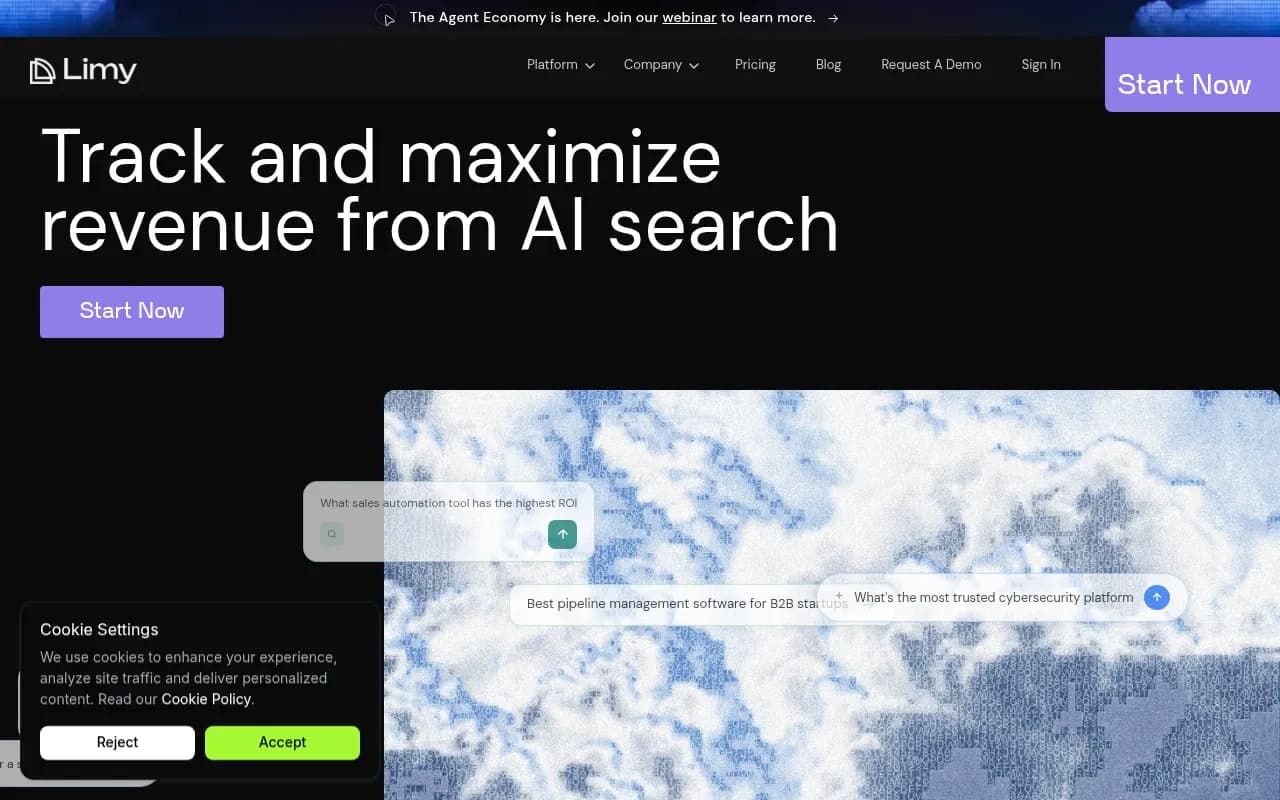
Limy AI is a B2A (Business-to-Agent) optimization platform that helps brands monitor, measure, and improve how AI search engines like ChatGPT, Perplexity, and Claude recommend their products. Unlike monitoring-only tools, Limy provides step-by-step optimization actions, sentiment analysis, and reven
Summary
- What it does: Limy AI is a B2A (Business-to-Agent) platform that tracks and optimizes how AI search engines recommend your brand, with revenue attribution and actionable optimization steps
- Lacks content generation and crawler logs: Unlike Promptwatch, Limy doesn't offer AI content generation, crawler log analysis, or Answer Gap Analysis to identify missing content opportunities
- Strong on revenue tracking: Limy's analytics connect AI visibility to actual user behavior and conversions -- a capability most GEO tools lack
- Best for: E-commerce brands and B2B companies that need to prove ROI from AI search optimization, not just track mentions
- Pricing: Starts at $449/mo for growing businesses

Limy AI positions itself around a specific thesis: we're entering a "B2A" era where AI agents evaluate, choose, and act on behalf of humans. If ChatGPT or Perplexity recommends a competitor's product instead of yours, you lose the sale before a human even sees your website. Limy's pitch is that they provide the "operational layer" to win these AI-mediated consumer journeys.
The platform was built by a team that clearly understands the shift happening in search behavior. Their case studies feature real brands (CaPow for robotics energy, Alta for travel) with specific lift numbers (+246% visibility for individual product pages). The focus on measurable outcomes -- not just "we got mentioned more" -- sets them apart from pure monitoring dashboards.
Who built it and why
Limy AI appears to be a relatively new entrant in the GEO space, launched sometime in 2025 based on blog post dates. The company is positioning itself specifically for the "agentic web" -- the idea that AI agents will increasingly make purchasing decisions autonomously. Their messaging targets e-commerce brands, B2B SaaS companies, and anyone selling products that AI models might recommend in response to user queries.
The team's background isn't prominently featured on the site, but the product sophistication and case study quality suggest experienced operators who understand both SEO and product analytics. The CaPow case study (robotics energy company) and the "Gen Z insights" case study show they're working with real clients across different verticals.
Core capabilities
Visibility Tracking Across LLMs Limy monitors how often and how well AI models recommend your brand across ChatGPT, Perplexity, Claude, and other major platforms. The dashboard shows prompt-level data -- which specific queries trigger mentions of your brand, how you rank against competitors, and whether the sentiment is positive or negative. This is table stakes for any GEO tool, but Limy's interface appears clean and the data is organized by prompt categories.
The platform tracks "global" coverage, meaning you can monitor multiple languages and markets. For international brands, this matters -- a tool that only tracks English prompts misses huge swaths of AI search behavior.
Step-by-Step Optimization Actions This is where Limy tries to differentiate from monitoring-only competitors. The platform claims to provide "step by step actions that boost how often and how well LLMs recommend your brand" and promises to "tell you exactly what to do next." Based on the marketing copy, this appears to be prescriptive guidance -- the system analyzes your current visibility, identifies gaps, and suggests specific changes.
However, the site doesn't detail what these actions actually look like. Are they content recommendations? Schema markup fixes? Link building suggestions? The lack of specificity here is a red flag. Compare this to Promptwatch's Answer Gap Analysis, which explicitly shows you which prompts competitors rank for but you don't, then generates AI-optimized content to fill those gaps. Limy's "optimization" feature needs more transparency about what it actually delivers.
Prompt Analytics Limy surfaces which prompts are driving visibility and traffic. You can see prompt volume (how often users ask a specific question), your brand's position in AI responses, and how that changes over time. The platform also tracks "prompt sentiment" -- whether AI models are recommending you positively, neutrally, or negatively.
This is useful for prioritization. If you're invisible for high-volume prompts in your category, those become obvious targets for optimization. The sentiment layer adds nuance -- getting mentioned negatively is worse than not being mentioned at all.
Revenue Attribution (Limy Analytics) This is Limy's standout feature. According to their December 2025 blog post announcing "Limy Analytics," the platform now connects AI visibility to actual user behavior on your site. You can see which pages AI platforms are sending users to, how those users behave (time on site, pages visited, conversions), and ultimately tie AI search visibility to revenue.
The blog post asks: "Are users landing on your pricing page? Your product comparisons? Your case studies?" This level of attribution is rare in the GEO space. Most tools (Otterly.AI, Peec.ai, AthenaHQ) stop at visibility metrics. Limy's analytics layer closes the loop between "we got mentioned" and "we made money."
Implementation appears to require adding a tracking snippet to your site, similar to Google Analytics. The platform likely uses UTM parameters or referrer data to identify traffic originating from AI search platforms.
Narrative and Perception Tracking Limy monitors how AI models "perceive" your brand -- the tone, framing, and context in which you're mentioned. This goes beyond simple sentiment (positive/negative) to capture the actual narrative. For example, are you positioned as the premium option? The budget choice? The innovative newcomer?
This feature is harder to evaluate without hands-on access, but it's conceptually valuable. Brand positioning in AI responses matters as much as raw visibility. If ChatGPT consistently frames you as "expensive but high-quality" when you're trying to compete on value, that's a problem worth knowing about.
Performance Benchmarking Limy lets you compare your AI visibility against competitors. You can see who's winning for specific prompts, how your share of voice is trending, and where you have opportunities to gain ground. The case studies mention specific lift percentages (+246% for CaPow), suggesting the platform tracks performance changes over time with some rigor.
Who should use Limy AI
Limy is built for brands that sell products or services AI models might recommend. The ideal user is a marketing director or growth lead at a company where AI search is becoming a meaningful traffic and revenue channel.
E-commerce brands are the obvious fit. If you sell consumer products (electronics, home goods, outdoor gear, beauty products), AI models are increasingly answering "what's the best X" queries with specific product recommendations. Limy helps you track whether you're in those recommendations and optimize to get there more often.
B2B SaaS companies are another strong fit, especially in crowded categories. If prospects are asking ChatGPT "what's the best CRM for small teams" or "which project management tool has the best integrations," you need to know if you're in the answer. The revenue attribution feature is particularly valuable here -- you can prove to your CFO that AI search optimization is driving pipeline, not just vanity metrics.
Travel and hospitality brands appear to be a focus area based on the blog content ("Where Sources Come From in AI Search – Travel Edition"). Hotels, tour operators, and destination marketing organizations are all competing for AI recommendations when users ask about travel plans.
Who should NOT use Limy: If you're a local business, a personal brand, or a company in a niche where AI search isn't relevant yet, Limy is overkill. The $449/mo starting price also puts it out of reach for solopreneurs and very small businesses. And if you need content creation tools to actually improve your AI visibility (not just track it), Limy's lack of a built-in writing agent is a dealbreaker -- you'd be better served by Promptwatch, which combines monitoring with AI content generation and gap analysis.
Integrations and ecosystem
Limy's integration story is thin based on publicly available information. The platform clearly integrates with major AI search engines (ChatGPT, Perplexity, Claude, Gemini, etc.) for monitoring purposes. The analytics feature requires a tracking snippet on your website, which suggests it works alongside Google Analytics, not as a replacement.
There's no mention of API access, Zapier integration, or connections to SEO tools like Ahrefs or Semrush. For a platform targeting serious marketing teams, the lack of integration options is a gap. Compare this to Promptwatch, which offers Looker Studio integration, a full API, and Google Search Console connectivity for holistic visibility tracking.
The platform does support multi-language and multi-region tracking, which is valuable for global brands. You can monitor AI responses in different languages and from different geographic locations, capturing how recommendations vary by market.
Pricing and value
Limy's pricing starts at $449/month for "growing businesses, expanding companies, and ambitious startups." That's the only public pricing tier mentioned on the site. No free trial is advertised, and there's no freemium option.
At $449/mo, Limy is positioned as an enterprise-grade tool. For context:
- Promptwatch Professional is $249/mo (2 sites, 150 prompts, 15 AI-generated articles, crawler logs, traffic attribution)
- Otterly.AI starts around $99/mo for basic monitoring
- Peec.ai pricing is similar to Otterly
- Profound and Scrunch are in the $300-500/mo range
Limy's pricing is on the higher end, which makes sense if the revenue attribution feature delivers on its promise. If you can prove that AI search optimization drove $50K in new revenue last quarter, $449/mo is an easy sell. But if you're just getting started with GEO and need to build visibility before you can measure revenue, the high entry price is a barrier.
The lack of transparent pricing tiers is frustrating. What do you get for $449/mo? How many prompts can you track? How many team members? What's the upgrade path? These details matter for budget planning.
What Limy does well
Revenue attribution is a genuine differentiator. Most GEO tools stop at visibility metrics. Limy connects AI search to actual business outcomes, which is what executives care about. The analytics feature (tracking which pages AI sends users to, how they behave, whether they convert) is exactly what's missing from monitoring-only platforms.
The B2A framing is smart. Positioning the product around "Business-to-Agent" optimization (instead of just "AI SEO" or "GEO") signals that Limy understands where the market is heading. As AI agents gain more autonomy in making purchasing decisions, brands need infrastructure to influence those decisions. Limy is building that infrastructure.
Case studies with real numbers. The CaPow case study (+246% lift for individual product pages) and the Alta case study show Limy is working with real clients and delivering measurable results. Too many GEO tools launch with vague promises and no proof. Limy has proof.
Global coverage. Multi-language and multi-region tracking is table stakes for international brands, but many competitors don't offer it. Limy does.
Where Limy falls short
No content creation or gap analysis. Limy tells you where you're invisible and suggests "step by step actions," but it doesn't help you create the content that will actually improve your visibility. Promptwatch offers Answer Gap Analysis (showing exactly which prompts competitors rank for but you don't) and an AI writing agent that generates optimized articles based on 880M+ citations. Limy's lack of content tools means you're stuck doing the hard work manually.
No AI crawler logs. You can't see which AI models are actually crawling your site, how often, or what errors they're encountering. Promptwatch provides real-time crawler logs for ChatGPT, Claude, Perplexity, and others -- critical for diagnosing indexing issues. Limy doesn't mention this capability at all.
Vague optimization recommendations. The site promises "step by step actions" but doesn't explain what those actions are. Are they generic SEO tips? Specific content recommendations? Schema markup fixes? Without transparency, it's hard to evaluate whether Limy's optimization engine is actually useful or just a feature checkbox.
High price with unclear value tiers. At $449/mo with no free trial and no transparent feature breakdown, Limy is asking for a big commitment upfront. For comparison, Promptwatch Essential starts at $99/mo with a free trial, and Professional ($249/mo) includes content generation, crawler logs, and traffic attribution -- more features for less money.
Limited integrations. No API, no Zapier, no mention of connecting to existing SEO or analytics tools. For a platform targeting marketing teams, this is a significant gap.
No Reddit or YouTube tracking. AI models heavily cite Reddit discussions and YouTube videos in their responses. Promptwatch surfaces these citations so you know where to engage. Limy doesn't mention this capability.
No ChatGPT Shopping tracking. If you're an e-commerce brand, knowing when your products appear in ChatGPT's shopping recommendations is critical. Promptwatch tracks this. Limy doesn't mention it.
Bottom line
Limy AI is a solid GEO platform for brands that need to prove ROI from AI search optimization. The revenue attribution feature is genuinely valuable -- if you can connect AI visibility to actual conversions and revenue, you can justify the investment to leadership. The B2A positioning is forward-thinking, and the case studies show real results.
But Limy is a monitoring and analytics tool, not an optimization platform. It tells you where you're invisible and tracks the results, but it doesn't help you create the content or fix the technical issues that will actually improve your visibility. For brands that want a complete solution -- monitoring, gap analysis, content generation, crawler logs, and traffic attribution -- Promptwatch is the stronger choice at a lower price point ($249/mo Professional vs $449/mo Limy).
Best use case in one sentence: E-commerce or B2B brands with existing content resources that need to measure and prove the revenue impact of AI search visibility.
Frequently asked questions
What is Limy AI and what does it do?
How much does Limy AI cost?
Is there a free version of Limy AI?
Who is Limy AI best for?
What makes Limy AI different from other GEO tools?
What AI search engines does Limy AI track?
What is B2A optimization?
Similar and alternative tools to Limy AI