Key Takeaways
- Pricing gap: Promptwatch starts at $99/mo vs Limy AI at $449/mo -- a 4.5x difference for entry-level plans. Promptwatch offers better value for small teams and agencies testing AI visibility tracking.
- Action vs monitoring: Promptwatch includes built-in content generation and Answer Gap Analysis to fix visibility problems. Limy AI focuses on monitoring with "step-by-step optimization actions" but no integrated content creation.
- Prompt volume: Limy AI's base plan tracks 200 prompts/day vs Promptwatch Essential's 50 prompts/month -- different measurement units make direct comparison tricky, but Limy appears to offer higher query volume at the cost of much higher pricing.
- Crawler intelligence: Promptwatch provides real-time AI crawler logs showing exactly when ChatGPT, Claude, and other models hit your site. Limy AI doesn't advertise this capability.
- Market maturity: Promptwatch has 7,000+ customers including Booking.com and Center Parcs with data featured in Wall Street Journal. Limy AI is newer with less public traction data.
- Free trial: Promptwatch offers a 7-day free trial. Limy AI's trial availability is unclear from public info.
Overview: Two approaches to AI search visibility
Promptwatch

Promptwatch positions itself as an end-to-end AI Search Visibility platform used by 7,000+ brands and agencies. The core pitch: most competitors show you data but leave you stuck -- Promptwatch helps you take action. It monitors 10 AI models (ChatGPT, Claude, Perplexity, Gemini, Google AI Overviews, Meta AI, DeepSeek, Grok, Mistral, Copilot) and combines tracking with content gap analysis, an AI writing agent, and crawler log monitoring. The platform has processed over 1.1 billion citations and clicks, with data referenced in Wall Street Journal, Yahoo Finance, and Axios.
The workflow: find gaps in your AI visibility using Answer Gap Analysis, generate optimized content with the built-in AI agent, then track results with page-level citation tracking and traffic attribution. Additional features include Reddit and YouTube insights, ChatGPT Shopping tracking, competitor heatmaps, and multi-language/multi-region monitoring.
Pricing starts at $99/mo for the Essential plan (1 site, 50 prompts, 5 AI-generated articles). Dutch company (Promptwatch B.V.).
Limy AI
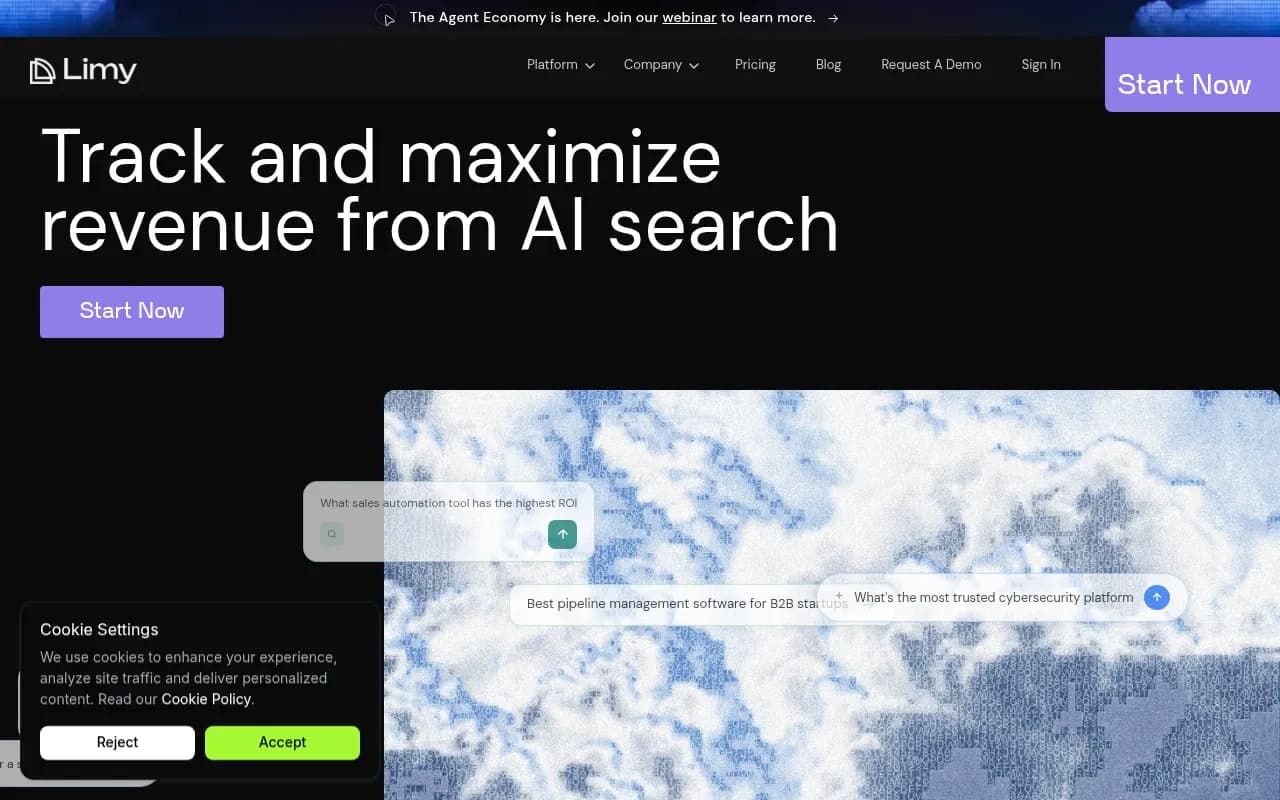
Limy AI calls itself a "B2A (Business-to-Agent) optimization platform" -- the idea being that businesses now sell to AI agents that evaluate and choose on behalf of humans. The platform tracks how AI search engines like ChatGPT, Perplexity, and Claude recommend your products, with a focus on making that visibility "convertible and measurable."
Limy differentiates itself as more than monitoring-only by providing "step-by-step optimization actions" and sentiment analysis. The website emphasizes revenue tracking from AI search and shows UI screenshots of prompt tracking, citation analysis, and competitive positioning.
Pricing starts at $449/mo. The platform appears newer to market with less public customer data compared to Promptwatch. Trial availability not clearly advertised.
Side-by-Side Comparison
| Feature | Promptwatch | Limy AI |
|---|---|---|
| Starting price | $99/mo (Essential) | $449/mo |
| Free trial | 7 days | Unclear |
| AI models tracked | 10 (ChatGPT, Claude, Perplexity, Gemini, Google AI Overviews, Meta AI, DeepSeek, Grok, Mistral, Copilot) | ChatGPT, Perplexity, Claude (others unclear) |
| Prompt tracking | 50/month (Essential), 150/month (Pro), 350/month (Business) | 200/day (base plan) |
| Content generation | Yes -- AI writing agent included | No |
| Answer Gap Analysis | Yes | Not advertised |
| AI crawler logs | Yes -- real-time logs of AI bots crawling your site | Not advertised |
| Reddit/YouTube tracking | Yes | Not advertised |
| ChatGPT Shopping | Yes | Not advertised |
| Citation analysis | Yes -- 880M+ citations analyzed | Yes |
| Competitor tracking | Yes -- heatmaps and side-by-side visibility | Yes |
| Traffic attribution | Yes -- code snippet, GSC integration, server logs | Yes -- revenue tracking emphasized |
| Multi-language/region | Yes | Unclear |
| API access | Yes | Unclear |
| Customer count | 7,000+ | Not disclosed |
| Notable customers | Booking.com, Center Parcs, Yelp, Typeform | Not disclosed |
Pricing comparison
| Plan | Promptwatch | Limy AI |
|---|---|---|
| Entry tier | Essential $99/mo<br>1 site, 50 prompts/month, 5 articles, basic tracking | Base plan $449/mo<br>200 prompts/day, details unclear |
| Mid tier | Professional $249/mo<br>2 sites, 150 prompts/month, 15 articles, crawler logs, state/city tracking | Not publicly detailed |
| High tier | Business $579/mo<br>5 sites, 350 prompts/month, 30 articles, full feature set | Not publicly detailed |
| Enterprise | Custom pricing | Custom pricing |
| Annual discount | 25% off | Unclear |
| Free trial | 7 days | Unclear |
The pricing gap is the most striking difference. Limy AI's entry point is 4.5x higher than Promptwatch's Essential plan. For that premium, you get higher daily prompt volume (200/day vs 50/month), but it's unclear if you get the same breadth of features -- Limy doesn't advertise crawler logs, content generation, or Reddit/YouTube tracking.
Feature deep-dive
Monitoring and tracking
Both platforms track how AI models mention your brand, but the scope differs.
Promptwatch monitors 10 AI models explicitly: OpenAI/ChatGPT, Perplexity, Google AI Overviews, Google AI Mode, Claude, Gemini, Meta/Llama, DeepSeek, Grok, Mistral, and Copilot. You can track prompts across all these models, see citation sources (which pages, Reddit threads, YouTube videos, domains get cited), and compare your visibility vs competitors with heatmaps. The platform also tracks ChatGPT Shopping recommendations -- a channel most competitors ignore.
Prompt volume on Essential is 50/month, which sounds low but is measured monthly. Professional bumps to 150/month, Business to 350/month.
Limy AI tracks ChatGPT, Perplexity, and Claude based on website screenshots. Other models aren't clearly listed. The base plan offers 200 prompts/day, which is a much higher volume -- but measured daily instead of monthly, and priced at $449/mo.
The measurement unit difference makes direct comparison awkward. If you need high query volume and can afford $449/mo, Limy's 200/day (6,000/month) beats Promptwatch's 350/month cap. But for most teams, Promptwatch's monthly allotments at lower price points are more practical.
Both platforms provide citation analysis and competitor tracking. Promptwatch explicitly mentions 880M+ citations analyzed and shows competitor heatmaps. Limy emphasizes "convertible and measurable" visibility but doesn't share data scale.
Verdict: Promptwatch covers more AI models and offers more transparent feature breakdowns. Limy AI has higher prompt volume but at a much steeper price.
Content optimization and generation
This is where the platforms diverge sharply.
Promptwatch includes an AI writing agent that generates articles, listicles, and comparisons grounded in real citation data, prompt volumes, persona targeting, and competitor analysis. The workflow: Answer Gap Analysis shows you which prompts competitors rank for but you don't, then the AI agent creates content designed to get cited by ChatGPT, Claude, and Perplexity. Essential includes 5 articles/month, Professional 15, Business 30.
This is the "action loop" Promptwatch emphasizes: find gaps, create content, track results. Most monitoring tools stop at step one.
Limy AI describes itself as providing "step-by-step optimization actions" and sentiment analysis, but doesn't advertise built-in content generation. The website mentions optimization guidance but not an integrated writing tool.
If you just want to see where you're invisible, either platform works. If you want help fixing it, Promptwatch has a clear edge.
Verdict: Promptwatch wins on actionability. Limy AI may offer optimization suggestions, but Promptwatch automates content creation.
AI crawler intelligence
This feature is unique to Promptwatch and worth calling out.
Promptwatch provides real-time logs of AI crawlers (ChatGPT, Claude, Perplexity, etc.) hitting your website. You see which pages they read, errors they encounter, how often they return. This helps you understand how AI engines discover your content and fix indexing issues -- similar to how you'd use Google Search Console for traditional SEO.
This is available starting on the Professional plan ($249/mo).
Limy AI doesn't mention crawler logs or bot monitoring in public materials.
For technical SEO teams or anyone debugging why AI models aren't citing their content, this is a big gap. Crawler logs let you see the AI's perspective directly.
Verdict: Promptwatch only. Limy AI doesn't compete here.
Reddit and YouTube insights
AI models increasingly cite Reddit discussions and YouTube videos in their responses. Tracking these sources matters.
Promptwatch surfaces Reddit threads and YouTube videos that influence AI recommendations. You can see which discussions are driving citations and where to engage or publish.
Limy AI doesn't advertise Reddit or YouTube tracking.
This is another channel where Promptwatch goes deeper than most competitors.
Verdict: Promptwatch has it, Limy AI doesn't mention it.
Traffic attribution and revenue tracking
Both platforms claim to connect AI visibility to actual business outcomes.
Promptwatch offers traffic attribution via code snippet, Google Search Console integration, or server log analysis. You can see which AI-driven visits convert and close the loop from visibility to revenue.
Limy AI emphasizes "convertible and measurable" visibility and revenue tracking from AI search. The website shows UI for tracking revenue impact, but implementation details aren't public.
Both platforms recognize that tracking citations without tracking conversions is incomplete. The difference is in transparency -- Promptwatch documents three attribution methods, Limy AI shows the concept but not the mechanics.
Verdict: Tie on concept, Promptwatch more transparent on implementation.
Integrations and API
Promptwatch integrates with Looker Studio for custom reporting and offers an API for custom workflows. This matters for agencies or enterprises with existing dashboards.
Limy AI's integration and API story isn't clear from public info.
Verdict: Promptwatch documented, Limy AI unclear.
Multi-language and multi-region
Promptwatch supports monitoring AI responses in any language, from any country, with customizable personas that match how your actual customers prompt. This is critical for global brands.
Limy AI's multi-language/region capabilities aren't advertised.
Verdict: Promptwatch explicit, Limy AI unclear.
User experience and interface
Both platforms show polished UI in their screenshots. Promptwatch's interface emphasizes dashboards with visibility scores, citation sources, competitor heatmaps, and prompt tracking. Limy AI's screenshots show similar layouts with prompt tracking, citation analysis, and sentiment scoring.
Without hands-on access to both, it's hard to judge which is more intuitive. Both appear modern and data-dense.
One practical difference: Promptwatch's 7-day free trial lets you test before committing. Limy AI doesn't clearly advertise a trial, which makes the $449/mo entry price riskier.
Verdict: Promptwatch's free trial lowers risk. UI quality appears comparable.
Market traction and credibility
Promptwatch has 7,000+ customers including Booking.com, Center Parcs, Yelp, Typeform, and Google. Its data has been cited in Wall Street Journal, Yahoo Finance, Seeking Alpha, and Axios. The company is Dutch (Promptwatch B.V., KVK: 97074756) and has been operating long enough to process 1.1 billion citations.
Limy AI doesn't disclose customer count or notable clients. The website shows logos (Google, Yelp, others) but it's unclear if these are customers or just brands tracked in the platform. The company appears newer with less public traction.
For risk-averse buyers, Promptwatch's track record and customer base provide more confidence.
Verdict: Promptwatch has proven market traction. Limy AI is less established publicly.
Pros and cons
Promptwatch pros
- Much lower entry price ($99/mo vs $449/mo)
- Built-in content generation with AI writing agent
- AI crawler logs show exactly how models discover your content
- Reddit and YouTube tracking for social citation sources
- ChatGPT Shopping monitoring
- 10 AI models tracked (most comprehensive coverage)
- 7,000+ customers with public case studies
- 7-day free trial
- Looker Studio integration and API access
- Multi-language and multi-region support
- 25% discount on annual billing
Promptwatch cons
- Lower prompt volume on entry tier (50/month vs 200/day)
- Monthly prompt limits may feel restrictive for high-volume users
- Feature set can feel overwhelming for teams just starting with AI visibility
Limy AI pros
- Higher prompt volume (200/day on base plan)
- Emphasis on revenue tracking and B2A optimization
- Sentiment analysis included
- Clean, modern interface
Limy AI cons
- 4.5x more expensive entry point ($449/mo)
- No built-in content generation
- Fewer AI models tracked (ChatGPT, Perplexity, Claude confirmed; others unclear)
- No AI crawler logs
- No Reddit or YouTube tracking advertised
- No ChatGPT Shopping monitoring
- Less transparent feature documentation
- No clear free trial
- Fewer public customers and case studies
- Integration and API capabilities unclear
Who should pick which tool
Choose Promptwatch if:
- You're a small to mid-sized team or agency testing AI visibility for the first time -- the $99/mo entry point and free trial make experimentation low-risk
- You want an all-in-one platform that finds gaps AND helps you fix them with content generation
- You need technical depth like AI crawler logs to debug indexing issues
- You track brands across Reddit, YouTube, and ChatGPT Shopping
- You need multi-language or multi-region monitoring for global brands
- You want proven market traction and public customer references
- You prefer transparent pricing and feature documentation
Choose Limy AI if:
- You need very high prompt volume (200/day) and can justify the $449/mo cost
- You're focused specifically on B2A (Business-to-Agent) optimization and revenue attribution
- You prefer a platform that emphasizes strategic guidance over automated content creation
- You're comfortable with less public documentation and want to evaluate via demo
- You're willing to pay a premium for what may be a more consultative approach
Consider both if:
- You're an enterprise with budget for multiple tools and want to compare data quality across platforms
- You're an agency managing multiple clients and need high prompt volume (Limy) plus content generation (Promptwatch)
Final verdict
Promptwatch delivers better value for most teams. The $99/mo entry price, built-in content generation, AI crawler logs, and comprehensive model coverage (10 AI engines) make it the more complete platform. The 7,000+ customer base and public case studies reduce risk. For agencies and small teams testing AI visibility, the free trial and lower pricing make Promptwatch the obvious starting point.
Limy AI's main advantage is prompt volume -- 200/day vs Promptwatch's 50-350/month depending on plan. If you're running thousands of queries and can afford $449/mo, that volume matters. But for most use cases, the lack of content generation, crawler logs, and Reddit/YouTube tracking makes Limy feel incomplete compared to Promptwatch's action-oriented workflow.
The pricing gap is hard to justify unless you specifically need Limy's higher query volume or prefer its B2A framing. Promptwatch's "find gaps, generate content, track results" loop is more actionable than monitoring alone.
Bottom line: Start with Promptwatch's free trial. If you outgrow the prompt limits and need 200/day, then evaluate Limy AI. But for 90% of teams, Promptwatch's feature set and pricing make it the better choice in 2026.