Key Takeaways
- Peec AI starts at €89/mo with a free trial and focuses on visibility tracking across ChatGPT, Perplexity, and Gemini -- Limy AI starts at $449/mo with no free tier and positions itself as a revenue optimization platform
- Limy AI includes step-by-step optimization actions and revenue attribution -- Peec AI provides "smart suggestions" but is primarily a monitoring dashboard
- Peec AI supports multi-language tracking across all countries -- Limy AI's language/region coverage is unclear from public materials
- Both platforms track visibility, position, and sentiment, but Limy emphasizes converting visibility into measurable revenue while Peec focuses on benchmarking competitors
- Peec AI is used by 1,500+ marketing teams and agencies -- Limy AI targets enterprise brands with higher budgets and revenue-focused use cases
- For teams just starting with AI visibility tracking or working on tight budgets, Peec AI is the accessible entry point. For brands ready to invest in optimization and revenue tracking, Limy AI offers more depth.
Overview
Peec AI

Peec AI is a multi-language AI search monitoring platform built for marketing teams and agencies. It tracks how your brand shows up across ChatGPT, Perplexity, and Gemini, measuring visibility (share of mentions), position (ranking within responses), and sentiment (how AI models talk about you). The platform lets you add custom prompts, organize them with tags, and track performance across any country. Peec positions itself as an analytics tool with "smart suggestions" to help you improve, and it's used by over 1,500 brands and agencies. Pricing starts at €89/mo for the Starter plan, with a free trial available.
Limy AI
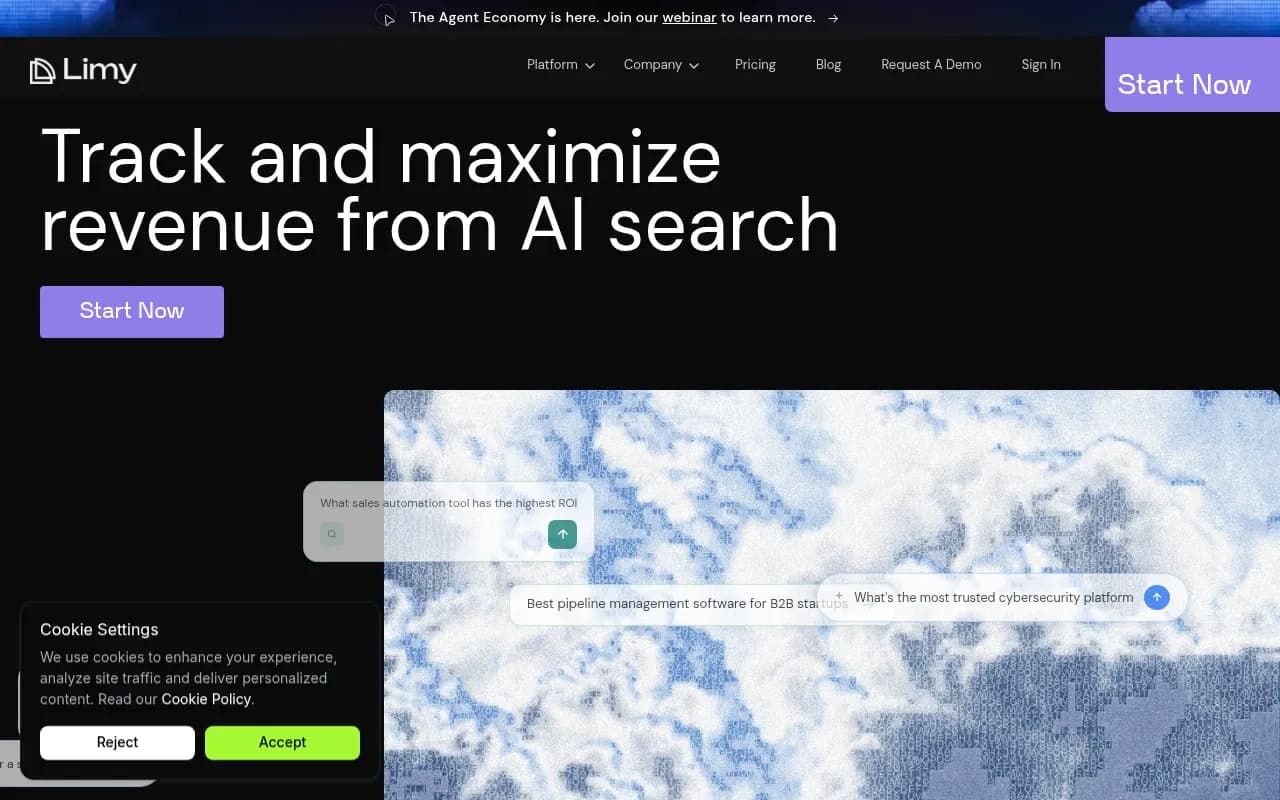
Limy AI calls itself a "B2A (Business-to-Agent) optimization platform" -- the idea being that AI agents are now evaluating and recommending products on behalf of humans, so brands need infrastructure to own that market. Limy tracks visibility across AI search engines like ChatGPT, Perplexity, and Claude, but the core pitch is optimization and revenue attribution. The platform provides step-by-step actions to improve how AI models recommend your products, tracks sentiment, and connects visibility to actual revenue. Pricing starts at $449/mo with no free trial mentioned. Limy targets enterprise brands and companies treating AI search as a revenue channel, not just a monitoring exercise.
Side-by-side comparison
| Feature | Peec AI | Limy AI |
|---|---|---|
| Starting price | €89/mo (~$95/mo) | $449/mo |
| Free trial | Yes | Not mentioned |
| AI models tracked | ChatGPT, Perplexity, Gemini | ChatGPT, Perplexity, Claude (others unclear) |
| Core focus | Visibility tracking & benchmarking | Revenue optimization & attribution |
| Multi-language support | Yes, all countries | Unclear |
| Custom prompts | Yes, unlimited on paid plans | Likely yes |
| Optimization actions | Smart suggestions | Step-by-step optimization playbook |
| Revenue attribution | No | Yes |
| Sentiment analysis | Yes | Yes |
| Competitor benchmarking | Yes, visual comparisons | Unclear |
| Target audience | Marketing teams, agencies, SMBs | Enterprise brands, revenue-focused teams |
| Users/customers | 1,500+ teams | Not disclosed |
| Ease of setup | "Less than [time not specified]" | Not specified |
Pricing breakdown
The price gap is the first thing you'll notice.
| Plan | Peec AI | Limy AI |
|---|---|---|
| Free trial | Yes | No |
| Starter/Entry | €89/mo (~$95/mo) | $449/mo |
| Professional/Mid | €199/mo (~$213/mo) | Not disclosed |
| Enterprise | Custom pricing | Custom pricing |
Peec AI is priced for teams that want to start tracking AI visibility without a massive upfront commitment. The €89/mo Starter plan gets you in the door, and you can test it with a free trial before paying anything. Limy AI starts at $449/mo with no trial -- nearly 5x the entry cost. That pricing signals Limy is targeting companies that already see AI search as a revenue driver and are willing to pay for optimization tools, not just dashboards.
Neither platform publishes detailed feature breakdowns by tier on their public sites, so you'll need to talk to sales to understand what you get at each level. Peec's Professional plan at €199/mo likely adds more prompts, users, or advanced features. Limy's pricing tiers beyond $449/mo aren't public.
Core capabilities: monitoring vs optimization
Both platforms track the same basic metrics -- visibility, position, sentiment -- but they diverge in what you do with that data.
Peec AI is a monitoring and analytics platform. You see where your brand shows up, how often, in what position, and with what tone. The dashboard shows trends over time, lets you compare yourself to competitors (with visual charts showing your share vs theirs), and surfaces "smart suggestions" to improve. But Peec doesn't spell out what those suggestions look like or how actionable they are. The vibe is: we'll show you the data and give you hints, but you're responsible for figuring out the fixes.
Limy AI positions itself as an optimization platform. The pitch is that visibility alone doesn't matter -- revenue does. Limy tracks the same metrics but adds "step-by-step optimization actions" (their words) to improve how AI models recommend your products. They also claim to measure revenue attribution, connecting AI visibility to actual conversions. This is a bigger promise than Peec makes. If Limy delivers on it, you're not just seeing charts -- you're getting a playbook and ROI tracking.
The catch: Limy's website is light on specifics. What do the optimization actions look like? How does revenue attribution work -- is it a tracking pixel, server log analysis, something else? Peec is more transparent about what you're getting (a dashboard with competitor benchmarks and suggestions), even if it's less ambitious.
Multi-language and regional tracking
Peec AI explicitly supports multi-language tracking across all countries. You can add prompts in any language, track how your brand performs in French, German, Spanish, Japanese, whatever, and see results by region. This matters if you're a global brand or agency managing clients in multiple markets.
Limy AI doesn't mention multi-language or regional tracking anywhere on their site. That doesn't mean they don't support it, but the absence is notable. If you need to track AI visibility in non-English markets, confirm this with Limy before signing up.
AI models covered
Peec AI tracks ChatGPT, Perplexity, and Gemini. Those are the big three for most use cases, but it's missing Claude (Anthropic), Grok (X.ai), Meta AI, DeepSeek, and others. If you need coverage beyond those three, Peec won't help.
Limy AI mentions ChatGPT, Perplexity, and Claude on their site. Claude is a meaningful addition -- Anthropic's models are widely used, especially in enterprise contexts. But Limy doesn't list other models, so it's unclear if they track Gemini, Grok, Meta AI, etc. Again, you'll need to ask.
For context, platforms like Promptwatch track 10+ AI models including all the ones above, plus Google AI Overviews, Mistral, and Copilot. If comprehensive model coverage is critical, both Peec and Limy fall short compared to more expansive platforms.

Competitor benchmarking
Peec AI makes competitor benchmarking a visible part of the product. The dashboard screenshots show side-by-side visibility percentages for your brand vs competitors (e.g. "Salesforce 62%, Attio 47%, HubSpot 65%"). You can see who's winning for specific prompts and track how your share changes over time. This is useful for agencies pitching clients or brands trying to close the gap with market leaders.
Limy AI doesn't highlight competitor benchmarking in their materials. The focus is on optimizing your own performance and tying it to revenue, not comparing yourself to others. If competitive intelligence is a priority, Peec has the edge here.
Sentiment analysis
Both platforms track sentiment -- how positively or negatively AI models talk about your brand. Peec shows a sentiment score (e.g. "2/14" in their dashboard screenshot, though the scale isn't explained). Limy mentions sentiment analysis as part of their feature set but doesn't show what it looks like.
Sentiment tracking is table stakes for AI visibility tools in 2026. The question is how actionable it is. Does the platform just give you a score, or does it show you which prompts are generating negative sentiment and suggest fixes? Neither Peec nor Limy provides enough detail to judge this.
Revenue attribution and ROI tracking
This is where Limy AI differentiates itself. The platform claims to make AI visibility "convertible and measurable" by tracking revenue from AI search. The pitch: you can see which prompts drive traffic, which traffic converts, and what your ROI is from optimizing AI visibility.
Peec AI doesn't mention revenue attribution at all. It's a visibility and analytics tool, not a conversion tracking tool.
If Limy's revenue attribution works as advertised, that's a huge advantage for brands treating AI search as a performance marketing channel. But the lack of detail is frustrating -- how does it integrate with your analytics stack? Does it require custom implementation? What attribution model does it use? These are questions you'll need to answer in a demo.
Ease of use and setup
Peec AI emphasizes quick setup ("less than [time]" -- they don't finish the sentence on their site, which is odd). The interface looks clean and modern based on screenshots. Adding custom prompts, tagging them, and organizing tracking seems straightforward.
Limy AI's site is visually slick but doesn't talk about ease of use or onboarding. The higher price point suggests they might offer white-glove setup or dedicated support, but that's speculation.
For teams that want to get up and running fast without hand-holding, Peec is probably the safer bet. For enterprise buyers who expect implementation support, Limy might deliver that (ask them).
Who's using these platforms?
Peec AI lists 1,500+ marketing teams as customers and shows logos from brands and agencies. The customer base skews toward agencies managing multiple clients and mid-market brands.
Limy AI doesn't disclose customer numbers or show logos. The $449/mo starting price and revenue-focused positioning suggest they're targeting larger companies with established AI search strategies, not teams just dipping their toes in.
Pros and cons
Peec AI pros
- Affordable entry point at €89/mo with a free trial
- Multi-language and multi-region tracking out of the box
- Strong competitor benchmarking with visual comparisons
- Used by 1,500+ teams, so there's a track record
- Clean interface and quick setup
Peec AI cons
- Only tracks three AI models (ChatGPT, Perplexity, Gemini)
- "Smart suggestions" are vague -- unclear how actionable they are
- No revenue attribution or conversion tracking
- Monitoring-focused, not optimization-focused
Limy AI pros
- Step-by-step optimization actions (if they deliver on this)
- Revenue attribution and ROI tracking (unique among competitors)
- Tracks Claude in addition to ChatGPT and Perplexity
- Positioned as a full optimization platform, not just a dashboard
Limy AI cons
- Expensive starting price ($449/mo) with no free trial
- Lacks transparency -- few details on features, setup, or how things work
- Multi-language and regional support unclear
- No public customer logos or case studies to validate claims
- Unclear which AI models beyond ChatGPT, Perplexity, Claude are supported
Who should pick which tool?
Pick Peec AI if:
- You're a marketing team or agency just starting to track AI visibility and want an affordable, low-risk entry point
- You need multi-language tracking for global campaigns or international clients
- Competitor benchmarking is a priority -- you want to see how you stack up against rivals
- You're comfortable with a monitoring tool that gives you data and suggestions, then leaves the optimization work to you
- You want to test the platform with a free trial before committing
Pick Limy AI if:
- You're an enterprise brand or well-funded company treating AI search as a revenue channel, not just a visibility experiment
- You want step-by-step optimization guidance, not just dashboards and charts
- Revenue attribution matters -- you need to connect AI visibility to actual conversions and ROI
- You're willing to pay 5x more for a platform that promises deeper optimization capabilities
- You primarily care about English-language markets (or are willing to confirm multi-language support with their team)
Consider alternatives if:
- You need tracking across 10+ AI models including Google AI Overviews, Grok, Meta AI, DeepSeek, Mistral, and Copilot
- You want content gap analysis and AI-generated content creation to fix visibility issues, not just monitoring
- You need crawler log analysis to see how AI models are actually indexing your site
Final verdict
Peec AI and Limy AI are solving related problems but targeting different buyers.
Peec AI is the accessible, transparent option. It's priced for teams that want to start tracking AI visibility without betting the farm, and it delivers on the basics: visibility metrics, competitor benchmarks, multi-language support. The trade-off is that it's a monitoring tool first -- you get data and hints, but you're on your own for optimization. For agencies managing multiple clients or brands testing the waters, Peec makes sense.
Limy AI is the ambitious, expensive option. It promises to go beyond monitoring and actually help you optimize for revenue, with step-by-step actions and attribution tracking. If those features work as advertised, Limy could be a game-changer for brands treating AI search as a core growth channel. But the lack of transparency -- no free trial, vague feature descriptions, no public customers -- makes it a riskier bet. You're paying a premium for capabilities that sound impressive but aren't proven in public materials.
For most teams reading this in 2026, Peec AI is the safer starting point. It's affordable, it works, and it gives you the visibility data you need to make decisions. If you outgrow it or need deeper optimization, you can always upgrade to something more powerful later. Limy AI is worth considering if you're already convinced AI search is a revenue driver and you have the budget to invest in optimization infrastructure -- just make sure you get a thorough demo and ask hard questions about how their optimization and attribution features actually work.