Key Takeaways
- Price difference is massive: Writesonic starts at $39/mo while Limy AI starts at $449/mo -- that's an 11x difference at entry level
- Writesonic includes content generation: Built-in AI writer creates optimized articles based on citation gap analysis. Limy AI focuses on monitoring and optimization recommendations but doesn't generate content for you
- Limy AI targets B2A (Business-to-Agent): Specifically built for brands selling products that AI agents evaluate and recommend. Writesonic takes a broader AI visibility approach across all content types
- Both track 10+ AI models: Coverage is similar (ChatGPT, Perplexity, Claude, Gemini, etc.) but implementation differs -- Writesonic emphasizes Reddit/UGC tracking, Limy AI emphasizes sentiment analysis and revenue attribution
- Writesonic is better for content teams: If you need to create and refresh content at scale, Writesonic's integrated writing agent saves you from juggling multiple tools. Limy AI is better if you already have content production handled and just need deep optimization insights
- Limy AI's revenue tracking is more sophisticated: Direct attribution from AI search visibility to actual revenue, which matters for enterprise buyers who need to justify spend
Overview
Writesonic
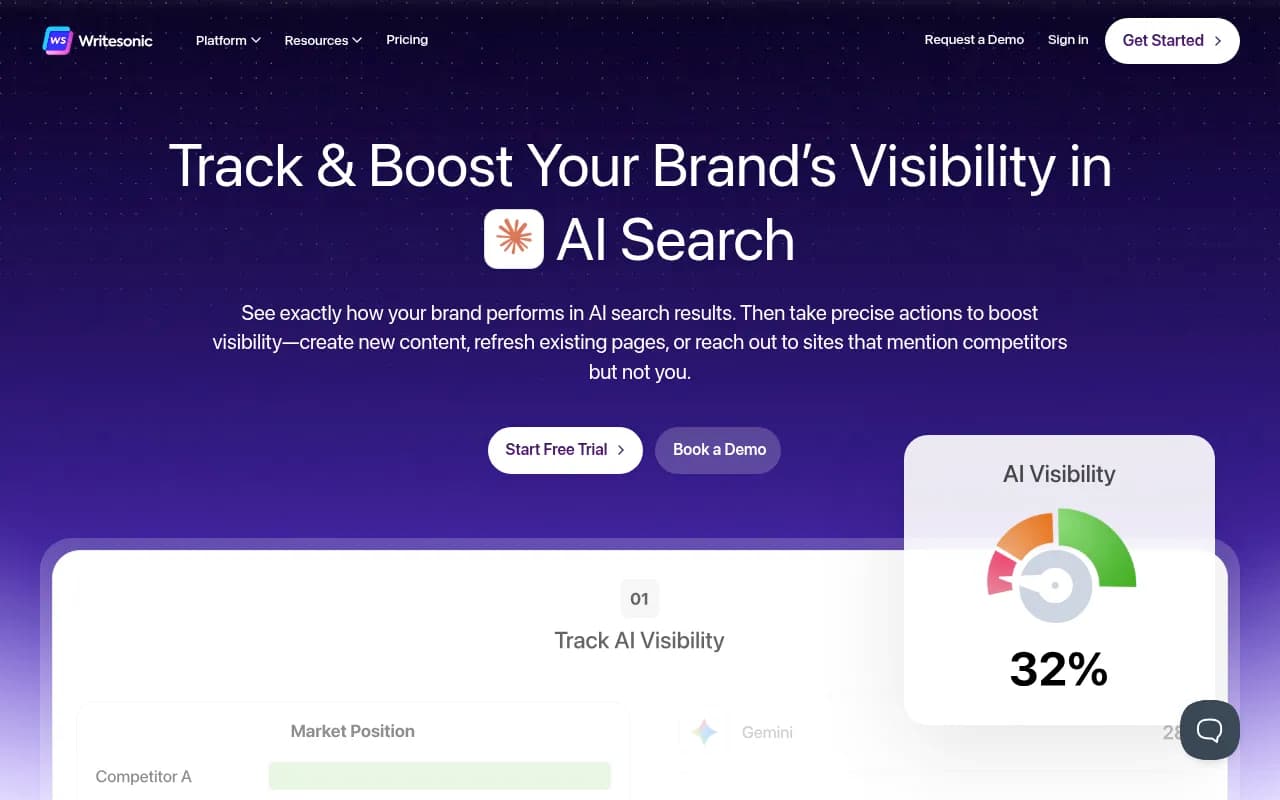
Writesonic positions itself as an end-to-end AI search visibility platform. The pitch: track how your brand appears in ChatGPT and 10+ AI models, identify citation gaps, then generate optimized content to fill those gaps. It's trying to be the complete loop -- monitoring, analysis, content creation, and results tracking.
The platform monitors ChatGPT, Perplexity, Gemini, Claude, and other major AI search engines. What sets it apart is the integrated content generation -- when it finds gaps (prompts where competitors get cited but you don't), it can create articles designed to close those gaps. Reddit and UGC forum tracking is another differentiator.
Pricing starts at $39/mo for the Lite plan and goes up to $499/mo for Advanced, with enterprise custom pricing available. They offer a free trial and 20% off annual billing.
Limy AI
Limy AI takes a B2A (Business-to-Agent) angle. The focus is on brands selling products that AI agents evaluate and recommend -- think SaaS tools, services, physical products where ChatGPT or Perplexity might suggest options to users.
The platform tracks visibility across AI search engines but emphasizes optimization actions over content generation. You get sentiment analysis (how AI models talk about your brand), step-by-step optimization recommendations, and revenue attribution that connects AI visibility to actual conversions.
Pricing starts at $449/mo. No public details on upper tiers or enterprise pricing, but the entry point is significantly higher than Writesonic.
Side-by-side comparison
| Feature | Writesonic | Limy AI |
|---|---|---|
| Starting price | $39/mo | $449/mo |
| Free trial | Yes | Not specified |
| AI models tracked | 10+ (ChatGPT, Perplexity, Gemini, Claude, etc.) | 10+ (ChatGPT, Perplexity, Claude, Gemini, etc.) |
| Content generation | ✓ Built-in AI writer | ✗ Recommendations only |
| Citation gap analysis | ✓ | ✓ |
| Reddit/UGC tracking | ✓ Emphasized | Not specified |
| Sentiment analysis | Not specified | ✓ Emphasized |
| Revenue attribution | Basic tracking | ✓ Advanced B2A focus |
| Content refresh | ✓ | Not specified |
| Optimization actions | ✓ | ✓ Step-by-step |
| Target audience | Content teams, marketers, agencies | Product brands, SaaS, e-commerce |
| Annual discount | 20% | Not specified |
Content generation and optimization
Writesonic's big differentiator is the integrated content engine. When it identifies a prompt where competitors rank but you don't, it can generate an article targeting that prompt. The content is grounded in citation data -- what AI models actually cite when answering similar queries.
This matters if you're a content team trying to scale. Instead of manually writing articles based on gap analysis, you get drafts that are already optimized for AI search. You still need to edit and refine, but the heavy lifting is done.
Limy AI doesn't generate content. It gives you optimization recommendations -- what to fix, what angles to cover, which pages need work. You then take those recommendations to your writers or content team. For some teams, this is fine. For others, it's an extra step that slows things down.
Verdict: Writesonic wins if you need content production. Limy AI wins if you have content resources and want pure optimization intelligence.
Tracking and monitoring capabilities
Both platforms track the major AI search engines: ChatGPT, Perplexity, Claude, Gemini, and others. Coverage is roughly equivalent.
Writesonic emphasizes Reddit and UGC forum tracking. AI models pull heavily from Reddit discussions, so seeing which threads mention your brand (or competitors) gives you targets for engagement or content creation.
Limy AI emphasizes sentiment analysis. It doesn't just track whether you're mentioned -- it analyzes how AI models talk about your brand. Positive, negative, neutral? What specific attributes do they highlight? This is valuable for brand positioning and messaging adjustments.
Both platforms offer citation analysis (which sources AI models cite), competitor tracking, and prompt-level visibility scores.
Verdict: Tie. Different strengths depending on what you care about -- Reddit insights vs sentiment depth.
Pricing and value
| Plan | Writesonic | Limy AI |
|---|---|---|
| Entry tier | $39/mo (Lite) | $449/mo |
| Mid tier | $199/mo (not specified in data) | Not specified |
| High tier | $499/mo (Advanced) | Not specified |
| Enterprise | Custom | Custom |
| Annual discount | 20% | Not specified |
The price gap is the elephant in the room. Writesonic's entry point is $39/mo. Limy AI's is $449/mo. That's not a small difference -- it's a different market segment.
Writesonic is accessible to small teams, agencies, and individual marketers. Limy AI is priced for established brands with real budgets.
What do you get for that extra $410/mo? Presumably deeper B2A optimization, more sophisticated revenue attribution, and enterprise-grade support. But Limy AI doesn't publish detailed feature breakdowns by tier, so it's hard to say exactly where the value lands.
For most teams, Writesonic's pricing is easier to justify. You can start small, see results, then scale up. Limy AI requires more upfront commitment.
Verdict: Writesonic wins on accessibility. Limy AI might justify the cost for enterprise brands with complex attribution needs, but you need to see a demo to know for sure.
Revenue attribution and ROI tracking
Limy AI's core pitch is B2A optimization with revenue attribution. The platform connects AI search visibility to actual conversions -- which prompts drive traffic, which traffic converts, what's the revenue impact.
This is where Limy AI's higher price point might make sense. If you're a SaaS company spending $10k+/mo on content and SEO, knowing which AI search prompts drive $50k in MRR is worth paying for.
Writesonic has basic tracking (traffic attribution via code snippet or GSC integration) but doesn't emphasize revenue attribution the way Limy AI does. You can see which pages get cited and which drive traffic, but connecting that to revenue requires your own analytics setup.
Verdict: Limy AI wins for enterprise teams that need to prove ROI. Writesonic is fine for teams that just want to see traffic impact.
User interface and ease of use
Neither platform has extensive public reviews on UI/UX, but based on positioning:
Writesonic targets a broader audience (content teams, agencies, marketers), so the interface likely prioritizes simplicity and quick wins. The content generation workflow needs to be straightforward -- find gap, generate content, publish.
Limy AI targets product brands and enterprise buyers, so the interface likely emphasizes data depth and customization. More dashboards, more filters, more ways to slice visibility data.
No clear winner here without hands-on testing, but expect Writesonic to be more plug-and-play, Limy AI to have a steeper learning curve with more power-user features.
Integration and workflow
Writesonic mentions tracking via code snippet, GSC integration, or server log analysis. Standard stuff for connecting visibility to traffic.
Limy AI emphasizes "infrastructure" for AI search, which suggests deeper integrations with CRM, analytics, and revenue systems. But specifics aren't public.
If you're a small team, Writesonic's simpler integration approach is probably fine. If you're an enterprise with complex attribution needs, Limy AI's infrastructure focus might be necessary.
Verdict: Depends on your stack complexity.
Who should pick Writesonic
- Content teams that need to produce at scale: The integrated AI writer is the killer feature. Find gaps, generate content, publish. One platform instead of three.
- Agencies managing multiple clients: Lower price point makes it easier to add AI search visibility as a service offering without huge upfront costs.
- Small to mid-size brands: $39-$499/mo is accessible. You can start small and scale as you see results.
- Teams focused on Reddit and UGC: If your audience lives on Reddit or niche forums, Writesonic's tracking here gives you actionable targets.
- Anyone who wants a free trial: Test before committing.
Who should pick Limy AI
- Product brands selling through AI recommendations: If ChatGPT or Perplexity recommending your product drives real revenue, Limy AI's B2A focus is built for you.
- Enterprise teams with attribution requirements: Need to connect AI visibility to revenue and prove ROI to executives? Limy AI's revenue tracking is more sophisticated.
- Brands with existing content production: If you already have writers and a content engine, you don't need Writesonic's generation features. Limy AI's optimization intelligence is enough.
- Teams that care deeply about sentiment: How AI models talk about your brand matters as much as whether they mention you. Limy AI's sentiment analysis goes deeper.
Pros and cons
Writesonic pros:
- Much lower entry price ($39/mo vs $449/mo)
- Integrated content generation saves time and tools
- Reddit and UGC tracking for community-driven brands
- Free trial available
- Broader target audience (content teams, agencies, marketers)
Writesonic cons:
- Revenue attribution is basic compared to Limy AI
- Less emphasis on B2A-specific optimization
- Sentiment analysis not highlighted as a core feature
Limy AI pros:
- Deep B2A (Business-to-Agent) optimization for product brands
- Sophisticated revenue attribution connecting visibility to conversions
- Sentiment analysis shows how AI models talk about your brand
- Built for enterprise buyers with complex needs
Limy AI cons:
- 11x more expensive at entry level ($449/mo vs $39/mo)
- No content generation -- recommendations only
- Less accessible for small teams and agencies
- Limited public information on features and pricing tiers
Final verdict
Writesonic wins for most teams. The combination of tracking, gap analysis, and content generation at $39-$499/mo is hard to beat. You get the full loop -- see where you're invisible, create content to fix it, track results. For content teams, agencies, and small to mid-size brands, this is the more practical choice.
Limy AI makes sense for a specific buyer: established product brands (SaaS, e-commerce, services) where AI recommendations directly drive revenue and you need sophisticated attribution to prove it. If you're spending $10k+/mo on content and SEO already, Limy AI's $449/mo entry point is a rounding error. But for everyone else, it's overkill.
One more thing: if you're also looking to understand how AI crawlers interact with your site (which pages they read, how often they return, indexing issues), Promptwatch offers crawler log analysis alongside visibility tracking -- something neither Writesonic nor Limy AI emphasizes. Worth checking out if you want the full technical picture of how AI engines discover and cite your content.
