Key Takeaways
- Price difference is massive: Searchable starts at $50/mo while Limy AI starts at $449/mo -- nearly 9x more expensive for entry-level access
- Searchable is monitoring-focused: Strong dashboard for tracking visibility across 5 AI engines, but lighter on actionable optimization steps
- Limy AI emphasizes revenue attribution: Built around B2A (Business-to-Agent) optimization with sentiment analysis and step-by-step actions, not just tracking
- User base tells a story: Searchable claims 12,000+ users vs Limy's smaller, enterprise-focused customer base -- reflects different target markets
- Content generation approach differs: Searchable generates full blog posts and landing pages; Limy provides optimization actions and recommendations rather than finished content
- Free trial accessibility: Searchable offers 14-day trial with no credit card; Limy's trial terms unclear but pricing suggests enterprise sales cycle
Overview
Searchable
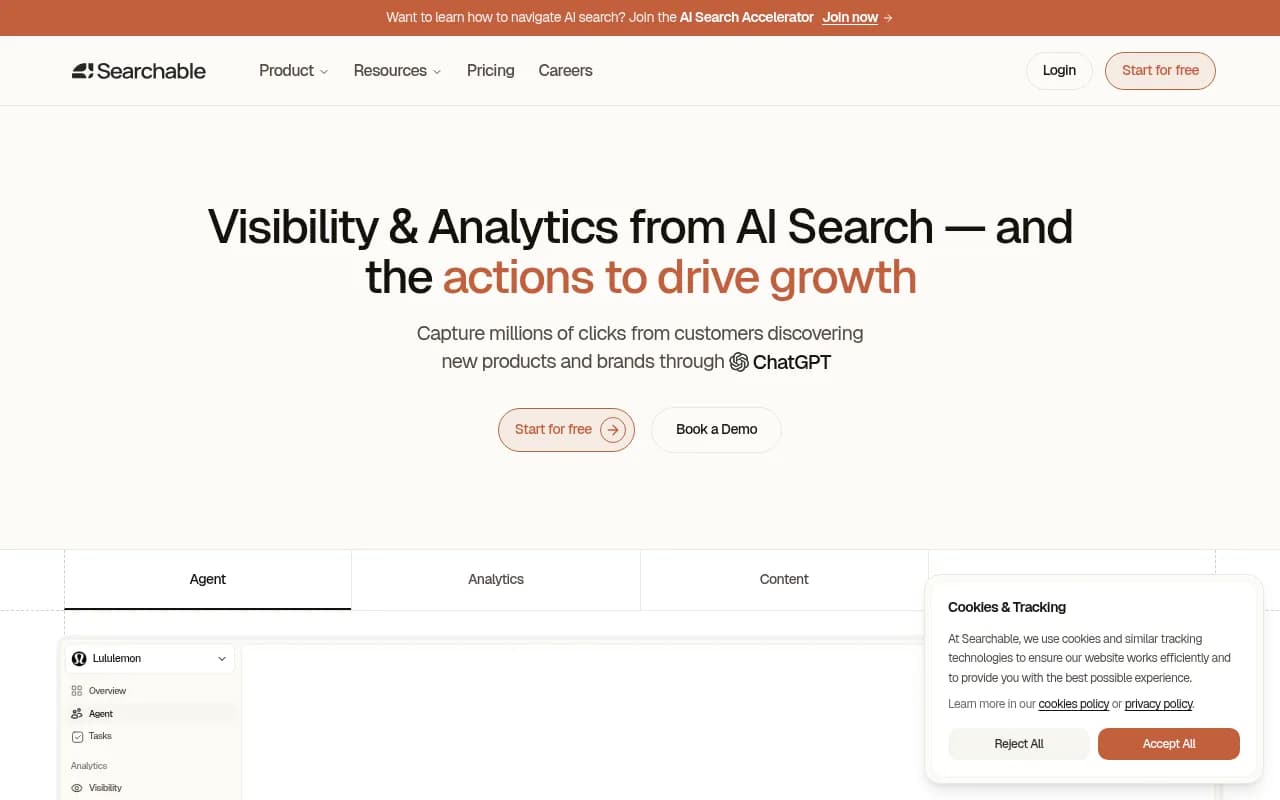
Searchable is an AI search optimization platform that tracks brand visibility across ChatGPT, Claude, Perplexity, Google AI Overviews, and Microsoft Copilot. Founded by SEO specialists with agency backgrounds, it combines monitoring dashboards with AI-powered content generation and technical audits. The platform positions itself as accessible to mid-market brands and agencies, with 12,000+ users and pricing that starts at $50/mo. The core pitch: see where you appear in AI search results, get actionable recommendations from an AI agent that learns your brand voice, and generate content optimized for AI citation.
Limy AI
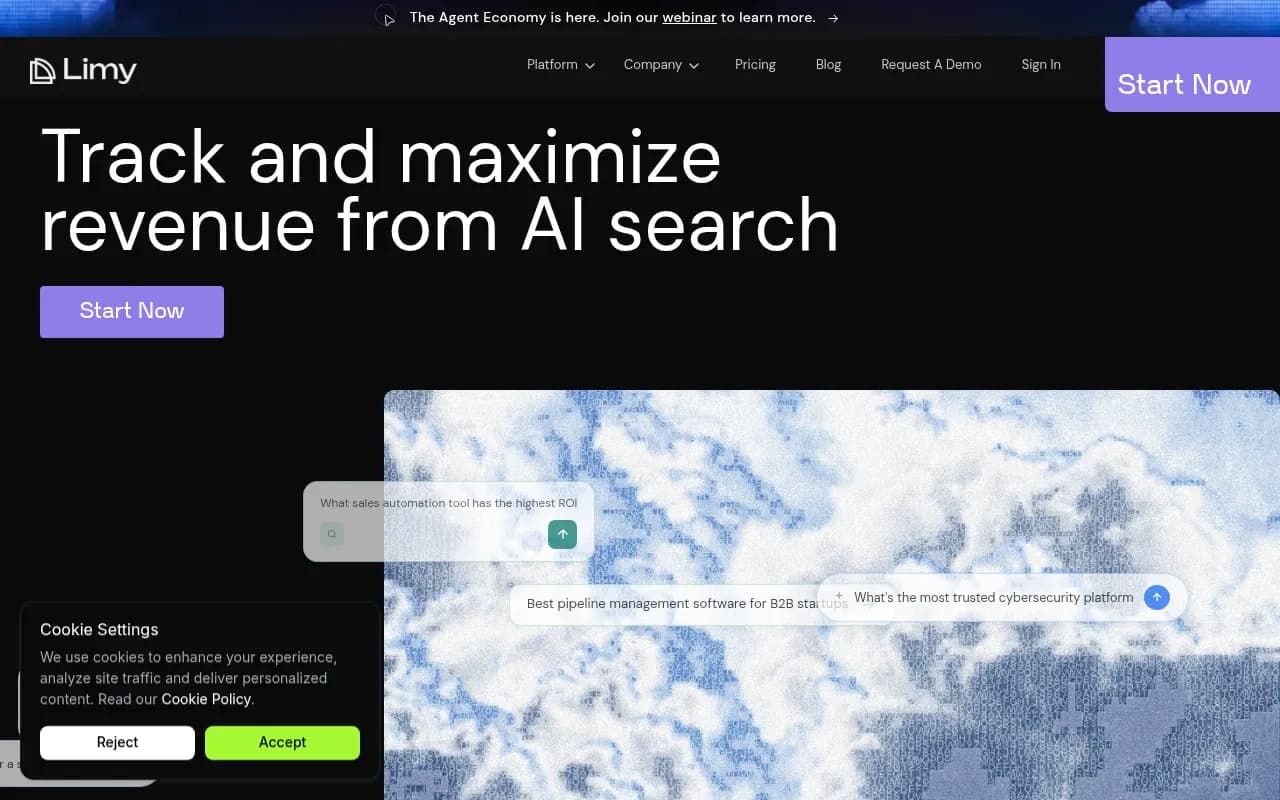
Limy AI takes a different angle -- it's a B2A (Business-to-Agent) optimization platform focused on how AI agents evaluate, choose, and recommend products on behalf of humans. Rather than just monitoring visibility, Limy emphasizes revenue attribution, sentiment analysis, and step-by-step optimization actions. The platform tracks ChatGPT, Perplexity, Claude, and other AI engines, but frames everything around measurable business outcomes. Pricing starts at $449/mo, signaling an enterprise or high-growth target market. The pitch: own the market in AI search by making your brand visibility convertible and measurable.
Side-by-Side Comparison
| Feature | Searchable | Limy AI |
|---|---|---|
| Starting price | $50/mo (Starter) | $449/mo |
| Free trial | 14 days, no credit card | Not specified |
| AI engines monitored | ChatGPT, Claude, Perplexity, Google AI Overviews, Copilot (5 total) | ChatGPT, Claude, Perplexity, others mentioned but not fully listed |
| User base | 12,000+ marketers and agencies | Smaller, enterprise-focused |
| Content generation | Full blog posts, landing pages, product descriptions | Optimization actions and recommendations |
| Technical audits | Schema markup, content structure, crawlability fixes | Not prominently featured |
| Revenue attribution | Google Analytics, GSC, HubSpot, Salesforce integrations | Core feature -- B2A optimization with measurable revenue tracking |
| Sentiment analysis | Not mentioned | Yes -- tracks how AI engines perceive your brand |
| Personal AI agent | Yes -- learns brand voice and generates tailored recommendations | Not explicitly mentioned |
| Competitor analysis | Yes -- see where competitors outrank you | Yes -- implied in visibility tracking |
| Target audience | Mid-market brands, agencies, marketers | Enterprise brands, high-growth companies |
| Ease of onboarding | Self-serve with 14-day trial | Likely sales-assisted given pricing |
Pricing
The price gap is the first thing you notice.
| Plan | Searchable | Limy AI |
|---|---|---|
| Starter/Entry | $50/mo (1 domain, 50 prompts) | $449/mo (details not public) |
| Professional | $100-125/mo (unlimited domains, 200 prompts) | Not disclosed |
| Scale/Enterprise | $400/mo | Custom pricing |
| Free trial | 14 days, no credit card required | Not specified |
Searchable's pricing is transparent and accessible. You can start at $50/mo and scale up as you need more prompts and domains. The Professional plan at $100-125/mo gives you unlimited domains and 200 prompts -- enough for most mid-market brands.
Limy AI starts at $449/mo with no public details on what that includes. The lack of transparent pricing and the high entry point suggest this is an enterprise tool sold through a sales process, not a self-serve product. If you're a small brand or agency testing AI search optimization for the first time, that's a tough pill to swallow.
Monitoring and visibility tracking
Both platforms track how your brand appears in AI search results, but the execution differs.
Searchable monitors 5 AI engines explicitly: ChatGPT, Claude, Perplexity, Google AI Overviews, and Microsoft Copilot. The dashboard shows where you appear, where competitors outrank you, and which opportunities you're missing. It's a comprehensive view of your AI search footprint across the major players.
Limy AI tracks ChatGPT, Claude, Perplexity, and mentions "other AI engines" without specifying. The platform frames monitoring around B2A optimization -- how AI agents evaluate and recommend your products. This is a conceptual shift: instead of just "are we mentioned?", it's "how are we being recommended and what's the sentiment?"
Verdict: Searchable wins on clarity and breadth of monitoring. Five explicitly named engines vs vague "others" is a meaningful difference. Limy's B2A framing is interesting but doesn't compensate for less transparent coverage.
Actionable insights and optimization
This is where the platforms diverge most.
Searchable's AI agent analyzes your visibility data and generates recommendations tailored to your brand. You get content briefs optimized for AI citation, technical fixes for crawlability, and strategic insights. The agent learns your brand voice from day one. The platform also generates full content -- blog posts, landing pages, product descriptions -- engineered for AI citation with structured data, authoritative tone, and comprehensive coverage.
Limy AI emphasizes step-by-step optimization actions rather than content generation. The platform provides sentiment analysis (how AI engines perceive your brand), revenue attribution (connecting visibility to actual business outcomes), and specific actions to improve your position. It's less about "here's a blog post" and more about "here's what to fix and why it matters to revenue."
Verdict: Depends on what you need. If you want finished content and technical audits, Searchable delivers. If you want revenue-focused optimization steps and sentiment tracking, Limy AI is the better fit. Searchable feels more hands-on for content teams; Limy feels more strategic for performance marketers.
Content creation capabilities
Searchable has a full content engine. It generates blog posts, landing pages, and product descriptions optimized for AI citation. The platform understands what makes AI engines cite sources -- structured data, authoritative tone, comprehensive coverage -- and applies those principles to every piece of content. This is a big deal if you're a small team that needs to produce AI-optimized content quickly.
Limy AI doesn't emphasize content generation. The platform provides optimization recommendations and actions, but you're expected to create (or have someone create) the actual content. It's more of a strategic layer than a production tool.
Verdict: Searchable wins decisively if content generation matters to you. Limy AI isn't competing in this category.
Technical SEO and infrastructure
Searchable offers technical SEO audits specifically for AI search. The audits identify schema markup opportunities, content structure improvements, and crawlability fixes that help ChatGPT, Claude, and Perplexity understand and cite your content. This is valuable because AI search engines process websites differently than traditional search -- Searchable's audits account for that.
Limy AI positions itself as "infrastructure to own the market in AI search" but doesn't detail technical audit capabilities on its website. The focus is more on visibility, sentiment, and revenue attribution than on technical fixes.
Verdict: Searchable has a clear edge on technical SEO. If you need help with schema markup, structured data, and crawlability for AI engines, Searchable delivers. Limy AI doesn't appear to compete here.
Revenue attribution and business outcomes
Limy AI's core differentiator is revenue attribution. The platform is built around B2A optimization -- making your brand visibility in AI search convertible and measurable. It tracks sentiment, provides step-by-step actions, and connects visibility to business outcomes. This is the platform's main selling point: not just "are we visible?" but "is this visibility driving revenue?"
Searchable integrates with Google Analytics, Google Search Console, HubSpot, and Salesforce to correlate AI visibility with traffic, leads, and revenue. You can prove ROI and optimize based on real business outcomes. The integrations are solid, but revenue attribution isn't the central narrative the way it is with Limy AI.
Verdict: Limy AI wins on revenue attribution as a core feature. Searchable has the integrations to track outcomes, but Limy is architected around this from the ground up. If proving ROI to executives is your main concern, Limy's approach is more aligned.
User experience and onboarding
Searchable offers a 14-day free trial with no credit card required. You can sign up, explore the platform, and see results within your first week. The self-serve model and transparent pricing make it easy to get started. The platform is designed for marketers and agencies who want to dive in without a sales call.
Limy AI's onboarding isn't detailed on the website, but the $449/mo starting price and lack of transparent trial terms suggest a sales-assisted process. This isn't necessarily bad -- enterprise tools often need customization and onboarding support -- but it's a higher barrier to entry.
Verdict: Searchable is easier to start with. If you want to test AI search optimization without committing to a sales cycle, Searchable's 14-day trial is the clear winner.
Integrations and ecosystem
Searchable integrates with Google Analytics, Google Search Console, HubSpot, Salesforce, and other marketing tools. You can connect your existing stack and correlate AI visibility with traffic, leads, and revenue. The integrations are practical and cover the tools most marketing teams already use.
Limy AI mentions integrations but doesn't list them explicitly on the website. Given the enterprise positioning, it's likely they offer custom integrations or API access, but the lack of transparency is a downside.
Verdict: Searchable wins on integration clarity. Knowing exactly what connects to your stack matters when evaluating a new tool.
Who should pick Searchable
- Mid-market brands and agencies testing AI search optimization for the first time -- the $50/mo entry point is low-risk
- Content teams that need AI-optimized blog posts, landing pages, and product descriptions generated quickly
- Marketers who want technical audits for schema markup, structured data, and crawlability fixes
- Teams that value self-serve onboarding -- the 14-day free trial with no credit card required makes it easy to start
- Brands monitoring 5+ AI engines -- Searchable explicitly covers ChatGPT, Claude, Perplexity, Google AI Overviews, and Copilot
Searchable is the accessible option. It's built for marketers who want to see results quickly without a massive upfront investment. The content generation and technical audits are real differentiators if you're a small team.
If you're also looking to track how your brand shows up in AI search results with more advanced analytics and content gap analysis, Promptwatch covers that angle with features like Answer Gap Analysis and AI-powered content generation grounded in 880M+ citations.

Who should pick Limy AI
- Enterprise brands with budgets for premium tools and a focus on measurable ROI
- Performance marketers who need revenue attribution and sentiment analysis, not just visibility tracking
- Companies selling products where AI agents make recommendations -- Limy's B2A optimization is purpose-built for this
- Teams that want strategic optimization actions rather than finished content -- Limy tells you what to fix, you handle execution
- Brands willing to go through a sales process -- the $449/mo entry point and lack of transparent trial suggest this isn't self-serve
Limy AI is the strategic option. If you're a high-growth or enterprise brand that needs to prove AI search visibility is driving revenue, Limy's approach is more aligned with that goal. The higher price point buys you a platform architected around business outcomes, not just monitoring.
Pros and cons
Searchable pros
- Affordable entry point ($50/mo vs $449/mo)
- 14-day free trial with no credit card required
- Full content generation (blog posts, landing pages, product descriptions)
- Technical SEO audits for AI search
- Monitors 5 AI engines explicitly
- Self-serve onboarding
- 12,000+ user base suggests product-market fit
Searchable cons
- Revenue attribution isn't the core focus (though integrations support it)
- Sentiment analysis not mentioned
- May feel less strategic for enterprise teams focused purely on ROI
Limy AI pros
- Revenue attribution is a core feature, not an add-on
- Sentiment analysis tracks how AI engines perceive your brand
- B2A optimization framework is conceptually aligned with how AI agents work
- Step-by-step optimization actions for performance marketers
- Enterprise-grade positioning
Limy AI cons
- $449/mo starting price is 9x more expensive than Searchable's entry tier
- No transparent free trial or self-serve onboarding
- Doesn't generate finished content
- Technical audit capabilities unclear
- AI engine coverage less transparent ("others" vs explicit list)
- Smaller user base suggests less proven product-market fit
Final verdict
Searchable wins for most teams. The combination of affordable pricing, content generation, technical audits, and self-serve onboarding makes it the practical choice for mid-market brands and agencies exploring AI search optimization. You can start at $50/mo, see results within a week, and scale up as needed. The 12,000+ user base suggests this is a proven product.
Limy AI is the better fit if you're an enterprise brand with a serious budget and a mandate to prove AI search visibility drives revenue. The B2A optimization framework, sentiment analysis, and revenue attribution are compelling -- but only if you can justify the $449/mo starting price and navigate a likely sales-assisted onboarding process.
For most readers deciding between these two: start with Searchable's 14-day free trial. If you outgrow it or need deeper revenue attribution, Limy AI is there. But the price-to-value ratio heavily favors Searchable for anyone not operating at enterprise scale.