Key Takeaways
- Bear AI starts at $100/mo (Basic plan, ChatGPT only, 30 prompts, 2 blogs/mo) while Ceyo AI starts at $49/mo (Core plan with multi-platform tracking) -- Ceyo is half the price at entry level
- Bear AI positions itself as a "marketing stack for AI agents" with revenue generation focus, while Ceyo focuses purely on visibility tracking and sentiment analysis
- Ceyo tracks ChatGPT, Gemini, Claude, and Perplexity out of the box on the Core plan; Bear AI's Basic plan only covers ChatGPT ("GPT-5"), requiring Enterprise for full platform coverage
- Bear AI includes content generation (2 blogs/mo on Basic), while Ceyo appears to be monitoring-only with no built-in content creation
- Both are Y Combinator-backed startups targeting marketing teams, but Bear AI emphasizes traffic generation while Ceyo emphasizes competitive positioning and sentiment
- Neither platform offers a free tier or trial period based on available data
Overview
Bear AI
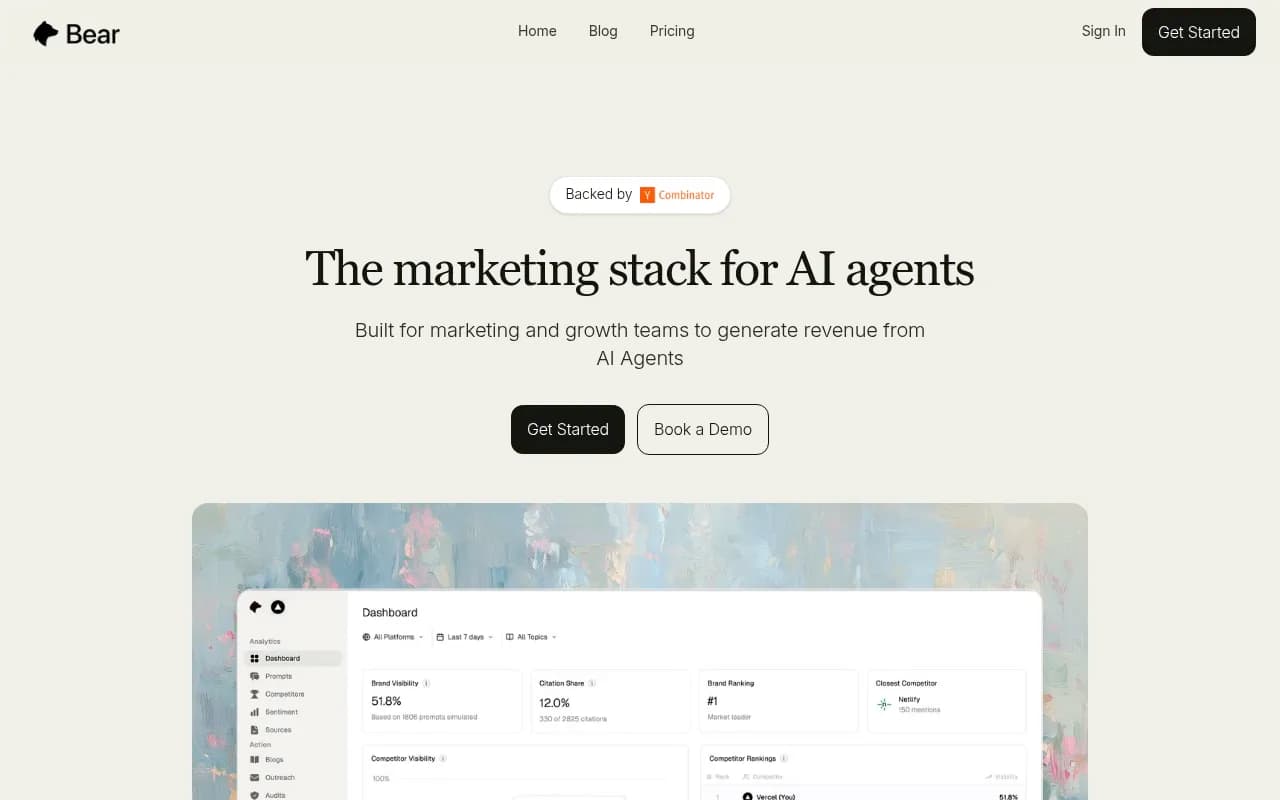
Bear AI calls itself "the marketing stack for AI agents" and targets marketing and growth teams looking to generate revenue from AI-powered search. Backed by Y Combinator (F25 batch), Bear AI takes a more aggressive positioning around traffic generation and revenue outcomes rather than just monitoring. The platform tracks how AI agents discover your brand and provides optimization guidance to boost traffic. Customers include Peerspace, Medal, Wispr Flow, and other tech companies.
The platform's messaging focuses on "being the answer in AI" and helping brands dominate AI-powered search. Bear AI bundles tracking with content generation -- even the Basic plan includes 2 blog posts per month, suggesting they see content creation as part of the core loop.
Ceyo AI
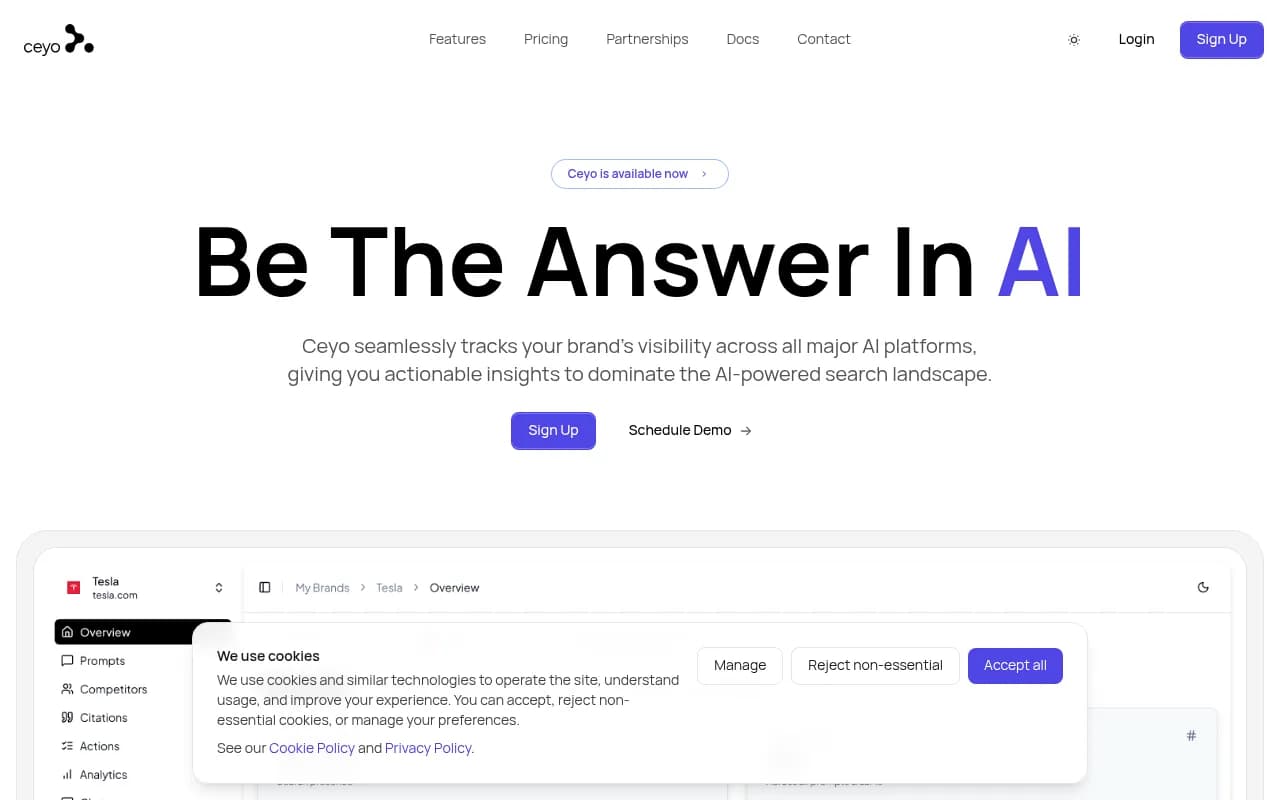
Ceyo AI positions itself as a brand visibility tracker across major AI platforms. The focus is on monitoring brand mentions, sentiment analysis, and competitive positioning in LLM responses. Ceyo provides real-time alerts and actionable recommendations, with a strong emphasis on understanding which prompts drive your brand's presence.
The platform's interface shows detailed prompt analytics including visibility percentages, sentiment scores, average position, impact ratings, and competitive brand tracking. Ceyo is used by agencies like Brandfirm and Zigt, plus partners like Enreach. The messaging is more conservative -- "track your brand's AI visibility" rather than "generate revenue from AI agents."
Side-by-side comparison
| Feature | Bear AI | Ceyo AI |
|---|---|---|
| Starting price | $100/mo | $49/mo |
| Entry-level AI platforms | ChatGPT only ("GPT-5") | ChatGPT, Gemini, Claude, Perplexity |
| Prompt tracking (entry plan) | 30 prompts | Unknown (not specified) |
| Content generation | ✓ (2 blogs/mo on Basic) | ✗ (monitoring only) |
| Sentiment analysis | Unknown | ✓ |
| Competitive brand tracking | Unknown | ✓ |
| Real-time alerts | Unknown | ✓ |
| Multi-region tracking | Unknown | ✓ (shows country flags) |
| Free tier | ✗ | ✗ |
| Target audience | Marketing/growth teams | Marketing teams, agencies |
| Positioning | Revenue generation | Visibility monitoring |
| Enterprise plan | Custom pricing, all platforms | Unknown |
Pricing breakdown
| Plan | Bear AI | Ceyo AI |
|---|---|---|
| Entry plan | $100/mo (Basic: ChatGPT only, 30 prompts, 2 blogs/mo) | $49/mo (Core plan, all major platforms) |
| Mid-tier | Not specified | $89/mo (depending on source) |
| Enterprise | Custom pricing (all AI platforms, unlimited tracking) | Unknown |
| Annual discount | Unknown | Available |
| Free trial | No | No |
The pricing gap is significant. Ceyo's Core plan at $49/mo gives you multi-platform tracking right away, while Bear AI's $100/mo Basic plan only covers ChatGPT. If you need visibility across Claude, Gemini, and Perplexity from day one, Bear AI forces you into their Enterprise tier at custom pricing. That's a big jump.
Bear AI bundles content generation into the price -- 2 blog posts per month on Basic. If you value that, the $100/mo makes more sense. If you just want monitoring and already have a content team, you're paying for something you don't need.
Platform coverage and tracking depth
Bear AI's Basic plan explicitly states "GPT-5 only" -- meaning you're locked into ChatGPT tracking at the entry level. Their Enterprise plan unlocks "all AI platforms" with unlimited tracking, but there's no transparent pricing. The website shows logos for Gemini, Claude, ChatGPT, AI Search, and Perplexity, but these appear to be Enterprise-only based on the Basic plan restrictions.
Ceyo AI lists ChatGPT, Gemini, Claude, and Perplexity as core platforms tracked from the start. Their prompt analytics table shows multi-platform data without tier restrictions mentioned. The interface displays country-specific tracking (US, UK, Germany, Singapore, Netherlands, France, Japan flags visible), suggesting geographic segmentation is built in.
Verdict: Ceyo wins on platform coverage at the entry level. Bear AI's decision to gate multi-platform tracking behind Enterprise pricing is a dealbreaker for most teams who need to monitor more than just ChatGPT.
Analytics and insights
Ceyo's interface shows granular prompt-level data:
- Visibility percentage (how often your brand appears)
- Sentiment classification (Positive/Neutral/Negative)
- Average position in responses
- Impact rating (High/Medium/Low relevance, volume, or intent)
- Competing brands mentioned in the same responses
- Category tagging
- Geographic origin (GEO flags)
This is detailed competitive intelligence. You can see exactly which prompts you're winning, where you're losing to competitors, and what sentiment AI models associate with your brand.
Bear AI's website emphasizes "trending prompts" and "see how AI talks about you" but doesn't show the same level of granular analytics in their screenshots. The focus is more on traffic generation and optimization guidance than deep competitive analysis. The inclusion of content generation (2 blogs/mo) suggests Bear AI is trying to close the loop from insight to action, but we don't see the same prompt-level breakdowns.
Verdict: Ceyo provides richer competitive and sentiment analytics. Bear AI seems more focused on actionable outputs (content, traffic) than deep data exploration.
Content generation and optimization
Bear AI includes content generation as a core feature -- even the Basic plan comes with 2 blog posts per month. This suggests they see content creation as part of the optimization loop, not just an add-on. The positioning around "marketing stack for AI agents" implies they're trying to be an end-to-end solution: track visibility, identify gaps, generate content to fill those gaps.
Ceyo AI appears to be monitoring-only. The website emphasizes "actionable insights" and "recommendations" but doesn't mention content generation or an AI writing assistant. If you want to act on Ceyo's insights, you'll need to create content yourself or use a separate tool.
This is a fundamental difference in philosophy. Bear AI wants to be your full stack. Ceyo wants to be your analytics layer.
Verdict: Bear AI wins if you need content generation bundled in. Ceyo wins if you already have a content team and just want clean data.
If you're looking to not just monitor but actively improve your AI search visibility with content that ranks, tools like Promptwatch take this a step further with AI-generated articles grounded in 880M+ citations and prompt volume data.

User interface and workflow
Ceyo's screenshots show a clean, data-dense interface with sortable tables, sentiment badges, and competitive brand logos inline. The workflow appears to be: browse prompts, filter by category/sentiment/impact, drill into specific queries to see competitive positioning. It's built for analysts who want to explore the data.
Bear AI's website shows a more visual, dashboard-style interface with "trending prompts" cards and AI platform logos. The emphasis is on high-level insights and quick wins rather than deep data exploration. The inclusion of content generation suggests a more guided workflow: here's what's trending, here's what you should write about.
Verdict: Ceyo for data exploration, Bear AI for guided action. Pick based on whether your team wants to dig into the data or just wants to be told what to do.
Target audience and use cases
Bear AI explicitly targets "marketing and growth teams to generate revenue from AI Agents." The customer logos (Peerspace, Medal, Wispr Flow, Slashy, Defx, Dabble) are mostly B2C tech companies. The messaging is aggressive: dominate AI search, boost traffic, generate revenue. This is for growth hackers and performance marketers who care about outcomes, not just data.
Ceyo AI targets "marketing teams and agencies" with a focus on brand monitoring and competitive positioning. The partner logos include agencies (Brandfirm, Zigt) and enterprise brands (Enreach). The messaging is more conservative: track visibility, understand sentiment, stay ahead of competition. This is for brand managers and agencies who need to report on AI presence to clients.
Verdict: Bear AI for growth-focused startups and product companies. Ceyo for agencies and enterprise brands who need clean reporting.
Limitations and gaps
Bear AI:
- Basic plan only covers ChatGPT -- no multi-platform tracking without jumping to Enterprise
- No transparent mid-tier pricing between $100/mo and custom Enterprise
- Limited information about analytics depth and competitive tracking
- No free trial or demo access to test before committing
- Content generation limited to 2 blogs/mo on Basic (unclear if quality matches specialized tools)
Ceyo AI:
- No content generation or optimization tools -- monitoring only
- Pricing details sparse (conflicting $49/mo vs $89/mo sources)
- No information about prompt limits on Core plan
- No free trial mentioned
- Less emphasis on actionable next steps compared to Bear AI
Pros and cons
Bear AI pros
- Bundles content generation with tracking (2 blogs/mo on Basic)
- Revenue-focused positioning with clear growth outcomes
- Y Combinator backing and tech startup customer base
- Enterprise plan offers unlimited tracking across all platforms
- Emphasizes traffic generation and optimization guidance
Bear AI cons
- Basic plan only tracks ChatGPT ($100/mo for single-platform is expensive)
- No transparent mid-tier pricing
- Limited analytics depth shown in marketing materials
- No free trial to test content quality
- Forces Enterprise upgrade for multi-platform tracking
Ceyo AI pros
- Half the price at entry level ($49/mo vs $100/mo)
- Multi-platform tracking (ChatGPT, Gemini, Claude, Perplexity) on Core plan
- Detailed sentiment and competitive analytics
- Geographic tracking built in
- Real-time alerts for brand mentions
- Agency-friendly with white-label potential
Ceyo AI cons
- No content generation or optimization tools
- Monitoring-only approach requires separate content workflow
- Sparse pricing details and plan differentiation
- Less emphasis on actionable outcomes
- No information about prompt volume limits
Who should pick which tool
Pick Bear AI if:
- You're a growth-focused startup that needs content generation bundled with tracking
- You only care about ChatGPT visibility right now and can upgrade later
- You want a "marketing stack" that guides you from insight to action
- You have budget for Enterprise and need unlimited tracking across all platforms
- You prefer opinionated tools that tell you what to do rather than just showing data
Pick Ceyo AI if:
- You need multi-platform tracking (ChatGPT, Claude, Gemini, Perplexity) from day one
- You already have a content team and just need clean visibility data
- You're an agency managing multiple client brands and need detailed competitive analysis
- You want sentiment tracking and geographic segmentation built in
- You have a tighter budget and need the most platform coverage per dollar
- You prefer exploratory analytics over guided workflows
Pick neither if:
- You need a platform that combines deep monitoring with content generation and optimization tools -- in that case, look at platforms like Promptwatch that offer answer gap analysis, AI content generation grounded in citation data, and page-level tracking
- You need more than basic monitoring but don't want to jump to Enterprise pricing
- You require a free trial or demo before committing
Final verdict
Ceyo AI wins on value at the entry level. $49/mo for multi-platform tracking beats $100/mo for ChatGPT-only by a wide margin. If you're a marketing team or agency that just needs visibility data and already has content workflows in place, Ceyo is the obvious choice.
Bear AI wins if you need content generation bundled in and are willing to pay for it. The 2 blogs/mo on the Basic plan could justify the higher price if the content quality is good. But the single-platform limitation at that tier is a tough sell.
The real decision point is whether you want monitoring-only (Ceyo) or monitoring + content generation (Bear AI). Both platforms are young, Y Combinator-backed startups with limited public information about analytics depth, so you're taking some risk either way. Ceyo's transparent multi-platform coverage and lower price make it the safer bet for most teams. Bear AI's bundled content generation is interesting but unproven, and the ChatGPT-only restriction on Basic is a dealbreaker unless you're absolutely certain you only care about OpenAI's platform.
For teams serious about not just tracking but actually improving their AI search rankings, neither platform offers the full loop of gap analysis, content generation, and optimization that more mature platforms provide. But if you're choosing between these two, Ceyo gives you more platform coverage for less money, while Bear AI bets on content generation as a differentiator that may or may not deliver.