Key Takeaways
- Ceyo AI starts at $49-89/mo with straightforward monthly plans, while Authoritas uses a credit-based system starting at £90/mo (~$115) that can get expensive fast
- Authoritas covers 7 AI models including DeepSeek and Bing AI; Ceyo focuses on the big 4 (ChatGPT, Perplexity, Claude, Gemini)
- Ceyo is built specifically for AI visibility tracking with a clean interface focused on prompt analytics and sentiment. Authoritas is a traditional SEO platform that added AI tracking as a bolt-on feature
- Authoritas charges per query with credits (1 credit = 1 query to 1 LLM), making costs unpredictable. Ceyo includes thousands of prompts in each plan
- For brands just starting with AI visibility, Ceyo's simpler pricing and focused feature set make more sense. For enterprises already using Authoritas for SEO who want to add AI tracking, the integration might justify the premium
- Neither platform offers content generation or optimization tools -- they're monitoring-only dashboards that show you data but don't help you fix gaps
Overview
Ceyo AI
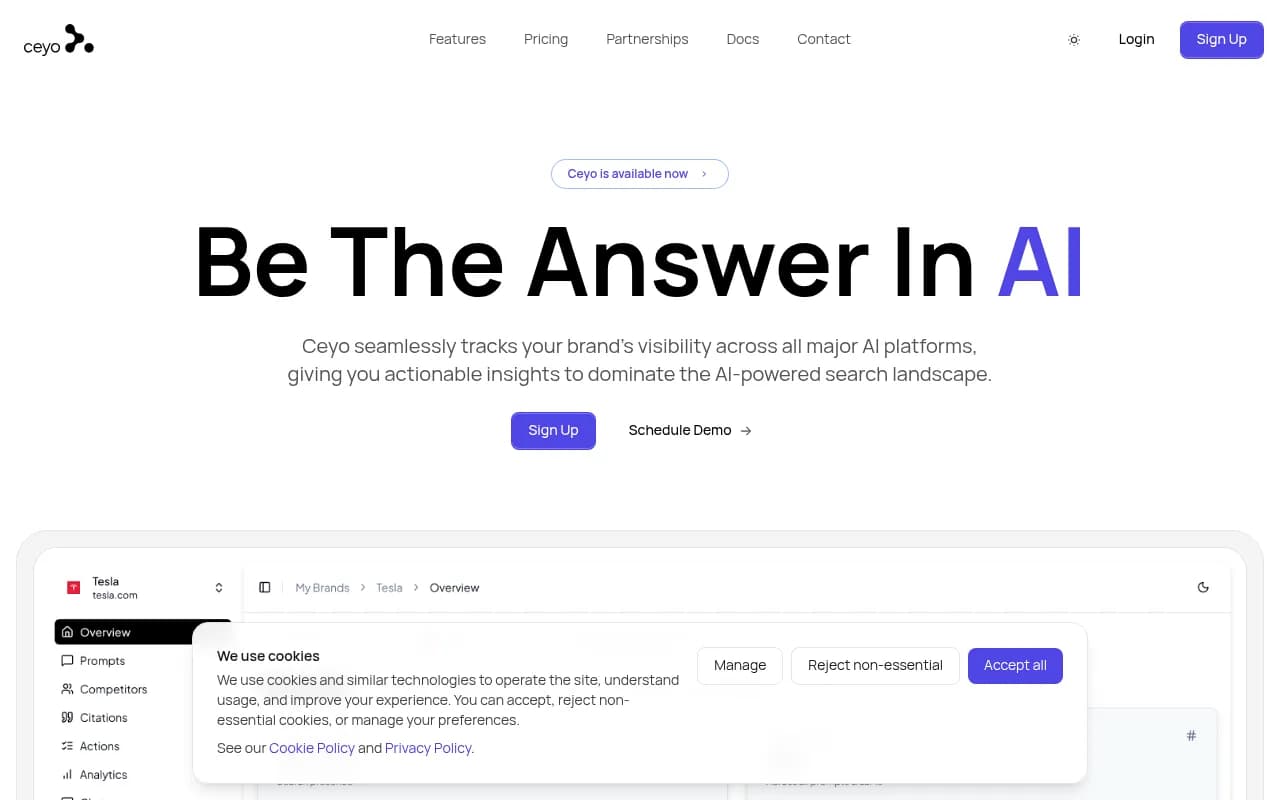
Ceyo AI launched as a dedicated AI visibility tracker for marketing teams and agencies. It monitors how your brand appears in responses from ChatGPT, Gemini, Claude, and Perplexity. The platform tracks brand mentions, sentiment analysis, competitive positioning, and sends real-time alerts when your visibility changes. Built from the ground up for AI search monitoring, not retrofitted from an existing SEO tool.
Authoritas AI Tracker

Authoritas started as a traditional SEO platform for eCommerce businesses, agencies, and publishers. In 2024-2025, they added AI Tracker as a separate module to monitor brand mentions across 7 AI engines: ChatGPT, Perplexity, Claude, Gemini, DeepSeek, Google AI Overviews, and Bing AI. The AI tracking uses a credit-based system separate from their core SEO platform pricing. Authoritas positions itself as a "complete AI Search + SEO Visibility Platform" combining traditional rankings with LLM monitoring.
Side-by-Side Comparison
| Feature | Ceyo AI | Authoritas AI Tracker |
|---|---|---|
| Starting price | $49-89/mo | £90/mo (~$115) for 2,000 credits |
| Pricing model | Fixed monthly plans | Credit-based (pay per query) |
| Free tier | No | 50 credits free |
| AI models tracked | 4 (ChatGPT, Perplexity, Claude, Gemini) | 7 (adds DeepSeek, Google AIO, Bing AI) |
| Prompts included | Thousands per plan | Depends on credits (1 credit = 1 query to 1 LLM) |
| Sentiment analysis | ✓ Yes | ✓ Yes |
| Competitive tracking | ✓ Yes | ✓ Yes |
| Real-time alerts | ✓ Yes | Not mentioned |
| Citation tracking | ✓ Yes | ✓ Yes |
| Geographic tracking | ✓ Yes (shown in UI) | Not clear |
| SEO platform integration | No (AI-only) | Yes (separate SEO plans £99-799/mo) |
| Content optimization | No | No |
| API access | Not mentioned | Not mentioned |
Pricing: Fixed plans vs credit consumption
Ceyo AI pricing
Ceyo uses straightforward monthly subscription pricing:
| Plan | Price | What you get |
|---|---|---|
| Core | $49/mo or $89/mo (conflicting sources) | Brand monitoring across 4 LLMs, prompt analytics, sentiment tracking, competitive insights |
| Higher tiers | Not publicly listed | Likely more prompts, brands, or team seats |
The pricing is simple -- you pay a flat monthly fee and get access to thousands of prompts. No surprise bills from running too many queries.
Authoritas AI Tracker pricing
Authoritas uses a credit system where each query to each LLM costs credits:
| Plan | Price | Credits/month | Cost per credit |
|---|---|---|---|
| Free | £0 | 50 | £0 |
| P1 | £90/mo (~$115) | 2,000 | £0.045 |
| P2 | £225/mo (~$287) | 6,000 | £0.0375 |
| P3 | £495/mo (~$632) | 15,000 | £0.033 |
| Enterprise | £1,125/mo (~$1,436) | 42,000 | £0.027 |
The catch: 1 credit = 1 query to 1 LLM. If you want to check the same prompt across all 7 models, that's 7 credits. Track 100 prompts across all models? That's 700 credits. The 2,000-credit P1 plan gives you roughly 285 prompts checked across all 7 models, or 2,000 prompts on a single model. For ongoing monitoring, credits burn fast.
Authoritas also offers separate traditional SEO platform plans (Essential £99/mo, Advanced £399/mo, Expert $799/mo) that don't include AI tracking credits. You'd pay for both if you want the full suite.
Pricing verdict
Ceyo wins on pricing transparency and predictability. You know what you're paying each month. Authoritas's credit model makes sense for occasional spot-checks but gets expensive for continuous monitoring. If you're tracking 500+ prompts regularly across multiple LLMs, Ceyo's flat-rate model is far more economical.
LLM coverage and tracking depth
Ceyo AI: The big 4
Ceyo tracks ChatGPT, Perplexity, Claude, and Gemini. These four models handle the vast majority of consumer AI search queries in 2026. The platform shows:
- Visibility percentage per prompt
- Sentiment (positive, neutral, negative)
- Average position when mentioned
- Impact score (relevance, volume, intent)
- Competing brands in the same response
- Category and geographic data
The UI displays this in a clean table view where you can scan hundreds of prompts at once and spot patterns.
Authoritas: 7 models including enterprise AI
Authoritas covers ChatGPT, Perplexity, Claude, Gemini, DeepSeek, Google AI Overviews, and Bing Copilot. The extra three models matter if:
- You care about Google AI Overviews (the AI-generated summaries in Google Search)
- Your audience uses Bing Copilot (enterprise users, Microsoft ecosystem)
- You're tracking DeepSeek adoption (growing in Asia and among developers)
For most brands, the big 4 are enough. For publishers or B2B companies with enterprise customers, the extra coverage is useful.
Authoritas also shows citation sources -- which URLs the LLMs pulled from when mentioning your brand. This helps identify which content is driving your AI visibility.
Coverage verdict
Authoritas has broader model coverage, but Ceyo covers the models that matter most for consumer-facing brands. If you need Google AI Overviews or Bing tracking, Authoritas is the only option here. Otherwise, Ceyo's focused approach is simpler.
Worth noting: if you're looking to not just track AI visibility but actually improve it with content gap analysis and optimization, Promptwatch covers 10 AI models and includes tools to generate content that ranks in AI search results.

User interface and workflow
Ceyo AI: Built for AI visibility
Ceyo's interface is purpose-built for prompt analytics. The main view is a sortable table of prompts showing visibility, sentiment, average position, impact, competing brands, category, and geography. You can:
- Filter by sentiment, category, or geographic region
- Sort by visibility percentage to find your strongest and weakest prompts
- Click into individual prompts to see full LLM responses
- Set up alerts for visibility changes
The design is clean and focused. You're not navigating through a maze of SEO features to find AI data.
Authoritas: AI tracking inside an SEO platform
Authoritas's AI Tracker is a module within a larger SEO platform. The interface shows:
- Share of voice trends over time (line graphs comparing your brand to competitors)
- Prompt categorization (informational, where to buy, branded, location-based)
- Journey mapping (connecting prompts to customer journey stages)
- Persona-based prompt groups
- Citation source analysis
The data is richer and more contextual, but the interface is busier. If you're already using Authoritas for traditional SEO, the integration is convenient. If you're only here for AI tracking, the extra complexity is overhead.
Interface verdict
Ceyo is faster to learn and easier to navigate if AI visibility is your only focus. Authoritas offers more analytical depth and context but requires more time to master. Pick based on whether you want a focused tool or a unified SEO+AI platform.
Competitive intelligence and benchmarking
Both platforms track competing brands mentioned in the same LLM responses.
Ceyo shows competing brands as favicon icons in the prompt table. You can see at a glance which competitors appear alongside you for each query. The impact score helps prioritize which competitive battles matter most.
Authoritas goes deeper with share of voice trend graphs. You can track your brand's visibility percentage over time compared to 5-10 competitors, see which brands are gaining or losing ground, and identify prompts where competitors dominate. The journey mapping feature connects competitive data to customer intent stages.
For basic competitive awareness, Ceyo is enough. For strategic competitive analysis with trend data and journey mapping, Authoritas has more firepower.
Sentiment analysis and brand safety
Both platforms analyze sentiment in LLM responses.
Ceyo labels each prompt as positive, neutral, or negative sentiment. The table view makes it easy to filter for negative mentions and investigate what's causing them. Real-time alerts can notify you when sentiment shifts.
Authoritas also tracks sentiment but doesn't emphasize real-time alerting in their marketing. The focus is more on aggregate sentiment trends over time rather than immediate notification of reputation issues.
If you need instant alerts for brand safety (e.g. detecting when an LLM starts giving negative recommendations), Ceyo's real-time alerting is more explicit. Authoritas is better for analyzing sentiment patterns over weeks or months.
Geographic and persona targeting
Ceyo's UI shows geographic flags (🇺🇸 🇬🇧 🇩🇪 🇸🇬 🇳🇱 🇫🇷 🇯🇵) in the prompt table, indicating they track regional variations in LLM responses. This matters because ChatGPT and Perplexity can give different answers based on user location.
Authoritas emphasizes persona-based prompt groups and journey mapping. You can organize prompts by customer persona (e.g. "budget-conscious buyer" vs "enterprise decision-maker") and journey stage (awareness, consideration, decision). This is more sophisticated for B2B or complex customer journeys.
For eCommerce and consumer brands, Ceyo's geographic tracking is more immediately useful. For B2B and enterprise sales, Authoritas's persona framework fits better.
What's missing from both platforms
Neither Ceyo nor Authoritas helps you fix visibility gaps. They show you where you're invisible or poorly positioned, but they don't:
- Identify which content your website is missing
- Generate optimized content to improve AI visibility
- Track AI crawler behavior on your site
- Provide prompt volume estimates or difficulty scores
- Offer Reddit or YouTube citation analysis
They're monitoring dashboards, not optimization platforms. You get data, then you're on your own to figure out what to do with it.
If you want a platform that closes the loop from gap analysis to content creation to visibility improvement, Promptwatch is built around that action cycle. It shows you exactly which prompts competitors rank for but you don't, generates content grounded in 880M+ citation data points, and tracks the results with page-level visibility scoring.
Pros and cons
Ceyo AI pros
- Simple, predictable monthly pricing
- Clean UI focused on AI visibility without SEO clutter
- Real-time alerts for visibility and sentiment changes
- Geographic tracking built into the prompt table
- Lower barrier to entry at $49-89/mo
Ceyo AI cons
- Only 4 AI models (no Google AI Overviews, Bing, or DeepSeek)
- No traditional SEO features if you need both
- Limited public information about higher-tier plans
- No content optimization or gap analysis tools
- Monitoring-only -- doesn't help you improve visibility
Authoritas AI Tracker pros
- Covers 7 AI models including Google AI Overviews and Bing
- Deep competitive analysis with share of voice trends
- Persona and journey mapping for complex customer paths
- Citation source tracking to see which URLs drive visibility
- Integrates with Authoritas's full SEO platform
Authoritas AI Tracker cons
- Credit-based pricing gets expensive fast for ongoing monitoring
- Complex interface if you only want AI tracking
- No real-time alerting emphasized
- SEO platform costs extra (£99-799/mo) if you want the full suite
- Monitoring-only -- no content generation or optimization
Who should pick Ceyo AI
Ceyo makes sense if you:
- Are a marketing team or agency focused specifically on AI visibility
- Want simple, predictable monthly costs without credit math
- Need real-time alerts for brand mentions and sentiment shifts
- Care most about ChatGPT, Perplexity, Claude, and Gemini (the consumer-facing models)
- Prefer a clean, focused interface over a multi-tool platform
- Are just starting with AI visibility tracking and want a lower entry price
Ceyo is the specialist tool. It does one thing (AI visibility monitoring) with a straightforward interface and pricing model.
Who should pick Authoritas AI Tracker
Authoritas fits better if you:
- Need Google AI Overviews, Bing Copilot, or DeepSeek tracking
- Already use Authoritas for traditional SEO and want to add AI monitoring
- Run a publisher or content site and care about citation source analysis
- Have complex B2B customer journeys that benefit from persona mapping
- Want deep competitive trend analysis with share of voice over time
- Have budget for a more expensive, feature-rich platform
- Do occasional spot-checks rather than continuous monitoring (credit model works better)
Authoritas is the enterprise-grade option with broader coverage and deeper analytics, but you pay a premium for it.
Final verdict
For most brands starting with AI visibility tracking in 2026, Ceyo AI is the better choice. The pricing is transparent, the interface is easier to navigate, and it covers the AI models that actually matter for consumer search. Real-time alerting is a practical advantage for brand safety.
Authoritas AI Tracker makes sense in two scenarios: (1) you're already an Authoritas customer for SEO and want to add AI tracking without switching platforms, or (2) you specifically need Google AI Overviews, Bing, or DeepSeek coverage. The credit-based pricing and complex interface are trade-offs you accept for broader model support and deeper analytics.
Both platforms share the same fundamental limitation: they're monitoring-only tools. They tell you where you're invisible but don't help you fix it. If you want a platform that identifies content gaps, generates optimized articles, and tracks the visibility improvements, you're looking at a different category of tool entirely -- one that combines monitoring with optimization and content creation.