Key Takeaways
- Pricing difference is significant: Otterly.AI starts at $29/mo for 15 prompts while Ceyo AI starts at $49/mo (or $89/mo depending on plan) -- Otterly wins on entry-level affordability
- Ceyo tracks more AI models: Ceyo monitors ChatGPT, Gemini, Claude, and Perplexity; Otterly covers ChatGPT, Perplexity, Google AI Overviews, AI Mode, Gemini, and Copilot -- Otterly has broader platform coverage
- Feature depth varies: Ceyo emphasizes sentiment analysis and competitive positioning; Otterly includes GEO auditing (25+ on-page factors) and AI keyword research -- different optimization angles
- Otterly scales better for volume: Standard plan at $189/mo gets you 100 prompts vs Ceyo's unclear prompt limits at similar price points
- Both are monitoring-first tools: Neither platform includes content generation or gap analysis features -- you'll see the data but need to act on it yourself
- Target audience differs: Ceyo positions for marketing teams and agencies; Otterly explicitly targets smaller budgets and editorial teams
Overview
Ceyo AI
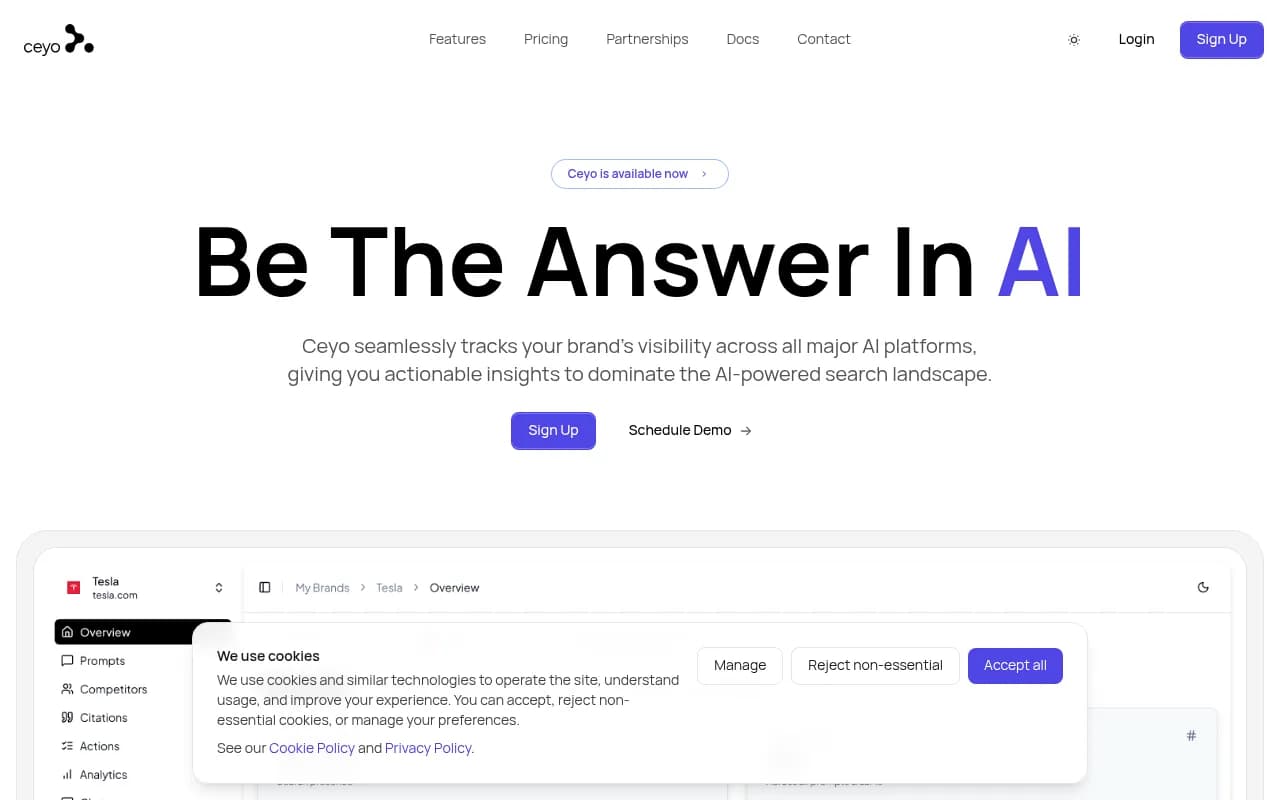
Ceyo AI launched as a brand visibility tracker for major language models. It monitors how your brand appears in AI-generated search results across ChatGPT, Gemini, Claude, and Perplexity. The platform targets marketing teams and agencies with real-time alerts, sentiment tracking, and competitive positioning data. Ceyo's interface shows comprehensive prompt analytics including visibility percentages, sentiment scores, average position, impact metrics, and geographic data.
Otterly.AI

Otterly.AI entered the market in October 2024 as one of the first platforms built specifically for AI search monitoring. It tracks brand mentions and website citations across six AI platforms: ChatGPT, Perplexity, Google AI Overviews, Google AI Mode, Gemini, and Copilot. Otterly positions itself as the affordable option with a $29/mo entry point and includes GEO auditing tools that analyze 25+ on-page factors. The platform is rated #1 for affordability in multiple 2026 comparisons.
Side-by-Side Comparison
| Feature | Ceyo AI | Otterly.AI |
|---|---|---|
| Starting price | $49/mo (or $89/mo) | $29/mo (Lite: 15 prompts) |
| Mid-tier price | Not specified | $189/mo (Standard: 100 prompts) |
| Free trial | Not specified | 14 days |
| AI platforms monitored | ChatGPT, Gemini, Claude, Perplexity (4 models) | ChatGPT, Perplexity, Google AI Overviews, AI Mode, Gemini, Copilot (6 platforms) |
| Sentiment analysis | ✓ Yes | Not mentioned |
| GEO auditing | Not mentioned | ✓ Yes (25+ factors) |
| AI keyword research | Not mentioned | ✓ Yes |
| Competitive tracking | ✓ Yes | ✓ Yes (Share of Voice) |
| Geographic tracking | ✓ Yes | Not specified |
| Real-time alerts | ✓ Yes | ✓ Yes |
| Citation tracking | Brand mentions | Brand mentions + website citations |
| Content generation | No | No |
| API access | Not specified | Not specified |
Platform coverage
Otterly.AI monitors six AI search platforms while Ceyo tracks four. The difference matters depending on where your audience searches.
Otterly covers Google AI Overviews and AI Mode -- two platforms that directly impact traditional search traffic. If you're worried about Gartner's prediction of a 50% decline in organic traffic by 2028, monitoring Google's AI features makes sense. Otterly also includes Microsoft Copilot, which matters for enterprise audiences.
Ceyo focuses on the big four conversational AI models: ChatGPT, Gemini, Claude, and Perplexity. It skips Google's AI features and Copilot but includes Claude, which Otterly doesn't explicitly list. Claude matters for technical and research-oriented queries where Anthropic's model gets used heavily.
Neither platform tracks newer models like DeepSeek, Grok, or Meta AI. For comprehensive coverage across 10+ models, you'd need to look at platforms like Promptwatch, which monitors the full landscape of AI search engines.
Verdict: Otterly wins on breadth with six platforms including Google's AI features. Ceyo wins if Claude visibility specifically matters to your brand.
Pricing breakdown
| Plan | Ceyo AI | Otterly.AI |
|---|---|---|
| Entry tier | $49/mo (Core) or $89/mo | $29/mo (Lite: 15 prompts) |
| Standard tier | Not specified | $189/mo (Standard: 100 prompts) |
| Premium tier | Not specified | Custom (Premium: unlimited prompts) |
| Free trial | Not mentioned | 14 days |
| Annual billing | Available (discount not specified) | Not specified |
Otterly.AI has the clearer pricing structure and the lower entry point. At $29/mo for 15 tracked prompts, it's accessible for small businesses testing AI visibility for the first time. The jump to $189/mo for 100 prompts is steep but reasonable if you're tracking a comprehensive prompt set.
Ceyo's pricing is murkier. Sources list both $49/mo and $89/mo as starting prices without explaining what you get at each tier. The lack of transparent prompt limits or feature breakdowns makes it harder to budget.
For agencies managing multiple clients, Otterly's unlimited prompt tier (custom pricing) scales better than Ceyo's unspecified structure.
Verdict: Otterly.AI wins on pricing transparency and affordability. The $29/mo entry point is half Ceyo's cost.
Feature depth and optimization tools
Ceyo AI's strengths
Ceyo's prompt analytics table shows visibility percentage, sentiment (positive/neutral/negative), average position, impact level, competing brands, category, and geographic data. The sentiment analysis is more prominent than Otterly's feature set -- you can see at a glance whether AI models are saying positive or negative things about your brand.
The competitive positioning view shows which other brands appear in the same prompts. This helps you understand who you're competing against in AI search results, not just traditional SEO.
Geographic tracking by country (US, UK, Germany, Singapore, Netherlands, France, Japan shown in their demo) matters for international brands that need to know how visibility varies by region.
Otterly.AI's strengths
Otterly includes a GEO Audit tool that analyzes 25+ on-page factors to identify what's blocking your site from earning citations. This is actionable -- it tells you what to fix, not just what's wrong. Most monitoring tools (including Ceyo) show you the problem but leave you guessing about solutions.
The AI keyword research feature uncovers conversational prompts your audience is actually asking. This feeds content strategy directly. Ceyo doesn't mention keyword research or prompt discovery.
Otterly tracks both brand mentions and website citations. The citation tracking shows which specific pages on your site AI models reference. Ceyo focuses on brand mentions without the same page-level granularity.
Verdict: Ceyo wins on sentiment analysis and geographic tracking. Otterly wins on actionable optimization (GEO audit) and keyword research. Pick based on whether you need diagnostic depth (Ceyo) or optimization guidance (Otterly).
User interface and workflow
Ceyo's demo shows a clean table-based interface with color-coded sentiment indicators and brand logos. The layout is scannable -- you can see visibility trends across dozens of prompts at once. The emphasis on visual data (logos, flags, color coding) makes it easy to spot patterns.
Otterly's marketing emphasizes "getting your team into action mode" with three levers: optimizing on-page content, media outreach, and community mobilization. The GEO audit tool presumably guides the on-page work, but the interface details aren't as visible in their public materials.
Both platforms offer real-time alerts when brand mentions change. Neither shows advanced filtering, custom dashboards, or API access in their public documentation.
Verdict: Ceyo appears more polished for reporting and visualization. Otterly seems more workflow-oriented for teams that need to act on the data.
What's missing from both
Neither Ceyo nor Otterly includes content generation capabilities. You'll see where you're invisible, but you're on your own to create content that fixes it. Platforms like Promptwatch combine monitoring with AI-powered content generation based on citation data -- that's the difference between a dashboard and an optimization platform.
Neither tool shows AI crawler logs. You won't see which pages ChatGPT or Perplexity are actually reading on your site, how often they crawl, or what errors they encounter. This makes it harder to diagnose indexing issues.
Prompt volume estimates and difficulty scoring aren't mentioned by either platform. Without knowing which prompts get high search volume, you're guessing at which ones to prioritize.
Reddit and YouTube tracking -- two sources that heavily influence AI recommendations -- aren't part of either tool's feature set.
Pros and cons
Ceyo AI pros
- Sentiment analysis built into core analytics
- Geographic tracking across multiple countries
- Clean, visual interface with brand logos and color coding
- Competitive positioning shows which brands appear together
- Tracks Claude (missing from Otterly)
Ceyo AI cons
- Higher starting price ($49-89/mo vs $29/mo)
- Unclear pricing tiers and prompt limits
- No GEO auditing or optimization guidance
- No AI keyword research for prompt discovery
- Fewer AI platforms monitored (4 vs 6)
- No mention of website citation tracking at page level
Otterly.AI pros
- Most affordable entry point at $29/mo
- GEO audit tool with 25+ on-page factors
- AI keyword research for prompt discovery
- Tracks 6 AI platforms including Google AI features
- Clear pricing structure with 14-day free trial
- Website citation tracking at page level
- Rated #1 for affordability in multiple 2026 reviews
Otterly.AI cons
- No sentiment analysis (or not prominently featured)
- Geographic tracking not specified
- Less visual/polished interface based on public materials
- Doesn't track Claude
- Steep jump from $29/mo (15 prompts) to $189/mo (100 prompts)
Who should pick which tool
Choose Ceyo AI if:
- Sentiment tracking is critical -- you need to know if AI models are saying positive or negative things about your brand
- You operate internationally and need geographic visibility breakdowns
- Claude visibility matters to your audience (technical, research-heavy users)
- You prefer a polished, visual reporting interface for stakeholder presentations
- Budget isn't the primary constraint
Choose Otterly.AI if:
- You're working with a limited budget and need to start at $29/mo
- You want actionable optimization guidance (GEO audit) not just monitoring data
- Google AI Overviews and AI Mode visibility matter to your SEO strategy
- You need AI keyword research to discover new prompts to target
- You're tracking 100+ prompts and need the volume pricing to make sense
- You want page-level citation tracking to see which content gets referenced
Look elsewhere if:
- You need content generation tools to fix visibility gaps (not just identify them)
- You want AI crawler logs to diagnose indexing issues
- You need to track 10+ AI models including DeepSeek, Grok, Meta AI
- You want Reddit/YouTube tracking to see what influences AI recommendations
- You need prompt volume estimates and difficulty scoring to prioritize efforts
Final verdict
Otterly.AI wins on value for most teams. The $29/mo entry point, GEO auditing, and keyword research make it the better choice for small businesses and content teams on a budget. The broader platform coverage (6 vs 4) and page-level citation tracking add practical value.
Ceyo AI makes sense for larger marketing teams that need sentiment analysis, geographic tracking, and a polished reporting interface. If you're presenting AI visibility data to executives or clients, Ceyo's visual approach works better. The Claude monitoring is a niche advantage for technical brands.
Both tools are monitoring-first platforms -- they show you the problem but don't help you fix it with content generation or optimization workflows. For teams that want to close the loop from visibility gaps to content creation to results tracking, neither tool goes far enough. That's where platforms like Promptwatch differentiate by combining monitoring with content gap analysis and AI-powered content generation.

Bottom line: Start with Otterly if budget matters. Upgrade to Ceyo if you need sentiment depth and geographic granularity. Consider a more comprehensive platform if you want to optimize, not just monitor.