Key Takeaways
- Ceyo AI starts at $49/mo with more comprehensive prompt analytics and competitive positioning features, while Mentions.so offers a free tier and starts paid plans at $99/mo
- Mentions.so includes AI traffic attribution tracking (see actual traffic from AI models), which Ceyo AI doesn't publicly advertise
- Both track the same core AI models (ChatGPT, Claude, Gemini, Perplexity) plus additional platforms, but Ceyo emphasizes real-time alerts while Mentions.so focuses on actionable recommendations
- Ceyo's interface shows more granular prompt-level data (visibility %, sentiment, average position, impact scoring), making it better for deep analysis
- Mentions.so positions itself around fixing problems ("why we're not mentioned and how to fix it") with AI-generated prompt suggestions, while Ceyo is more monitoring-focused
- For brands also tracking how they appear across multiple AI search engines beyond just mentions, Promptwatch offers crawler logs, content gap analysis, and an AI writing agent that generates citation-optimized content -- capabilities neither Ceyo nor Mentions.so provide
Overview
Ceyo AI
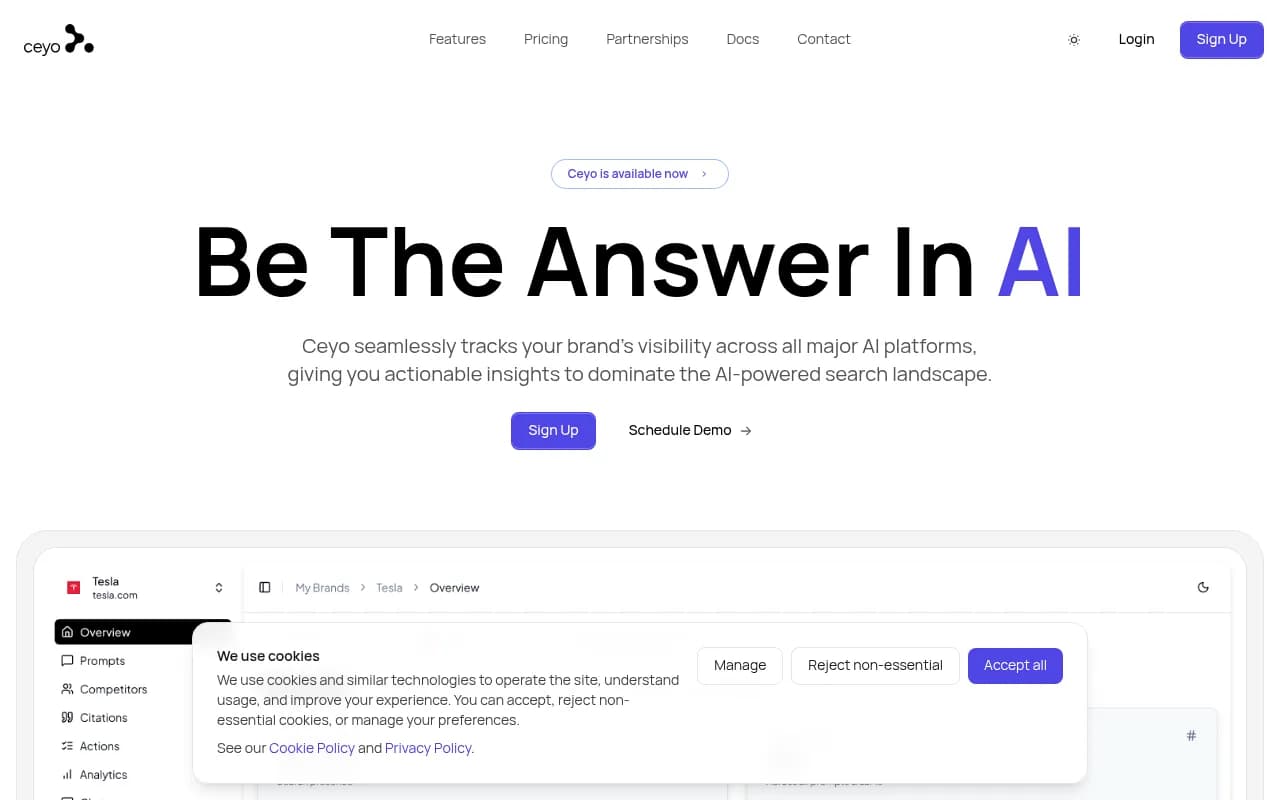
Ceyo AI is a brand visibility tracker built specifically for marketing teams and agencies who need to monitor how their brand appears in AI-generated search results. It tracks mentions, sentiment, and competitive positioning across ChatGPT, Gemini, Claude, and Perplexity with real-time alerts. The platform emphasizes comprehensive prompt analytics -- showing not just whether you're mentioned, but visibility percentages, sentiment scores, average position, and impact metrics for thousands of prompts. Ceyo is designed for teams that want granular data on exactly which queries drive their brand's presence in LLM responses.
Mentions.so
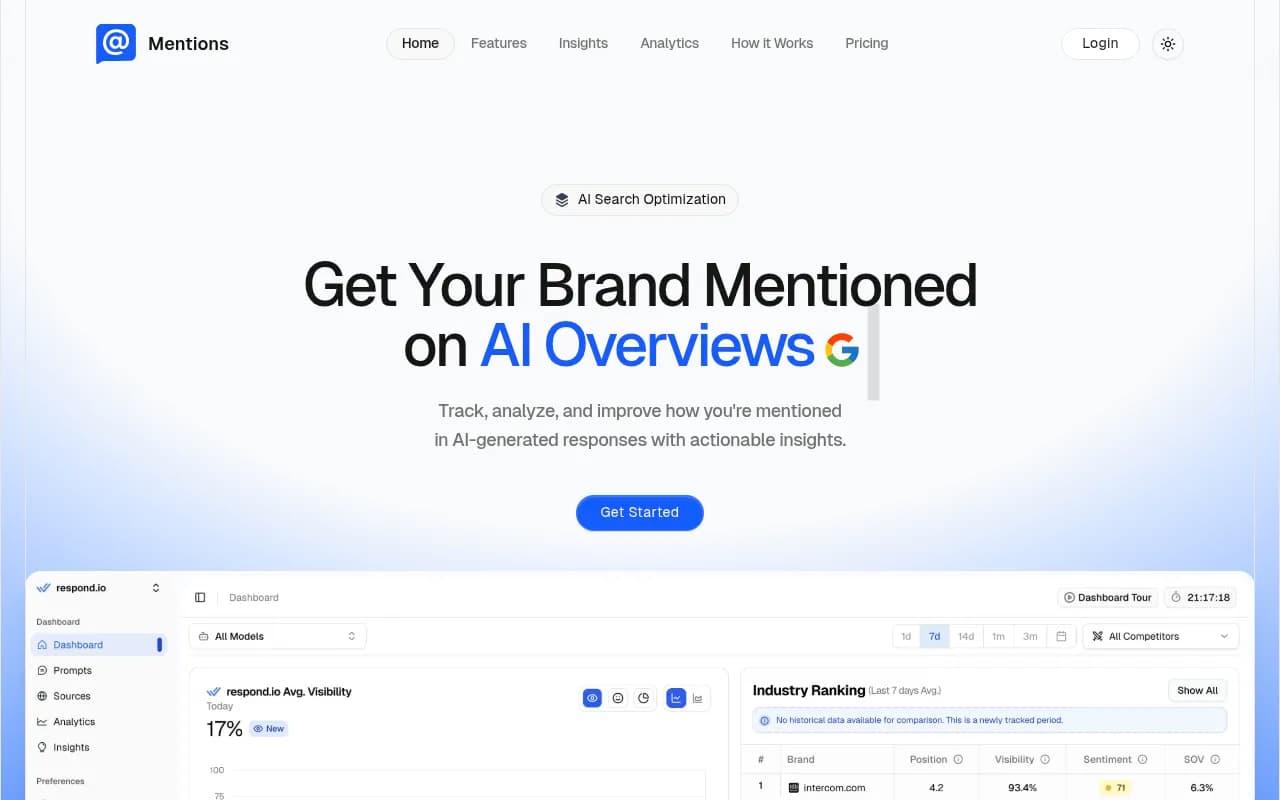
Mentions.so takes a slightly different angle: it's built around understanding what AI says about your brand and giving you clear steps to improve it. Beyond tracking mentions across the same core AI models (ChatGPT, Claude, Gemini, Perplexity, plus Grok, DeepSeek, Meta AI, and Google Overview), Mentions.so includes AI traffic attribution -- you can see how much traffic you're actually getting from AI models and where it's coming from. The platform also offers AI-suggested prompts and actionable recommendations, positioning itself as a tool that doesn't just show you the problem but helps you fix it. A free tier is available, making it more accessible for smaller brands testing the waters.
Side-by-Side Comparison
| Feature | Ceyo AI | Mentions.so |
|---|---|---|
| Starting price | $49/mo (Core plan) | Free tier available; paid from $99/mo |
| AI models tracked | ChatGPT, Gemini, Claude, Perplexity | ChatGPT, Claude, Gemini, Perplexity, Grok, DeepSeek, Meta AI, Google Overview |
| Sentiment analysis | ✓ (Positive/Neutral/Negative with scores) | ✓ (Very Positive/Neutral/Negative with weekly shifts) |
| Prompt analytics | ✓ (Visibility %, avg position, impact, category, GEO) | ✓ (Custom and AI-suggested prompts) |
| Competitive comparison | ✓ (See which brands appear in same prompts) | ✓ (Real-time competitor visibility %) |
| Real-time alerts | ✓ (Advertised feature) | Not explicitly mentioned |
| AI traffic attribution | Not advertised | ✓ (Track actual traffic from AI models) |
| Actionable recommendations | ✓ (Mentioned as feature) | ✓ ("Clear steps to rank higher") |
| AI prompt suggestions | Not mentioned | ✓ (AI-generated prompt recommendations) |
| Daily/weekly reports | Not specified | ✓ (Daily performance reports) |
| Target audience | Marketing teams, agencies | Individual users to agencies |
| Annual billing discount | Available | 16% savings |
| Free trial/tier | Not mentioned | ✓ (Free tier available) |
Pricing comparison
| Plan | Ceyo AI | Mentions.so |
|---|---|---|
| Free | Not available | ✓ Free tier (limited features) |
| Starter/Core | $49/mo or $89/mo (conflicting sources) | $99/mo |
| Mid-tier | Not publicly detailed | Not specified |
| Agency/Top tier | Not publicly detailed | $599/mo (Agency plan) |
| Annual discount | Available (amount not specified) | 16% off |
Ceyo's pricing is less transparent -- sources mention both $49/mo and $89/mo for the Core plan, and higher tiers aren't detailed on the public site. Mentions.so clearly lists a free tier, $99/mo Starter, and $599/mo Agency plan with 16% annual savings. If you're budget-conscious or want to test before committing, Mentions.so's free tier is a clear advantage. If you need the lowest entry price for paid features, Ceyo might edge ahead at $49/mo (if that's the real starting price).
Feature deep-dive
Prompt analytics and tracking depth
Ceyo AI's interface shows a detailed prompt table with columns for visibility percentage, sentiment, average position, impact level, competing brands, category, and geographic location. This is granular -- you can see that "Best laptop for developers" has 85% visibility, positive sentiment, average position 2.3, high relevance impact, and competing brands Apple/Lenovo/Dell in the US market. That level of detail is useful if you're optimizing for specific high-value prompts and want to understand exactly where you stand.
Mentions.so shows prompt tracking but emphasizes AI-suggested prompts and custom prompt creation. The interface displays competitor visibility percentages over time (e.g., Kajabi 67%, Thinkific 59%) and sentiment trends across days. It's less about drilling into individual prompt metrics and more about seeing the big picture: are you gaining or losing ground, and what should you do about it?
Verdict: Ceyo wins on prompt-level granularity. Mentions.so wins on ease of setup (AI suggests prompts for you) and trend visualization.
Sentiment analysis
Both platforms track sentiment, but they present it differently. Ceyo shows sentiment as Positive/Neutral/Negative with a score, tied to each individual prompt. You can see that one prompt has positive sentiment while another has negative sentiment, and track how that changes.
Mentions.so shows sentiment trends over time ("Very Positive Sentiment" vs "Neutral Sentiment" vs "Negative Sentiment" across days) and emphasizes weekly sentiment shifts with a clear score. The focus is on understanding whether AI's overall tone toward your brand is improving or declining.
Verdict: Tie. Ceyo is better for prompt-specific sentiment. Mentions.so is better for tracking sentiment momentum over time.
Competitive intelligence
Ceyo's prompt table shows which brands appear alongside yours in each prompt response. You can see that for "Best laptop for developers," Apple, Lenovo, and Dell are mentioned. This is useful for understanding who you're competing against in specific contexts.
Mentions.so shows real-time competitor visibility percentages and lets you compare your visibility to competitors' over time. The interface displays a chart with competitor names and their visibility scores (Kajabi 67%, Thinkific 59%, Teachable 46%, etc.), making it easy to see who's winning and by how much.
Verdict: Mentions.so is clearer for competitive benchmarking. Ceyo gives you more context on which prompts competitors dominate.
AI traffic attribution
This is a big differentiator. Mentions.so explicitly advertises AI traffic attribution -- you can see how much traffic you're getting from AI models and where it's coming from. This closes the loop between visibility and actual business impact. If you're mentioned in ChatGPT responses but getting zero traffic, you know the mentions aren't converting.
Ceyo doesn't mention traffic attribution in its public materials. It's possible the feature exists in higher tiers, but it's not a selling point.
Verdict: Mentions.so wins decisively here. Traffic attribution is critical for proving ROI.
Actionable recommendations
Both platforms claim to offer actionable recommendations, but they approach it differently. Ceyo mentions "actionable recommendations" as a feature but doesn't detail what that looks like. The focus seems to be on surfacing data (visibility %, sentiment, impact) and letting you decide what to do.
Mentions.so is more explicit: "Mentions.so analyzes how AI talks about your brand and gives you clear steps to rank higher." The platform offers AI-suggested prompts, daily performance reports with insights ("Keyword 'digital marketing' performance is up by 12%"), and a stated focus on helping you fix problems, not just identify them. One testimonial says: "It's the only tool that tells me why we're not mentioned in AI, and how to fix it."
Verdict: Mentions.so is more action-oriented. Ceyo is more analytics-oriented.
AI model coverage
Ceyo tracks ChatGPT, Gemini, Claude, and Perplexity. Mentions.so tracks those four plus Grok, DeepSeek, Meta AI, and Google Overview. That's eight models vs four.
Verdict: Mentions.so covers more AI platforms, which matters if you care about emerging models like DeepSeek or want to track Google Overview specifically.
User interface and ease of use
Ceyo's interface (based on the screenshot) is data-dense with tables, metrics, and filters. It's built for analysts who want to slice and dice data. The learning curve is probably steeper, but you get more control.
Mentions.so's interface emphasizes simplicity: "3 Simple Steps to Dominate AI Conversations." Add your brand, pick or customize prompts (AI suggests them), get daily insights. The design is cleaner and more guided, which is better for non-technical users or smaller teams.
Verdict: Mentions.so is easier to onboard. Ceyo is better for power users who want granular control.
Real-time alerts
Ceyo explicitly mentions real-time alerts as a feature. If your brand suddenly gets mentioned negatively or a competitor overtakes you, you get notified immediately.
Mentions.so doesn't highlight real-time alerts in its public materials. It emphasizes daily reports instead.
Verdict: Ceyo wins if you need instant notifications. Mentions.so is fine if daily reports are enough.
Pros and cons
Ceyo AI pros
- More granular prompt-level analytics (visibility %, avg position, impact scoring)
- Real-time alerts for brand mention changes
- Lower starting price ($49/mo vs $99/mo, depending on source)
- Geographic tracking (see which prompts matter in which countries)
- Built for agencies and marketing teams who need detailed reporting
Ceyo AI cons
- No free tier or trial mentioned
- Pricing transparency is poor (conflicting sources, no public tier details)
- Doesn't advertise AI traffic attribution
- Fewer AI models tracked (4 vs 8)
- Less emphasis on actionable recommendations -- more of a monitoring tool
Mentions.so pros
- Free tier available for testing
- AI traffic attribution (see actual traffic from AI models)
- Tracks 8 AI models including Google Overview, Grok, DeepSeek, Meta AI
- AI-suggested prompts make setup easier
- More action-oriented ("why we're not mentioned and how to fix it")
- Cleaner, simpler interface for non-technical users
- Clear pricing with 16% annual discount
Mentions.so cons
- Higher starting price for paid plans ($99/mo vs $49/mo)
- Less granular prompt-level metrics (no average position, impact scoring)
- No real-time alerts advertised
- Fewer competitive intelligence details per prompt
Who should pick which tool
Pick Ceyo AI if:
- You're an agency or marketing team managing multiple brands and need detailed, exportable data
- You want real-time alerts when brand mentions change
- You need to track prompt performance by geography (US vs UK vs Germany, etc.)
- You're comfortable with a data-heavy interface and want maximum control over filtering and analysis
- You're optimizing for a small set of high-value prompts and need to track average position and impact scores
- Budget is tight and you can get in at $49/mo (verify pricing before committing)
Pick Mentions.so if:
- You want to test AI visibility tracking for free before paying
- You need to see how much actual traffic you're getting from AI models (traffic attribution is a must-have)
- You're tracking a broader set of AI platforms including Google Overview, Grok, DeepSeek, Meta AI
- You prefer a simpler, more guided interface with AI-suggested prompts
- You want a tool that tells you not just what's wrong but how to fix it (actionable recommendations)
- You're a smaller team or individual user who doesn't need agency-level granularity
- You care more about trends and momentum ("are we improving?") than drilling into individual prompt metrics
Consider Promptwatch if:
- You want to go beyond monitoring and actually fix the problem -- Promptwatch shows you which content gaps are killing your AI visibility, then generates citation-optimized articles to fill them
- You need crawler logs to see which pages AI models are reading (and which they're ignoring)
- You want prompt volume estimates and difficulty scores to prioritize winnable opportunities
- You're tracking Reddit and YouTube discussions that influence AI recommendations (neither Ceyo nor Mentions.so cover this)
- You need multi-language and multi-region tracking with customizable personas

Final verdict
Mentions.so is the better choice for most teams in 2026. The free tier lets you test before committing, AI traffic attribution proves ROI, and the action-oriented approach (AI-suggested prompts, clear recommendations) makes it easier to actually improve your visibility instead of just watching numbers. Tracking eight AI models instead of four future-proofs your monitoring as platforms like DeepSeek and Meta AI gain traction.
Ceyo AI is the better choice if you're an agency or data-driven team that needs granular prompt analytics, real-time alerts, and geographic tracking. The interface is built for power users who want to export data, slice by category, and track average position changes over time. If you can get in at $49/mo, it's also the cheaper option -- but verify pricing first, because the public information is inconsistent.
Both tools are monitoring-first platforms. If you're serious about improving your AI visibility (not just tracking it), you'll eventually need a platform that helps you create content AI models actually want to cite -- that's where tools like Promptwatch come in.