Key Takeaways
- Rankshift offers significantly higher prompt volumes (150-850 prompts/day vs Ceyo's unspecified limits) and includes unlimited users/projects on all plans -- making it better for agencies and teams
- Ceyo AI starts at $49/mo vs Rankshift's €69/mo, but Rankshift's credit system and higher prompt limits often deliver better value at scale
- Both platforms track the same four major LLMs (ChatGPT, Perplexity, Claude, Gemini), but Rankshift explicitly supports AI Overviews while Ceyo's coverage is less clear
- Rankshift includes a 30-day free trial with full feature access; Ceyo offers signup but trial details are unclear
- For small teams monitoring a few dozen prompts, Ceyo's lower entry price makes sense. For agencies, growing brands, or anyone tracking 100+ prompts daily, Rankshift's unlimited users and higher limits are the better deal
- Neither platform offers content generation or optimization features -- if you need to act on visibility gaps (not just monitor them), tools like Promptwatch fill that gap with AI content creation and answer gap analysis
Overview
Rankshift
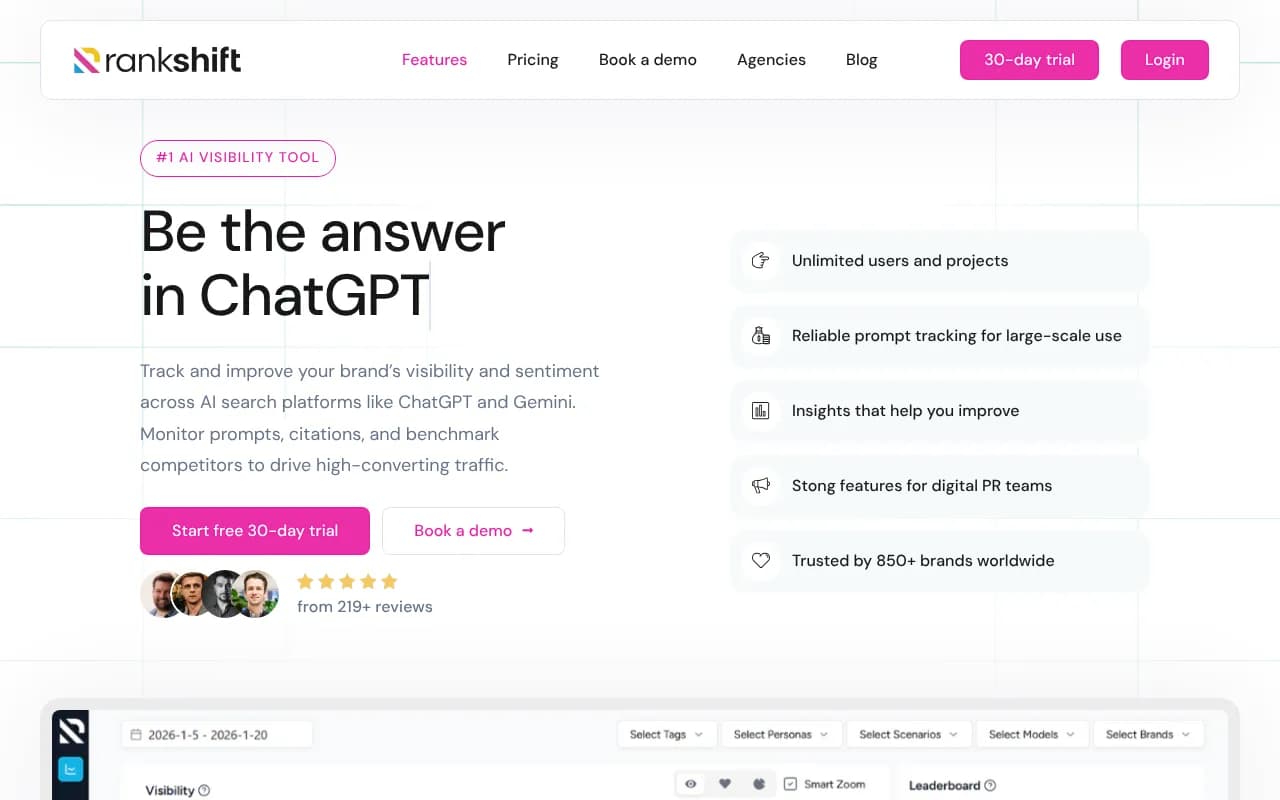
Rankshift is a specialized AI visibility tracking platform focused on monitoring brand mentions and sentiment across large language models. Built for agencies and marketing teams, it emphasizes scalability with unlimited users and projects across all pricing tiers. The platform tracks ChatGPT, Perplexity, Claude, Gemini, and AI Overviews, with a credit-based system that supports 150-850 prompts per day depending on plan. Rankshift positions itself as a reliable tool for large-scale prompt tracking with strong features for digital PR teams. Based in Europe, pricing is in euros with a 30-day free trial and 10% annual discount.
Ceyo AI
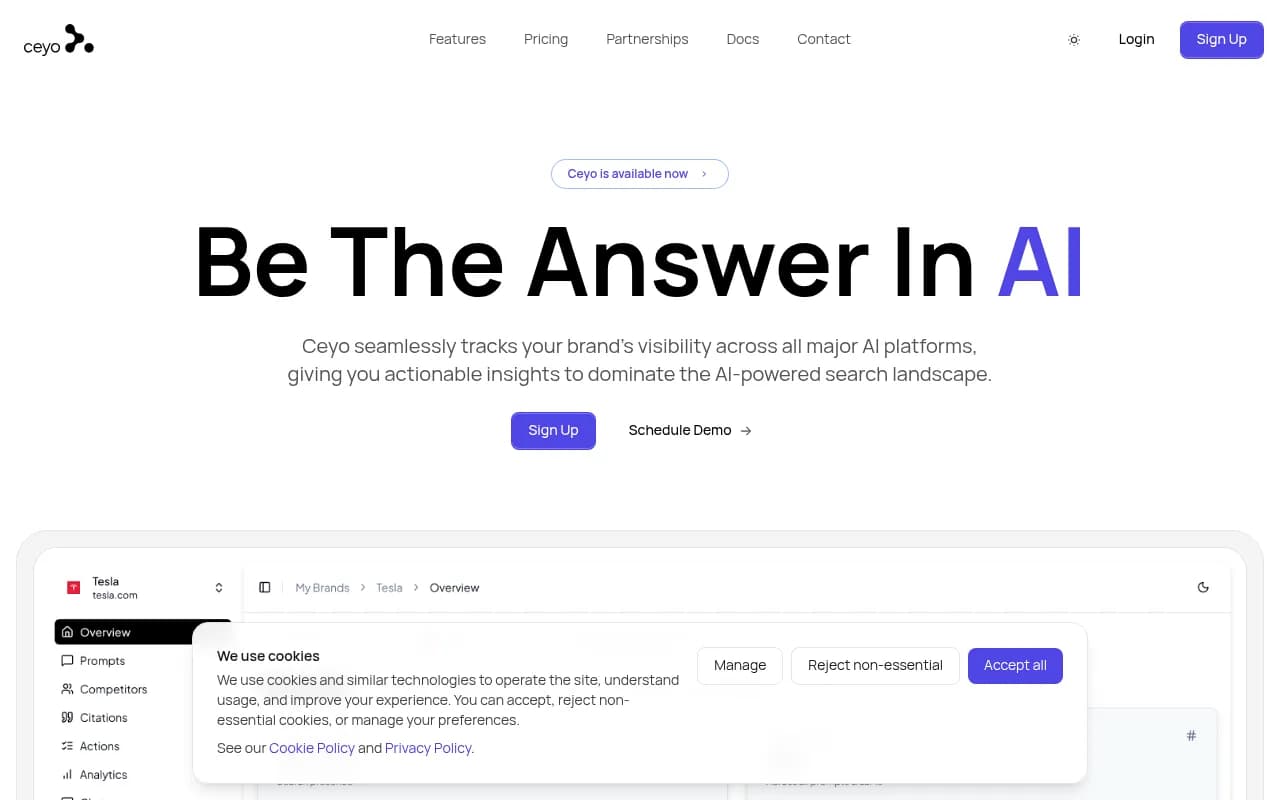
Ceyo AI is an AI visibility monitoring tool that tracks brand presence across ChatGPT, Gemini, Claude, and Perplexity. Marketed toward marketing teams and agencies, it focuses on brand mentions, sentiment analysis, and competitive positioning in LLM responses. The platform offers real-time alerts and actionable recommendations, with pricing starting at $49/mo (though some sources cite $89/mo). Ceyo emphasizes ease of use and quick setup, with a dashboard that surfaces prompt analytics, visibility scores, and sentiment tracking. The platform is newer to market and less transparent about specific feature limits compared to Rankshift.
Side-by-Side Comparison
| Feature | Rankshift | Ceyo AI |
|---|---|---|
| Starting price | €69/mo (~$73) | $49-89/mo (conflicting sources) |
| Free trial | 30 days, full access | Signup available, details unclear |
| Prompts per day | 150-850 (plan-dependent) | Not specified |
| Credits/month | 9,500-53,000 | Not specified |
| Users included | Unlimited (all plans) | Not specified |
| Projects included | Unlimited (all plans) | Not specified |
| LLMs tracked | ChatGPT, Perplexity, Claude, Gemini, AI Overviews | ChatGPT, Perplexity, Claude, Gemini |
| Annual discount | 10% | Not specified |
| Agency/Enterprise | Custom pricing available | Not specified |
| Sentiment tracking | ✓ | ✓ |
| Competitive benchmarking | ✓ | ✓ |
| Real-time alerts | Not specified | ✓ |
| Multi-language support | Not specified | Not specified |
Pricing comparison
Both platforms use monthly subscription models, but Rankshift is more transparent about what you get at each tier.
| Plan | Rankshift | Ceyo AI |
|---|---|---|
| Entry tier | €69/mo: 150 prompts/day, 9,500 credits, unlimited users/projects | $49/mo (Core): limits not specified |
| Mid tier | €169/mo: 400 prompts/day, 25,000 credits, unlimited users/projects | $89/mo: limits not specified (conflicting source) |
| High tier | €359/mo: 850 prompts/day, 53,000 credits, unlimited users/projects | Not specified |
| Annual billing | 10% discount | Not specified |
| Custom/Enterprise | Available | Not specified |
| Free trial | 30 days | Unclear |
Rankshift's pricing is clearer and more predictable. The credit system lets you allocate resources across different LLMs and prompt types. Ceyo's pricing is murkier -- the website says $49/mo but other sources mention $89/mo, and there's no breakdown of what you get at each level.
User limits and team collaboration
This is where Rankshift pulls ahead decisively.
Rankshift includes unlimited users and unlimited projects on every plan, including the €69/mo starter tier. For agencies managing multiple clients or marketing teams with cross-functional stakeholders, this is a huge advantage. You can onboard your entire team, create separate projects for each brand or campaign, and not worry about per-seat fees eating into your budget.
Ceyo AI doesn't specify user limits anywhere on their site or in available documentation. This is a red flag -- most SaaS tools that don't mention user limits either charge per seat or impose restrictive caps. If you're a solo marketer, this might not matter. If you're an agency or a team of five, the lack of clarity is a problem.
Prompt tracking and volume limits
Rankshift is explicit about daily prompt limits: 150/day on Starter, 400/day on Growth, 850/day on Business. These are real limits you can plan around. If you're tracking 50 prompts and running them twice daily across four LLMs, that's 400 prompt executions -- you'd need the Growth plan.
Ceyo AI doesn't publish prompt limits. The website talks about "thousands of prompts" in marketing copy but doesn't specify how many you can actually track per day or month. This makes it impossible to know if you'll hit a wall as you scale.
For small-scale monitoring (a handful of key prompts checked a few times per week), Ceyo's lower entry price might work. For systematic tracking of competitive landscapes or large prompt sets, Rankshift's transparent limits and higher capacity are more reliable.
LLM coverage
Both platforms track the big four: ChatGPT, Perplexity, Claude, and Gemini. Rankshift explicitly lists AI Overviews (Google's AI-generated search results) as a fifth tracked platform. Ceyo's website doesn't mention AI Overviews, though it's possible they track it without advertising it prominently.
Neither platform tracks newer or niche models like DeepSeek, Grok, Mistral, or Meta AI. If you need broader LLM coverage, Promptwatch monitors 10+ models including those.

Sentiment and competitive analysis
Both platforms offer sentiment tracking (positive, neutral, negative) and competitive benchmarking. Rankshift's dashboard shows visibility scores, average position, and brand mentions across prompts. Ceyo's interface (based on screenshots) displays similar metrics: visibility percentage, sentiment, average position, and which brands appear in each prompt's response.
The core functionality here is comparable. Both tools let you see where your brand ranks, how sentiment trends over time, and which competitors dominate specific prompts. Neither offers a clear edge in this area based on available information.
Alerts and notifications
Ceyo AI explicitly advertises "real-time alerts" as a feature. Rankshift doesn't mention alerts prominently on their site, though this doesn't mean they lack them -- it's common for monitoring tools to include basic alerting without making it a headline feature.
If proactive notifications (e.g. "Your brand dropped out of the top 3 for this prompt") are critical to your workflow, Ceyo's explicit focus on alerts is a point in its favor. But without knowing the specifics of Rankshift's alerting, it's hard to call this a decisive difference.
Ease of setup and user experience
Both platforms emphasize quick setup. Rankshift claims "setup in just 3 minutes" with a three-step process: add prompts and brands, choose LLMs to monitor, get insights. Ceyo's site doesn't specify setup time but shows a clean, modern dashboard with prompt analytics front and center.
Rankshift's interface (based on screenshots) looks more data-dense -- tables with visibility scores, sentiment, categories, and GEO flags. Ceyo's screenshots show a similar table layout with brand logos, visibility percentages, and sentiment indicators. Both are clearly built for marketers who want to scan data quickly, not developers who need raw API access.
Neither platform has a reputation for being difficult to use. If you've used any SaaS analytics tool, you'll figure out either one in under an hour.
What's missing from both platforms
Here's what neither Rankshift nor Ceyo AI does:
- Content optimization: They show you where you're invisible, but they don't help you fix it. No content gap analysis, no suggestions for what to write, no AI-generated articles to improve your visibility.
- Crawler logs: You can't see which AI models are actually crawling your website or what pages they're reading.
- Traffic attribution: No way to connect AI visibility to actual website traffic or conversions.
- Broader LLM coverage: Both focus on the big four models and skip newer entrants.
If you need more than monitoring -- if you want to actually improve your AI visibility with content creation and optimization -- you're looking at a different category of tool. Promptwatch, for example, combines tracking with answer gap analysis and an AI writing agent that generates content designed to get cited by LLMs. But that's a different use case than pure monitoring.
Pros and cons
Rankshift pros
- Unlimited users and projects on all plans (huge for agencies and teams)
- Clear, transparent prompt limits (150-850/day)
- Explicit credit allocations (9,500-53,000/month)
- 30-day free trial with full feature access
- Tracks AI Overviews in addition to the big four LLMs
- 10% discount on annual billing
- Trusted by 850+ brands (per their site)
Rankshift cons
- Pricing in euros may be less convenient for US-based teams
- Higher starting price than Ceyo (€69 vs $49)
- No explicit mention of real-time alerts
- Doesn't offer content optimization or creation features
Ceyo AI pros
- Lower entry price ($49/mo vs €69/mo)
- Explicit focus on real-time alerts
- Clean, modern interface
- Actionable recommendations (per marketing copy)
Ceyo AI cons
- No transparency on user limits, project limits, or prompt volumes
- Conflicting pricing information ($49 vs $89 depending on source)
- No mention of AI Overviews tracking
- Less clear about trial terms
- Newer to market with less customer proof
- No annual discount mentioned
Who should pick Rankshift
Rankshift is the better choice if you:
- Run an agency managing multiple clients (unlimited projects is a game-changer)
- Have a team of 3+ people who need access (unlimited users saves you hundreds per month)
- Track 100+ prompts daily or need high-volume monitoring
- Want predictable, transparent limits you can plan around
- Need to monitor AI Overviews in addition to ChatGPT/Perplexity/Claude/Gemini
- Value a longer free trial (30 days) to properly evaluate the tool
- Prefer a platform with more customer proof (850+ brands)
Rankshift is built for scale. The unlimited users/projects model and high prompt limits make it the obvious pick for agencies, growing brands, and any team that's serious about systematic AI visibility tracking.
Who should pick Ceyo AI
Ceyo AI makes sense if you:
- Are a solo marketer or very small team (2-3 people max)
- Track a small set of prompts (a few dozen at most)
- Have a tight budget and need the lowest possible entry price
- Prioritize real-time alerts and notifications
- Don't need AI Overviews tracking
- Are comfortable with less transparency around limits and features
Ceyo's lower starting price is its main advantage. If you're just dipping your toes into AI visibility tracking and don't need enterprise-grade limits, it's a reasonable starting point. But the lack of clarity around what you actually get at each price point is a concern.
Final verdict
Rankshift wins this comparison for most use cases. The unlimited users and projects, transparent prompt limits, and higher capacity make it the better value for agencies, marketing teams, and any brand tracking AI visibility at scale. Ceyo's lower entry price is appealing, but the lack of transparency around limits and features makes it hard to recommend confidently.
If you're a solo marketer monitoring a handful of prompts, Ceyo's $49/mo price point might save you $20-30/month. But if you're an agency, a team, or a brand that's serious about AI visibility, Rankshift's €69/mo starter plan delivers more value -- and the Growth and Business tiers offer capacity that Ceyo simply doesn't specify.
One-liner: Rankshift is the scalable, transparent choice for teams and agencies; Ceyo is a budget option for solo marketers with light monitoring needs.